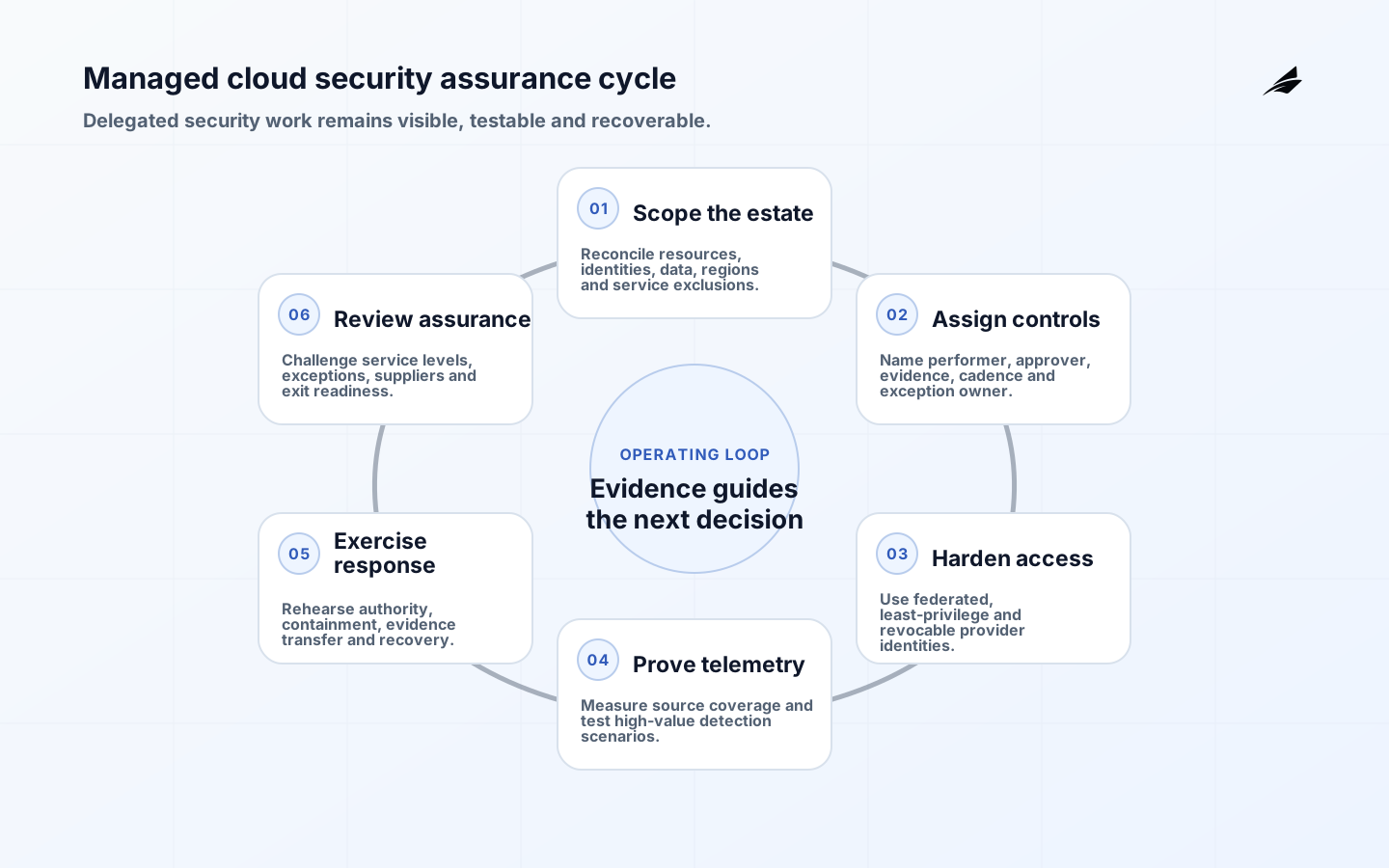
Managed cloud security services add an operator to cloud shared responsibility; they do not remove customer accountability. A provider may monitor identity, posture, vulnerabilities, workloads and incidents, but the customer still owns business risk, data use, legal decisions and service oversight. This implementation checklist turns a broad service promise into named controls, secure access, tested response and evidence.
Use the managed cloud security services delivery plan to set commercial boundaries and the managed cloud security services FAQ to resolve buyer questions. Organizations spanning regions should compare the worldwide managed cloud security plan. The implementation should begin only when both parties can name the estate, control and authority being transferred.
Scope the cloud estate and service catalog
Inventory organizations, tenants, accounts, subscriptions, projects, regions, networks, workloads, identities, data classes, keys, logs, security tools, backups and critical suppliers. Reconcile cloud-native inventory with configuration, identity and billing records. Define whether newly discovered resources enter scope automatically, are quarantined or await owner approval. Unknown resources must create an owned workflow, not disappear from a denominator.
List service activities separately: baseline configuration, posture monitoring, vulnerability management, identity review, threat detection, log operations, incident coordination, key operations, backup monitoring and evidence production. For each, state resources, hours, severity, response, authority, exclusions and evidence. The CISA Cloud Security Technical Reference Architecture connects shared services, migration and cloud security posture management; use that broader lens to avoid buying a dashboard without operational action.
| Service area | Provider activity | Customer decision |
|---|---|---|
| Identity | Monitor privileged roles and fulfill approved changes | Role design, workforce authority and exceptions |
| Posture | Detect drift and remediate authorized findings | Baseline, risk tolerance and application context |
| Vulnerability | Collect, enrich, route and verify remediation | Priorities, downtime and risk acceptance |
| Detection | Operate telemetry and triage alerts | Incident criteria and business impact |
| Resilience | Monitor backup and execute restore procedures | Recovery objectives and business validation |
Build a control responsibility matrix
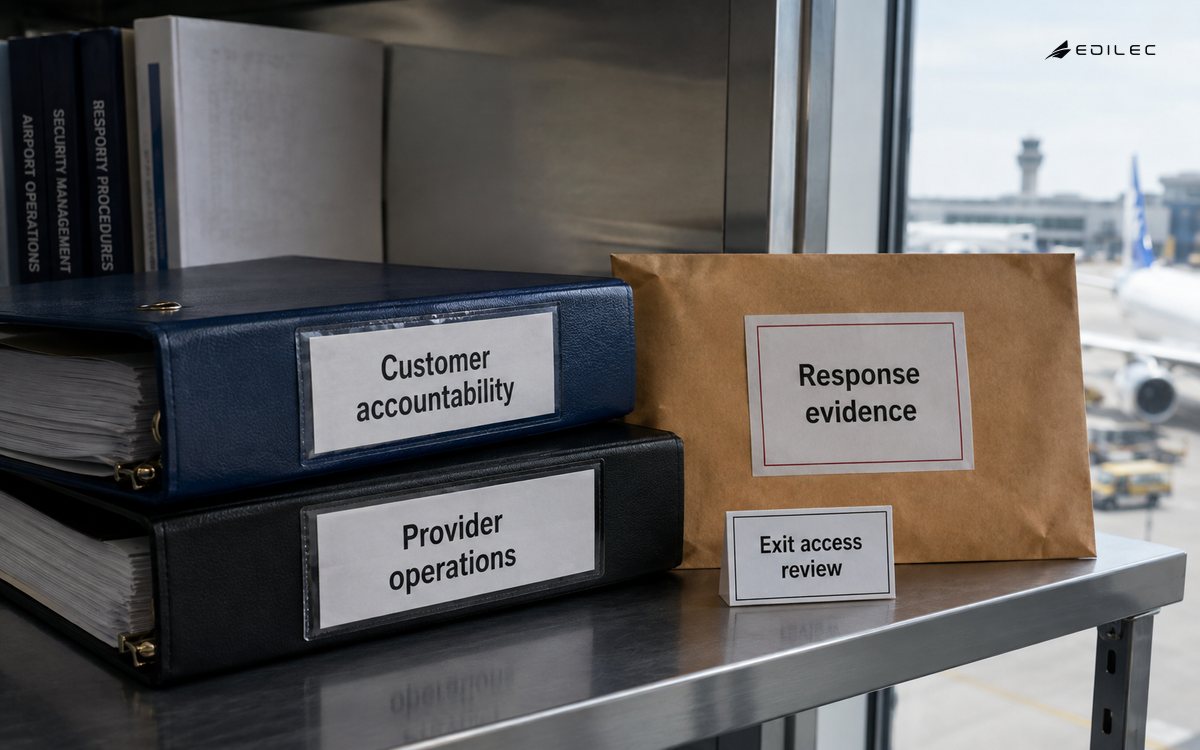
Cloud provider responsibility changes by service model and configuration. The AWS shared responsibility model, for example, distinguishes infrastructure operated by AWS from customer responsibilities such as guest operating systems, applications and service configuration. A managed provider performs selected customer-side tasks but does not inherit every customer obligation. Map responsibility at the resource and control level.
For each control, name performer, approver, evidence producer, evidence reviewer, cadence, trigger, service objective, exception owner and escalation. The Cloud Controls Matrix v4.1 provides cloud control objectives and mappings, while its introductory guidance discusses shared security responsibility. Tailor controls to the actual architecture; a generic questionnaire answer is not proof that a control operates on the customer's resources.
Onboard provider access securely
Use federated, attributable provider identities with phishing-resistant authentication where available, least privilege, approved source or device conditions and time-bounded elevation. Avoid shared administrative accounts and permanent owner roles. Separate read-only monitoring, routine remediation and emergency containment permissions. Require tickets or recorded approvals for privileged sessions and route activity to customer-controlled logging that provider administrators cannot alter.
The NIST zero trust architecture rejects implicit trust based only on network location or ownership. Apply that principle to the managed operator: authenticate each session, evaluate context, authorize the narrow task and monitor the result. Test access creation, elevation, revocation and emergency loss. Keep a customer-controlled route to remove provider access even if the provider's identity service or support channel is unavailable.
- Approve in-scope resources, exclusions, data locations and criticality tiers.
- Create separate provider roles for observation, remediation and emergency response.
- Verify logs include provider identity, role, source, target, action and result.
- Test revocation for one analyst, one supplier group and the entire provider.
- Review unused access and high-risk permissions on a defined cadence.
- Document subcontractor access, support locations and customer notification obligations.
Prove telemetry and detection coverage
Define required signals by resource class: control-plane events, identity, network, workload, data access, key management, configuration, vulnerability, endpoint and backup. Document source, fields, timestamps, route, retention, integrity, expected volume and permitted loss. Compare resources sending required telemetry with reconciled inventory. Alert counts alone are misleading if a region, account or log source stopped reporting.
Develop detections from high-value scenarios such as privileged role change, disabled logging, public exposure, key-policy modification, unusual data transfer, suspicious workload execution and backup deletion. Each detection needs purpose, data dependency, logic version, test fixture, severity, triage guide, owner and review date. Exercise true-positive, benign and missing-data cases. Measure precision and coverage so tuning does not merely reduce alert volume.
| Measure | Definition | Decision |
|---|---|---|
| Inventory coverage | Observed in-scope resources divided by reconciled resources | Can the service see its promised estate? |
| Telemetry health | Required sources meeting freshness and field criteria | Is detection evidence currently usable? |
| Triage time | Alert availability to documented severity decision | How quickly is a signal understood? |
| Containment time | Authorization to verified containment | Can the provider execute agreed action? |
| Exception age | Open control exceptions by age and risk | Is residual exposure being governed? |
| Restore proof | Critical services with successful tested restoration | Can recovery evidence be trusted? |
Integrate incident response and recovery
Name the customer incident commander and business decision makers before service acceptance. Pre-authorize narrow containment actions for defined events, such as disabling a compromised provider identity, and define which actions require customer approval because they can interrupt service or evidence. Maintain cloud provider escalation contacts, legal and privacy routes, communications ownership, evidence transfer procedures and a decision log.
NIST SP 800-61 Revision 3 connects incident response with broader cybersecurity risk management. Exercise detection, analysis, containment, recovery and improvement across both organizations. Include nights, supplier unavailability, incomplete telemetry and a disputed severity. Verify restored business service and data, not only infrastructure. Track lessons into detection, access, architecture and contract changes with owners and deadlines.
Set service acceptance and assurance gates
Before go-live, approve the inventory baseline, responsibility matrix, access model, telemetry coverage, detection tests, contact tree, service objectives, evidence format and inherited risk register. Run one privileged change, one misconfiguration remediation, one high-severity simulation and one restore. Record gaps as dated transition work, not as assumptions that operations will solve later.
Review monthly or quarterly evidence based on risk: control coverage, stale resources, provider access, alert quality, incident actions, vulnerabilities, exceptions, recovery tests, subcontractors and service changes. Give the customer access to sufficiently detailed, exportable records. Audit rights should include the ability to challenge how a result was produced. A report stating all controls green is less useful than coverage, exceptions and evidence tied to the agreed estate.
Plan transition and exit before signing off
Define ownership and export for rules, cases, dashboards, runbooks, tickets, configurations, logs and evidence. Specify retention, deletion confirmation, credential revocation and handover support. Avoid proprietary detections that cannot be inspected or migrated when they protect critical scenarios. Test an export during steady state and keep customer contacts and architecture current enough for another operator to assume service.
Exit readiness also improves incident resilience. If the provider is unavailable or compromised, the customer should still be able to reach cloud accounts, access essential logs, revoke provider identities and execute critical containment and recovery actions. Review that capability after platform, identity or contract changes. Managed service is operational delegation with oversight, not dependency without a fallback.
Connect service levels to security outcomes
Specify where each clock starts and stops. Alert acknowledgement is not triage, and a remediation ticket is not verified containment. Define severity criteria, coverage hours, customer dependency, pause conditions and evidence for completion. Include objectives for access revocation, telemetry restoration, critical misconfiguration response, vulnerability handling and incident escalation. Service credits may address commercial failure but do not reduce security risk, so repeated misses need corrective action, root-cause review and an escalation right. Measure customer-caused delay separately without allowing it to hide provider performance.
Implementation example: critical account onboarding
For a production account handling customer records, onboarding starts with owner, region, criticality, data class, services and recovery objectives. The responsibility matrix assigns posture remediation to the provider within an approved baseline, but public-access exceptions and downtime remain customer decisions. Provider analysts receive a read role and request time-bounded remediation elevation. Control-plane, identity, network, data-access and backup telemetry route to customer-controlled storage and the provider's analysis platform through documented interfaces.
Acceptance injects a prohibited public configuration, a privileged role change and a disabled log source. The team verifies detection, triage evidence, escalation and authorized remediation. It then restores a representative dataset and has the business owner validate it. Dashboards show inventory and telemetry coverage alongside findings. A night-shift exercise confirms that the provider can reach the customer commander and that pre-authorized containment is understood. The final record includes open exceptions, provider access, detection versions, contacts and exit exports. This makes the account's service state observable and prevents a connected tool from being mistaken for completed onboarding.
Key takeaways
- Scope resources and service actions precisely enough to calculate coverage.
- Map cloud provider, managed provider and customer responsibility for every control.
- Use attributable, least-privilege and revocable operator access.
- Test telemetry completeness and detection logic with representative events.
- Pre-agree incident authority, evidence handling and recovery validation.
- Review coverage and exceptions, and maintain an executable provider exit path.
Can the provider require its own security tools?
Yes, when their purpose, access, data flow, cost, support and exit are acceptable. Assess each tool as a supplier and privileged component. Define who owns configuration and data, how it is monitored, and how agents or integrations are removed. Require interoperability or export for critical evidence. Tool standardization can improve service, but it should not conceal control behavior or make transition impractical.
Conclusion
Managed cloud security becomes dependable when every promise is attached to an estate, authority, operating method and evidence trail. Secure onboarding, tested detections, shared response and exit readiness make the service governable. The customer can then delegate daily work while retaining the knowledge and control needed to own risk.