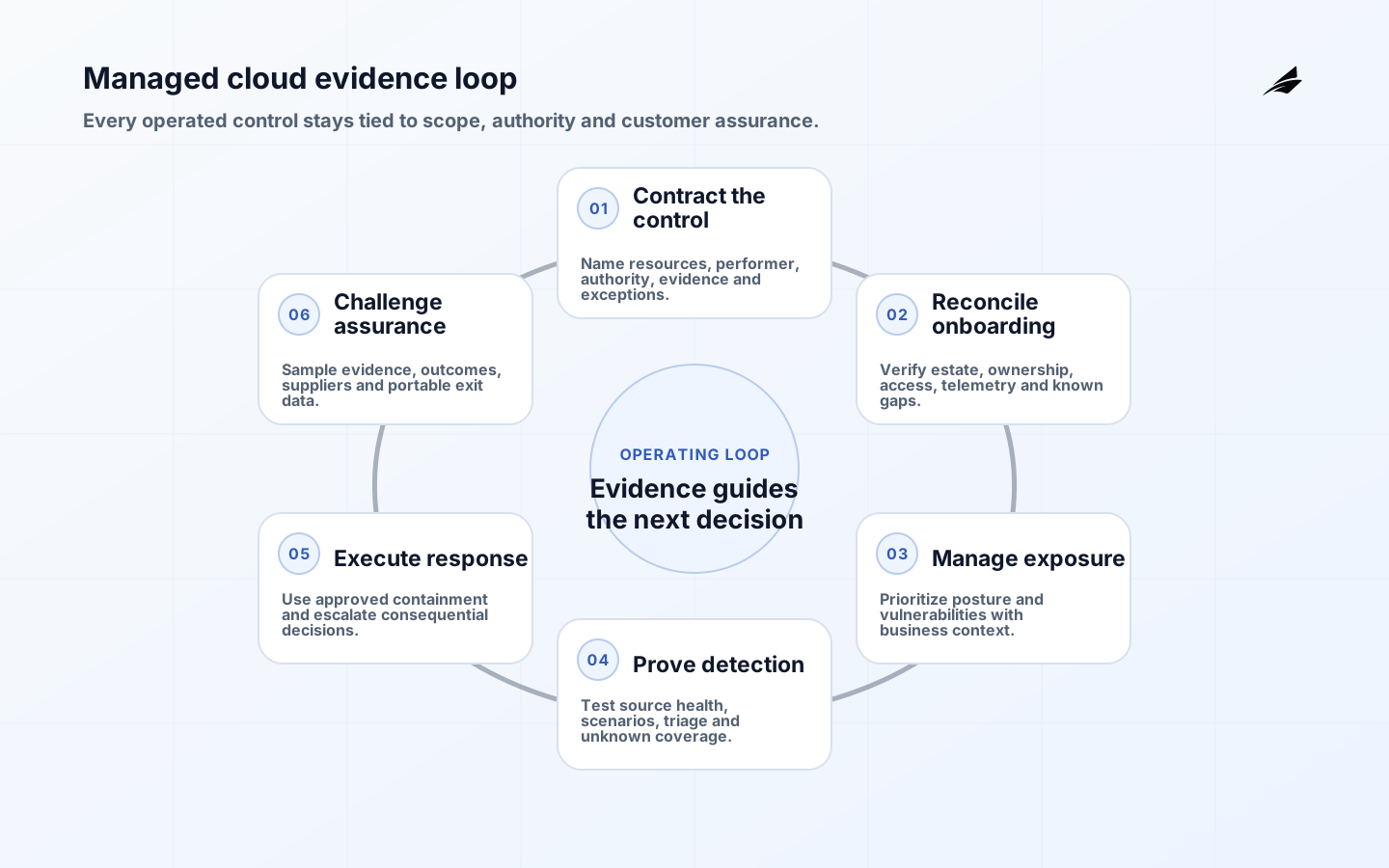
Managed cloud security services operate named customer-side security controls across cloud accounts, platforms or workloads. A provider may maintain baselines, monitor posture, triage events, manage vulnerabilities or coordinate response, but the customer still owns business risk, data purpose and consequential decisions. This FAQ helps buyers turn a broad promise to handle cloud security into an observable service with explicit resources, actions, evidence and escalation.
Use the managed cloud security implementation checklist, scope and delivery guide and security managed cloud delivery plan to prepare procurement. Compare actual control catalogs rather than labels: a managed SOC, posture tool and full cloud security operations service have different authority and evidence.
What do managed cloud security services include?
Common components include account inventory, identity review, secure configuration, posture monitoring, vulnerability triage, log onboarding, detection engineering, alert response, key or secret operations, backup assurance and compliance evidence. Scope varies by IaaS, PaaS, SaaS, containers, applications and data. List supported services and excluded resource types. A provider cannot operate a control for an account it cannot see or a service its tooling does not understand.
Require a service catalog with activity, resource boundary, trigger, frequency, performer, action authority, evidence, service objective and exception route. The CSA Cloud Controls Matrix 4.1 can organize requirements across cloud domains, but mapping is not operation. Ask the provider to show how a selected control works in each cloud and how customer-specific exceptions remain visible.
| Service area | Provider activity | Customer decision |
|---|---|---|
| Identity | Monitor privileged roles and process approved changes | Role design, workforce authority and exception acceptance |
| Posture | Detect drift and remediate within approved classes | Baseline, risk tolerance and application exception |
| Vulnerability | Normalize findings and coordinate remediation | Business priority, downtime and risk acceptance |
| Detection | Collect telemetry, tune rules and triage events | Coverage priorities and escalation thresholds |
| Response | Execute pre-approved containment and preserve evidence | Material business, legal and recovery decisions |
Does a managed provider replace shared responsibility?
No. Cloud shared responsibility divides work between cloud provider and customer; a managed provider performs selected customer activities under contract. The customer remains accountable for selecting services, configuring scope, authorizing identities, classifying data and overseeing risk. Create a control-level responsibility matrix and reconcile it with the cloud provider's current documentation. Avoid one generic matrix for all service models because responsibility shifts substantially between infrastructure, platform and software services.
For every control, name the performer, approver, evidence, cadence and exception owner. Distinguish advise, implement, approve and verify. Split duties for privileged changes where risk requires it. Review the matrix when a workload moves, a cloud service changes or the provider adds automation. Unassigned work should be treated as a gap, not silently absorbed by whichever team notices first.
What should happen during onboarding?
Reconcile organizations, tenants, subscriptions, accounts, projects, regions, networks, workloads, identities, data stores and existing tools. Classify criticality and identify owners. Establish least-privilege provider access, federation, privileged escalation, break-glass and offboarding. Validate log sources and retention, deploy baselines in observe mode where appropriate, record accepted exceptions and test a representative remediation. The CISA Cloud Security Technical Reference Architecture is a useful architecture reference.
Baseline current exposure rather than promising an instantly clean estate. Agree how legacy findings are prioritized and distinguish onboarding remediation from ongoing service. Connect ticketing, change and incident systems, then test identifiers and ownership. Rehearse a provider escalation and customer approval. Exit criteria should include verified asset and log coverage, functioning access, runbooks, responsibility acceptance, known gaps and a signed transition to steady-state operations.
How are posture, vulnerability and detection managed?
Posture management compares observed configuration with approved policy. Findings require asset context, exposure, exploitability, data sensitivity and owner before they become useful work. Establish suppression and exception rules with expiry. Vulnerability service levels should account for active exploitation and reachable attack paths, not score alone. Validate that remediation does not disrupt managed platform behavior and that accepted risk remains visible to accountable leaders.
Detection coverage begins with threat scenarios and required telemetry. Track source onboarding, event health, parsing, rule tests, triage quality and missed events. Use controlled tests to prove detections and escalation, not just count enabled rules. Protect logs from unauthorized change and align time. A provider should distinguish a telemetry outage from a quiet environment. Unknown coverage must be reported as unknown, not green.
| Service measure | Useful denominator | Misleading substitute |
|---|---|---|
| Asset coverage | Known in-scope resources by type | Raw number of scanned assets |
| Log coverage | Required sources sending valid recent events | Daily log volume |
| Detection quality | Tested scenarios and qualified alerts | Number of rules enabled |
| Remediation | Eligible findings closed within risk target | Tickets closed |
| Response | Qualified incidents contained within authority | Average alert acknowledgment |
What incident actions can the provider take?
Create an action matrix by severity and resource. Pre-approved actions may include disabling a compromised session, isolating a workload, blocking an indicator or preserving a snapshot, subject to tested safeguards. Shutting down revenue systems, rotating high-impact keys or failing over regions may require customer command. Define declaration, evidence, communication, legal coordination and recovery authority. The provider must know when to stop automation and escalate.
NIST SP 800-61 Rev. 3 positions incident response across cybersecurity risk management, so preparation, protection and learning are part of the service. Exercise cloud identity compromise, data exposure, ransomware, control-plane outage and log loss. Review whether actions were timely and correct, evidence was portable and business owners could decide. Update rules and permissions from valid lessons.
Which service levels and pricing models are useful?
Service levels should measure what the provider controls: onboarding time, telemetry restoration, qualified triage, customer escalation, approved containment, remediation coordination and evidence delivery. Pair speed with quality, coverage and false-positive burden. Define severity clearly and state clock pauses, dependencies and reporting. A rapid acknowledgment that forwards an unqualified alert does not improve response.
Pricing may use accounts, workloads, cloud spend, log volume, users, service modules or a hybrid. Test how scaling, retention, incident surges and new regions affect cost. Include onboarding, tuning, integrations, after-hours response, exercises and exit. Align commercial units with service work without creating incentives to ingest unnecessary telemetry or ignore small but critical estates. Require forecasts and thresholds before variable costs become surprises.
How should the customer assure and exit the service?
Review reconciled scope, access, exceptions, detection tests, incidents, recovery exercises, vulnerability trends and subcontractor changes. Sample evidence to source systems and challenge unexplained improvements. Certifications inform provider governance but do not demonstrate customer control performance. Use the NIST Cybersecurity Framework to connect service evidence with enterprise governance, identification, protection, detection, response and recovery outcomes.
Maintain exportable configurations, rules, asset mappings, case records, runbooks and decision history. Define transition assistance, data return, deletion evidence and credential revocation. Test that the customer or successor can receive telemetry and open cases before termination. Exit planning also covers provider failure or acquisition. A service is governable only when the customer can change it without losing visibility during the transition.
How should buyers compare managed cloud security providers?
Give each bidder the same representative estate, control scenarios and evidence questions. Ask them to trace an exposed resource from discovery through ownership, prioritization, approved remediation and closure. Ask them to demonstrate a telemetry failure and a qualified incident, not a prepared dashboard tour. Evaluate supported services, automation safeguards, analyst competence, integration effort, subcontractors and the customer's continuing workload. References should resemble the buyer's cloud complexity and risk.
Test the provider's willingness to state limits. Mature providers identify unsupported resources, uncertain coverage and actions they cannot safely automate. Require sample reports with denominators, exceptions and evidence links. Review privileged-access architecture, development security for provider tooling and vulnerability disclosure. Commercial confidence should follow technical transparency; a provider that promises complete protection without an estate inventory has not defined the service.
Where should automation stop?
Automate high-volume, reversible actions with strong identity, tested preconditions and clear audit records. Examples may include opening an owned ticket, enriching an event or applying an approved low-risk tag. Increase authority only after observing accuracy and failure. For isolation, credential changes or policy enforcement, validate resource criticality and dependencies, cap scope and retain a rapid reversal route. Never let a probabilistic classification become unrestricted cloud administrator authority.
Measure automation quality through correct action, prevented harm, reversal, exception and manual rework. Review near misses and attempts blocked by policy. Changes to provider logic should be versioned, tested and communicated when customer risk changes. The customer needs an emergency disable route independent of the failing automation. The objective is faster dependable control performance, not the highest possible percentage of actions without a person.
Key takeaways
- Contract specific control activities, resource boundaries, authority and evidence.
- Reconcile the estate and telemetry before accepting steady-state operation.
- Keep customer business risk and exception decisions explicit.
- Measure coverage and quality alongside response time.
- Pre-authorize bounded incident actions and rehearse customer command.
- Preserve portable service evidence and test exit before it is needed.
Frequently asked questions
Is a managed SOC the same service?
Usually not. A SOC generally emphasizes telemetry, detection and incident triage. Managed cloud security may also operate identity, configuration, vulnerability, keys, backup and platform controls. Compare the actual catalog and authority rather than the name.
Can one provider create consistent multicloud security?
It can create common outcomes, reporting and governance, but native services and evidence differ. Require provider-specific implementation and tests in each environment. Consistency means comparable control results, not identical tooling or dashboard labels.
Conclusion
Managed cloud security services are valuable when specialist capacity becomes a controlled extension of the customer's operations. Define scope and decision rights, prove visibility, test detection and response, and challenge assurance evidence. The customer then gains operational support without surrendering the authority and understanding required to govern its cloud risk.