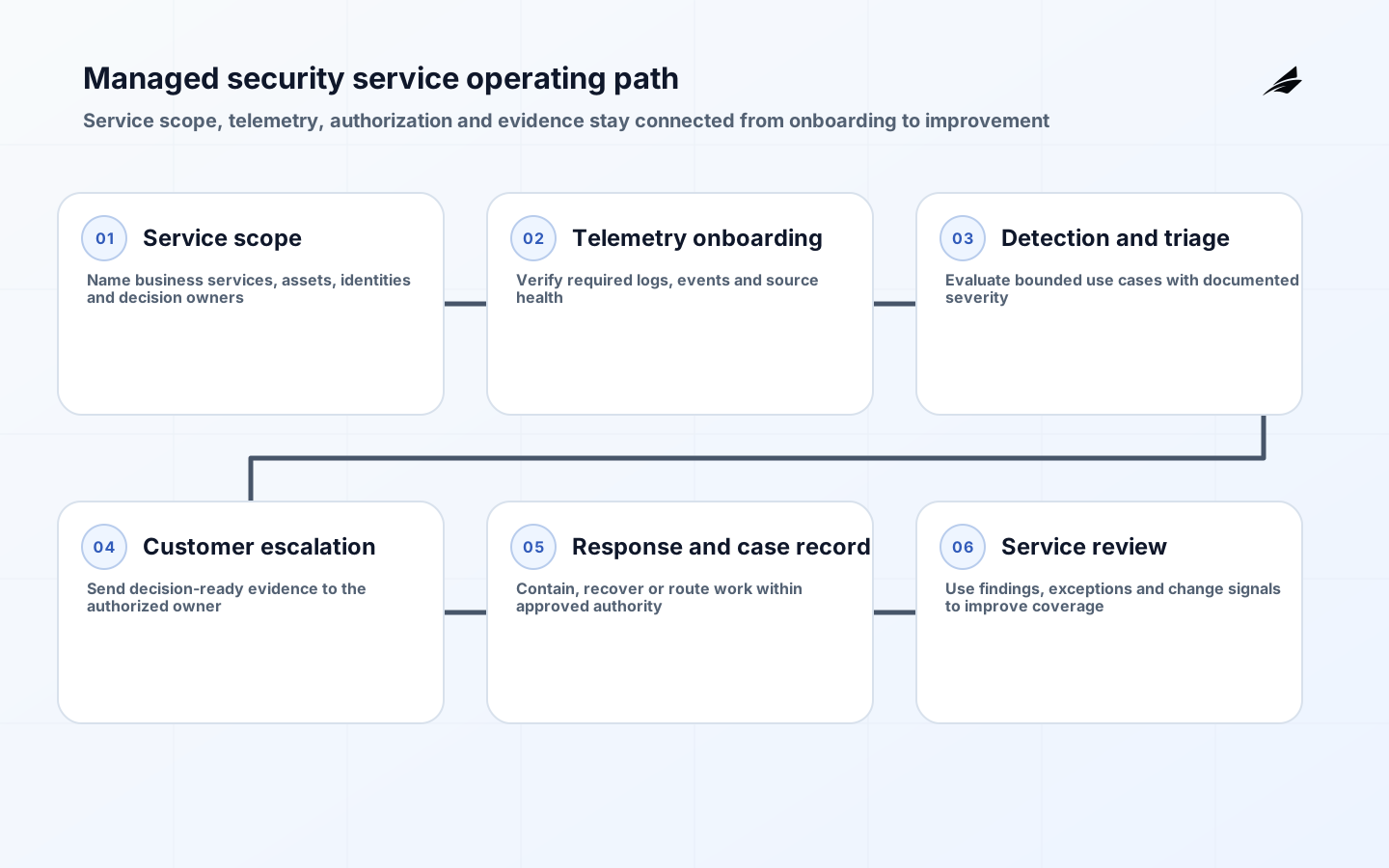
Managed security services are a way to operate defined security outcomes with outside capability; they are not a transfer of accountability. The customer still owns business risk, acceptable service interruption, data handling choices and decisions that change its environment. The provider may operate tooling, investigate defined events, maintain content or perform agreed response tasks. A useful engagement therefore begins with a precise operating question: which business services, identities, assets and failure conditions must this service help protect, and which decisions remain with internal owners? A broad promise to "monitor everything" produces alert noise and disputed handoffs. A bounded service produces an observable queue, a defensible escalation path and evidence that people can use.
Define the managed service boundary
Build the boundary from services and risk scenarios rather than from a vendor catalogue. Name the in-scope environments, data classes, identities, telemetry sources, response actions and hours of coverage. Then name exclusions with equal care: unsupported applications, unmanaged endpoints, third-party systems, forensic work, recovery execution or legal notifications may require distinct ownership. For each handoff, identify an accountable customer role, a provider role, the information exchanged and the maximum time before escalation. This is more valuable than a generic responsibility matrix because it shows what happens when an analyst needs an application owner at 02:00, when the log source is silent, or when a proposed containment step could interrupt revenue.
| Boundary element | Decision to record | Evidence at transition |
|---|---|---|
| Business service | Which journeys and impact levels the service protects | Service owner and criticality record |
| Telemetry | Which logs, events and health signals are required | Source inventory and ingestion test |
| Response authority | Which actions the provider may take without approval | Approved playbook and emergency contacts |
| Data handling | What analysts may view, retain or export | Access model and retention decision |
| Escalation | Who receives which decision at each severity | Tested contact and notification path |
Design the detection and response path
A managed service should make its path from signal to decision visible. The path normally includes collection, normalization, enrichment, triage, investigation, escalation, containment recommendation, recovery coordination and learning. It does not mean every event needs the same treatment. Define use cases that correspond to credible risk scenarios, such as privileged account misuse, suspicious sign-in patterns, exposed credentials or unusual data transfer. For every use case, record the required telemetry, detection owner, expected context, false-positive handling and response authority. The detection is incomplete if no one can obtain the context needed to decide; the playbook is incomplete if it tells an analyst to contain a system without stating who can authorize the interruption.
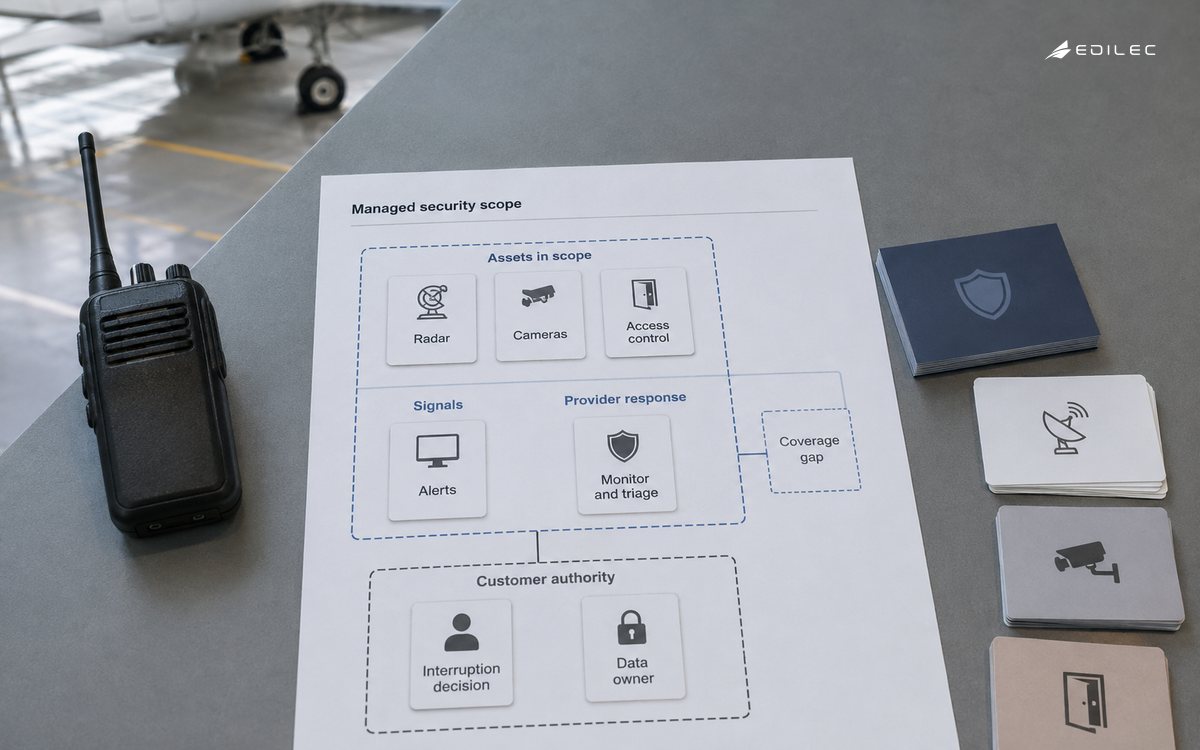
Treat operational metrics as decision aids, not as a contest over ticket volume. Time to acknowledge, time to triage and time to escalate can reveal flow problems, but they do not prove that a service reduced risk. Pair them with coverage measures: percentage of priority assets sending usable telemetry, proportion of critical use cases tested after a change, age of unresolved high-impact findings and completion of response exercises. Keep a distinction between an alert, an investigation and an incident. Collapsing those categories makes reporting look busy while hiding whether the organization is learning from meaningful events.
| Operating stage | Control that matters | Failure to surface early |
|---|---|---|
| Collection | Source ownership and ingestion health checks | A critical system stops reporting without notice |
| Triage | Documented severity and enrichment criteria | Different analysts reach incompatible conclusions |
| Investigation | Time-bounded evidence capture and case records | Context disappears before the customer can review it |
| Response | Preapproved actions and approval route | Containment is delayed or exceeds authority |
| Review | Post-incident owners and tracked improvements | The same detection or handoff failure repeats |
Govern access and provider risk
Provider access deserves the same engineering attention as production administration. Use named identities, least privilege, strong authentication, bounded support roles and a reviewable route for elevated access. The provider should not need permanent broad credentials merely because the service is continuous. Decide where investigations occur, whether raw records leave the customer environment, how case evidence is retained and how access is removed when personnel or scope changes. Contract language may express these duties, but the operational proof is technical: identity records, access reviews, configuration history, export controls and a tested offboarding path. Those artifacts turn assurance from a sales statement into something an internal risk owner can inspect.
Price the whole operating model
The visible subscription is only one part of managed security cost. Work expands with the number and volatility of assets, telemetry volume, integration effort, detection content, response coverage, retained evidence, change requests and customer participation. A low entry price can be sensible for a narrow service, but it should not be compared to a 24-hour model with onboarding, investigation support and exercise commitments as if the outcomes were identical. Ask which activities are included, which are consumption-based, which need professional services and which remain internal. Price the customer-side work too: application owners must supply context, approve response actions, remediate findings and keep inventories current.
| Cost driver | Why it changes effort | Question for planning |
|---|---|---|
| Asset and identity scope | More varied systems require more onboarding and context | Which assets are priority in the first wave? |
| Telemetry quality | Incomplete or noisy signals increase triage work | Who owns source health and parsing changes? |
| Coverage model | After-hours escalation changes staffing and authority needs | Which decisions need a live customer contact? |
| Integration depth | Ticketing, CMDB and automation links require maintenance | Which integration is essential before service acceptance? |
| Improvement backlog | Tuning and new use cases consume recurring attention | How are enhancements approved and funded? |
Stage onboarding and acceptance
Use a staged transition instead of declaring the service live after a connector is enabled. First confirm scope, asset ownership, contact paths and data-handling rules. Next onboard a representative set of telemetry sources and prove that health monitoring can detect a silent source. Then exercise a small set of high-value detections from signal through escalation with the people who will operate the real path. Only after those tests should the team expand coverage. Acceptance criteria should describe observable behavior: a source arrives with required fields, a case can be reconstructed, an escalation reaches the right decision maker, and a privileged access review is complete. They should not be a vague statement that the platform was configured.
Keep a joint register for assumptions, exceptions and service changes. An exception needs an owner, rationale, compensating control, review date and closure condition; otherwise it quietly becomes permanent scope. Review the register alongside service metrics and major environment changes. This makes the service resilient to ordinary change: new cloud accounts, reorganized teams, retired applications and altered identity flows all affect what can be detected and who may act. Managed security becomes dependable when transition is treated as the beginning of stewardship, not the end of implementation.
Prepare for provider transition
Plan the exit path while the relationship is still being designed. The customer should be able to retain or export configuration, case records, detection logic where contractual terms permit, asset context, access records and outstanding improvement items in a usable format. Define who owns documentation, how credentials and integrations are removed, and how an incoming team receives the current queue without losing history. Transition planning is not a prediction that the service will fail. It is a control against dependency on undocumented provider knowledge, and it gives both parties a clearer incentive to keep the operating model legible.
Test a representative service handover during a major review or exercise. Ask whether a new analyst could understand a detection, reconstruct an escalation and locate the system owner using the retained records. This test frequently exposes missing context that ordinary response metrics do not reveal. It also ensures that improvement work, exceptions and unreviewed risks remain visible when staffing, contracts or tooling change.
Treat service reporting as a bilateral control. The provider should explain material changes in coverage, source health and detection logic; the customer should explain material asset, identity and business-service changes. A monthly review without those inputs becomes a status meeting rather than a mechanism for keeping protection aligned with the environment.
Key takeaways
- Scope the service around business services, risk scenarios and named response authority.
- Require evidence for telemetry health, access control, escalation and improvement work before acceptance.
- Separate alert throughput from meaningful coverage and incident learning.
- Price customer participation, integrations and improvement work alongside the provider subscription.
- Use exercises and change review to keep the service aligned with the live environment.
Frequently asked questions
Does a managed service make the provider accountable for cyber risk?
No. A provider can take contractual responsibility for defined service activities, but the organization retains responsibility for its business decisions, environment and risk acceptance. The operating model should make the distinction practical through named owners and escalation authority.
What should be included in a first managed security service?
Start with a limited group of high-value assets, usable telemetry, a small set of credible detection scenarios, named contacts and exercised escalation. Expand after those foundations work rather than onboarding every source before the team can operate any of them well.
How should service quality be reviewed?
Review source health, detection coverage, investigation quality, response exercises, unresolved findings and exceptions together. A single response-time measure cannot reveal whether the service is seeing the right risks or improving the environment.
Conclusion
Managed security services earn trust when they make security work more legible: clear scope, usable evidence, constrained access, fast handoffs and learning that reaches the environment. Choose a provider and a commercial model only after the organization can describe those operating commitments. The desired result is not a dashboard full of alerts; it is a service that helps accountable people make better security decisions under ordinary change and real pressure.