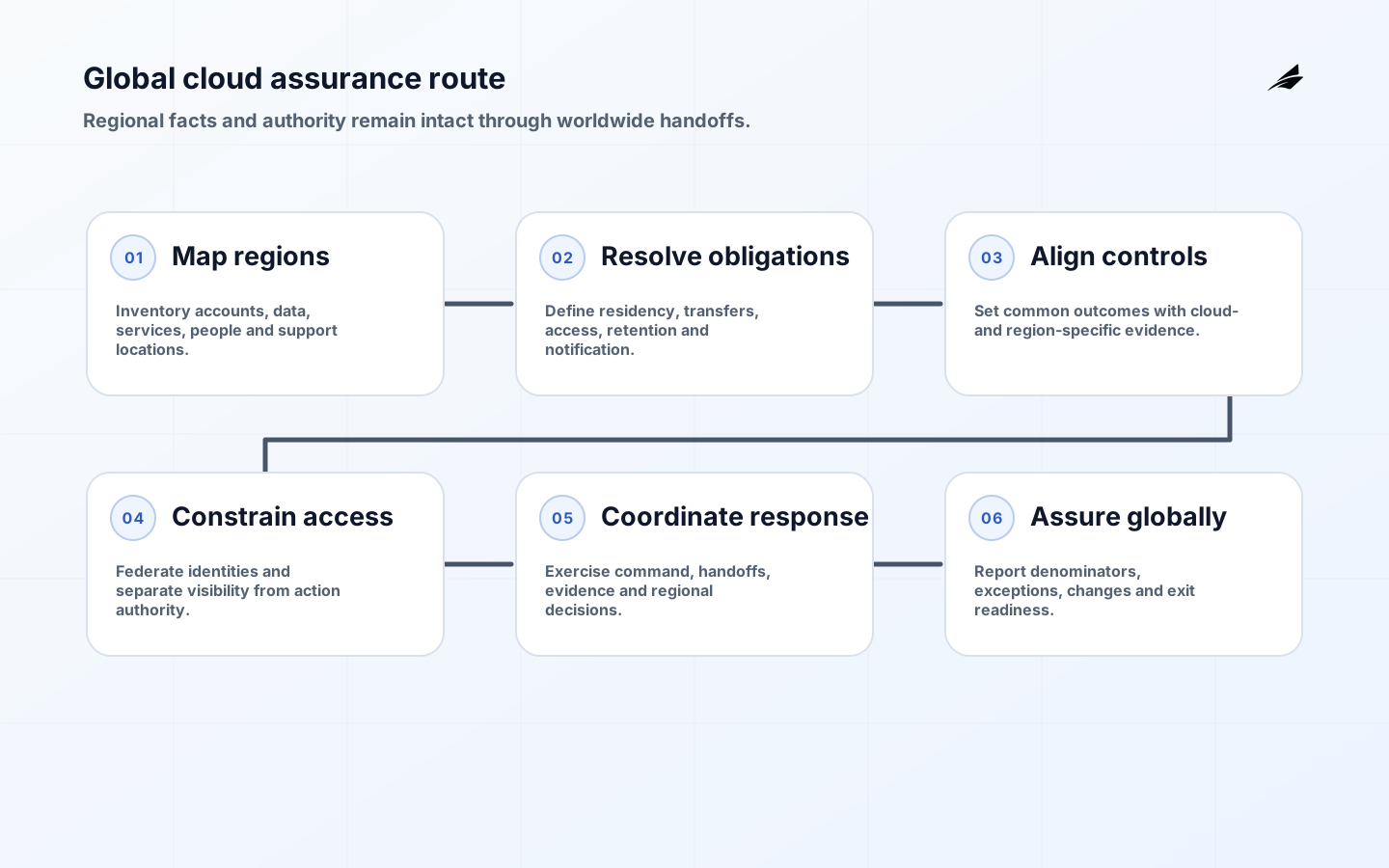
Worldwide managed cloud security is a coordinated service for cloud estates that cross providers, business units, countries and time zones. Worldwide should describe verified operating reach, not a map of sales offices. The service needs regional legal and data controls, consistent security outcomes, local escalation knowledge and handoffs that preserve context. This FAQ explains how to evaluate global scope without assuming one dashboard or one contract makes every region equivalent.
Use the worldwide managed cloud security delivery plan and global implementation checklist for procurement and rollout. The managed cloud security implementation checklist covers control operation in depth. Start with an estate and obligation inventory; geography matters only in relation to data, people, services and authority.
What should worldwide managed cloud security mean?
The provider should identify supported cloud services, regions, languages, operating hours, response locations, subcontractors and on-call escalation. A follow-the-sun model can shorten response, but each transfer must include incident state, evidence, decisions and outstanding actions. Ask whether teams can perform the contracted containment in each environment and whether regional staff have equivalent training, tooling and authorization. Coverage that stops at alert forwarding is not managed response.
Define a common control outcome with region-specific implementation. Identity, logging, vulnerability, backup and key management may use different native services across cloud providers. Standardize ownership, evidence and thresholds while documenting technical variation. The CSA Cloud Controls Matrix 4.1 provides 207 controls across 17 domains and shared-responsibility guidance; tailor controls to the estate rather than claiming blanket framework coverage.
| Worldwide claim | Evidence to request | Risk if absent |
|---|---|---|
| 24x7 monitoring | Staffing model, queue ownership and handoff test | Alerts wait despite global branding |
| Regional compliance | Service/data locations and obligation mapping | Unexpected transfer or access |
| Multicloud consistency | Control mapping and provider-specific tests | Uniform reports hide different behavior |
| Local response | Named authority, language and escalation coverage | Decisions stall during an incident |
| Global assurance | Comparable metrics with regional exceptions | Aggregate score conceals weak regions |
How do residency, location and international transfers differ?
Data residency describes where data is stored; processing location covers where systems and people access or transform it; jurisdiction concerns which laws and authorities may apply. These are not interchangeable. Inventory primary data, replicas, backups, logs, support captures, threat samples and case records. Record provider, region, access roles, subprocessors, retention and deletion. A regional workload can still create an international transfer when an overseas analyst accesses personal data.
Legal teams must determine lawful mechanisms and supplementary safeguards for the actual processing. The European Data Protection Board's SCC resource explains that standard contractual clauses are pre-approved clauses for certain transfers; a clause does not map the architecture or configure controls. Minimize security-case data, redact where workable, enforce regional access, log support access and ensure investigation evidence remains useful.
Who owns controls across providers and countries?
The cloud provider secures contracted platform layers, the managed provider performs named customer-side activities, and the customer retains business risk, data decisions and oversight. Build a matrix per control and service model with performer, approver, evidence, cadence, exception and incident authority. Add regional owners for obligations and business impact. A global service owner should reconcile gaps and prevent each business unit from silently assuming another party manages a control.
Use federated governance: central policy and assurance, regional implementation input, and local accountability where law or operations require it. Exception decisions need expiry and a plan, not permanent regional footnotes. Inventory acquisitions and shadow cloud accounts. Align account hierarchy, identity federation, tagging, logging and baseline policy while preserving approved regional differences. The CISA Cloud Security Technical Reference Architecture connects shared services, migration and posture management.
| Control area | Global baseline | Regional decision |
|---|---|---|
| Identity | Federation, MFA, privileged access and lifecycle | Permitted identity source and local admin route |
| Telemetry | Required events, time sync, fields and retention tiers | Storage location and analyst access |
| Encryption | Approved algorithms, key ownership and rotation | Key region and legal access conditions |
| Response | Severity, evidence, authority and communication | Notification deadlines and local counsel |
| Resilience | Recovery objectives and test evidence | Regional dependency and failover legality |
How should global access be controlled?
Do not trust an analyst because they sit on a corporate network or provider team. NIST Zero Trust Architecture focuses on protecting resources rather than implicit network trust. Federate provider identities into customer-controlled or strongly governed access, require phishing-resistant authentication where risk warrants it, use just-in-time privileged roles, constrain sessions by task and record administrative actions. Break-glass access needs approval, alerts and retrospective review.
Separate monitoring visibility from change authority. Analysts may need enough context to classify an event without broad access to customer content. Pre-approve low-risk containment such as disabling a known compromised credential, while reserving workload shutdown or cross-region failover for named customer leaders. Test access from every support location and confirm denied paths. Offboarding must remove the provider workforce, subcontractor and service accounts promptly across every cloud.
How do global incident response and notification work?
Create one incident command model with regional legal and operational branches. Define severity, declaration authority, evidence custody, communication, translation and decision logging. Map notification obligations and customer contacts before an event, but let qualified counsel determine applicability. NIST SP 800-61 Rev. 3 integrates incident response across Govern, Identify, Protect, Detect, Respond and Recover, supporting preparation and learning beyond the active response window.
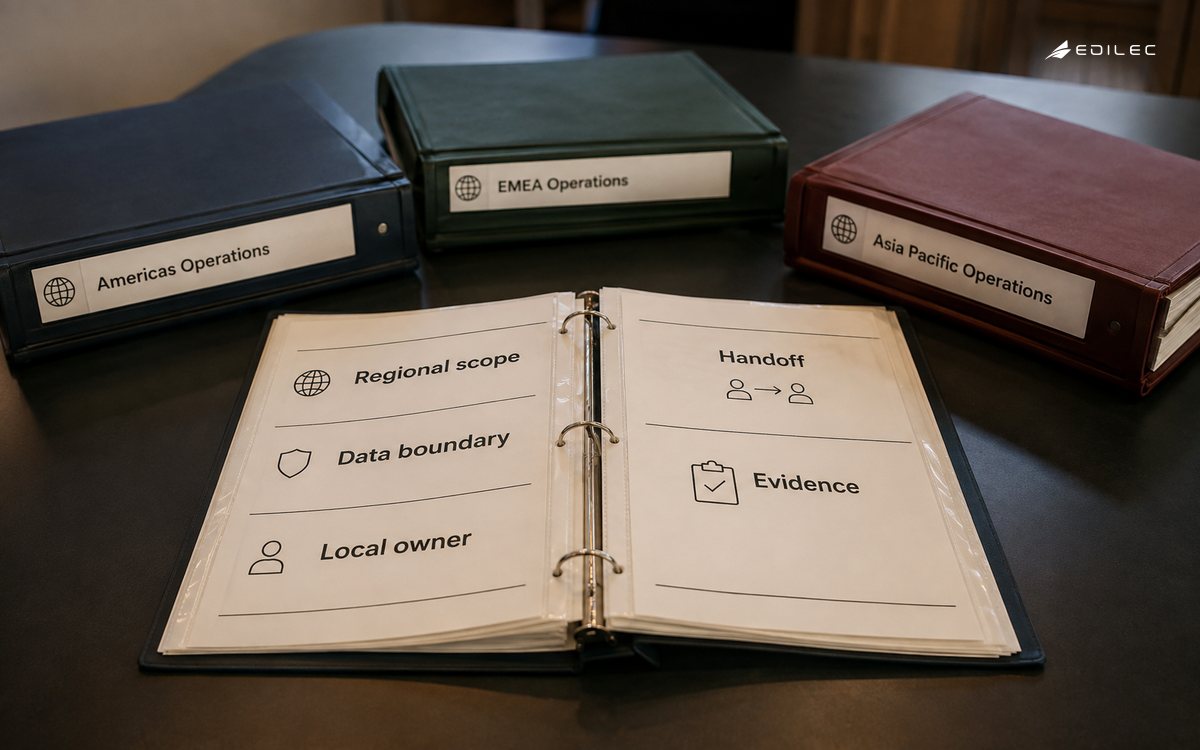
Run exercises across time-zone handoffs, provider boundaries and region loss. Include compromised provider credentials, unavailable log region, ransomware, unlawful data access and a cloud control-plane outage. Verify that evidence timestamps align, contact information works and the next team can explain current hypotheses and decisions. Measure time to qualified triage, customer decision and containment by region, plus handoff defects and evidence completeness.
How should worldwide service assurance be reported?
Report coverage and quality, not raw alert volume. Reconcile accounts, identities, data stores and log sources against the estate. Show control exceptions, privileged access, high-risk exposure, detection test results, response performance, restoration evidence and overdue actions by region and provider. Include denominators and freshness. A global average can conceal a region with no telemetry; require distributions, outliers and explicit unknowns.
Use independent certifications and provider assessments as inputs, then test controls in customer context. Sample a security event from cloud source through triage and closure. Review subcontractors, service locations and material changes. Confirm evidence export and retention. Exit testing should prove the customer can transfer rules, cases, configurations and knowledge, revoke access and continue operations without losing regional history.
What should global procurement and contracts require?
Attach the country, cloud and service matrix to the contract rather than relying on generic worldwide availability. State approved service locations, subprocessors, access conditions, languages, hours, data categories and notification contacts. Require notice before material location, subcontractor or tooling changes. Define evidence rights, audit cooperation, vulnerability disclosure, law-enforcement request handling and how conflicts between regional instructions are escalated. Validate these terms with privacy, security, procurement and local business owners.
Commercial models should expose regional cost drivers: data ingestion, retention, currency, local staffing, premium response and cross-cloud integrations. Require unit definitions and forecasts. Avoid pricing that encourages the provider to centralize sensitive logs merely to reduce cost or to suppress necessary telemetry. Compare the cost of required coverage, not headline per-gigabyte rates. Include exercises, travel where needed, translation, onboarding remediation and transition assistance.
Practical example: adding a regulated region
A retailer entering a new country should not simply clone its existing security workspace. The team maps local customer and workforce data, available cloud services, support access and notification obligations. It decides which telemetry remains in region, which derived indicators may enter the global view and which responders can access case detail. Regional counsel validates transfer arrangements, while security tests that global analysts can triage without unrestricted content access.
Before launch, the provider proves account discovery, identity lifecycle, log health, a regional detection and one containment handoff. An exercise starts during the local night shift and transfers command twice. Assurance reports the new region separately until coverage and response quality meet steady-state criteria. This staged model preserves the global operating standard while making local facts visible instead of forcing premature uniformity.
The same discipline applies when leaving a country or cloud region. Freeze new dependencies, identify records and retention duties, move or delete data through approved procedures, preserve incident evidence and revoke regional provider access. Verify that global dashboards no longer expect retired sources and that unresolved cases have an accountable destination. Regional exit is a controlled security change, not simply cancellation of a cloud subscription. Test the final access revocation from every former support location.
Key takeaways
- Define worldwide coverage through locations, people, services, authority and tested handoffs.
- Map storage, processing, support access and subprocessors separately.
- Use one control outcome with provider- and region-specific implementation evidence.
- Apply resource-focused, time-bound access and split visibility from action authority.
- Exercise incidents across borders, clouds, time zones and legal branches.
- Report regional denominators and preserve portable evidence for exit.
Frequently asked questions
Does a global SOC make a service worldwide?
Not by itself. The service also needs supported regional cloud services, lawful access, language and escalation capability, executable response authority, tested handoffs and comparable assurance. A central SOC can coordinate these elements but cannot substitute for them.
Is a sovereign cloud automatically compliant?
No. Sovereign offerings may provide useful location, control or ownership features, but compliance depends on the organization's processing, configuration, access, contracts and obligations. Validate the precise service and architecture rather than relying on the label.
Conclusion
Worldwide managed cloud security succeeds when a global control model remains accurate at regional level. Inventory where data and decisions travel, allocate responsibility, constrain cross-border access, rehearse handoffs and report exceptions without averaging them away. That creates real operating coverage and gives leaders the evidence to govern a distributed cloud estate.