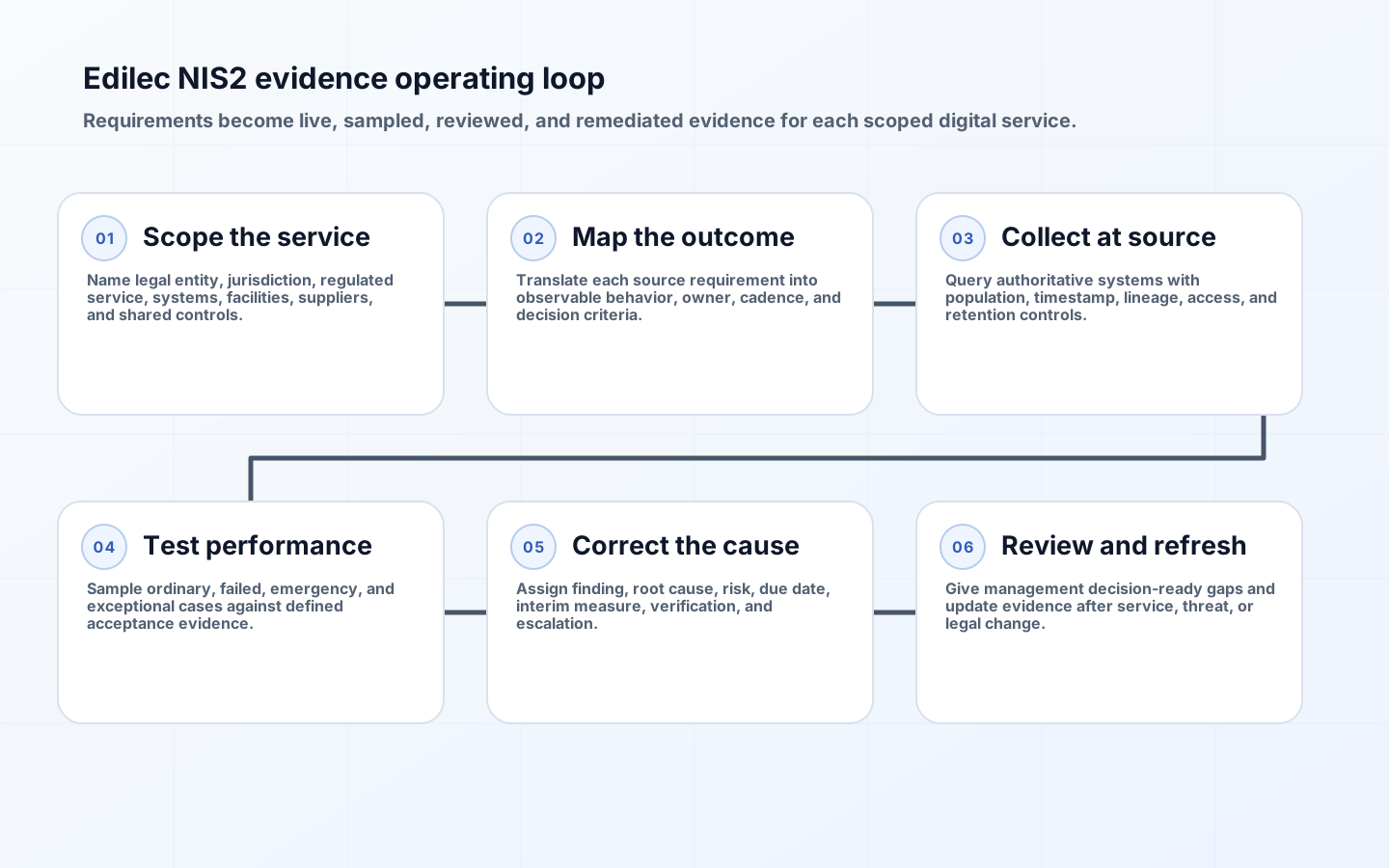
NIS2 implementation evidence is the information that lets an organization demonstrate that required cybersecurity risk-management measures operate in its real environment. A policy asserting that incidents are handled is weaker than an approved process plus on-call records, classified cases, notification decisions, exercise results, corrective actions, and management review. For cloud, data-centre, managed-service, managed-security, marketplace, search, social-platform, DNS, CDN, and trust-service entities covered by Commission Implementing Regulation (EU) 2024/2690, the evidence map should follow the regulation's technical and methodological requirements rather than a generic security checklist.
The ENISA technical implementation guidance offers practical advice, examples of evidence, and mappings for these sectors. It is guidance, while the Implementing Regulation, NIS2, national transposition, and competent-authority decisions establish obligations. Build a crosswalk that identifies the legal source, applicability, operating process, control owner, system of record, sample population, review cadence, exception path, and management recipient. That turns compliance from annual evidence hunting into normal operational accountability.
Confirm entity, service, and jurisdiction applicability
Identify the legal entities and services that fit NIS2 categories, their Member State establishment or jurisdiction, size and exception facts, and whether they are essential or important entities under applicable national law. Map cloud computing, data-centre, CDN, managed service, managed security, online platform, search, DNS, TLD, registration, and trust services separately. A group may have one technical platform serving entities with different status. Preserve the decision source and reviewer rather than applying one group-wide label.
Define the information systems, facilities, people, suppliers, and processes used to deliver each relevant service. This boundary drives risk assessment, incident significance, continuity, access, supply-chain, and audit samples. Record dependencies on parent-company identity, shared SOC, public cloud, colocation, telecom, and subcontracted support. When evidence comes from a group control, document which scoped entity relies on it and how local management assures performance. Revisit the map after acquisition, market entry, service redesign, or national-law change.
Build a NIS2 implementation evidence map
Create one row per requirement or coherent control outcome. Translate legal language into an observable operating statement without narrowing it. For example, a requirement to review cybersecurity policy becomes an owned policy set, approval authority, scheduled review, trigger-based review, communicated changes, exceptions, and evidence that controls follow the current version. Link each row to evidence objects, not folder paths alone. A ticket query, configuration export, exercise record, meeting approval, or monitoring dashboard needs a defined custodian and retention rule.

| Field | Purpose | Example | Failure signal |
|---|---|---|---|
| Applicability and rationale | Shows why a requirement applies to a service | Managed-service systems in entity boundary | Group policy cited with no scoped service |
| Control outcome and owner | Makes expected behavior accountable | Critical patch exceptions approved by security owner | Team name without decision authority |
| System of record | Makes evidence reproducible | Change platform query with immutable timestamps | Screenshots selected manually |
| Population and sample | Supports completeness testing | All privileged accounts, quarterly sample and exceptions | Only successful examples retained |
| Cadence and trigger | Keeps evidence current | Annual review plus material-change review | No refresh after service acquisition |
| Exception and remediation | Shows control failures are governed | Risk, due date, owner and closure proof | Expired waiver with no escalation |
Map governance, policy, and risk-management evidence
Retain the risk-management framework, approved cybersecurity policies, roles and authorities, management oversight, risk appetite or acceptance criteria, risk assessments, treatment plans, and independent review. For each scoped service, evidence should show assets and dependencies, threats and vulnerabilities, likelihood and impact method, selected treatment, residual acceptance, and follow-up. Management training and approval matter because NIS2 places responsibility on management bodies. Meeting minutes should record decisions and challenge, not merely attendance.
Connect risk records to service changes and business priorities. A new administrative API, outsourced operations team, or data-centre region should trigger assessment before production. Maintain a control library, but avoid scoring maturity as a substitute for resolving specific risk. The identity-governance guide can support ownership and access lifecycle evidence. Add scoped management approval, competence, and review records required by the regulatory context.
Map incident handling, continuity, and crisis evidence
Evidence the complete incident path: monitored sources, detection rules, triage criteria, severity, on-call escalation, containment authority, forensic preservation, communications, significance assessment, regulatory notification, recovery, lessons, and corrective action. Link incidents to the service and affected recipients. The Implementing Regulation specifies cases in which incidents are significant for covered entity types; encode those thresholds and qualitative conditions into a decision worksheet with versioned logic. Preserve non-reporting decisions as carefully as reports.
Continuity evidence begins with service impact analysis, recovery objectives, redundancy design, backup scope, restoration tests, crisis roles, alternate communications, supplier dependencies, and exercise outcomes. A successful database restore does not prove service recovery if identity, secrets, DNS, queues, or customer communication fail. Use the incident-playbook guide to make procedures executable. Record actual recovery times, data-loss points, unmet assumptions, assigned improvements, and retest results rather than marking the exercise complete at the meeting's end.
Map technical and operational control evidence
For asset management, retain inventory sources, ownership, classification, network and service dependencies, approved software, lifecycle state, and reconciliation exceptions. For access control, preserve identity source, joiner-mover-leaver events, privileged paths, authentication policy, periodic reviews, emergency access, and revocation tests. For cryptography, connect data classification and threat to algorithms, key custody, rotation, revocation, certificate monitoring, and migration. For configuration and change, show baselines, authorization, testing, separation of environments, emergency changes, rollback, and post-change review.
Vulnerability and patch evidence should join discovery sources, coverage, asset identity, severity and exploitability, treatment deadlines, exceptions, remediation, and verification. Security testing needs scope, independence, environment, findings, owners, deadlines, retest, and residual acceptance. Logging evidence should prove protected collection, time synchronization, detection use, retention, access, and incident reconstruction. The SaaS audit-log guide helps design useful events; regulatory evidence adds completeness, review cadence, and accountable corrective action.
Map supply-chain, personnel, and security-awareness evidence
Inventory direct suppliers and the services, systems, data, locations, and critical functions they support. Tier due diligence by dependency and risk; preserve security requirements, evaluation, contract clauses, incident notification, access constraints, continuity, subcontractor visibility, monitoring, findings, and exit plans. Do not treat a certification as complete evidence. Record its scope and date, map uncovered requirements, and monitor provider performance. The vendor-access guide supports attributable access and revocation for provider personnel.
Personnel evidence should cover role screening where lawful, security responsibilities, onboarding, role-specific training, acceptable use, disciplinary process, offboarding, and privileged-user competence. Awareness exercises should generate decisions: which population failed what behavior, what corrective training occurred, and whether a repeat test improved performance. Include contractors and supplier operators who act inside the service boundary. Protect personal data and avoid retaining unnecessary surveillance; evidence should demonstrate control performance without creating an unmanaged sensitive-data collection.
| Process | Primary owner | Decision-useful evidence | Review question |
|---|---|---|---|
| Risk management | Risk and service leadership | Scoped assessment, treatment and accepted residual risk | Did service change invalidate assumptions? |
| Incident management | SOC and incident commander | Timeline, significance decision, notices and lessons | Can the case be reconstructed? |
| Continuity | Service and resilience owners | Impact analysis, restore result and corrective retest | Did the complete service meet objectives? |
| Vulnerability management | Security and platform teams | Coverage, prioritization, exception and verified fix | Are exposed assets aging outside policy? |
| Supplier security | Procurement and service owner | Dependency, due diligence, contract and monitoring | Can a provider disruption be contained or exited? |
| Access governance | Identity and system owners | Lifecycle, privilege review and emergency-access test | Are all active rights justified? |
Operate assurance, sampling, and remediation
Define a review calendar based on control risk and evidence volatility. Automated evidence collectors should expose source, query, time range, completeness, and failure status; automation that silently stops is worse than a visible manual gap. Conduct owner attestations only after population-based checks. Independent assurance should sample both normal and exceptional activity, including emergency changes, overdue patches, failed backups, terminated suppliers, and incidents below reporting thresholds. Track every finding to root cause, accountable owner, due date, verification method, and escalation.
Build management reporting around decisions: unassessed services, expired risk acceptances, unresolved high-risk findings, control coverage, significant incident readiness, continuity objective misses, supplier concentration, and evidence freshness. Avoid a single compliance percentage that hides a critical unsupported service. Periodically perform an evidence-retrieval drill for a selected service and time period. If teams cannot produce the governing policy, population, exceptions, approvals, and corrective evidence promptly, the process is not supervisory-ready even if technical controls appear sound.
Evidence retention needs an explicit design. Define the period, lawful basis, confidentiality, integrity protection, approved viewers, export controls, and deletion process for each artifact class. Incident records, identity reviews, personnel cases, supplier assessments, packet captures, and customer communications carry different sensitivities. Keep proof sufficient to reconstruct control operation without collecting unnecessary personal or customer data. Test that access to the evidence repository is itself logged and periodically reviewed. When an entity changes platforms or providers, migration acceptance should include hashes, row counts, relationship checks, and retrieval tests; losing historical exceptions during a tool replacement can make current compliance claims impossible to substantiate.
Key takeaways
- Map applicability by legal entity, regulated service, jurisdiction, and shared dependency.
- Translate every requirement into an observable outcome, accountable owner, and authoritative evidence source.
- Preserve populations, exceptions, failed events, and remediation rather than curated successful samples.
- Connect incident significance and notification decisions to service-level facts.
- Treat supplier, personnel, and management-body evidence as operating controls, not paperwork appendices.
- Test evidence retrieval and freshness throughout the year.
NIS2 implementation evidence FAQ
Does ISO 27001 certification prove NIS2 compliance?
No. Certification can support selected controls, but its scope, period, exclusions, and evidence must be mapped to the entity's specific NIS2 and national requirements. Gaps still need owned treatment.
Is ENISA guidance legally binding?
ENISA guidance is an authoritative implementation aid, not a replacement for the Directive, Implementing Regulation, national transposition, or competent-authority requirements. Cite which source supports each decision.
Is every SaaS provider covered by Implementing Regulation 2024/2690?
No. Determine whether the legal entity and service fit a covered category such as cloud computing or managed service, then apply NIS2 and national scope rules. The SaaS label alone is not decisive.
Conclusion
A useful NIS2 evidence map lets management and supervisors see how a scoped service identifies risk, operates controls, handles exceptions, and improves after failure. Its value comes from traceability to live systems and accountable decisions. When evidence is generated by normal work, regulatory readiness and operational resilience reinforce each other.