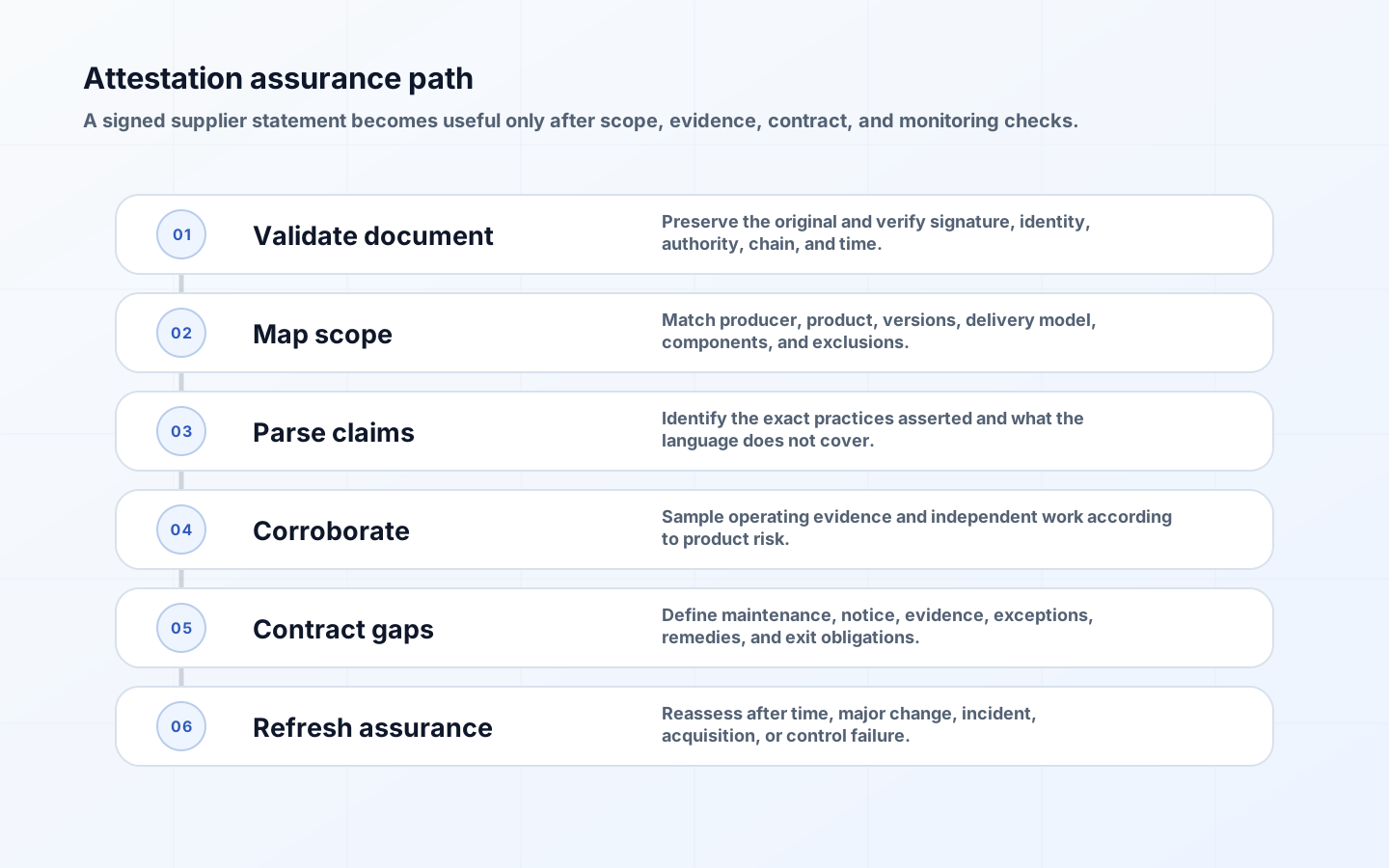
A signed secure software attestation is a supplier's authenticated statement about a defined product and a defined set of development practices. It can establish who made the statement, preserve the text against undetected alteration, and create accountability for a named signatory. It does not independently prove that the practices operated effectively, that every product version is in scope, that no vulnerability exists, or that the supplier retained adequate evidence. Procurement teams should therefore treat the document as one evidence-bearing representation, not as a security certificate.
The U.S. federal policy context changed materially in 2026. OMB Memorandum M-26-05 rescinded M-22-18 and M-23-16 and directed agencies toward assurance policies matched to risk and mission. It says agencies may continue using resources developed under the former policy, including the Secure Software Development Attestation Form. Buyers outside government can likewise use an attestation, but should avoid presenting an optional form or a supplier's signature as universal proof of secure development.
Place the attestation in its current policy context
For federal buyers, acquisition instructions, agency policy, contract clauses, and system risk now determine whether a form is requested and what accompanies it. Historic documents may still appear in supplier portals and contract records, so note the governing policy date rather than assuming the old collection mandate remains current. The GSA secure software development attestation page identifies GSA Form 7700 and its revision; a form's existence does not itself make it mandatory for every transaction.
For enterprise procurement, the useful question is not whether a vendor can produce any attestation. Ask whether the statement covers the exact offering, delivery model, versions, producer entities, and development environments on which the buyer relies. Determine whether the contract incorporates the statement, whether inaccurate material claims trigger notice or remedies, and whether the buyer can request supporting evidence. A polished document disconnected from the purchased SKU and operating boundary has little assurance value.
Separate what the signature proves from what the statement claims
Digital signing can authenticate a key holder and protect document integrity, but only when the buyer validates the signature, certificate chain, signing time, and identity. An image of a signature or typed name has different verification properties, though it may still carry contractual meaning. Confirm that the signatory is authorized to bind the producer, not merely employed by a reseller. Preserve the original signed object and validation result; printing it to PDF can discard signature data needed later.
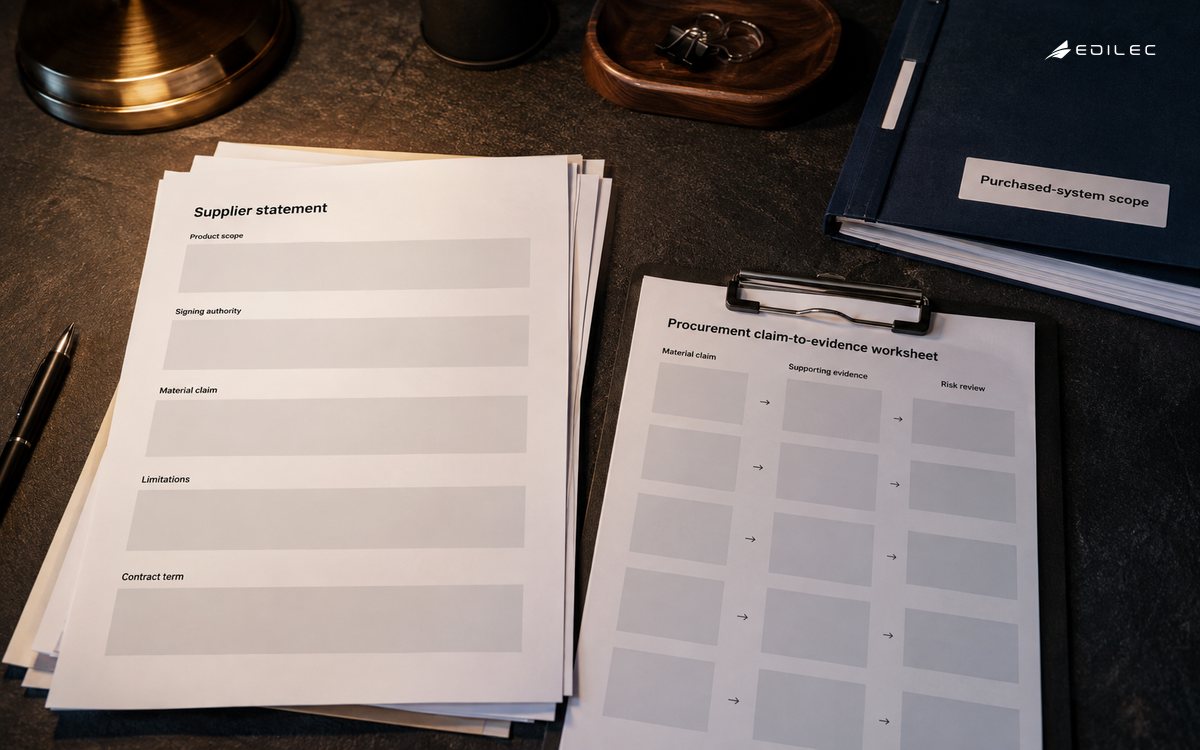
The underlying claim is usually a management assertion that specified secure development practices were followed. NIST SP 800-218 defines the Secure Software Development Framework as high-level practices organized around preparing the organization, protecting software, producing well-secured software, and responding to vulnerabilities. Conformance language must be read against the exact practices listed in the form or contract. The signatory does not magically attest to every SSDF task, every implementation example, or every component supplied by another organization.
| Element | Reasonable conclusion | Unsafe conclusion | Buyer check |
|---|---|---|---|
| Valid document signature | Accepted identity signed unchanged content | Every factual claim has been independently tested | Validate chain, signer authority, time and original file |
| Named product scope | Statement applies to listed offering and versions | All products, tenants and future releases are covered | Map names to contract SKUs and release lifecycle |
| Practice assertion | Producer represents that listed practices were followed | Controls operated effectively in every build | Request evidence samples and exceptions |
| Third-party assessment | Assessor performed described procedures | Unqualified certification of all security | Read scope, criteria, period, method and limitations |
| Submission date | Claim was made at that time | Claim remains current after major changes | Define refresh and change-notice triggers |
Test scope before scoring the supplier
Create a scope map with producer legal entity, product and product line, version rule, deployment model, build environments, source repositories, hosted dependencies, open-source components, update channels, and support period. Compare that map with the architecture being purchased. A SaaS attestation may concern the provider's application development while excluding customer-written extensions, marketplace apps, on-premises agents, mobile clients, or acquired products. Record exclusions as procurement facts, not footnotes to discover during an incident.
Version language deserves special attention. A point-version statement ages quickly; a broad product-line statement may conceal significant differences. Define how major releases, acquisitions, compiler migrations, build-platform changes, and new hosting models affect validity. Ask whether the producer uses one common secure development system or many. Require notice when a change makes the earlier representation materially inaccurate, plus a period for updated evidence and a risk decision by the buyer.
Verify the claim with proportionate evidence
Evidence review should be risk-tiered. A low-impact commodity tool may justify document validation, public vulnerability-disclosure review, and contractual update duties. Software with privileged access, sensitive data, safety effects, or broad fleet reach should receive deeper sampling: build protection diagrams, access-control records, provenance examples, vulnerability handling records, test summaries, secure configuration, dependency governance, and independent assessment results. Evidence can be viewed under controlled access without demanding source code or unrestricted penetration-test reports.
Use the NIST SP 1326 due diligence guide to place the statement within a wider supplier assessment covering provenance, resilience, foundational cyber practices, supply-chain tiers, and relevant ownership or control considerations. Corroborate claims across artifacts rather than collecting unrelated files. For example, an assertion about protected builds is stronger when the supplier can show separated release identities, immutable logs, signed provenance, controlled exceptions, and one release traced from source approval to customer package.
| Risk tier | Minimum corroboration | Enhanced evidence | Decision owner |
|---|---|---|---|
| Limited | Signature validation, scope match, vulnerability disclosure and support policy | Targeted clarification for material exclusions | Service owner with procurement |
| Moderate | Control narrative, evidence samples, incident and patch obligations | SBOM on request, provenance sample, recent assessment summary | Security and service owner |
| High | Structured evidence review and architecture walkthrough | Independent procedures, build trace, resilience test and remediation validation | CISO delegate and business risk owner |
| Critical | Continuous assurance plan and contractual audit rights | Release-level evidence, rapid incident access, exit and continuity exercises | Executive risk authority |
Translate assurance gaps into contract language
Attach the accepted attestation by identifier and date, define the covered offering, and state which representations survive renewal. Add duties to maintain the asserted practices, retain supporting evidence for an agreed period, correct materially inaccurate statements, and notify the buyer of scope or control changes. Specify security update support, vulnerability disclosure, coordinated incident notification, subprocessor governance, evidence access, and secure termination. Remedies should be proportionate and usable: remediation plans, service restrictions, termination rights, or transition assistance rather than an implausible promise of zero vulnerabilities.
Do not convert every desirable artifact into an unconditional delivery requirement. An SBOM, penetration report, SOC report, provenance record, and attestation answer different questions and may require different access controls. Define when each is produced, format, freshness, permitted recipients, and how deficiencies are handled. The contract should preserve the buyer's ability to investigate a material event without obligating the supplier to distribute sensitive security material to every requester.
Govern exceptions, refresh, and ongoing monitoring
A supplier that cannot attest fully should identify each unmet practice, affected scope, risk, compensating measures, milestones, owner, and target date. Procurement should decide whether that plan is acceptable for the intended use; the supplier should not self-approve the buyer's residual risk. Time-bound exceptions belong in a tracked register linked to contract renewal and technical deployment controls. Repeated deadline movement should trigger escalation or an alternative-product assessment.
Refresh the assurance record after major product or build changes, acquisitions, material incidents, control failures, and on a risk-based cadence. Monitor public advisories, support changes, vulnerability response, and promised milestones. Compare observed behavior with the statement: delayed customer notification or unsigned release artifacts may challenge related claims even if the form remains technically unexpired. Keep an evidence chronology so the organization can explain what it knew, what it verified, and why it continued use.
Ask decision-grade review questions
- Which legal producer, offerings, versions, build systems, and delivery models are included or excluded?
- What exactly did the authorized signatory assert, under which criteria and policy version?
- How was the document signature validated and how will the original be retained?
- Which records substantiate each material practice, and can the buyer inspect a representative sample?
- What changes, incidents, or elapsed time require an updated statement?
- Which gaps are accepted, by whom, with what compensating controls, milestones, and exit path?
Key takeaways
- Treat the form as an authenticated supplier representation, not independent proof of security.
- Reflect the 2026 risk-based federal policy context instead of citing rescinded collection mandates as current.
- Map the statement to exact products, versions, producers, and delivery boundaries.
- Corroborate high-risk claims with targeted operating evidence and independent work where appropriate.
- Put refresh, notification, evidence retention, exceptions, and remedies into the contract and monitoring plan.
Frequently asked questions
Does an attestation mean the software is compliant with all of NIST SSDF?
Not necessarily. Read the exact practices and scope stated in the form. SSDF contains practices, tasks, and implementation examples; an attestation may cover a defined subset or government-specified minimums rather than every possible implementation.
Is the federal common form still mandatory after M-26-05?
M-26-05 rescinded M-22-18 and M-23-16 and permits agencies to continue using the form within their risk-based policies. Whether it is required for a specific acquisition depends on current agency policy, solicitation, contract, and system risk.
Is third-party assessment always better than self-attestation?
It can provide independent procedures and evidence, but value depends on criteria, scope, assessor competence, period, sampling, and report limitations. A narrow third-party review can be less useful than a precise self-attestation supported by accessible operating evidence.
Conclusion
A secure software attestation is useful when procurement can validate its origin, understand its language, map it to the purchased system, and test important claims. Its signature creates integrity and accountability; it does not perform the underlying engineering or erase residual risk. Current practice should combine the statement with risk-tiered due diligence, clear contract duties, monitored exceptions, and refresh triggers. That approach respects what an attestation can prove while extracting genuine commercial value from what the producer is willing to assert.