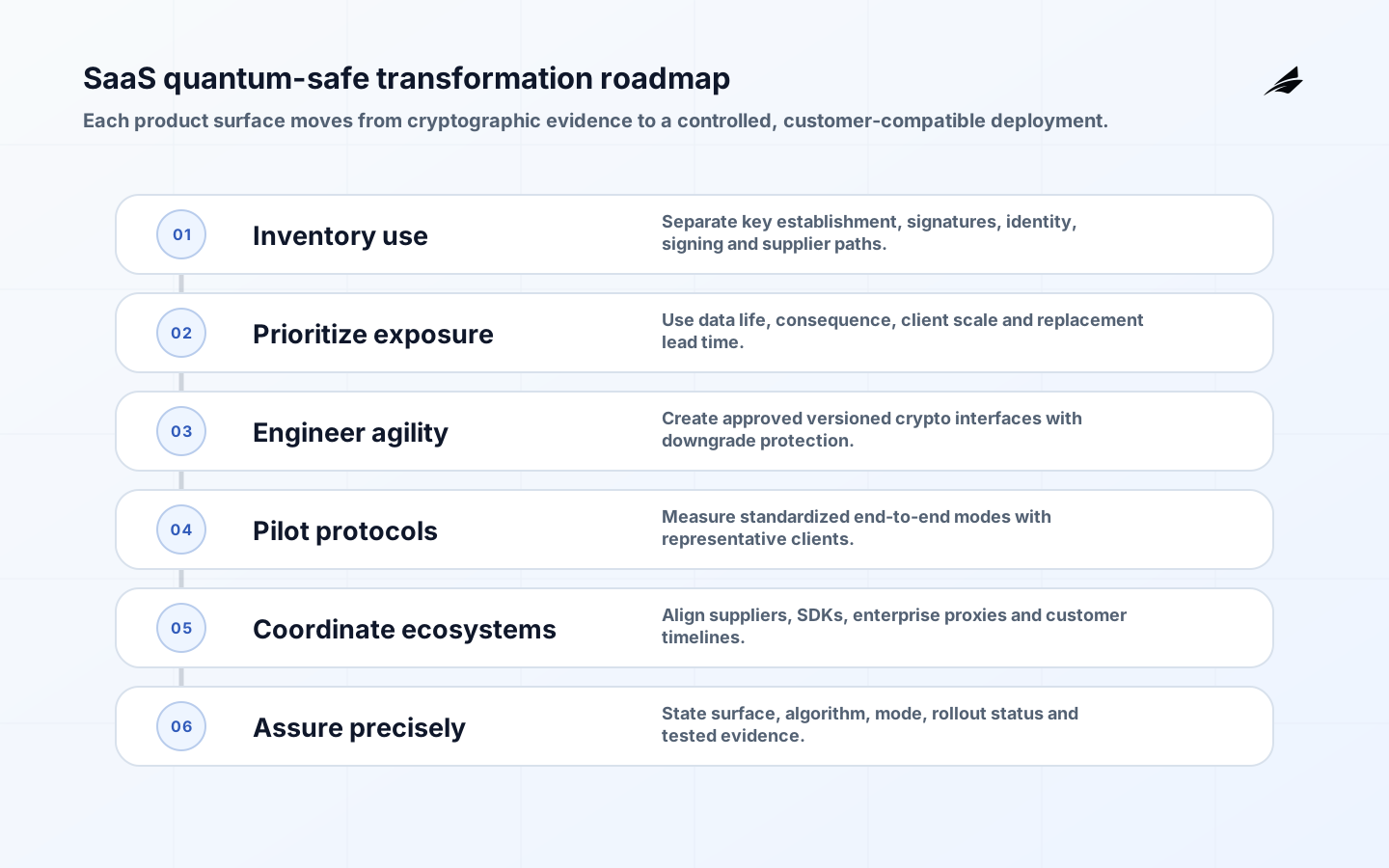
Quantum-safe transformation for SaaS companies is a multi-year product and operating change that replaces quantum-vulnerable public-key cryptography while preserving customer access, integrations and trust. It is not a single TLS upgrade. SaaS products depend on public-key mechanisms for browser and API sessions, workload identity, SSO, certificates, code signing, webhooks, mobile applications, backups, documents and supplier connections. Each dependency has a different standards path, owner and interoperability window.
NIST finalized FIPS 203 for ML-KEM, FIPS 204 for ML-DSA and FIPS 205 for SLH-DSA in August 2024 and urges organizations to begin migration. ML-KEM is a key-encapsulation mechanism; ML-DSA and SLH-DSA are digital-signature standards. Choosing an algorithm name is only one step. A SaaS roadmap must discover use, prioritize long-lived data, test protocols and client support, design crypto agility and communicate accurately with customers.
Why should a SaaS company start before a quantum computer exists?
Migration takes time because protocols, products, customers and suppliers change at different rates. Confidential data can also be collected now and decrypted later if a capable quantum computer becomes available during its useful secrecy life. Prioritize data and signatures by consequence and duration rather than predicting a date for such a machine. Long-lived intellectual property, health, financial or government data may require earlier action than short-lived operational telemetry.
There are also ordinary benefits. A cryptographic inventory reveals expired certificates, unsupported libraries, unmanaged keys and brittle coupling. Crypto-agile interfaces reduce the cost of future algorithm changes unrelated to quantum computing. Customer procurement teams increasingly ask for roadmaps and supplier dependencies. Answer with current scope, standards and tested milestones; do not claim that the whole product is “quantum proof” because one endpoint negotiated an experimental mechanism.
| SaaS use | Quantum concern | Migration dependency |
|---|---|---|
| TLS and APIs | Public-key establishment and authentication | Browsers, clients, gateways and certificates |
| SSO and tokens | Identity-provider and signature support | IdP, libraries and customer federation |
| Code signing | Long-lived release trust | Build, verifier, device and update ecosystem |
| Workload identity | Certificates and service authentication | Mesh, cloud and runtime support |
| Customer exports | Long-term signatures or encryption | Format, recipient and retention |
| Supplier SaaS | Opaque cryptographic implementation | Contract, roadmap and replacement |
What should discovery and prioritization cover?
Build a cryptographic inventory that records purpose, algorithm, protocol, implementation, key path, data life, external party, service owner and evidence. Combine code, configuration, certificate, network, cloud, HSM, build and supplier sources. Include dormant recovery, regional and mobile paths. Confirm automated findings with owners. A dependency map matters as much as a primitive list because migration succeeds only when communicating parties and verification systems support the chosen mode.
Prioritize by confidentiality life, signature validity, external exposure, customer concentration, replacement lead time and rollback difficulty. Separate key establishment from signatures. Group records into use cases such as edge TLS, service identity, software signing and enterprise federation. Set a target state and pilot for each group. Some uses may move through standardized hybrid configurations; others must wait for ecosystem support while improving inventory, lifecycle and agility.
How should the product be prepared for algorithm change?
Place cryptographic choices behind owned, versioned interfaces rather than scattering direct library calls through business code. Keep algorithm and parameter policy separate from tenant data and workflow. Support multiple approved modes during transition, but make the active mode visible in telemetry and evidence. Design certificate, key and trust-store rotation without downtime. Preserve enough metadata to verify older signatures and decrypt retained data under authorized recovery procedures.
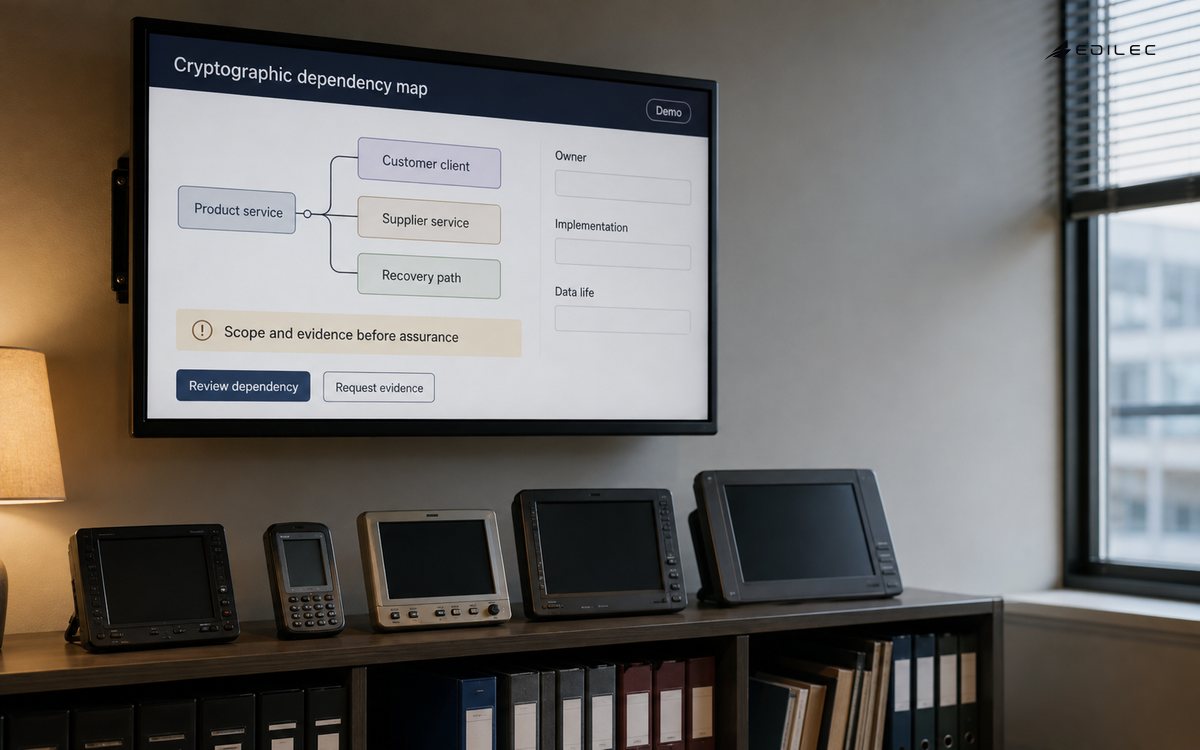
Crypto agility does not mean accepting arbitrary algorithms at runtime. NIST CSWP 39 describes organizational and technical capabilities for replacing mechanisms while maintaining operations. Approved suites, downgrade protection, configuration authority and testing remain essential. Review message and certificate size, handshake behavior, memory, CPU, latency, connection limits and middleboxes. Test clients at real network conditions. A functionally correct library benchmark does not prove end-to-end SaaS readiness.
What makes a useful PQC pilot?
Select a bounded production-like path with clear value and recoverability, such as internal service communication or a controlled API client. State the question: compatibility, performance, certificate handling, operational visibility or rollout. Use standardized algorithms and supported protocol implementations. Capture baseline and changed results for latency, payload, CPU, memory, failure, observability and support effort. Exercise mixed client versions, rollback and expired or invalid credentials.
Do not expose customers to silent experiments. Use explicit cohorts and document the security mode. A hybrid approach combines classical and post-quantum mechanisms so security can remain if one component is sound, but only when the protocol composition is defined and implemented correctly. Ad hoc concatenation can create vulnerabilities and interoperability failures. Feed pilot findings into architecture and supplier requirements rather than treating the demonstration as migration completion.
| Program gate | Required evidence | Stop condition |
|---|---|---|
| Inventory | Owned use cases and dependency coverage | Material services remain unknown |
| Priority | Data life and migration sequence approved | Order follows publicity, not risk |
| Architecture | Versioned crypto interface and mode visibility | Algorithm is hard-coded across product |
| Pilot | End-to-end compatibility and performance results | Only library benchmark exists |
| Rollout | Cohort, rollback and support plan | Mixed clients fail unpredictably |
| Assurance | Customer claim maps to deployed evidence | Marketing exceeds tested scope |
How should suppliers and customers be managed?
Ask cloud, identity, CDN, HSM, database, observability, payment and security suppliers where public-key cryptography is used, which NIST standards and protocols they support, how mode is configured and observed, and what timeline applies to each region and product tier. Contract for timely security updates and material dependency changes. Maintain an alternative or compensating plan for critical suppliers whose roadmap does not meet the product’s need.
Customer communication should distinguish availability, preview, default and enforced states. State which surfaces are covered and whether customer software must change. Provide test environments, compatibility matrices and migration dates with enough notice. Enterprise customers may need evidence for their own inventories. Offer stable documentation and machine-readable configuration where possible. Avoid promising permanent security or a universal completion date while standards and ecosystems continue to evolve.
How is the transformation governed?
Assign executive sponsorship, a cryptography program owner and technical owners for each use case. Integrate migration work with architecture, product, infrastructure, security, procurement and customer success. Track inventory coverage, long-lived data exposure, supplier readiness, pilot results, migrated traffic or signatures, rollback tests and expired exceptions. Review standards and product support on a scheduled cadence; do not let every team independently interpret algorithm status.
Keep current security strong during transition. Patch libraries, rotate keys, protect build and identity systems, enforce approved TLS and remove deprecated algorithms. PQC work should not displace vulnerability response or access control. Preserve decision and test evidence for customer and internal assurance. Update disaster recovery so new key, certificate and signature mechanisms remain available during an outage and historical data can still be handled lawfully.
Worked example: migrating an enterprise API edge
A SaaS provider chooses an enterprise API edge as its first controlled migration. Inventory identifies gateway TLS, customer SDKs, certificate automation, web application firewall, observability and two enterprise proxies. The pilot uses a supported standardized hybrid key-establishment mode for opt-in test tenants. Baselines capture handshake size, latency, CPU, connection reuse and failure. Telemetry records the negotiated mode without recording secrets, and support can correlate a client failure with its SDK and proxy version.
Testing discovers that one older proxy rejects the larger handshake and that aggressive packet inspection creates timeouts on a high-latency path. The provider keeps the cohort opt-in, publishes a compatibility note and works with affected customers rather than silently falling back. Rollback is exercised by configuration and leaves certificate automation unchanged. Once support, performance and customer evidence are complete, the product team can decide whether to expand the cohort; the pilot has answered readiness instead of merely proving that two lab endpoints connect.
The same program keeps code signing and SSO as separate migration tracks because their verifiers and validity periods differ. Supplier reviews reveal that one mobile push provider has no public roadmap, so procurement records a dependency risk and an alternative. Customer statements name the API surface and preview state precisely. This prevents a successful edge pilot from becoming an unsupported claim about the entire SaaS product.
Each expanded cohort must reproduce compatibility, rollback and support evidence. A feature flag alone is not assurance if teams cannot tell which sessions used the intended cryptographic mode.
Key takeaways
- Start with cryptographic purpose, data life and dependency inventory.
- Separate key-establishment and signature migration paths.
- Build controlled crypto agility with visible approved modes.
- Pilot standardized end-to-end protocols under real client conditions.
- Make supplier roadmaps and customer compatibility part of product governance.
Frequently asked questions
Which NIST algorithms are final?
FIPS 203 specifies ML-KEM for key encapsulation. FIPS 204 specifies ML-DSA and FIPS 205 specifies SLH-DSA for digital signatures. Use current NIST guidance and protocol standards for deployment.
Does a SaaS company need QKD?
Usually not for general product traffic. QKD requires specialized physical infrastructure and fixed links. PQC is the broadly deployable software migration path; QKD may fit a small number of specialized connections.
Do existing certificates need immediate replacement?
Plan migration according to protocol, certificate ecosystem, data life and risk. Do not make an unsupported emergency change. Inventory use, follow standards and vendor support, test interoperability and maintain current certificate hygiene.
Conclusion
SaaS quantum-safe transformation is a disciplined product migration, not a slogan. Inventory real cryptographic uses, prioritize durable risk, decouple algorithms, test standardized protocols and coordinate suppliers and customers. Teams that can prove the active mode and recover from change will be ready for PQC adoption and better prepared for the cryptographic transitions that follow.