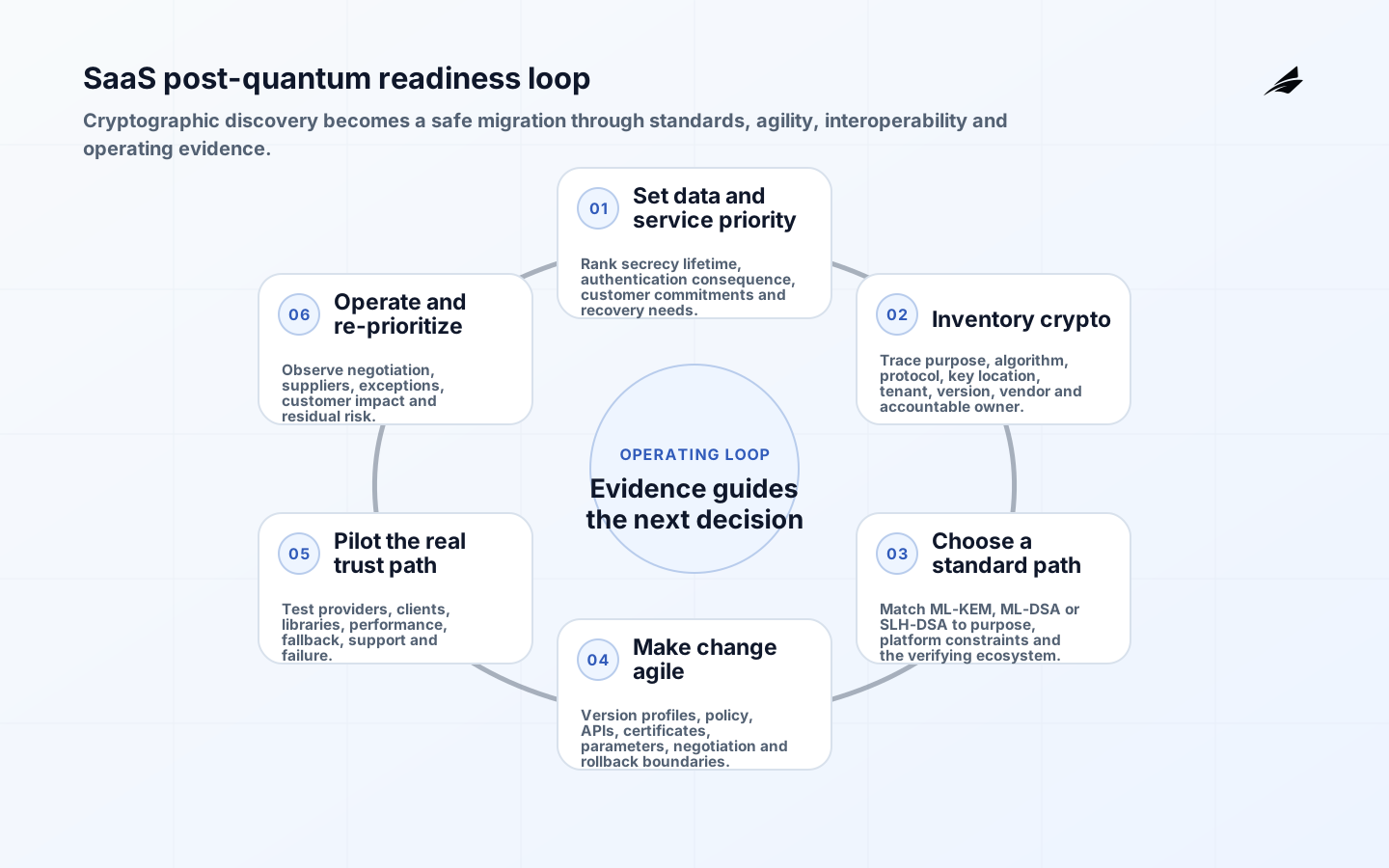
Post-quantum cryptography readiness for SaaS is a dependency-management program, not a one-time library upgrade. A SaaS product may use public-key cryptography in transport, certificates, service identity, customer federation, code signing, key wrapping, backups, archives, tokens and vendor integrations. The product owner must know which use protects confidentiality, which authenticates a signer, how long the protected data must remain private and who can change the implementation when a protocol or algorithm moves.
Start with the SaaS PQC scope and delivery plan for investment and sequencing, use the SaaS PQC FAQ for stakeholder questions, and connect implementation work to the crypto agility roadmap and cryptographic inventory checklist. This checklist focuses on the evidence a SaaS team needs to migrate without breaking tenants, integrations or long-lived records.
The standards baseline is now concrete. NIST's PQC project identifies FIPS 203 for ML-KEM key establishment, FIPS 204 for ML-DSA signatures and FIPS 205 for SLH-DSA signatures as the principal standards released in 2024. The joint CISA, NSA and NIST quantum-readiness guidance urges organizations to inventory vulnerable cryptography, assess risk, create a roadmap and engage suppliers. The correct starting point is therefore discovery and prioritization, not an untested algorithm swap.
Begin with data lifetime and service authority
Choose the service, tenant journey or trust relationship that will anchor readiness work. Record the users, data classes, customer commitments, regulatory obligations, retention period, secrecy lifetime and consequence of an authentication or integrity failure. A public web session, a signed software update, a ten-year archive and a customer-managed key exchange may all use public-key cryptography but deserve different urgency and test depth. Make a non-PQC fallback explicit for each critical journey while the migration is being designed.
Assign authority before technical discovery. The product owner sets service and customer priorities; security defines risk and control requirements; platform teams own shared cryptographic services; application teams own use-specific integration; procurement owns supplier evidence; and operations owns change, observation and recovery. A migration item without an accountable owner becomes a spreadsheet entry that survives every planning cycle. Track unknowns with a due date and evidence request rather than silently classifying them as low risk.
| Inventory field | Question to answer | Accountable role |
|---|---|---|
| Purpose | Does the use establish keys, sign, verify, encrypt, authenticate or protect a record? | Application or platform owner |
| Algorithm and protocol | Which implementation, parameter, certificate profile and negotiation path are active? | Security architecture |
| Protected value | What data or authority is exposed if the use is broken or unavailable? | Business and data owner |
| Dependency and lifecycle | Which library, HSM, provider, device, customer or vendor controls replacement? | Service owner and procurement |
| Change evidence | Can the team test, release, observe and reverse the cryptographic change? | Operations and release owner |
Build a cryptographic inventory that can be queried
Discovery should combine code, configuration, runtime traffic, certificates, key stores, build artifacts, infrastructure, archived data and supplier statements. Search for algorithms and libraries, but do not confuse a string match with a complete use record. Capture where a key is generated, stored, rotated, authorized, backed up and destroyed; which protocol negotiates it; and whether a customer or external partner controls one side. Include signing of containers, firmware, packages, identity metadata and long-lived documents, not only TLS termination.
Make the inventory useful to delivery teams. It should answer which tenants, regions, products, versions, vendors and data sets a change will affect. Link each use to an owner, risk tier, replacement candidate, interoperability constraint, test environment and target window. The NIST migration project describes discovery and prioritization as part of migration, while the joint factsheet calls out harvest-now-decrypt-later risk for information whose secrecy lasts beyond today. Keep that risk separate from the probability of a cryptographically relevant quantum computer arriving on a particular date.
Match use cases to NIST's first standards

Use standards by cryptographic purpose. FIPS 203 defines ML-KEM, a key-encapsulation mechanism for establishing a shared secret over a public channel, with ML-KEM-512, ML-KEM-768 and ML-KEM-1024 parameter sets. It is not a drop-in replacement for every certificate, protocol or key-management interface. Test message sizes, negotiation, middleboxes, latency, memory, hardware support, logging and failure behavior in the actual service path.
For signatures, FIPS 204 specifies ML-DSA for generating and verifying digital signatures, while FIPS 205 specifies the stateless hash-based SLH-DSA algorithm. The choice depends on signature size, verification cost, platform constraints, assurance needs and the ecosystem that must verify the result. Do not select a scheme from a benchmark alone; an update service fails if a bootloader, package verifier, certificate chain or customer SDK cannot consume the chosen representation.
| Standard | Primary SaaS use | Decision and test focus |
|---|---|---|
| ML-KEM, FIPS 203 | Key establishment for protected communications or wrapped secrets | Protocol support, parameter choice, size, latency and fallback |
| ML-DSA, FIPS 204 | General digital signatures for identity, artifacts or records | Certificate ecosystem, signature size, verification and key custody |
| SLH-DSA, FIPS 205 | Stateless hash-based signatures for suitable assurance or diversity needs | Signature size, performance, interoperability and operational fit |
| Hybrid transition | A staged protocol or product path while dependencies catch up | Exact composition, downgrade resistance and exit criteria |
Design crypto agility into SaaS boundaries
NIST defines crypto agility as the capability to replace and adapt algorithms in protocols, applications, hardware, firmware and infrastructure while preserving security and ongoing operations. Its CSWP 39 update treats agility as an engineering and operational problem, not merely an abstraction in code. Centralize policy without centralizing every key. Separate algorithm choice from business logic, version cryptographic profiles, expose supported combinations, and ensure that a service can reject an unsafe or unknown option rather than silently negotiating the weakest common path.
Useful boundaries include a reviewed cryptographic API, certificate and key-management service, typed protocol profile, dependency policy, tenant capability record and release gate. Keep algorithm identifiers and parameter sets in configuration that is versioned and observable. Protect migration metadata because it can reveal high-value trust relationships. Test rotation, revocation, compromise, expiry, rollback, partial rollout and customer opt-out. Agility is not permission to change cryptography casually; it is the ability to make a governed change without rewriting the entire service under pressure.
Pilot protocols, certificates, libraries and vendors
Select a pilot that exercises a real trust path, such as service-to-service TLS, customer federation, artifact signing or backup encryption. Include one internal client, one external dependency and one representative customer configuration. Measure handshake time, payload and certificate sizes, CPU and memory, connection failure, retries, observability, policy enforcement and support workflow. Test a mixed fleet only when the protocol and security properties are understood; a hybrid label by itself does not prove downgrade resistance or compatibility.
Supplier readiness is a technical dependency. Ask cloud platforms, HSM providers, certificate authorities, operating-system vendors, database vendors, identity providers and customer-installed agents for supported standards, implementation versions, validation status, planned dates, compatibility limits and migration evidence. A roadmap without a test build is a planning input, not an acceptance result. Keep a decision log for unsupported components, compensating controls, target replacement and the owner responsible for rechecking the supplier.
Operate evidence across tenants and releases
After migration, monitor what the product actually negotiates and verifies. Record algorithm, parameter, protocol, peer capability, certificate or key version, failure reason and service release without logging secret material. Alert on unexpected fallback, expired trust, unsupported clients, rising handshake failures, a signature-verification error or a tenant that has not completed a required capability change. Correlate cryptographic events with user impact so an operations team can distinguish a harmless compatibility probe from a production outage.
NIST's current project page says organizations should begin applying the first PQC standards now and describes a transition in which quantum-vulnerable algorithms are deprecated and ultimately removed from NIST standards by 2035, with high-risk systems moving earlier. Treat that direction as a planning constraint, not a date that makes every SaaS product identical. Reassess inventory, supplier progress, customer commitments, threat information, performance and residual risk on a recurring cadence, then update the roadmap and evidence rather than freezing a one-time migration plan.
Key takeaways for SaaS PQC readiness
- Start with data secrecy lifetime, authentication consequence, customer commitments and accountable service owners.
- Build a queryable inventory that connects algorithm use to code, configuration, keys, protocols, tenants, vendors and records.
- Map ML-KEM, ML-DSA and SLH-DSA to purpose and ecosystem constraints; do not choose from names or benchmarks alone.
- Make algorithm and parameter changes versioned, observable, testable and reversible where the service permits.
- Pilot an actual trust path with mixed dependencies, customer behavior, support and failure evidence.
- Keep supplier roadmaps, negotiated behavior, exceptions and residual risk current after the first migration.
Frequently asked questions
What does post-quantum cryptography readiness mean for a SaaS company? It means the company can identify vulnerable cryptographic use, prioritize it by data and business risk, test replacements, change algorithms safely and maintain evidence across its product and suppliers.
Should a SaaS team replace every RSA or elliptic-curve use immediately? Not as a blind bulk change. Inventory the purpose and dependency first, then use risk, data lifetime, interoperability, provider support and migration evidence to sequence work.
What is crypto agility in practical terms? It is the ability to adapt cryptographic algorithms and parameters in protocols, applications, hardware, firmware and infrastructure without losing security or interrupting the service.
How should SaaS providers involve customers? Publish a roadmap, supported algorithms and protocol combinations, compatibility assumptions, testing windows, customer actions, evidence and a route for exceptions or rollback.
Conclusion
A SaaS post-quantum program is ready when its owners can explain where public-key cryptography is used, why each use matters, what will replace it, which dependencies must move and how a failed change will be contained. Inventory turns an abstract future threat into accountable work. Standards, crypto agility, supplier evidence and observable pilots then turn that work into a migration a SaaS product can sustain across tenants, releases and the long life of the data it protects.