Quantum-safe transformation is the multi-year work of finding where quantum-vulnerable public-key cryptography protects data and systems, prioritizing the exposure, and migrating to suitable post-quantum cryptography as standards, protocols and products mature. Business teams should begin planning without pretending to know the date of a cryptographically relevant quantum computer. The case rests on long migration lead times, long-lived secrets, supplier dependence and the need to replace embedded cryptographic assumptions safely.
Use this guide to frame governance and investment, then apply the quantum-safe implementation checklist and quantum-safe transformation FAQ to delivery decisions. The program needs business service and data owners, enterprise and security architects, cryptography and PKI specialists, application and infrastructure teams, procurement, legal and risk roles, plus suppliers that control protocols, devices or managed services.
Understand what quantum safe means
Large fault-tolerant quantum computers would threaten widely used public-key mechanisms based on integer factorization and discrete logarithms, affecting key establishment and digital signatures. Symmetric cryptography is affected differently and is not replaced by the same migration. Scope should therefore begin with cryptographic purpose and implementation rather than a blanket search for encryption. Identify confidentiality, authentication, code signing, certificate, firmware, identity and integrity uses.
NIST finalized three principal PQC standards in August 2024: FIPS 203 for ML-KEM key encapsulation, FIPS 204 for ML-DSA signatures and FIPS 205 for SLH-DSA signatures, as described by the NIST Post-Quantum Cryptography project. An algorithm standard is a foundation, not an instruction to substitute code blindly. Products, protocols, certificate ecosystems, hardware, performance and interoperability also need readiness and validation.
Frame the business risk without speculative dates
Prioritize information whose required secrecy lifetime extends beyond a plausible migration window. An adversary may capture encrypted traffic now and attempt decryption later, so future capability can create present exposure for long-lived state secrets, health records, intellectual property, negotiations or critical infrastructure information. Signatures and roots of trust create another concern: devices, firmware and documents may need authentic verification for many years after deployment.
Create risk scenarios using data value, secrecy or authenticity lifetime, cryptographic dependency, exposure, system replacement cycle and migration complexity. Do not assign a precise probability to a quantum breakthrough merely to force a calculation. Use ranges, external guidance and risk tolerance. Existing cryptographic weaknesses, expired certificates, unsupported algorithms, unmanaged keys and unknown ownership still require immediate treatment; quantum planning should not displace basic cryptographic hygiene.
| Prioritization factor | Evidence question | Risk implication |
|---|---|---|
| Data lifetime | How long must confidentiality or authenticity hold? | Long-lived value raises early priority |
| Exposure | Can protected traffic or artifacts be collected today? | Harvest-now risk may already exist |
| System life | Will devices or infrastructure remain beyond migration targets? | Refresh decisions must include PQC capability |
| Crypto role | Is the dependency key exchange, signature, certificate or root of trust? | Migration patterns and failure effects differ |
| Supplier control | Who can change the protocol, firmware, service or library? | Roadmap depends on external readiness |
| Agility | Can algorithms and parameters change without system replacement? | Low agility increases time and cost |
Build a cryptographic inventory linked to services
Inventory certificates, keys, algorithms, protocols, libraries, modules, hardware security devices, firmware, code-signing systems, PKI, VPN, TLS, SSH, email protection, identity federation, backups, archives, databases, applications and third-party services. Record algorithm and parameter, purpose, location, owner, data or service, supplier, expiration, replacement path and evidence confidence. Link technical findings to business services so prioritization reflects impact.
Discovery needs several methods: configuration and code analysis, network observation, certificate repositories, cloud and key-management inventories, software composition data, architecture records, procurement information, interviews and supplier attestations. The NCSC's next steps for post-quantum preparation helps system and risk owners begin planning. No single scanner sees embedded devices, dormant archives, proprietary protocols and managed-service internals. Track blind spots and confidence rather than presenting false completeness.
Engage suppliers and standards ecosystems
Ask vendors which products and versions use quantum-vulnerable public-key cryptography, which NIST-standard algorithms they plan to support, whether deployment will be hybrid or post-quantum only, what protocol standards and validations they depend on, and how performance and interoperability are tested. Request dated roadmaps, supported upgrade paths, hardware constraints, API changes, fallback behavior and evidence. Contract renewals and hardware refreshes are opportunities to require crypto agility and exportable inventories.
Treat vague quantum-safe marketing cautiously. Determine whether a claim refers to standardized PQC, an experimental algorithm, symmetric controls, quantum key distribution or a proprietary scheme. The NSA post-quantum resources distinguish post-quantum algorithm guidance for National Security Systems from quantum key distribution, which NSA does not generally recommend for those systems unless stated limitations are overcome. Follow the requirements of your sector and jurisdiction.
Design for cryptographic agility and coexistence
Cryptographic agility is the ability to identify, replace and manage algorithms, parameters, protocols, keys and implementations without unacceptable disruption. Centralize policy and inventory where practical, use supported libraries and modules, separate cryptographic choices from business logic, automate certificate and key lifecycle, version protocol negotiation, and avoid hard-coded assumptions. Agility itself needs authorization, testing and downgrade protection; easy change without control can weaken security.
Migration may require traditional and PQC mechanisms to coexist while clients, servers and infrastructure upgrade. Hybrid mechanisms can reduce dependence on one algorithm family during transition, but they add message size, computation, complexity and interoperability considerations. Do not invent combinations. Use standardized protocol profiles and validated implementations appropriate to the environment when available. Define when legacy support can end and prevent silent downgrade from becoming permanent.
Run a six-stage quantum-safe migration roadmap
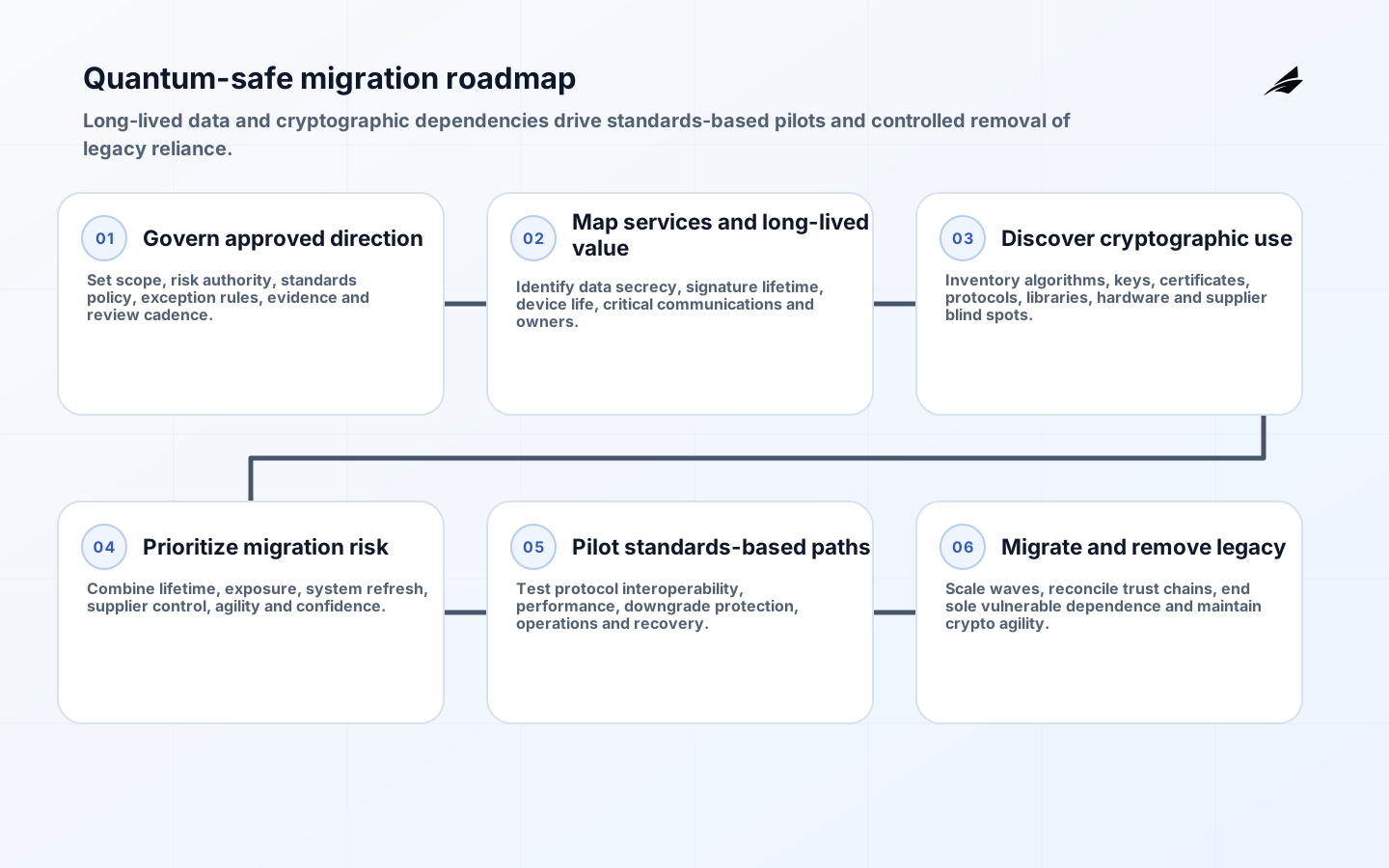
Sequence the program through governance, service and data mapping, cryptographic discovery, risk prioritization, controlled pilots, and migration waves with legacy removal. Governance defines scope, authority and accepted standards. Discovery creates an evidence backlog rather than waiting for a perfect inventory. Pilots should test representative protocols and constrained services in non-production or limited exposure before broad change. Every wave needs compatibility, performance, security, recovery and business acceptance.

The UK NCSC's PQC migration timeline recommends completing discovery and an initial plan by 2028, highest-priority migration and refined planning by 2031, and migration by 2035 for its intended audience. These are useful planning milestones, not universal law. Organizations should apply applicable government, regulator and sector direction, prioritizing long-lived information and systems with slow hardware or supplier cycles.
Pilot interoperability, performance and recovery
Choose pilots that answer real uncertainties: a service-to-service TLS path, code-signing chain, VPN, device update, certificate authority or document-signature workflow. Establish baseline latency, throughput, memory, packet and certificate size, handshake behavior, hardware use and operational effort. Test mixed clients, proxies, inspection tools, load balancers, observability, backup and disaster recovery. Larger keys, signatures or messages may expose limits in protocols and infrastructure that algorithm-level benchmarks miss.
Exercise failed negotiation, unsupported client, expired certificate, interrupted update, rollback, key compromise and emergency algorithm change. Preserve traceability to implementation and configuration versions. Independent cryptographic review and recognized validation may be needed for high-assurance environments. A successful lab connection does not establish production readiness until monitoring, support, supplier escalation, capacity, fallback and business continuity have passed.
Estimate investment and schedule by dependency
Cost includes program governance, discovery tools, specialist review, inventory maintenance, library and platform upgrades, certificates and PKI, hardware security modules, device replacement, protocol work, supplier premiums, testing, performance capacity, parallel operation, training and legacy retirement. Estimate by service and dependency chain. Long-lived operational technology and embedded devices may need procurement decisions years before a software-only service.
Align quantum-safe changes with planned certificate, network, operating system, device and cloud refreshes where risk permits. This can lower disruption and prevent buying equipment that becomes a migration blocker. Reserve contingency for evolving protocols and supplier dates. The joint CISA, NSA and NIST quantum-readiness factsheet urges roadmaps, inventories, risk analysis and vendor engagement, all of which need funded owners.
| Workstream | Cost driver | Schedule dependency |
|---|---|---|
| Discovery | Tools, interviews and specialist analysis | Estate access and inventory quality |
| PKI and identity | Certificate, directory and trust-chain change | Protocol and relying-party support |
| Applications | Library, code, test and deployment work | Supported runtime and release windows |
| Hardware and devices | Firmware, roots of trust and replacement | Procurement and physical lifecycle |
| Managed services | Supplier upgrade and contract change | Provider roadmap and export options |
| Transition | Hybrid operation, capacity and support | Interoperability and legacy retirement |
Govern standards, exceptions and migration evidence
Create an approved cryptographic policy that names allowed standards and profiles, prohibited custom schemes, validation needs, exception authority and review cadence. Maintain a risk register linked to services and procurement. Architecture and security governance should review new systems for crypto agility and suppliers for roadmap evidence. Avoid freezing an early experimental choice across the estate; standards and protocol guidance continue to evolve.
Track inventory coverage, priority services with plans, supplier responses, pilot results, migrated dependencies, remaining sole dependence on vulnerable public-key mechanisms and retired legacy support. Report confidence and blockers, not just percentages. Keep evidence of interoperability, performance, configuration, approval and recovery. Review after standards, threats, regulatory direction, supplier releases and major architecture changes.
Quantum-safe transformation takeaways
- Plan from data lifetime and migration lead time, not a predicted quantum date.
- Inventory cryptography by purpose and link it to business services.
- Use finalized standards and supported protocol profiles, not proprietary claims.
- Contract for supplier roadmaps, crypto agility and upgrade evidence.
- Pilot interoperability, performance, downgrade and recovery before scale.
- Remove sole legacy dependence after controlled migration and acceptance.
Frequently asked questions
Do quantum-safe systems require a quantum computer? No. Post-quantum algorithms run on conventional systems, subject to implementation support and performance. Should organizations replace all cryptography now? No. Inventory and prioritize public-key dependencies, use approved standards and follow ecosystem readiness. Is AES obsolete? The migration concern differs for symmetric cryptography; apply authoritative parameter guidance rather than treating all algorithms alike. Is buying a quantum-safe product enough? No. Protocol, configuration, interoperability, operations and the complete trust chain matter.
What should a small organization do first? Identify long-lived sensitive data, critical suppliers and public-key dependencies, then ask providers for roadmaps. Does hybrid cryptography solve migration permanently? It can support transition but adds complexity and needs standardized design and an end state. How complete must inventory be before planning? Start with highest-impact services while improving coverage and confidence. Who owns the program? An accountable risk leader supported by security architecture, service, data, procurement and technology owners.
Conclusion
Quantum-safe transformation is a disciplined cryptographic migration, not a wager on a date. Find where public-key mechanisms protect long-lived value, understand supplier and hardware constraints, build agility and test standards-based implementations in real protocol paths. Plan waves around business impact and ecosystem maturity, with evidence and recovery at every gate. Starting discovery and vendor engagement now gives organizations the time needed to migrate without rushed, proprietary or disruptive choices.