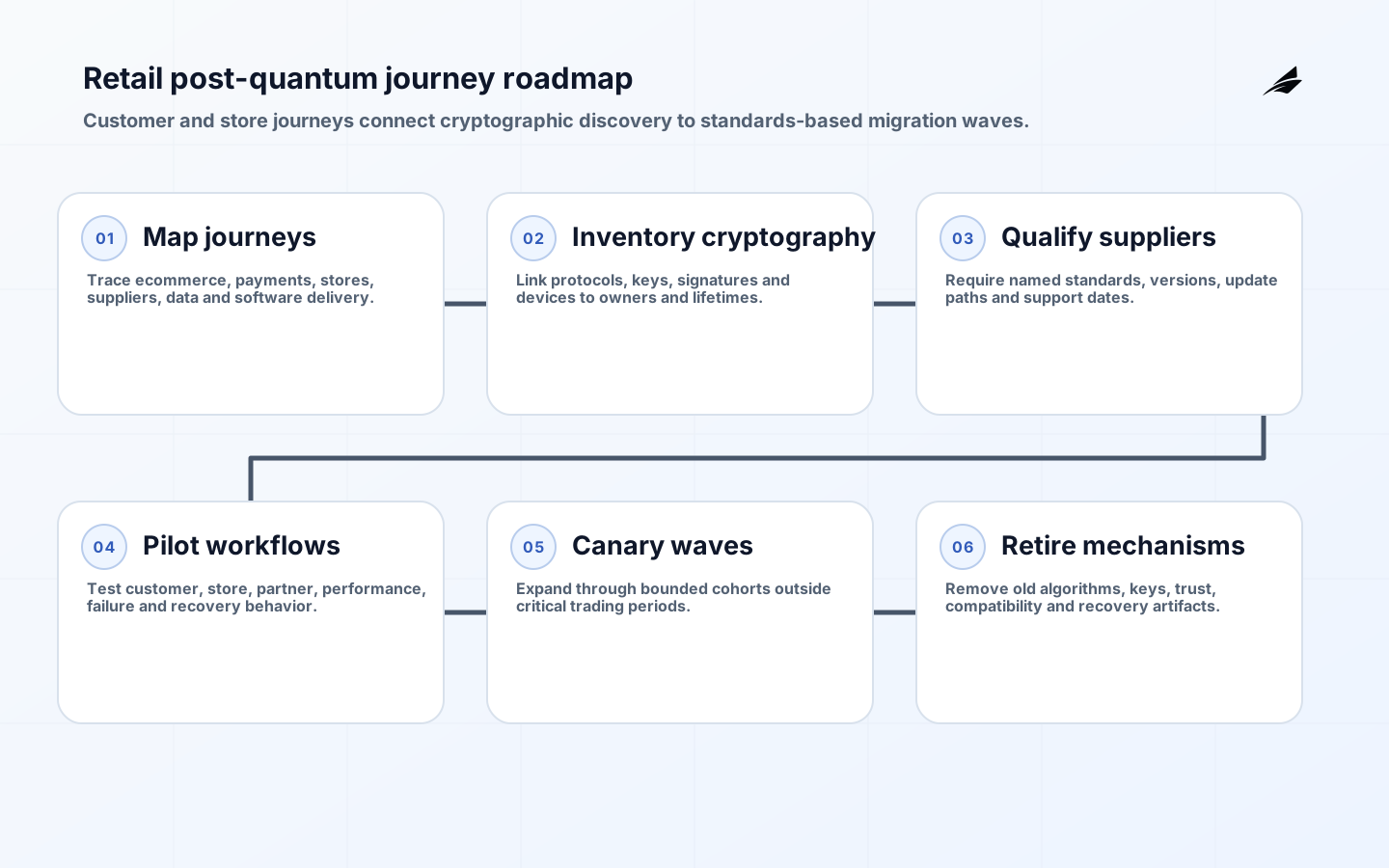
Quantum-safe transformation for retail is a cryptographic migration across a distributed business estate, not a replacement of website certificates alone. Retailers depend on ecommerce, payment services, loyalty systems, mobile apps, stores, warehouses, suppliers, identity providers, code signing, remote support and long-lived devices. Public-key cryptography can be embedded in each. Some customer and commercial data may remain sensitive long enough to justify early priority, while store equipment and partner interfaces can take years to replace.
CISA, NSA and NIST recommend cryptographic inventory and a quantum-readiness roadmap, and NIST has standardized post-quantum key-establishment and signature algorithms. Retail planning must also preserve existing payment-security obligations and supplier interoperability. The practical objective is crypto agility: the ability to transition approved cryptography while maintaining sales, fulfillment, evidence and recovery. This checklist organizes the work around customer journeys and estate constraints rather than a product purchase.
Map retail journeys and cryptographic dependencies
Begin with end-to-end journeys: customer login, checkout, payment authorization, refunds, loyalty redemption, inventory updates, supplier orders, store opening, device management and software deployment. For each, map external connections, certificates, signing, encryption, keys, devices and retained records. Include disaster recovery and offline store behavior. A certificate scan will not reveal cryptography in payment terminals, signed mobile applications, firmware updates, message payloads or partner file exchanges.
Connect technical findings to business attributes: transaction criticality, confidentiality lifetime, artifact validation lifetime, outage tolerance, geographic footprint, supplier and replacement lead time. Prioritize long-lived sensitive data, public endpoints, signing roots and devices that cannot be updated remotely. Keep cardholder-data environment boundaries visible. A PQC change does not remove PCI DSS responsibilities for strong cryptography, key management, access, logging and testing.
| Retail domain | Cryptographic uses to inspect | Migration constraint |
|---|---|---|
| Digital commerce | TLS, identity, API, tokens and application signing | High traffic and many external dependencies |
| Payments | Terminal, gateway, PIN, HSM and processor connections | PCI scope and certified supplier ecosystem |
| Stores | Wi-Fi, VPN, device identity, updates and local services | Large fleet and intermittent connectivity |
| Supply chain | B2B APIs, files, signatures and certificates | Partner coordination and contractual formats |
| Customer data | Field encryption, backups, exports and analytics | Confidentiality lifetime and deletion obligations |
| Software delivery | Code, container, firmware and update signatures | Long verification life and root-of-trust replacement |
Create an owner-linked cryptographic inventory
Collect endpoint scans, certificate and key records, source dependencies, API specifications, HSM configuration, device models, mobile signing, supplier attestations and procurement contracts. Record algorithm, purpose, protocol, key size, library, hardware, owner, supplier, update route and last verification. Track relationships between a customer journey and its cryptographic components. That graph makes it possible to identify one library or certificate authority used by hundreds of stores and to see which services depend on a partner’s migration.
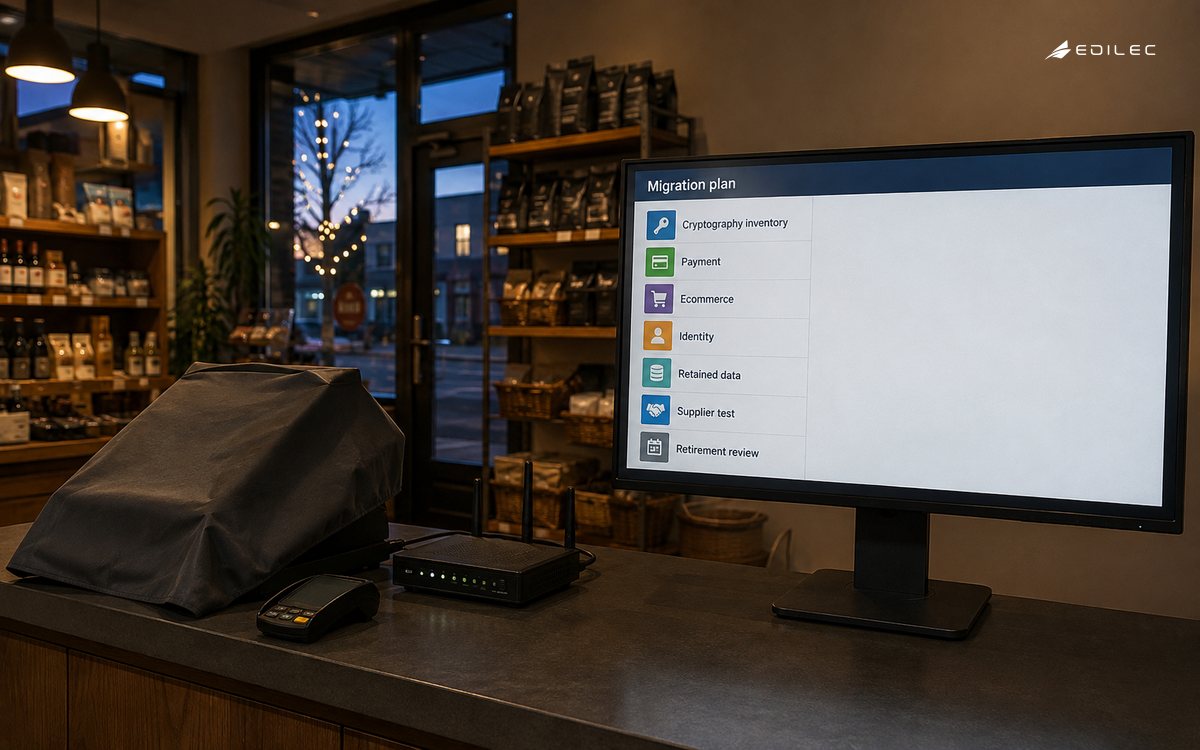
Ask suppliers for supported NIST standards, product versions, hybrid or coexistence behavior, performance evidence, certification plans and end-of-support dates. Contractual language should require a cryptographic bill of materials or equivalent disclosure, timely vulnerability notice and tested update path. Do not accept “quantum ready” without mechanism and version detail. Validate claims in representative environments because packet size, latency, constrained hardware and intermediary compatibility can affect retail availability.
Design a standards-based target architecture
Use supported cryptographic libraries and services that can change algorithms through policy and versioned interfaces. Keep application logic independent from key and algorithm construction. Protect keys in approved platforms, separate duties and make algorithm use observable. Formats for encrypted or signed data need identifiers and versioning so old and new material can coexist during a wave. Define negotiation and downgrade policy explicitly; compatibility must not allow an attacker or stale device to force a prohibited mechanism.
Segment the migration by function. Internet key establishment, internal service identity, document signatures, software updates and payment equipment may use different products and timelines. Pilot NIST-standardized algorithms through supported implementations rather than inventing combinations. Where hybrid modes are used, follow vendor and standards guidance and test both components. Preserve recovery capability: replacement keys, trust anchors, offline images and store failover must move with the production design.
Pilot complete customer and store workflows
Choose pilots that expose different constraints without risking a peak sales event: an internal API path, a customer-facing edge in a canary region, one signing workflow and a controlled device group. Test handshake and transaction latency, CPU, memory, packet size, HSM throughput, certificate operations, logging and failure recovery. Include browsers, mobile clients, CDN, WAF, API gateway, payment and supplier intermediaries as applicable. A successful component benchmark is not proof that checkout or store opening works.
Exercise mixed fleets and rollback. New clients must interact with old services during the approved transition window, and old clients must fail or fall back only as policy permits. Test certificate rotation, expired trust, unsupported algorithms, clock error, offline stores and restored backups. Ensure support can identify the cryptographic state of an affected store or customer request. Schedule pilots outside freeze periods and define automatic stop criteria for conversion, latency, error or security findings.
Control migration waves and retirement
Group assets by shared technology, business calendar and dependency. Retail change windows should respect seasonal peaks, inventory events and store operations, but long freezes increase exposure and backlog, so prepare and test before the window. Start with canary stores or tenant cohorts, monitor business conversion as well as technical errors, and retain rapid routing to the previous supported path where security policy allows. Coordinate partner cutovers with explicit acknowledgements and reconciliation.
A wave ends when legacy mechanisms are disabled, old keys and trust anchors are removed, recovery assets are updated and the inventory reflects verified state. Exceptions need owner, reason, compensating controls and expiry. Track customer journey coverage, not only server counts. Report long-lead devices and supplier blockers to procurement and risk owners early enough to replace them. Continue monitoring for newly discovered cryptography and assets restored from old images.
| Gate | Retail acceptance evidence | Stop condition |
|---|---|---|
| Inventory | Journey-linked endpoints, devices, keys, signatures and suppliers | Unknown critical path or owner |
| Supplier readiness | Named algorithms, versions, update and support dates | Marketing claim without testable support |
| Pilot | Conversion, latency, interoperability, security and recovery results | Material customer or store degradation |
| Canary | Bounded cohort with real monitoring and support coverage | Error, downgrade or reconciliation breach |
| Expansion | Capacity, partner and seasonal-window approval | Unresolved fleet or dependency gap |
| Retirement | Legacy disabled and recovery assets updated | Compatibility path still in active use |
Retail implementation checklist
Maintain one program backlog that joins security architecture, ecommerce, payments, stores, supply chain, mobile, legal, procurement and business continuity. Review NIST and sector guidance as standards and product support evolve. Measure inventory confidence, migrated journey coverage, unsupported devices, supplier commitments, exception age and legacy use. The program should improve future cryptographic changes as well as deliver PQC; otherwise the next transition will require the same estate discovery again.
- Map customer, payment, store, supplier and software-delivery journeys.
- Inventory protocols, keys, certificates, signatures, devices and recovery assets with owners.
- Prioritize data lifetime, signing lifetime, criticality and replacement lead time.
- Require specific standards, versions, update paths and evidence from suppliers.
- Pilot complete workflows under mixed-fleet, peak, failure and recovery conditions.
- Deploy by canary and season-aware wave, then disable and remove legacy mechanisms.
Create a retail migration control room
For each wave, maintain a live view of stores, channels, devices, suppliers, algorithms, deployment state and business health. Staff it with security architecture, ecommerce, payments, store technology, service operations and vendor contacts. Predefine who can pause deployment, revert a configuration or remove an unsupported client. Monitor sales conversion, authorization, queue age, device connectivity and cryptographic negotiation together so technical success cannot hide customer or operational harm.
After the observation period, reconcile inventory and confirm that every targeted asset reached the intended state. Sample stores and partner exchanges rather than trusting central deployment status alone. Review help-desk and fraud signals for unexpected effects. Capture lessons in reusable deployment, key and certificate procedures. Only then close the wave, revoke temporary access and remove obsolete trust or compatibility configuration.
Key takeaways
- Retail PQC scope spans payments, stores, suppliers, software signing and retained data.
- Prioritize by confidentiality or validation lifetime and replacement lead time, not visibility alone.
- Supplier claims must name standards, versions, update paths and interoperability evidence.
- Pilot complete checkout, store and recovery workflows rather than isolated algorithms.
- Migration completes with legacy retirement and updated disaster-recovery assets.
Frequently asked questions
Does a retailer need to replace payment terminals immediately?
Not solely because PQC standards exist. Inventory models and dependencies, consult payment ecosystem and supplier roadmaps, prioritize unsupported long-lived equipment, and plan replacement through approved standards and PCI obligations.
Is changing website TLS enough for quantum readiness?
No. TLS is one visible dependency. Retailers also rely on code and firmware signatures, device identity, partner exchanges, payment infrastructure, internal services, backups and retained encrypted data.
When should pilots begin?
Begin discovery and supported pilots before mandatory transition dates. Early pilots reveal packet, performance, intermediary, device and supplier constraints while there is still time to change architecture or procurement.
Conclusion
Retail quantum safety depends on disciplined migration of a broad, partner-dependent estate. By linking cryptography to customer journeys, using NIST standards through supported products, testing real store and ecommerce behavior and proving legacy retirement, a retailer can protect long-lived trust without putting daily trade at unnecessary risk.