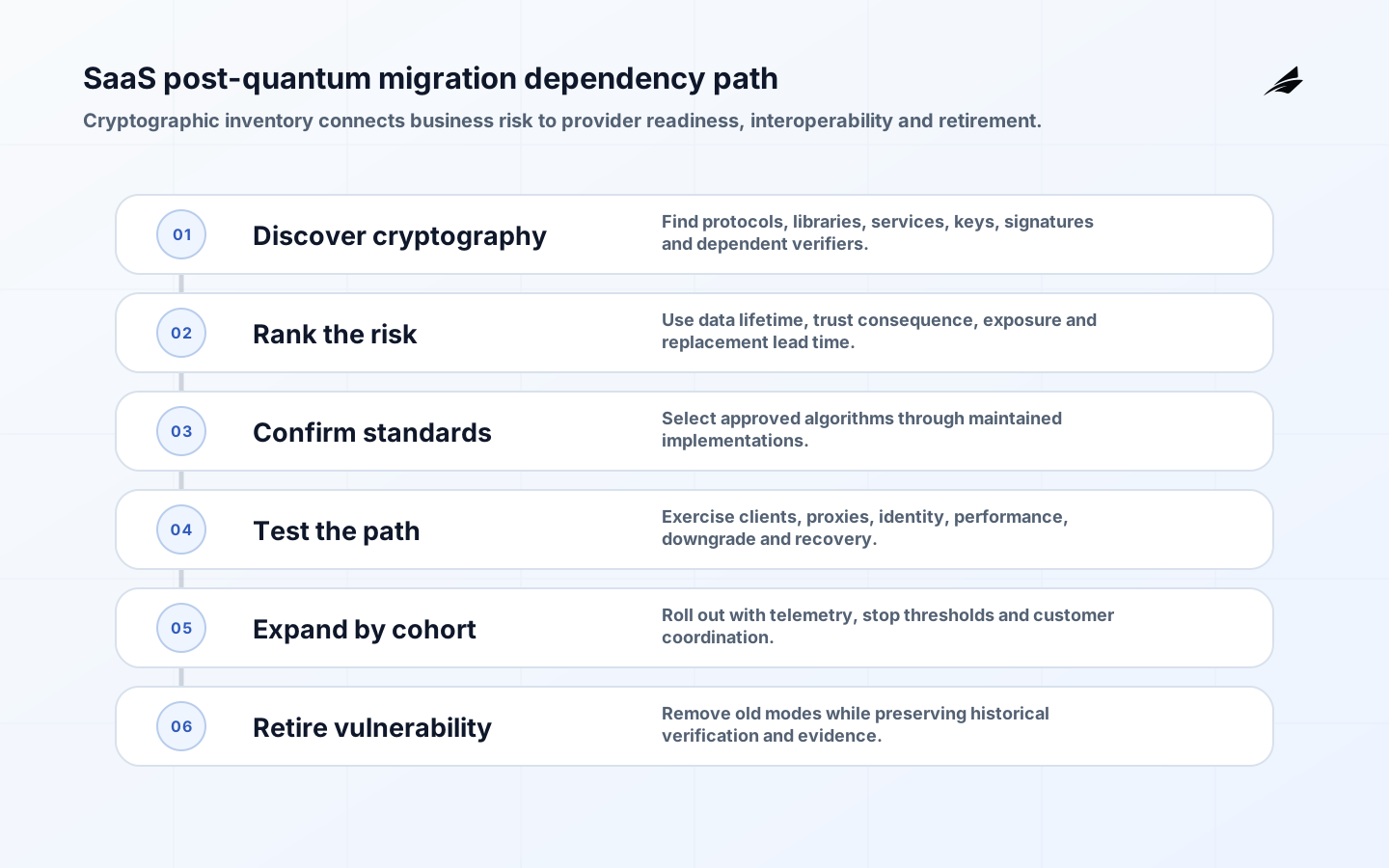
Post-quantum cryptography readiness for a SaaS company begins with knowing where public-key cryptography protects data, identity, software and trust. NIST finalized ML-KEM, ML-DSA and SLH-DSA standards in 2024, but migration is not a global search-and-replace. A SaaS product inherits cryptography from TLS libraries, cloud services, identity providers, certificates, code signing, package ecosystems, databases, backups, customer integrations and devices. Each dependency will become ready on a different schedule.
This FAQ helps security, platform and product teams organize a practical program without claiming that a quantum computer is imminent or that one vendor toggle completes the work. Use it with the SaaS PQC scope and risk plan and implementation checklist. Current obligations and approved algorithms vary by jurisdiction and customer, so regulated teams should align with their authorities and contracts.
Why should a SaaS company begin before every platform supports PQC?
Discovery and dependency change take years. Long-lived sensitive data may face harvest-now-decrypt-later risk: an adversary can retain encrypted traffic and attempt decryption if capable technology appears later. More immediate program risk comes from unknown certificates, embedded libraries, supplier roadmaps and hard-coded algorithm assumptions. Starting with inventory and crypto agility improves ordinary certificate and algorithm change management even when a specific production migration is not yet scheduled.
Prioritize by confidentiality lifetime, authentication consequence, signing lifetime, exposure and replacement lead time. Customer data retained for decades differs from short-lived public session data. Root certificate authorities, software-update signing and contractual document signatures may have long trust periods. A team should record uncertainty rather than assign every occurrence the same urgency. The risk register needs a business owner and technical owner for each important cryptographic use.
| Cryptographic use | Primary concern | Inventory evidence |
|---|---|---|
| External TLS | Confidentiality and endpoint authentication | Host, certificate, protocol and termination point |
| Workload identity | Service authentication and trust rotation | Issuer, subject, key type and lifetime |
| Code signing | Long-lived software trust | Signer, verifier population and update path |
| Customer-managed keys | Interoperability and contractual control | Provider, API, region and algorithm support |
| Archived encrypted data | Confidentiality lifetime and recoverability | Dataset, wrapper, keys and retention |
What should a cryptographic inventory contain?
Record the business service, data or trust decision, protocol, algorithm, parameters, library or service, key location, issuer, owner, environment, exposure, lifetime and dependent verifier. Include cryptography that SaaS teams do not configure directly, such as managed load balancers, identity tokens, database encryption, KMS envelopes, backup tooling, mobile clients, agents and build systems. Link each record to evidence from configuration, certificate scans, code analysis, cloud inventory or vendor attestation.
A cryptographic bill of materials can help exchange component data, but inventory must remain operational. Reconcile scans with architecture and procurement records; no one discovery method sees every use. Track unknown and inherited entries explicitly. Version the inventory and measure coverage by critical service, not raw item count. Every record needs a change path: application deployment, certificate rotation, provider upgrade, customer coordination, device update or complete product retirement.
Which algorithms should teams plan around?
NIST FIPS 203 specifies ML-KEM for key establishment, while FIPS 204 and FIPS 205 specify ML-DSA and SLH-DSA for signatures. They solve different problems and have different key, signature, performance and implementation characteristics. Teams should consume standardized algorithms through maintained cryptographic libraries and services rather than implementing the mathematics. Confirm module validation or regulatory requirements for the deployment context.
Do not label a system quantum-safe because one handshake uses a new primitive. Authentication, certificate chains, tokens, stored keys, signatures and recovery paths may still depend on quantum-vulnerable algorithms. Migration guidance will continue to evolve, including transition schedules and additional algorithms. Record the standard, implementation version and negotiated mode in evidence. Unsupported experimental variants should not enter production merely to make a roadmap look early.
When are hybrid or dual-algorithm deployments useful?
Hybrid approaches combine classical and post-quantum mechanisms so security does not rely solely on a newer algorithm during transition. They can reduce one form of migration risk, but they add protocol, certificate, message-size, latency and interoperability complexity. The combiner must be defined by the relevant protocol or product; concatenating keys or signatures without a reviewed construction is unsafe. Both endpoints and intermediaries must tolerate the larger artifacts and negotiation.
Use a controlled interoperability environment before production. Test browsers, SDKs, API gateways, proxies, service meshes, WAFs, load balancers, identity providers and customer clients. Measure handshake size, CPU, memory, connection setup, timeout and failure behavior under realistic concurrency. Confirm downgrade handling and telemetry. A hybrid rollout needs an explicit retirement condition so it does not become a permanent undocumented mode.
| Migration gate | Test evidence | Rollback condition |
|---|---|---|
| Library readiness | Approved version and known-answer tests | Implementation defect or unsupported platform |
| Protocol interoperability | Complete path succeeds through intermediaries | Negotiation or size failure |
| Performance | Capacity and latency within budget | Resource or timeout threshold exceeded |
| Operational visibility | Mode, failure and downgrade observable | Cannot distinguish actual protection |
| Customer compatibility | Supported SDK and client cohorts verified | Material client population cannot connect |
How should cloud and software suppliers be managed?
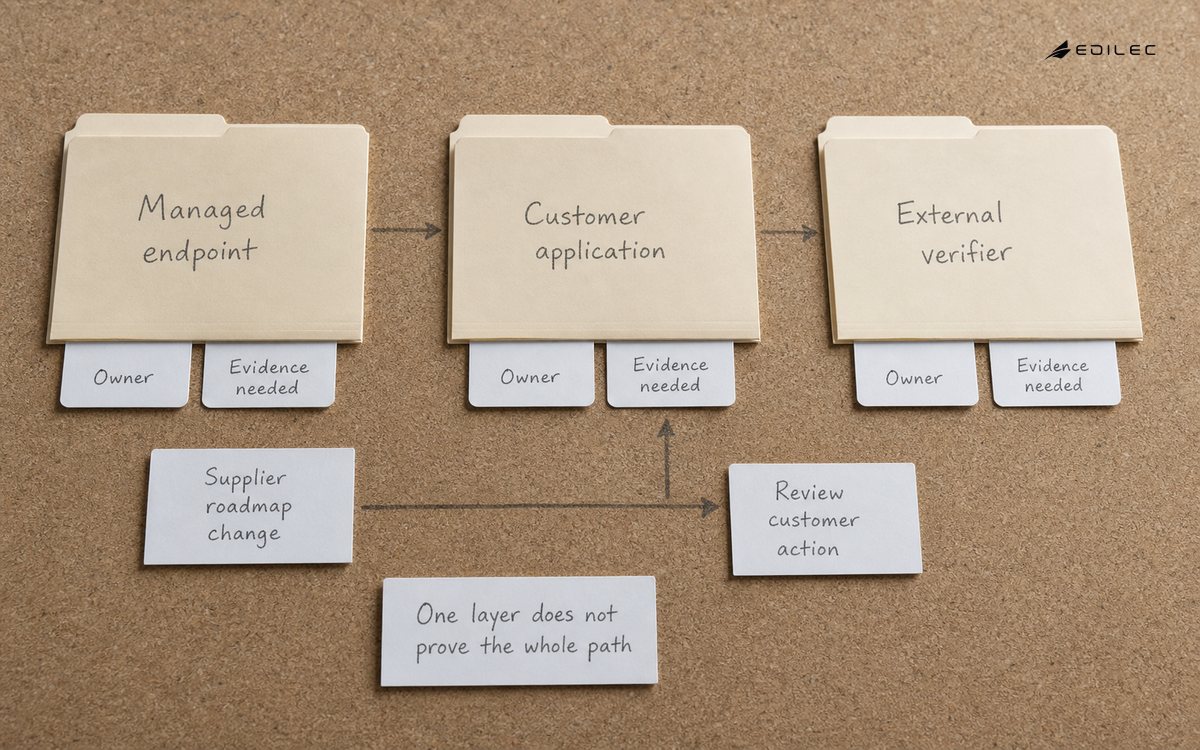
Ask each material provider which service layers use vulnerable public-key cryptography, which standards and protocols it plans to support, expected regions and tiers, customer actions, telemetry, fallback and evidence. Marketing statements are insufficient. A cloud provider may update a managed endpoint while customer applications, private certificates or third-party agents remain unchanged. Record roadmap date, confidence and contractual dependency in the migration register.
Procurement should require cryptographic transparency and change support without demanding unsupported commitments. New systems should avoid fixed algorithm fields, undersized storage and opaque key handling. Contracts can require notification of material roadmap changes, export of configuration and cooperation during transition. Keep alternative providers or compensating controls for high-consequence dependencies whose timelines do not fit the data or customer risk.
How should a SaaS rollout be sequenced?
Begin with nonproduction endpoints and internal workloads where both sides are controlled. Introduce capability detection and telemetry before enforcing a mode. Expand by protocol, service and client cohort with predefined stop thresholds. Keep classical compatibility only where the risk decision permits it, and prevent silent downgrade. For public APIs, publish SDK and protocol guidance, test major customer integrations and provide a supported transition window.
Treat certificate, key and signature migrations as separate programs if their dependencies differ. Some data may need rewrapping or re-encryption; some signatures only need new issuance while historical verification remains. Preserve old verification material and evidence for retained records. Rehearse rollback, but recognize that newly signed artifacts or rotated trust anchors may require forward recovery rather than a simple application deployment reversal.
What evidence and metrics show real readiness?
Governance should review coverage of critical services, unknown cryptographic uses, supplier readiness, vulnerable data by lifetime, tested interoperability and overdue migration decisions. Avoid reporting only the number of certificates scanned. Measure whether the organization can name the owner and transition path for every high-priority use. Keep architecture, inventory, test results, exceptions and customer communication linked to versioned decisions.
Define completion per use: approved standard and implementation, deployed mode, verified negotiation, acceptable performance, operational monitoring, restored backup compatibility, documented rollback and retired vulnerable path. Continue scanning because teams and providers introduce new dependencies. PQC readiness becomes sustainable when ordinary architecture review, procurement, software inventory and certificate management preserve crypto agility after the initial project ends.
Build one representative migration pilot
Choose a path that is important enough to reveal real constraints but bounded enough to control: an internal service connection, a nonproduction public endpoint or artifact signing for a limited verifier set. Inventory every participant in the path, capture current handshake or signature evidence and establish performance and compatibility baselines. Introduce the standardized mechanism through supported libraries, preserve fallback under an approved policy and make the negotiated result observable. Document every intermediary that required configuration or upgrade.
The pilot finishes with a repeatable deployment, fault and rollback exercise, not a successful one-off handshake. Test an unsupported client, oversized message, certificate or key rotation, library downgrade and backup restoration. Record resource change and operational alerts. Use the result to improve inventory fields, supplier questions, rollout gates and customer guidance. One deeply tested path teaches the program more than enabling experimental PQC settings across many disconnected systems. Security architecture should approve both the construction and the planned retirement state. Retain packet, configuration and benchmark evidence so later library or provider changes can be compared against the accepted baseline.
Key takeaways
- Start with cryptographic discovery and data-lifetime risk.
- Plan around standardized algorithms through maintained libraries and services.
- Test every protocol intermediary and client cohort before enforcement.
- Treat supplier roadmaps as dependencies that need evidence and alternatives.
- Define readiness by verified deployment and retirement, not scan counts.
Frequently asked questions
Does every encrypted database need immediate re-encryption?
Not automatically. Identify the public-key mechanisms that protect data keys, the confidentiality lifetime, backup and restore path, and provider roadmap. Symmetric encryption is affected differently from public-key establishment. Prioritize according to risk and authoritative guidance.
Can a SaaS company wait for its cloud provider?
Provider support is necessary for managed layers but does not cover application libraries, customer clients, private PKI, code signing or external integrations. Inventory and interoperability preparation should proceed while provider features mature.
What should a PQC readiness service deliver first?
A verified inventory method, critical-service coverage report, risk-based priority list, supplier dependency register and tested migration architecture for one representative path. A generic roadmap without configuration evidence is not enough.
Conclusion
PQC readiness is disciplined cryptographic change management. A SaaS company needs to know what it protects, how long protection matters, which systems and suppliers implement the cryptography, and how a safer mode can be introduced without losing compatibility or recoverability. Starting with inventory and one tested path builds practical momentum while standards and provider support continue to evolve.