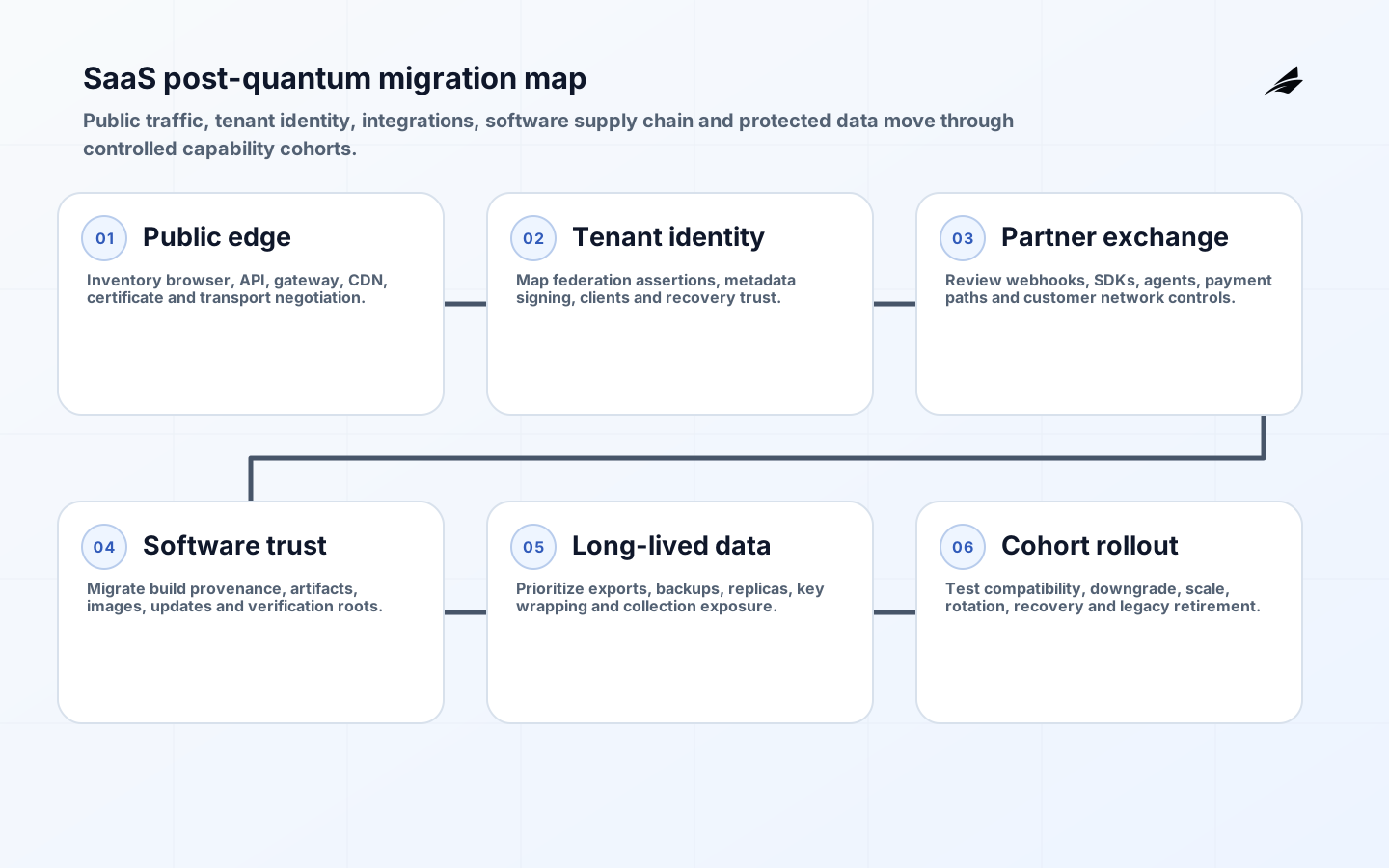
Quantum-safe transformation services for SaaS companies must cover the full customer service, not only the TLS endpoint. A multi-tenant product depends on public-key cryptography for browser and API connections, workload identity, customer federation, certificates, webhooks, code signing, software updates, secrets, backups, administrative access and supplier services. Some dependencies are visible in application code; others live in load balancers, identity providers, mobile clients, container registries, payment platforms or customer networks. The migration needs product, platform and customer coordination.
This checklist turns post-quantum readiness into a SaaS delivery program. NIST’s FIPS 203 standardizes ML-KEM for key establishment and FIPS 204 standardizes ML-DSA for signatures. That does not mean every SaaS endpoint can switch immediately: protocol profiles, libraries, certificate ecosystems, browsers, proxies and customer integrations must support the selected mechanism. The goal is to discover dependencies now, reduce long-lived data exposure, test supported paths and design cryptographic changes so they can be deployed without breaking every tenant at once.
Assign product and cryptographic ownership
Name an executive risk owner, cryptographic architecture lead and owners for edge, identity, platform, application, data, software supply chain and customer integrations. Establish a standards profile and exception process. Product management should identify customer contracts, regulated markets, long-term confidentiality needs and upgrade constraints. Customer success needs a communication and compatibility plan. Procurement must gather supplier roadmaps. Make post-quantum work part of normal product and platform planning rather than an isolated research project.
Define measurable completion by service. A migrated API path requires approved negotiation, compatible clients, observable use, recovery and retirement of the prohibited path. A migrated signing service requires protected key generation, artifact signatures, verification across deployment targets, rotation and old-key retirement. Use a decision log for hybrid profiles, third-party blockers and legacy support. Set expiry on exceptions and tie them to customer or product lifecycle decisions.
| SaaS surface | Cryptographic purpose | Migration owner |
|---|---|---|
| Browser and public API edge | Transport key establishment and server authentication | Edge or platform team |
| Customer SSO | Federation assertions, certificates and metadata | Identity team |
| Webhooks and partner APIs | Transport, request authentication and signatures | Integration team |
| Build and deployment | Artifact, image and update signing | Developer platform team |
| Backups and exports | Key wrapping, transfer and long-lived confidentiality | Data platform team |
| Mobile or agents | Pinned trust, update verification and release compatibility | Client product team |
Build a SaaS cryptographic inventory
Scan source, packages, containers, configuration and infrastructure definitions for algorithms, libraries and certificate use. Query certificate managers, key-management systems, gateways, service meshes, identity platforms and signing services. Observe representative handshakes at public edge, internal service and partner boundaries. Review mobile clients, SDKs, command-line tools and offline agents because their upgrade cadence differs from the web service. Ask suppliers for product-specific cryptographic bills of materials and roadmaps. Automated discovery should create reviewable evidence, not an unverified count.

Link each use to a service, tenant exposure, data, purpose, owner and update path. Record whether the SaaS company controls both peers or depends on a browser, customer identity provider, payment network or device. Note algorithm negotiation and fallback, certificate chain, library version and runtime evidence. Prioritize unknown high-impact paths. Add checks to architecture review, dependency policy and deployment so new vulnerable public-key use is identified. CISA’s inventory strategy emphasizes automation, but operational owners remain necessary to interpret what tools discover.
Prioritize tenant data and trust paths
Classify data by confidentiality lifetime and collection exposure. Archived exports, health or financial records, intellectual property and regulated documents may remain sensitive long after a session ends. Trace how each is transferred, replicated, backed up and shared. Prioritize externally observable traffic and stored packages that an adversary could retain. Also prioritize signing and trust systems whose compromise could distribute malicious software or impersonate services across many tenants. Impact breadth can make a signing path more urgent than a single encrypted database connection.
Coordinate risk with retention and minimization. Deleting data no longer needed reduces future exposure; encrypting every duplicate does not justify indefinite collection. Review export and backup keys, offline media and customer-managed key integrations. If tenants bring their own keys, define which layer they protect and whether associated key-wrapping or control connections remain quantum-vulnerable. Record data and trust risks in product terms so roadmap priority is not determined only by infrastructure convenience.
Create supported target patterns
Define patterns for public transport, internal service identity, federation, code signing, document signing and data-key protection using finalized standards and supported ecosystem profiles. Central platform teams can provide approved libraries, gateway configuration, certificate automation and telemetry. Avoid letting each product team choose algorithms or experimental packages independently. Parameter sets, hybrid construction and validation requirements need architecture review. Track NIST updates and implementation errata, and version the profile so teams can identify which controls were in force for a release.
Measure size and performance in realistic SaaS paths. Larger keys, signatures or certificates can affect handshake latency, gateway limits, headers, message queues, databases, hardware security modules and constrained clients. Test cold and resumed connections, burst traffic, certificate rotation and failure. Capacity results should include tenant and region segmentation. Avoid extrapolating from a cryptographic benchmark to the whole request path; network round trips, certificate chains and intermediary behavior often dominate user-visible results.
| Release test | Scenario | Required observation |
|---|---|---|
| Compatibility | Current and older supported clients connect | Negotiated profile and explicit unsupported-client result |
| Downgrade | Peer omits or rejects the target algorithm | Policy-controlled failure or visible bounded fallback |
| Scale | Burst handshakes and signature verification | Latency, CPU, memory and error behavior within budget |
| Rotation | Replace key, certificate and trust metadata | Continuous service and complete old-key retirement |
| Recovery | Restore region or signing service | Protected keys, trust and verification restored through tested procedure |
| Tenant rollout | Enable selected cohort then reverse | Tenant-scoped telemetry, support and rollback |
Manage customer and supplier compatibility
Inventory customer-managed identity providers, API clients, webhook receivers, SDK versions, network inspection and certificate pinning. Publish a capability and deprecation plan with test environments, supported versions and failure examples. Give enterprise customers enough time to update controlled clients. Do not expose algorithm selection as an unrestricted tenant preference; configuration must remain within supported profiles. Customer success and support teams need diagnostics that identify compatibility without exposing sensitive cryptographic detail.
For cloud, identity, CDN, payment, observability and support suppliers, obtain roadmap, current support, configuration, telemetry, notice and rollback behavior. A supplier may terminate TLS while the SaaS company sees only plaintext upstream, so runtime inventory must include that boundary. Contract renewals are opportunities to require migration evidence and transition assistance. Plan alternatives where a critical dependency has no credible roadmap. Avoid claiming the product is fully quantum safe while a material customer path remains outside visibility.
Roll out through controlled cohorts
Start in internal and test environments, then enable one service and a small compatible cohort. Instrument negotiated algorithms, certificate chains, handshake failures, client versions, latency and fallback. Keep telemetry free of secret material. Use feature and policy controls at service, region and tenant scope. Establish a rollback that restores a previously approved configuration, not an unknown legacy default. Run support and incident exercises for failed federation, rejected webhook, expired certificate and signing verification failure.
Separate enablement from retirement. First prove the target path, then make it preferred or required, then remove vulnerable configuration after all supported dependencies move. Observe for unexpected legacy use during a defined period. Revoke obsolete keys and certificates, update disaster recovery, remove old libraries and close exceptions. Preserve evidence of dates and affected versions for customer assurance. A migration flag marked complete while legacy negotiation remains available is not completion.
Build cryptographic agility into the SaaS platform
Provide reviewed cryptographic interfaces and configuration through platform capabilities, with protocol behavior visible to applications and operators. Separate algorithm policy from business logic where possible. Automate key and certificate lifecycle, but retain approval and recovery for high-impact trust changes. Test provider, library and algorithm upgrades through compatibility matrices and progressive delivery. Maintain the inventory from runtime and build evidence. Agility is measured by how safely the service changes and retires mechanisms, not by how many algorithm names appear in configuration.
Track critical-service inventory coverage, supplier readiness, target-path adoption, incompatible clients, fallback duration, legacy runtime observations, retirement and recovery tests. Review these with product, security and platform owners. Tie customer commitments to evidence and clarify scope. Continue ordinary security work: post-quantum algorithms do not prevent authorization defects, stolen sessions, compromised endpoints or weak recovery. The transformation should strengthen cryptographic governance without displacing present-day controls.
Key takeaways
- Inventory public edge, identity, integrations, signing, clients, data and supplier boundaries.
- Prioritize long-lived tenant data and broad trust paths such as software updates.
- Provide versioned, supported patterns instead of team-by-team experimental cryptography.
- Use tenant-aware cohorts, visible fallback and separate enablement from legacy retirement.
- Measure actual negotiated behavior and keep current security controls in scope.
Frequently asked questions
Can a SaaS company migrate before browsers and customers?
It can migrate controlled internal paths and prepare the public edge, but external interoperability depends on supported ecosystem profiles. Use test endpoints and cohorts, maintain bounded compatibility and avoid custom cryptography that clients cannot support safely.
Should every tenant receive the same migration date?
Not necessarily. Client and federation dependencies vary. Use supported cohorts and published deprecation windows while preserving one security policy and final retirement objective. High-risk paths may need earlier mandatory change.
When can a product claim quantum-safe support?
Claims should state the exact product version, path, protocol, algorithm profile, dependencies and exclusions. Legal and security review should prevent a narrow supported feature from being presented as protection of the entire service.
Conclusion
A quantum-safe SaaS transformation succeeds when customers can continue using the service while cryptographic dependencies change underneath controlled, observable boundaries. The work requires more than adding a library: teams must inventory real use, protect long-lived data and trust, coordinate suppliers and clients, test target profiles, stage rollout and prove retirement. Building those capabilities now makes future cryptographic change a managed product operation rather than an emergency rewrite.