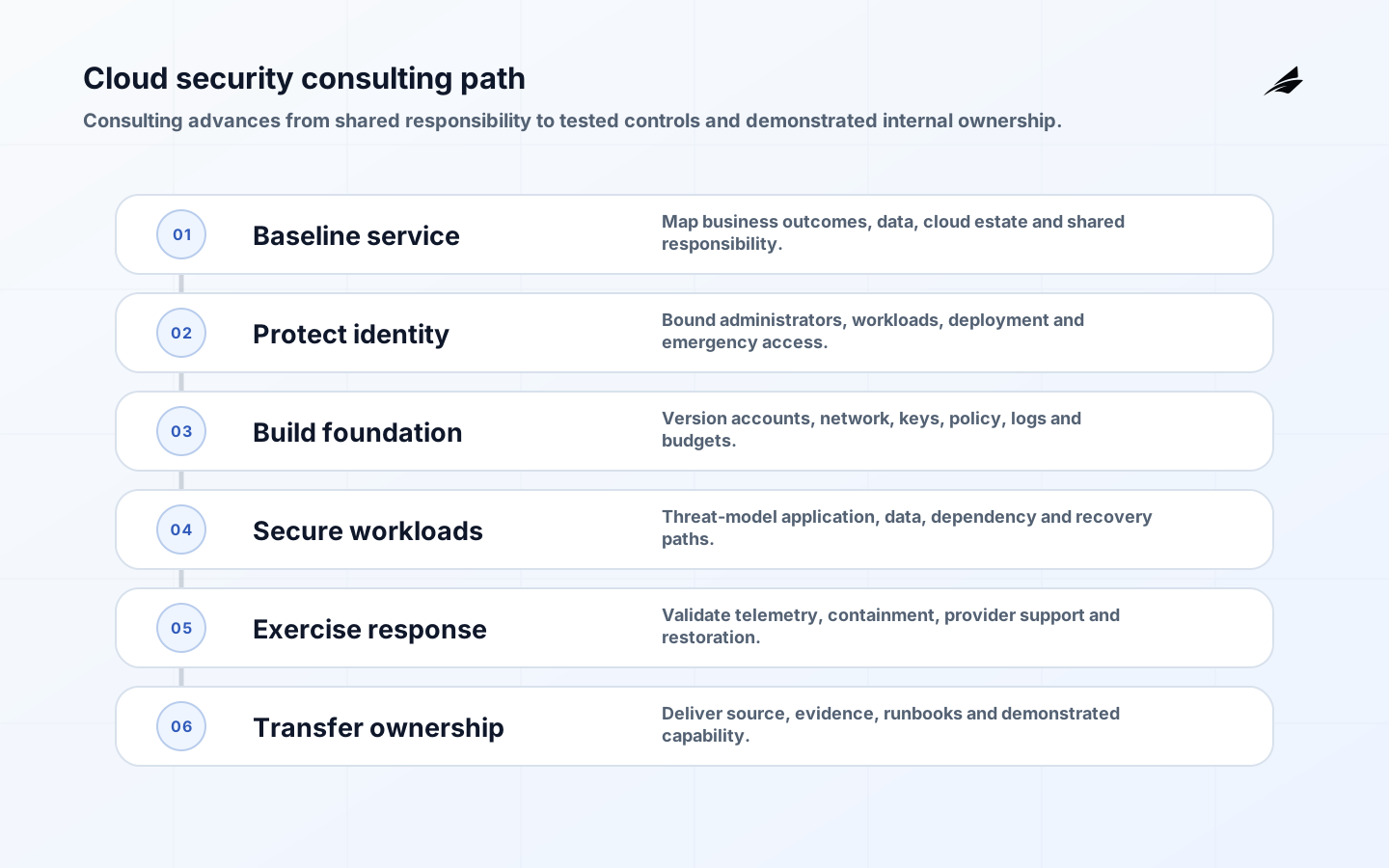
Cloud cybersecurity consulting should leave an organization with an operable security system, not only an assessment deck. The engagement must connect business services and data to tenant foundations, identities, workloads, provider controls, detection and response. Good consulting makes shared responsibility explicit, implements or validates high-priority controls, transfers ownership and records accepted risk. This FAQ answers the scoping and acceptance questions that buyers should settle before granting a consultant access to production cloud environments.
Cloud service models change which technical layers the provider operates, but they do not decide the customer’s business authorization, data use, tenant configuration or incident obligations. NIST SP 800-144 advises organizations to understand security and privacy risks before outsourcing public-cloud services. Current provider shared-responsibility documentation should be reviewed for each service, because responsibility differs among virtual machines, managed databases, serverless functions and software services and can change when optional controls are enabled.
What should cloud cybersecurity consulting include?
Scope should name organizations, cloud tenants, regions, accounts or subscriptions, business services, data classes, platforms and suppliers. Typical work includes governance and architecture, identity, landing-zone controls, network and data protection, workload security, logging and detection, incident response, resilience and assurance automation. State whether the consultant advises, implements, operates or independently verifies each area. Do not combine control implementation and assurance without disclosing the conflict and evidence boundaries.
Define deliverables as usable assets: current and target profiles, architecture decisions, prioritized risks, policy-as-code, identity roles, logging design, response runbooks, tested recovery, exception register and ownership plan. Require source and configuration in customer-controlled repositories. A maturity score can summarize, but it should link to observed evidence and business consequence. Include exclusions and assumptions so an unassessed acquired tenant or SaaS admin plane does not disappear from executive reporting.
| Workstream | Consulting output | Acceptance evidence |
|---|---|---|
| Governance | Target profile, policy and decision rights | Named owners approve priorities and exceptions |
| Identity | Role and privileged-access design | Representative access and revocation tests |
| Foundation | Account, network, key and policy baselines | Drift and denied-change evidence |
| Workloads/data | Threat models and secure patterns | Deployment and recovery tests |
| Detection/response | Telemetry map, analytics and runbooks | Scenario reaches authorized containment |
How is shared responsibility made actionable?
Create a layered matrix for provider service, customer tenant, shared platform, workload, data and business process. For each layer name who designs, configures, operates, verifies, monitors and responds. The verbs matter: a provider may operate physical infrastructure while the customer configures public access and application authorization. A consultant may implement a baseline while an internal owner approves exceptions. Link responsibilities to tools, records and escalation, not only a RACI chart.
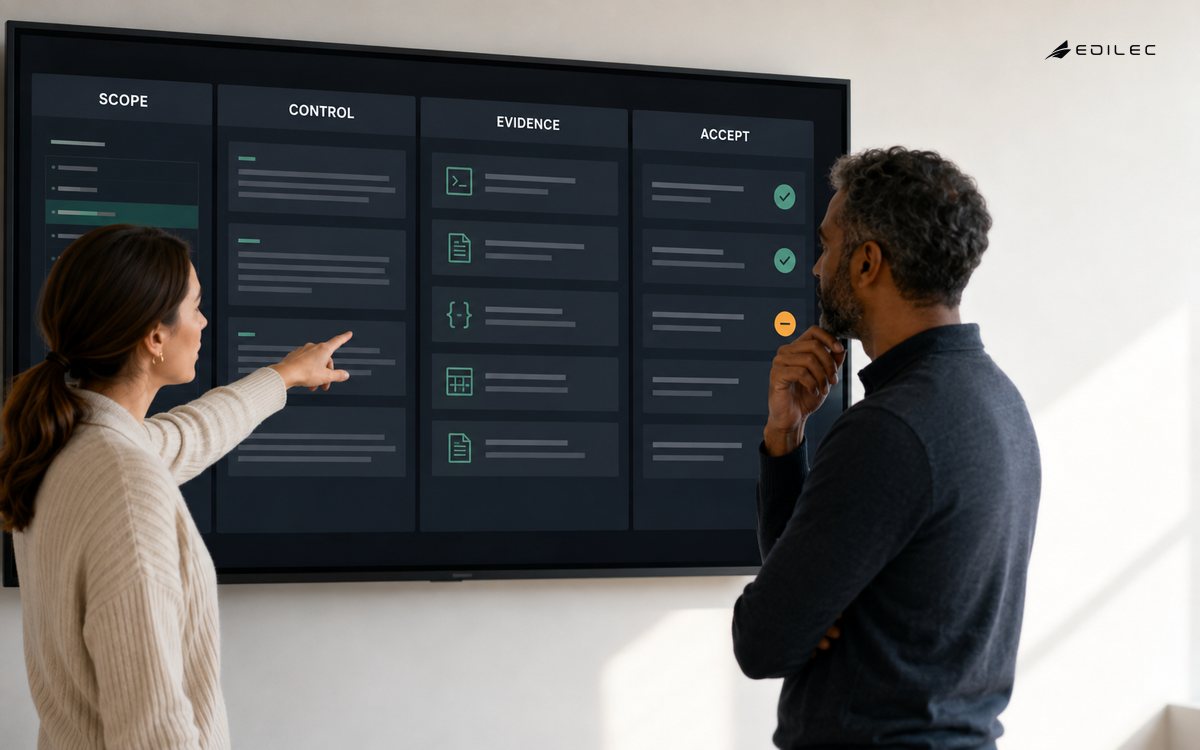
Test the interfaces. Ask what happens when a cloud threat finding identifies a workload with no owner, a key-management service is unavailable, a SaaS administrator leaves or the provider changes a service default. Reconcile asset IDs across cloud inventory, deployment, service catalog and incident platform. Shared responsibility is working when an event reaches the right owner with enough authority and context to act within the required time.
Which identity controls should be addressed first?
Protect the organization, tenant and emergency administrator paths first. Use federation, strong authentication, conditional and risk controls where appropriate, least privilege and time-bound elevation. Separate human, workload and deployment identities. Remove shared users and stale keys. Inventory trust relationships, application registrations and cross-account roles. Preserve emergency access that does not depend entirely on the normal identity path, and test it without turning it into an unmonitored permanent bypass.
Authorization should follow resources and actions, not job titles alone. Start from tasks and data consequence, then create reusable roles. Apply separation for identity policy, keys, logging and billing. Monitor role assignment and credential creation. A consultant should demonstrate onboarding, privilege elevation, service-identity use, revocation and forensic attribution. A design document without those exercises is not implementation evidence.
What makes a secure cloud foundation or landing zone?
A landing zone establishes account hierarchy, identity integration, approved regions, network patterns, DNS, keys, logging, security services, budgets, policy and deployment paths. It should be versioned like a product, with owners, tests and upgrade strategy. Guardrails must distinguish prevention from detection and provide an exception route. Blocking every deviation can create shadow environments; detecting without an owner creates an ignored dashboard. Design controls around business and threat scenarios.
Prove the foundation with a representative workload. Deploy through the intended pipeline, attach a managed identity, store and recover data, emit telemetry, exercise a denied configuration and remove the environment. Confirm policy changes are tested before broad rollout and that organization-level controls cannot be changed silently. The foundation should reduce product-team burden while leaving service ownership and workload-specific authorization clear.
How should data and workload security be assessed?
Trace sensitive data from collection through processing, storage, sharing, backup and deletion. Identify authoritative records, residency, keys, access, retention and recovery. Encryption is necessary in many contexts but does not correct broad application authorization or ungoverned export. Threat-model internet entry, service-to-service identity, dependency supply chain, secrets, administrative paths and abuse of legitimate functions. Use secure deployment templates and automated evidence, then test real application behavior.
Prioritize reachable and consequential exposures. Public storage, leaked credentials, excessive roles and unmonitored administrative APIs commonly deserve attention, but findings need business and architecture context. Establish patch, base-image, dependency and configuration ownership. Validate backup restoration and data reconciliation. If a consultant recommends a product, require the threat scenario, integration, owner, operating cost and acceptance measure it addresses.
| Acceptance question | Strong evidence | Weak substitute |
|---|---|---|
| Can privilege be bounded? | Timed role and tested revocation | Policy document |
| Can drift be detected and repaired? | Known change triggers alert and controlled remediation | Dashboard screenshot |
| Can an incident be contained? | Scenario exercise with decision log | Generic runbook |
| Can data be recovered? | Measured restore and reconciliation | Successful backup job |
| Can ownership transfer? | Internal team operates representative tasks | Training attendance |
What should cloud detection and incident response cover?
Map provider, tenant, identity, network, workload, data and application telemetry to scenarios. Confirm event access, time, retention, parsing and owner. Validate detections with safe test events. Define severity, declaration, secure communication, containment authority, provider support and evidence preservation. Some cloud actions are fast and irreversible; pre-authorize bounded containment where delay creates unacceptable impact, while preserving business decision authority for broader shutdown.
Run at least one technical exercise. Compromise a test credential, produce suspicious control-plane behavior, escalate, revoke access, identify affected resources and restore trusted state. Record delays and missing context. Include provider outages and identity dependency. Incident readiness should feed architecture: repeated inability to identify owners or rebuild from known-good infrastructure is a platform issue, not only a runbook issue.
How should a consulting partner and engagement be evaluated?
Ask for experience with the actual service models and operating constraints, not only certifications. Review a redacted architecture decision, control test and incident exercise. Confirm how the team researches current provider behavior, manages privileged access, separates implementation from assurance and transfers source and knowledge. Define milestones around evidence: baseline accepted, foundation exercised, workload path proven, incident rehearsed and ownership demonstrated.
Commercial terms should distinguish discovery, remediation, platform work and continuing operations. Avoid open-ended finding production without capacity to fix. Require named dependencies and change control. Preserve customer ownership of repositories and cloud accounts. Define exit and data deletion. Success is a smaller residual-risk backlog, higher automated coverage, faster safe response and internal teams able to operate the controls after consulting ends.
How should assessment findings become delivery work?
Normalize findings by affected service, threat scenario, control outcome, exposure, consequence and owner. Remove duplicates across tools and distinguish an individual defect from a missing platform capability. Set a target and verification method. Quick configuration fixes can proceed through normal change; architecture and identity changes need design and migration. Time-bound exceptions require approving authority, compensating control and expiry. A long spreadsheet sorted by scanner severity is not a remediation plan.
Select one improvement slice that proves the delivery mechanism: for example, a privileged-access path or public-storage prevention control from policy through deployment and monitoring. Measure whether the fix persists and reaches new environments. Then expand reusable patterns. Report risk removed, coverage and residual exceptions rather than closed ticket volume. Consulting produces durable value when remediation becomes part of the customer’s product and platform delivery system.
Keep the consultant’s assessment queries and evidence methods in a customer repository where licensing allows. Internal teams should be able to rerun the checks after a release and understand expected limitations. This converts point-in-time advice into a maintained assurance capability and makes future independent review more efficient without pretending every control can be fully automated.
Key takeaways
- Scope business services, data and cloud layers explicitly.
- Turn shared responsibility into tested ownership and escalation.
- Prioritize identity, tenant foundations and recoverable workload paths.
- Validate telemetry and response with production-like scenarios.
- Accept the engagement only when source, evidence and operating knowledge transfer.
Frequently asked questions
Does a cloud certification prove the consultant can secure our environment?
No. It can demonstrate baseline knowledge. Evaluate applied architecture, engineering, evidence, communication and operating transfer in environments like yours. Team composition and current service-specific experience matter.
Do we need a cloud security posture management tool first?
Not necessarily. Establish ownership, inventory, priorities and response before adding another finding source. A tool can improve scale and visibility if its outputs integrate with remediation and exceptions and its coverage is verified.
Should one control set be identical across cloud providers?
Use common outcome and evidence requirements, then implement them with provider-specific capabilities and service boundaries. Forced technical uniformity can weaken controls; unexplained divergence weakens governance. Record the rationale.
Conclusion
Cloud cybersecurity consulting is complete when security responsibility becomes executable. The organization should be able to trace a service through cloud layers, inspect control evidence, contain a representative incident, recover data and continue operating without privileged dependence on the consultant. Buy that outcome, not a quantity of recommendations.