Cloud security consulting should turn uncertainty into decisions and implemented controls. It can help an organization evaluate an existing estate, design a landing zone, secure a migration, rationalize multi-cloud controls or prepare evidence for assurance. The deliverable is not a slide deck declaring that identity and encryption matter. It is a verified current state, an agreed target state, a responsibility model, architecture decisions, a prioritized backlog and enough implementation support to make the first changes safely.
What buyers expect from cloud security consulting
Searchers are usually comparing consulting scope, cost and credibility or preparing an assessment. They need to know when external expertise is useful and how to avoid generic recommendations. Consulting adds value when the organization faces a material decision: entering a regulated market, creating a cloud foundation, recovering from rapid account growth, migrating sensitive workloads, consolidating identity, or establishing cross-cloud governance. If the need is routine alert handling or patching, a managed service may fit better. If the need is independent assurance, preserve assessor independence instead of asking the same team to design, implement and certify its own work.
Frame the engagement around decisions and outcomes
Write a one-page engagement charter before requesting proposals. Name the business trigger, cloud platforms, organizations or tenants, workload classes, data and regulatory boundaries, stakeholders, constraints and decisions due. Define what is out of scope. Select an outcome framework such as NIST CSF 2.0 and a cloud-specific reference such as the Cloud Security Alliance Cloud Controls Matrix, but do not apply every control blindly. NIST CSF profiles can express current and target outcomes; the CCM and CAIQ can help examine cloud control and supplier responsibilities. Provider frameworks then translate the target into platform-specific design.
| Engagement type | Best used when | Required deliverables | Weak substitute |
|---|---|---|---|
| Current-state assessment | Cloud use grew faster than governance or a risk decision is due | Validated inventory, trust paths, control evidence, findings and priorities | A questionnaire scored without technical verification |
| Target architecture | A landing zone, migration or identity redesign needs approved patterns | Principles, diagrams, decision records, policy hierarchy and exception model | A reference diagram disconnected from workload needs |
| Remediation program | Known gaps need design, implementation and adoption support | Backlog, owners, dependencies, tested changes, runbooks and handover | A findings report with no delivery capacity |
| Multi-cloud control model | Teams need consistent outcomes across different provider mechanisms | Common control objectives, platform mappings, evidence and divergence decisions | Forcing one cloud's configuration vocabulary onto every platform |
| Assurance readiness | Evidence must support customer, audit or regulatory review | Control ownership, evidence map, gap closure and test records | Treating a provider certification as coverage for customer configuration |
Map shared responsibility at the control level
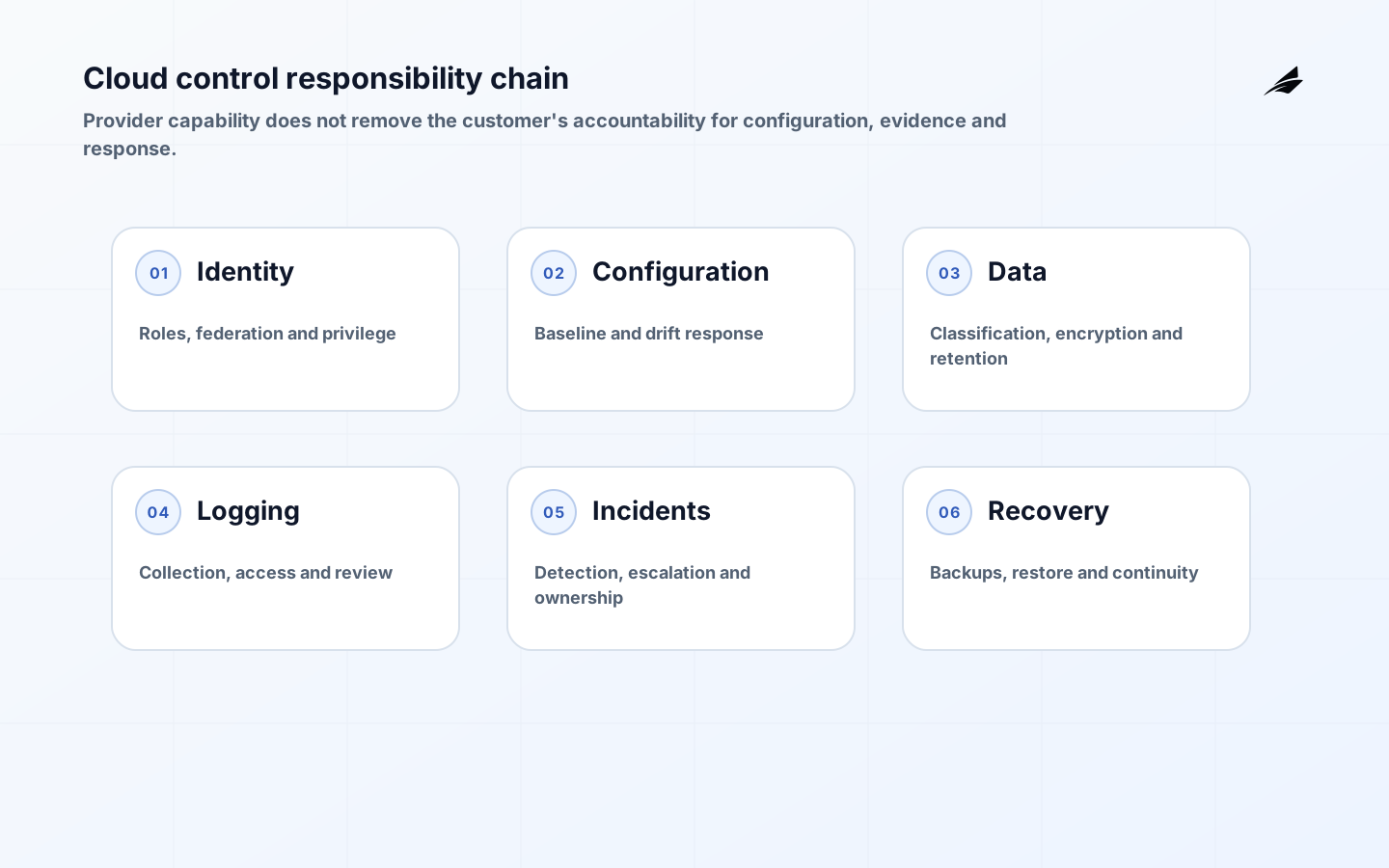
Cloud providers secure underlying services, but customers still own decisions about data, identity, configuration, workloads and legal obligations. The boundary shifts between infrastructure, platform and software services and can shift again when a managed provider is added. Create a matrix for every relevant control that identifies the cloud provider's inherited capability, the customer's retained accountability, delegated operating tasks, evidence source and escalation owner. Pay particular attention to patching, key management, logging, backup, vulnerability management and incident notification because the word 'managed' can conceal different boundaries.
Assess architecture, configuration and operating behavior
A balanced assessment combines interviews, document review, read-only technical inspection and sampled evidence. Examine organization and account hierarchy, federation and privileged roles, network ingress and egress, workload identities, secrets, encryption and key administration, data discovery, logging, posture policies, CI/CD, infrastructure as code, backup, incident integration and cost ownership. Sample both compliant and exception cases. Validate whether controls persist through deployment pipelines and whether findings reach accountable teams. CISA's cloud reference architecture emphasizes shared services, secure migration and cloud security posture management; use those as connected operating concerns rather than separate tools.
Design guardrails that teams can actually adopt
The target state should express paved paths: approved account or subscription vending, federated identity, network patterns, centralized logs, key and secret services, policy-as-code, infrastructure modules, deployment checks and exception workflows. AWS guidance emphasizes identity, traceability, defense in depth, automation, data protection and preparation for security events. Microsoft's Secure methodology spans strategy through operations, and Google's enterprise foundation combines architecture, policy and detective controls. The practical lesson across providers is consistent: cloud security is an operating system for delivery. Guardrails should be reusable, versioned, observable and owned, not a PDF that every product team must reinterpret.
| Roadmap workstream | First useful release | Measure of adoption | Decision owner |
|---|---|---|---|
| Identity | Federation, strong authentication and time-bound administration for priority environments | Privileged paths using approved controls and stale privilege removed | Identity and security leaders |
| Cloud foundation | Approved hierarchy, baseline policies, network pattern and log destinations | New environments created through the governed path | Platform owner |
| Workload delivery | Reusable infrastructure modules with security checks and ownership metadata | Deployments using modules and resolved policy failures | Engineering leader |
| Posture and detection | Priority misconfiguration rules, source-health monitoring and incident routing | Risk-aged findings and tested detection coverage | Security operations |
| Data and resilience | Classification-linked access, key ownership and recovery pattern for critical data | Sensitive stores covered and representative restores passed | Data and service owners |
Estimate consulting cost without buying ambiguity
Cost is driven by platforms, account count, workload diversity, regions, stakeholder groups, evidence quality, regulatory depth and whether implementation is included. A fixed-price assessment works only with a stable scope and agreed sampling. Time-and-materials suits discovery where the estate is uncertain, but needs budget checkpoints and decision logs. Implementation can be priced by workstream or sprint with acceptance criteria. Separate cloud and tool charges from consulting fees, including temporary environments, log ingestion, scanners and testing. Require named roles and expected allocation; a proposal built around senior experts can be delivered very differently if most work is handed to a general team.
Example: regulated data moving to a new cloud foundation
A company plans to move a customer-data platform from individually managed accounts into a governed cloud foundation. The consultant maps data flows, administrators, deployment paths and inherited provider controls, then creates current and target CSF profiles. The first delivery release establishes federated administration, separate production boundaries, centralized audit logs, customer-managed key decisions, approved infrastructure modules and a time-limited exception process. One representative workload migrates through the new path. Acceptance requires a successful deployment from code, blocked noncompliant changes, an alert reaching the incident system, access review evidence and a recovery test. The roadmap for remaining workloads is now based on observed migration effort rather than workshop estimates.
Risks that undermine consulting engagements
- Shelfware: contract for decision records, backlog items, owners and implementation pilots, not only presentation files.
- Tool-first bias: require outcomes and architecture rationale before accepting a product recommendation; disclose reseller or implementation incentives.
- Shallow discovery: provide read-only technical access and representative evidence while controlling sensitive-data exposure and recording consultant access.
- Framework inflation: tailor controls to risk and document exclusions; mapping many frameworks does not create stronger implementation.
- Unowned roadmap: secure executive, platform, security, engineering, data and operations owners before prioritization workshops end.
- Unsafe remediation: test policies in audit mode or lower environments, model blast radius, preserve break-glass access and define rollback.
- Consultant dependency: store architecture, modules, policies and evidence in customer repositories and pair consultants with internal maintainers.
- Conflicted assurance: use an appropriately independent reviewer when a formal opinion or certification is required.
A delivery plan from evidence to operation
- Mobilize: approve the charter, scope, access, evidence handling, stakeholders, framework, decision rights and success measures.
- Discover: inventory organizations, accounts, workloads, data, identities, controls, suppliers and current incidents; record uncertainty explicitly.
- Assess: verify representative configurations and evidence, map control responsibility, build current and target profiles and validate findings with owners.
- Prioritize: rank work by business impact, exposure, dependency and delivery effort; identify urgent containment separately from strategic architecture.
- Design: approve target patterns, policy hierarchy, exception process, operating ownership, architecture decisions and rollout safeguards.
- Pilot: implement the smallest end-to-end path on a representative workload, including identity, deployment, telemetry, response and recovery.
- Scale and hand over: convert lessons into modules and runbooks, train maintainers, track adoption and transfer the improvement forum to named internal owners.
Key takeaways
- Buy resolution of named cloud risk and architecture decisions, not generic best-practice advice.
- Use outcome, cloud-control and provider frameworks together, with documented tailoring.
- Verify shared responsibility and technical evidence instead of relying on provider assurance alone.
- Make paved paths, policy automation, evidence and operating ownership part of the target architecture.
- Pilot one end-to-end workload path before estimating and scaling the full roadmap.
FAQ: What should a cloud security consultant deliver?
Expect a validated current state, control-responsibility matrix, prioritized findings, target architecture, decision records, implementation backlog, cost and dependency view, acceptance criteria and handover plan. For delivery engagements, also expect customer-owned code, policies, runbooks, test results and evidence from a representative pilot.
FAQ: How long does a cloud security assessment take?
Duration depends on platforms, estate size, evidence quality, stakeholder access, regulation and sampling depth. Ask bidders to state assumptions and milestones rather than accept a universal duration. Use early inventory reconciliation as a checkpoint: if the discovered estate materially differs from the proposal baseline, re-scope openly.
FAQ: Can one framework cover multi-cloud security?
A common outcome framework can unify governance and reporting, but implementation differs by provider and service. Map each common objective to native identity, policy, logging, network and key-management mechanisms. Record deliberate differences where workload or provider architecture makes identical configuration undesirable.
Conclusion
The best cloud security consulting leaves the organization able to make and maintain better decisions. Tie scope to a business trigger, verify the estate, map responsibility, design reusable guardrails and pilot them on a real workload. When the backlog has owners, the architecture has tested paths and the evidence reaches operations, the engagement has moved beyond advice into durable security capability.