Cloud security basics are the small set of decisions that let a team explain who owns each cloud boundary, who can change it, how data is protected, how harmful behavior is detected, and how service is restored. The cloud provider operates part of the stack, but the customer still configures identities, networks, workloads, data and monitoring according to the service model. A managed platform can remove server maintenance without deciding whether an employee should export customer records or whether an application query crosses a tenant boundary.
The starting point is shared responsibility made specific to the service. NIST SP 800-144 describes security and privacy considerations when organizations place data and applications in public cloud environments. The practical work is to turn those considerations into owned controls and evidence. Use this article with Edilec's guides to data protection for custom software, web application incident response and application hardening.
Map shared responsibility to real components
Write a component-level responsibility matrix before debating controls. Include organization and project accounts, workforce identity, workload identity, domain and certificate management, public endpoints, compute services, managed databases, object storage, key services, deployment pipelines, logs, backups and third-party integrations. For each component, name what the provider operates, what the customer configures, who approves changes and what evidence proves the expected state. The answer changes across infrastructure, platform and software services, so generic provider diagrams are only a prompt.
Ownership must survive daily operation. A team may declare that security owns identity policy while platform engineering can create administrator roles and application teams can attach permissions to workloads. That split needs a review and escalation path. Supplier assurances do not cover customer configuration, code or business authorization. Conversely, customers should not duplicate provider controls they cannot meaningfully operate. Record dependencies and assurance sources, then focus internal effort where customer choices alter exposure.
| Cloud area | Baseline decision | Evidence |
|---|---|---|
| Account structure | Separate production, non-production and security administration | Organization policy and inventory |
| Workforce access | Federate identity and minimize standing privilege | Role assignments, MFA and access reviews |
| Workload access | Use scoped service identity without embedded secrets | Policy and credential age |
| Public exposure | Publish only reviewed endpoints | Asset inventory and external test |
| Data | Classify, encrypt, retain and restore | Configuration, key ownership and restore result |
| Detection | Centralize material control and workload events | Coverage map, alert test and retention |
Establish account and environment boundaries
Cloud organization design is a security control. Separate production from development so an experimental change cannot inherit production authority. Isolate centralized logging and recovery administration from the workloads they observe. Apply organization-level restrictions for prohibited regions, public storage, weak identity patterns and unapproved services where they are reliable. Keep a controlled path for exceptions; an absolute rule that operations routinely bypass is weaker than a narrow, visible exception with an owner and expiry.
Inventory should identify accounts, owners, purpose, lifecycle, data class and critical dependencies. Detect abandoned experiments, orphaned credentials and resources outside normal deployment. Tags help, but they are not authoritative if anyone can omit or rewrite them. Combine account registry, provider inventory and billing evidence. The NIST Cybersecurity Framework organizes outcomes across Govern, Identify, Protect, Detect, Respond and Recover; the account baseline should provide concrete evidence across all six rather than concentrating only on preventive settings.
Control human and workload access differently
Workforce access should be federated to a managed identity source, protected with strong multifactor authentication and granted through roles rather than shared users. Administrative privilege should be time-bounded where practical, with a separate emergency route. Review effective permissions, not only group names. A role that appears narrow may inherit broad permissions or allow privilege escalation by modifying a function, policy or deployment pipeline.
Workloads require non-human identity. Prefer provider or platform identity that issues short-lived credentials to embedded access keys. Bind identity to the runtime and intended service, constrain the resources and actions, and monitor unusual use. Secrets that remain necessary belong in a managed secret store with rotation and access evidence. Treat build and deployment identities as production identities: they can change code, configuration and infrastructure even when they cannot query customer data directly.
- Prohibit routine use of account root or equivalent owner credentials.
- Require an explicit owner and purpose for every privileged role.
- Test whether a role can create another path to privilege.
- Remove inactive users, workloads and credentials through lifecycle events.
- Separate read, change, security administration and billing responsibilities.
- Rehearse emergency access and review every use promptly.
Protect exposure, workloads and data
Start from intended traffic flows. Internet-facing services should have named owners, authenticated administration, transport protection, request limits and a patch route. Private connectivity reduces exposure but does not replace application authorization. Restrict outbound connectivity where the workload does not need arbitrary destinations; egress controls and DNS evidence can contain compromised services. Keep security groups or firewall rules narrow, versioned and testable. Avoid rules whose business meaning cannot be inferred from an IP address and a stale ticket.
Data controls depend on classification and lifecycle. Encrypt data in transit and at rest, but also decide who controls keys, who can decrypt, how backups are protected, and how deletion propagates. Prevent public access by default and test cross-account and cross-tenant boundaries. A backup is not recovery until restoration has been exercised with application configuration, identity, keys and dependencies. The CISA cloud security reference architecture is useful for examining identity, data protection, visibility and cloud posture as connected capabilities.
| Scenario | Expected safe behavior | Test |
|---|---|---|
| Stolen developer credential | Production change still requires stronger, bounded authority | Attempt privileged action from ordinary developer role |
| Public storage change | Organization policy blocks or immediately detects exposure | Deploy known unsafe test configuration |
| Compromised workload | Identity and egress limits constrain reach | Request unrelated secret and external destination |
| Logging interruption | Coverage loss alerts independently | Pause one material event source |
| Regional outage | Recovery follows approved dependency order | Restore a representative service |
| Key or secret rotation | Consumers update without uncontrolled downtime | Rotate in a non-production rehearsal |
Secure delivery and control drift
Define infrastructure and security configuration as reviewed code where feasible. Pin trusted modules and actions, protect the main branch, scan for exposed secrets and unsafe settings, and promote tested artifacts rather than rebuilding differently in production. A deployment record should connect source revision, artifact, infrastructure plan, approver and target. Emergency console changes need capture and reconciliation back into the declared configuration. Otherwise the next automated deployment may erase the fix or silently restore the vulnerability.
Posture tools can identify drift, but findings need prioritization and ownership. A broad rule violation on an isolated test resource is different from an exposed production identity path. Enrich findings with environment, data sensitivity, internet exposure, privilege and exploitability. Track time to remediate consequential findings and recurring causes. A healthy baseline reduces entire classes of unsafe changes through reusable modules and policy, instead of producing ever-larger queues of individual alerts.
Detect, investigate and recover
Collect control-plane events, authentication, network flow, workload and data-access evidence according to risk. Centralize material logs where a compromised workload cannot erase them, synchronize time, protect integrity and test that alerts can be generated. Detection should describe a response decision: which owner investigates, which account or identity can be contained, what evidence must be preserved, and when service can return. Avoid collecting every event without a query, retention purpose or response owner.
NIST SP 800-201 focuses on cloud forensic readiness, a useful extension of ordinary monitoring. Provider boundaries, distributed services and ephemeral resources can make evidence difficult to collect after an event. Record identifiers, region, tenant, actor and request relationships before an incident. Run a scenario that includes containment, credential rotation, restoration and integrity validation. Recovery privileges and backups must remain available when the normal production identity plane is impaired.
Review six connected cloud control layers
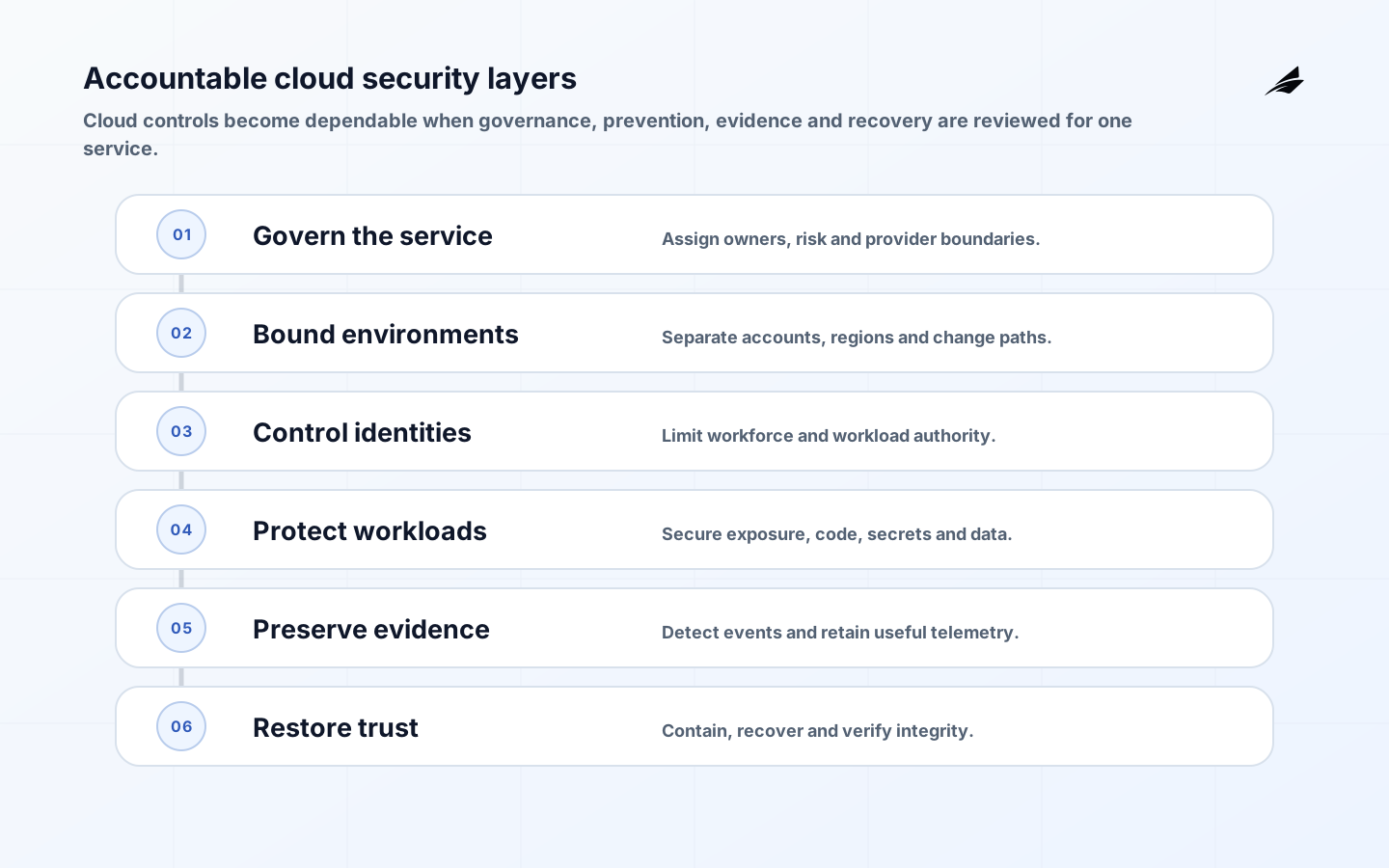
The layered diagram below is an operating review, not a maturity score. Governance defines ownership and risk; account boundaries limit blast radius; identity controls human and workload authority; workload and data controls protect the service; detection preserves visibility; recovery restores trusted operation. A weakness in a lower layer can invalidate confidence above it. Review the layers for one real service and one realistic failure rather than marking an enterprise-wide checklist complete.
Key takeaways
- Translate shared responsibility into component-level owners and evidence.
- Use account and environment boundaries to contain changes and compromise.
- Manage workforce and workload identities through different, lifecycle-aware controls.
- Protect data with authorization, key ownership, retention and tested restoration, not encryption alone.
- Treat infrastructure changes and emergency drift as reviewable releases.
- Design telemetry for response and forensic readiness, then rehearse recovery.
Frequently asked questions
What should a small team implement first?
Start with account inventory, federated MFA, removal of shared and long-lived credentials, production separation, reviewed public exposure, protected logs and one tested restore. These controls establish ownership and reduce common high-impact paths.
Does using managed services transfer security responsibility?
It transfers specific operating tasks. The customer still decides configuration, identities, application authorization, data use, integration and response. Document the boundary for each managed service instead of relying on a generic model.
Which cloud security framework should we use?
Choose a framework that matches obligations and customers, then map it to concrete service controls. NIST CSF offers outcome organization; other baselines may add detailed requirements. Evidence and operation matter more than the label.
Conclusion
A credible cloud security baseline makes provider and customer responsibilities visible in the architecture, delivery process and incident plan. Build around bounded accounts, strong human and workload identity, deliberate exposure, governed data, reviewable change, useful telemetry and tested recovery. The result is not a perfectly locked environment. It is a service whose risk decisions can be understood, verified and improved as the cloud estate changes.