SSO and MFA Rollout Planning: A Client Workflow Checklist is a practical guide for teams responsible for a client-facing product with users, customer organizations, administrators, and security-sensitive sign-in routes. SSO and MFA rollout planning starts with a concrete operating question: can the team introduce federation and stronger authentication while preserving a safe route for legitimate users? Begin by naming the assets involved: user identities, organization memberships, authenticators, assertions, sessions, recovery requests, and administrator controls. Then identify the people, workloads, services, and dependencies that influence the outcome. This framing turns a broad security theme into a decision that product, engineering, operations, and leadership can inspect together. It also prevents a late checklist from hiding unresolved ownership, unsafe exception routes, or recovery assumptions.
Set the operating boundary for SSO and MFA rollout planning
Set the boundary in ordinary language. For this guide, the work concerns a client-facing product with users, customer organizations, administrators, and security-sensitive sign-in routes. The desired result is to introduce federation and stronger authentication while preserving a safe route for legitimate users. The decisions that make the result credible are which users need which assurance, how identity providers connect, what recovery proves, and how local authorization stays correct. Write down what becomes harmful if the decision is wrong, who owns the affected resource, and which systems provide the trusted facts. A clear boundary tells a reviewer which workflow needs a negative test, which person can approve an exception, and when a change should force the plan back into review. Do not let a policy name stand in for this work.
| Planning area | Decision to make | Evidence of readiness |
|---|---|---|
| Protected outcome | State how the team will introduce federation and stronger authentication while preserving a safe route for legitimate users. | Named owner and impact statement. |
| Decision boundary | Record which users need which assurance, how identity providers connect, what recovery proves, and how local authorization stays correct. | Approved examples and denial cases. |
| Dependencies | Name identity, data, platform, supplier, and operating dependencies. | Failure behavior and recovery contact. |
| Review | Set a trigger for reconsidering the control. | Dated cadence and escalation path. |
Design a control that people can operate
The operating control is a risk-based sign-in and federation policy with tested enrollment, session, recovery, and fallback behavior. It must change a real outcome and have an accountable owner; a statement of intent is not enough. Describe the normal case, the denied case, a time-limited exception, and a dependency outage. Decide which inputs are authoritative, how fresh they must be, and who can change the rule. Keep enforcement close to the service that owns the record or action, especially when a browser, gateway, spreadsheet, or upstream system could be bypassed. The person on call should be able to understand the control without reconstructing its meaning from several unrelated tools.
- Name the protected outcome and accountable owner before choosing a tool.
- Use the smallest practical access, configuration, data set, or recovery action.
- Make exceptions attributable, time-bounded, and visible to the resource owner.
- Prove an invalid request or condition is refused through a realistic negative test.
- Review after material product, people, supplier, dependency, or incident change.
Make the control real in delivery
Make the plan part of delivery rather than a document created at the end. Connect each requirement to a component, configuration setting, operating procedure, or test that can demonstrate the intended behavior. Use versioned changes for high-impact settings and preserve the reviewer, reason, and expected outcome. Test cases should include a legitimate request as well as a wrong tenant, stale condition, expired approval, malformed input, or unavailable dependency. When a weakness remains, record its consequence, temporary safeguard, remediation owner, and expiry so a release decision is honest rather than silently optimistic. For SSO and MFA rollout planning, inventory every sign-in and recovery path before setting enforcement. That includes client administrators, invited users, mobile clients, support-assisted recovery, local fallback, and organization identity-provider mapping. Pilot with a representative client cohort and watch enrollment completion, assertion validation failures, account linking errors, session issues, and recovery volume. Use the evidence to tune the rollout rather than treating a successful federation handshake as proof of a usable, safe client workflow.
| Operating checkpoint | What to verify | Pause or escalate when |
|---|---|---|
| Control coverage | A real component or procedure implements every important decision. | A high-impact path has no owner, test, or safe failure behavior. |
| Access and data | The team understands exposure for user identities, organization memberships, authenticators, assertions, sessions, recovery requests, and administrator controls. | A privileged, cross-boundary, or export path bypasses the intended rule. |
| Evidence | Relevant actions and changes are attributable and retrievable. | Logs, approvals, or restoration evidence are incomplete. |
| Residual risk | An accountable person accepts a narrow, dated exception. | The exception lacks an expiry, compensating safeguard, or follow-up owner. |
Run and review SSO and MFA rollout planning
Run SSO and MFA rollout planning as a recurring decision. Give routine review work to the people who understand the business consequence, technical scope, and operating evidence. Capture material changes, denied attempts, emergency actions, and exceptions with enough context to investigate later. Avoid measuring success only by the number of tickets closed or events collected. A useful measure answers whether the team can prevent a harmful action, notice a control failure, and recover access or service safely. Review on a meaningful trigger such as a release, identity change, supplier change, incident, or new integration.
Plan for failure and recovery
Resilience is part of the control, not a separate project. Decide ahead of time what the system does when an identity source, policy service, log pipeline, key store, or third-party dependency fails. For destructive or privacy-sensitive work, refusal may be the safe response; for lower-risk activity, a bounded read-only or temporary route may be appropriate. Make emergency access narrow, attributable, and automatically expiring. Exercise one realistic scenario and record whether the team can identify impact, contain the problem, restore the needed capability, validate the result, and close the temporary exception. A strong primary MFA route is weakened by an untested recovery route. Decide what evidence permits a reset, role change, or new authenticator; rate-limit the workflow and record high-impact outcomes. For identity-provider outages, specify the session behavior and which actions require fresh authentication. Do not keep a silent local-password escape hatch that bypasses the assurance policy for a customer organization.
Follow the SSO and MFA rollout planning decision flow
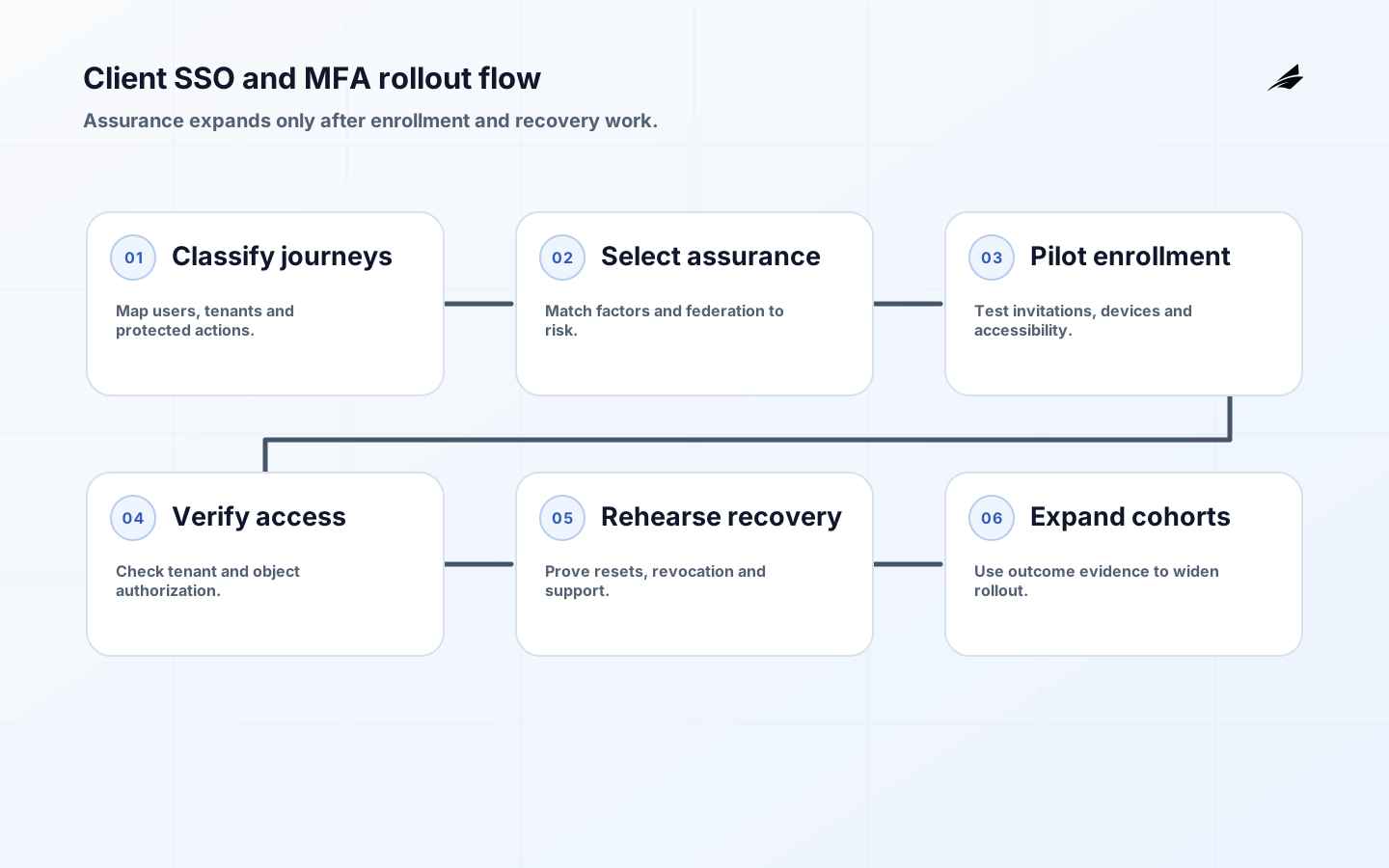
The six-stage decision flow makes the handoffs visible. It starts with a defined protected outcome, gathers the facts needed for a decision, applies a controlled rule, records the action, and finishes with a review that can improve the next cycle. The diagram belongs here because SSO and MFA rollout planning depends on a sequence that a team can inspect during design, release, and incident response. It is not a substitute for engineering detail; it is a shared map of responsibility.
Pilot the highest-friction client journey
A safe SSO and MFA rollout begins with the client journey most likely to expose design gaps: a new user accepts an invitation, authenticates through a federated identity provider, enrolls or uses an authenticator, changes organization context and recovers after losing a device. Test that path with real tenant rules before a broad mandate. The current NIST Digital Identity Guidelines separate identity proofing, authentication and federation, which helps a team avoid treating “SSO enabled” as a complete control. Select an assurance level from risk, offer phishing-resistant options where appropriate and make recovery at least as carefully controlled as enrollment.

| Pilot cohort | Scenario to prove | Evidence before expansion |
|---|---|---|
| Internal support team | Enrollment, factor replacement and account lockout | Support script, verified identity checks and complete event trail |
| Friendly client tenant | Federated login, domain claims and role mapping | Correct issuer, audience, tenant and authorization behavior |
| Privileged client users | Phishing-resistant authentication and step-up | Protected actions require the intended factor and recent authentication |
| Mixed-device users | Browser, mobile, accessibility and recovery paths | Completion and failure rates segmented by device and assistive need |
Do not measure success only by enrollment percentage. Track successful sign-ins, abandonment, recovery requests, factor resets, help-desk time, bypass use and suspicious authentication outcomes. NIST states that manually entered OTP methods are not phishing-resistant; CISA’s More Than a Password guidance likewise encourages stronger MFA. Pair authentication with server-side authorization because a valid login does not decide which client records a person may view. Edilec’s guides to identity governance, audit logs for SaaS platforms and secure API access control show the adjacent controls. Expand by tenant or role only after the previous cohort can enroll, work and recover without informal administrator bypasses.
Key takeaways
- SSO and MFA rollout planning is strongest when the outcome, owner, and decision boundary are explicit.
- Every material control needs a practical implementation, a negative test, and retrievable evidence.
- A time-bounded exception is safer than an informal permanent bypass.
- Recovery behavior should be chosen and exercised before a dependency fails.
- Use product, people, supplier, and incident changes to trigger focused review.
Frequently asked questions
Conclusion
SSO and MFA rollout planning becomes dependable when it is tied to the assets and decisions that matter. Keep the scope bounded, make the owner and enforcement point clear, preserve usable evidence, and rehearse failure handling before urgency forces improvisation. In practice, the next review should examine one recent SSO and MFA rollout planning decision from start to finish: the request or change, the resource affected, the person or workload involved, the rule applied, the evidence retained, and the recovery consequence if the decision had been wrong. Ask whether another accountable person could understand and repeat that decision with the available records. Where the answer is no, improve the ownership, data quality, test, or operating procedure before expanding scope. This small discipline turns routine changes into feedback that strengthens both access control and resilience.