Cloud consulting cybersecurity for small business should leave an owner with tested controls, useful evidence and a recoverable service, not a stack of dashboards. Small firms often depend on a few cloud applications, outsourced administrators and remote staff; a single compromised identity or unavailable system can therefore interrupt most of the business. The implementation should prioritize the business services and data that would cause material harm, then apply proportionate controls across governance, identity, devices, cloud configuration, backup, detection, response and supplier access.
This checklist follows the Govern, Identify, Protect, Detect, Respond and Recover view in NIST Cybersecurity Framework 2.0 while keeping the work manageable for a small team. Use it with the small-business cloud security scope guide and small-business cloud security FAQ. Do not buy every control at once. Establish a current profile, choose the few outcomes that reduce the largest plausible losses, implement them, and retain evidence that they work.
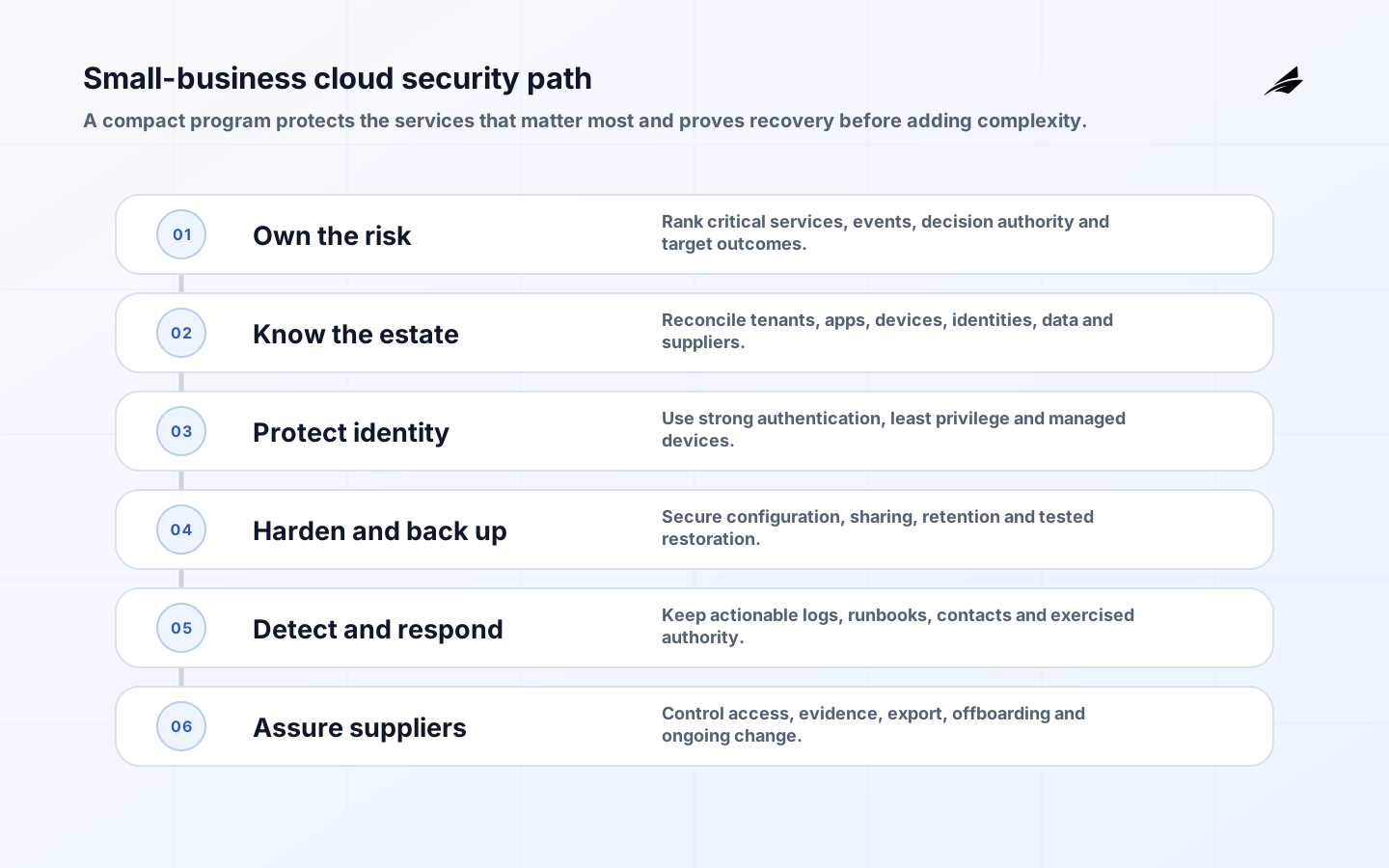
1. Assign cloud risk ownership and priorities
Name an executive risk owner and an operational security lead, even when both roles are part time. List the services required to sell, deliver, invoice, pay staff and communicate with customers. For each, record accountable owner, provider, administrator, data sensitivity, legal or contractual duties, recovery need and maximum tolerable outage. Identify who may accept risk, authorize emergency changes and communicate with customers. Document the managed-service provider’s duties separately from the business’s retained decisions; outsourcing administration does not outsource accountability.
Create a concise target profile for the next quarter. A typical first set includes phishing-resistant administrator authentication, reliable inventory, secure backup and restore, critical logging, timely patching, supplier offboarding and a rehearsed incident call tree. Record why each outcome matters and how completion will be proved. Review cyber insurance and customer contract requirements, but do not let a questionnaire become the risk program. NIST’s small-business guide is intended as a starting point; select outcomes based on actual exposure, resources and tolerance. Add an estimated implementation effort, operating burden and dependency to each outcome. This keeps a small team from committing to controls it cannot maintain and makes a managed provider’s responsibilities visible before work starts.
| Business service | Material event | Control owner | Required proof |
|---|---|---|---|
| Email and identity | Administrator account takeover | Business and identity provider | MFA, role and sign-in review |
| Finance | Fraudulent payment or invoice change | Finance lead | Out-of-band verification test |
| Customer records | Unauthorized export | Data owner | Access review and audit event |
| Operations | Ransomware or provider outage | Operations lead | Timed restore exercise |
2. Build an inventory that supports action
Inventory cloud tenants, subscriptions, domains, applications, data stores, endpoints, integrations, service identities, administrators and suppliers. Include free trials and employee-created services that hold business data. For each asset, record owner, purpose, criticality, region, authentication method, backup, logging and renewal date. Reconcile billing, identity-provider and endpoint records because no single source is complete. Remove abandoned resources and unknown access only after confirming dependencies. Assign a review cadence and a process for new services so the inventory remains operational.

Map external exposure and trust paths. Identify public services, remote-management tools, inbound email domains, shared links, API keys and connections between software-as-a-service products. Document where privileged access enters and which supplier staff can reach production or sensitive records. Treat internet-facing devices and edge appliances as high-priority assets because exploitation can bypass normal endpoint controls. Inventory is complete enough when an incident lead can answer what is affected, who owns it, how to isolate it and what evidence is available.
3. Secure identities, administrators and devices
Centralize workforce authentication where practical. Require multifactor authentication for all users and phishing-resistant methods for administrators and high-impact roles. Eliminate shared accounts; create separate administrative identities; restrict standing privilege; and protect break-glass accounts with strong controls, alerts and periodic tests. Configure conditional access using device and risk signals where supported, but preserve a tested recovery path. Review privileged roles monthly and all active users at least quarterly. Disable access promptly when a person or supplier leaves.
Enroll business devices in managed security controls. Apply supported operating systems, automatic updates, disk encryption, screen lock, endpoint protection and remote wipe according to risk. Separate personal and business use where sensitive work is performed. Protect browsers and password managers because cloud sessions and tokens are valuable targets. Restrict unmanaged devices from administrative work. Test lost-device and compromised-session procedures. A zero-trust approach evaluates identity, device and requested resource rather than assuming that traffic inside an office or VPN is safe.
4. Harden cloud configuration and data handling
Use provider security baselines as inputs, then tailor them to the service. Block public storage unless explicitly approved, restrict network exposure, encrypt supported data, rotate secrets, disable legacy authentication, and use separate production and nonproduction access. Prefer workload identities over long-lived keys. Apply policy checks to infrastructure changes where the platform allows it. Record exceptions with owner and expiry. Review alerts from security posture tools, but validate important findings manually; a high score does not prove that the service is secure or recoverable.
Classify data by consequence and define permitted locations, sharing and retention. Use business-managed collaboration spaces rather than personal accounts. Limit bulk export, external sharing and application consent for sensitive data. Review backups separately from provider resilience: a highly available service can faithfully replicate deletion or corruption. Maintain protected copies for critical records, define recovery point and recovery time needs, and perform restoration into a clean environment. Record actual duration, missing dependencies and reconciliation steps.
| Control | Minimum implementation | Acceptance test | Evidence |
|---|---|---|---|
| Administrator access | Separate account and phishing-resistant MFA | Attempt legacy and unmanaged login | Policy and sign-in record |
| Backup | Protected copy with defined retention | Restore representative service data | Timed restore report |
| Logging | Identity, admin and critical data events retained | Generate and find test events | Query results and retention setting |
| Supplier access | Named, scoped and time-bound accounts | Offboard a test supplier | Access removal record |
5. Make detection and response usable
Enable and retain logs for identity, administrative changes, public exposure, critical data access, security controls and backup. Route a small set of actionable alerts to a monitored destination: suspicious administrator sign-in, new privileged role, MFA change, disabled logging, public resource, unusual export and backup failure. Name primary and backup responders and define acknowledgement times. Test alerts by creating safe events. More telemetry is not automatically better; prioritize signals that support a concrete containment decision.
Prepare short runbooks for account takeover, business email compromise, ransomware, lost device, exposed data and provider outage. Include contact details, decision authority, evidence preservation, isolation options, insurer and legal notification paths, customer communication and recovery. Store an offline copy of essential contacts and tenant identifiers. Rehearse one scenario with leadership and the provider. Measure time to recognize, contain, restore and communicate. Correct the runbook and access gaps found during the exercise rather than treating completion as the objective.
6. Control suppliers and ongoing changes
For each material provider, document service boundary, data access, subcontractors, security contact, incident notification, export options and termination process. Request evidence relevant to the service rather than collecting certificates without analysis. Retain customer control of core domains, cloud tenants, source repositories and authoritative backups where feasible. Supplier personnel should use individual identities and approved support paths. Test offboarding and data export before dependency becomes difficult to reverse. Review material provider changes and unresolved findings at a defined cadence.
Operate security as a small backlog tied to the target profile. Review critical vulnerabilities, unsupported assets, privileged access, backup results, alert handling, supplier changes and incidents monthly. Reassess after acquisitions, new locations, major products or regulatory commitments. Use measures such as protected-admin coverage, known-asset ownership, restore success, high-risk patch age and alert acknowledgement. Avoid vanity totals such as blocked attacks. Evidence should tell leadership whether important services can resist, detect and recover from credible events. Record the decision made from each measure and retire reports that do not change action.
Key takeaways
- Prioritize the few cloud services whose loss would stop the business.
- Secure administrator identity and supplier access before adding complex tools.
- Treat backup restoration and alert detection as tested capabilities.
- Retain ownership of core accounts, records and transition paths.
- Use a quarterly target profile and evidence-based backlog to improve steadily.
Frequently asked questions
Does a cloud provider secure everything automatically?
No. Providers secure defined infrastructure and services, while customers still control identities, data, configuration, endpoints and application behavior to varying degrees. Document the boundary for each service and managed provider.
What should a small business implement first?
Start with accountable ownership, inventory, administrator MFA, timely patching, protected backups, critical logging and a rehearsed response plan. Tailor sequence to the events that would cause the greatest business harm.
Is a compliance report enough to approve a supplier?
No. It can support due diligence, but the business must still evaluate service scope, configuration, access, incident terms, data flows, recovery and exit. Test the controls that the business depends upon.
Conclusion
A small-business cloud security program is credible when important services have owners, access is constrained, recovery is demonstrated and incidents can be handled without improvisation. The goal is not enterprise-sized tooling. It is a compact operating system that makes material risk visible and gives people the authority and evidence to act.
Complete the first cycle by choosing one critical service and walking through compromise, isolation, restoration and customer communication. Record every missing identity, log, contact, permission and decision. Fix those gaps, repeat the exercise, and then extend the method to the next service. That sequence turns a checklist into resilience.