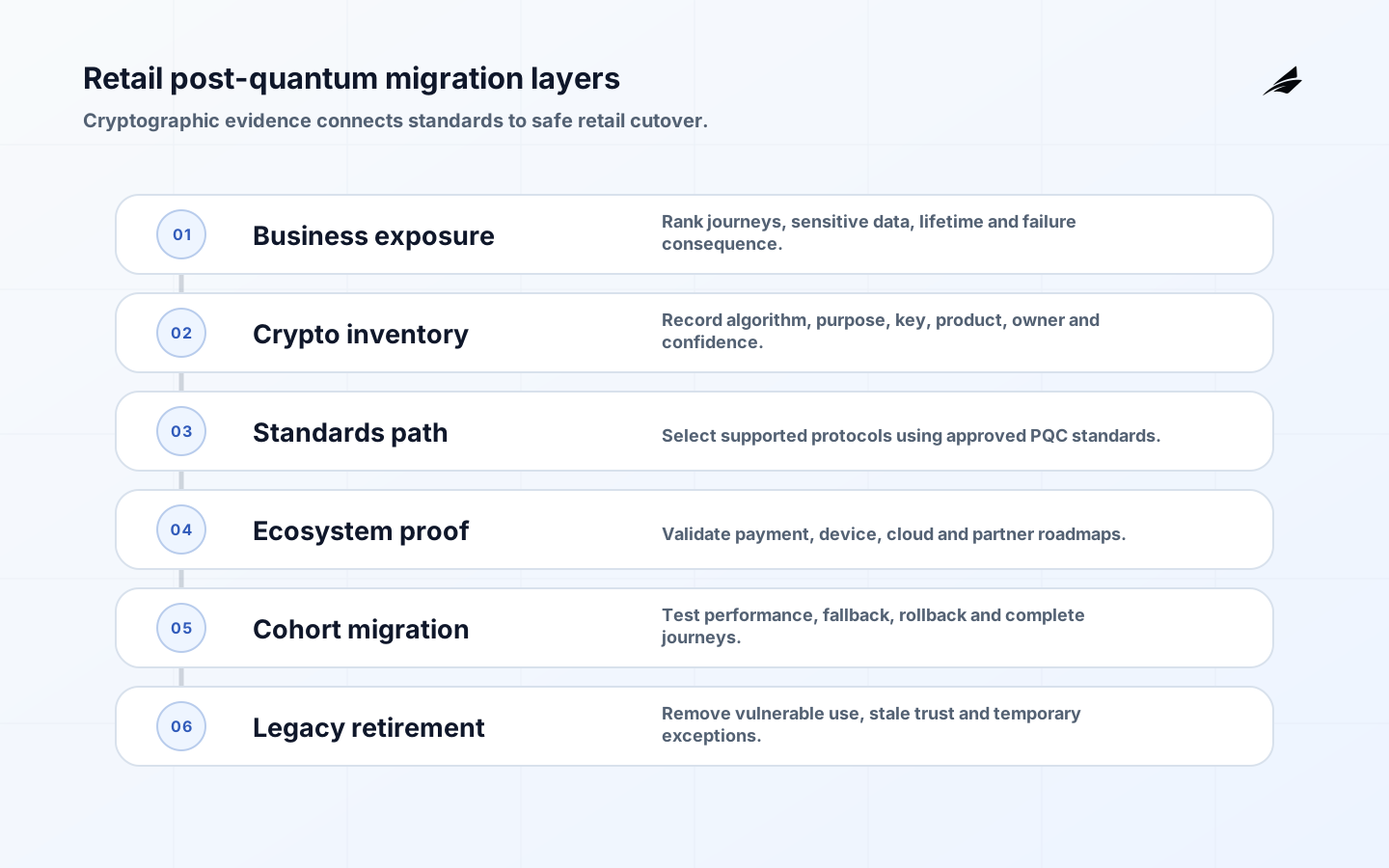
Quantum-safe transformation for retail is the controlled replacement of public-key cryptography that may be vulnerable to a future cryptographically relevant quantum computer. It is not an urgent rip-and-replace of every cipher, nor a reason to weaken systems with unproven products. Retailers should inventory where public-key algorithms protect long-lived data, identities, software, devices and transactions; prioritize by exposure and replacement difficulty; require vendor roadmaps; and test standardized post-quantum implementations in representative environments. Symmetric cryptography and hashing have different quantum considerations, so the program must be algorithm- and use-case-specific.
NIST finalized three initial standards in August 2024: FIPS 203 for ML-KEM key establishment, FIPS 204 for ML-DSA signatures, and FIPS 205 for SLH-DSA signatures. NIST says the standards are ready for use and encourages migration in its standards announcement. Retail teams should still follow protocol, platform and regulator guidance for each deployment. Use the retail transformation scope guide, implementation checklist and general PQC FAQ as companion material.
Why should retailers begin before a large quantum computer exists?
Migration lead time is the main reason. Cryptography is embedded in payment terminals, mobile applications, store networks, e-commerce platforms, APIs, certificates, signing services, data warehouses, supplier links, firmware and managed products. Some components are refreshed quickly; others remain in stores for years or depend on a vendor release. An inventory, ownership model and crypto-agile architecture provide value even if timelines change. They also expose expired certificates, weak key handling, undocumented trust paths and products that cannot be upgraded.
The second reason is information lifetime. An attacker can capture encrypted traffic or data now and attempt decryption later if the protected information remains valuable. Retailers should assess this risk by data type and retention, not by fear. Cardholder data, customer identity, employee records, commercial agreements and authentication secrets have different lifetimes and protections. Do not claim that every captured transaction will become readable; document the actual algorithm, protocol, forward secrecy, retained ciphertext and consequence.
What belongs in a retail cryptographic inventory?
Inventory cryptographic assets and their contexts: algorithm, parameter or key size, purpose, protocol, library or module, certificate, key owner, storage, rotation, data protected, environment, supplier, hardware dependency and replacement path. Include discovery confidence and last verification. Scan source, binaries, configurations, certificate stores, network traffic and cloud services, then reconcile automated results with architecture and vendor evidence. CISA's PQC discovery and inventory strategy treats automation as an evolving capability; no single scanner can reliably see every embedded or externally managed use.
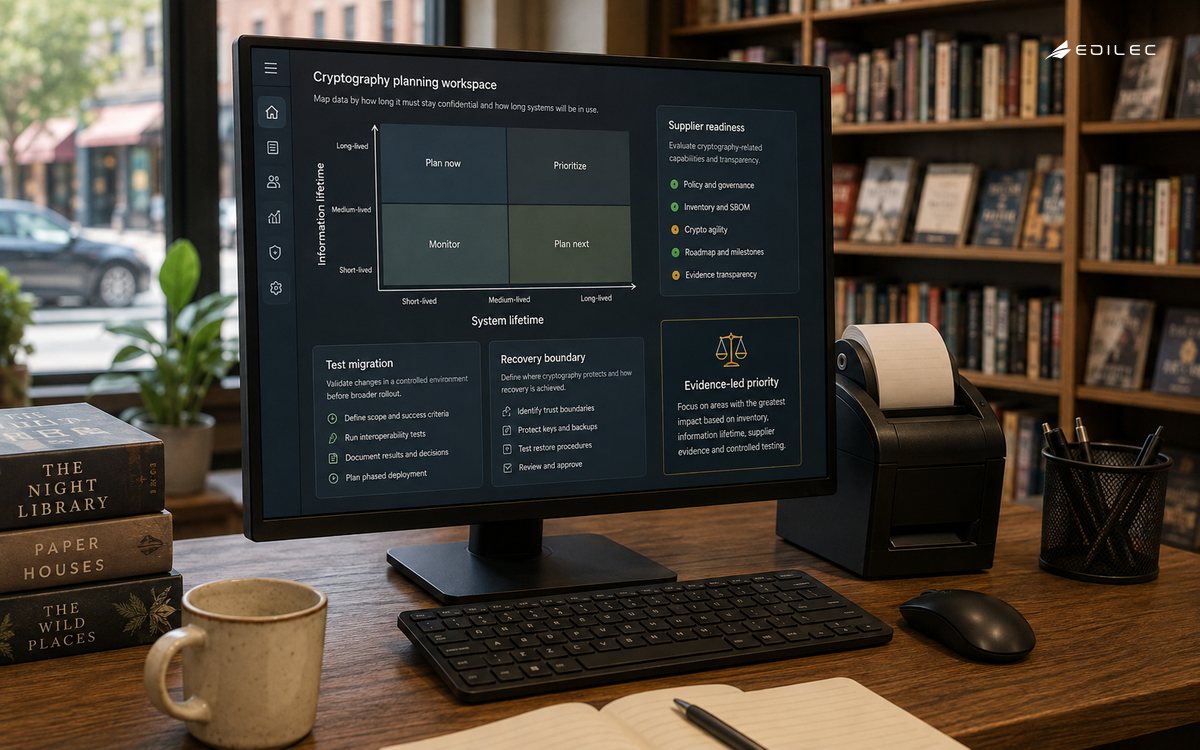
Trace business journeys through the inventory. A click-and-collect order may rely on browser TLS, payment-provider connections, API gateways, identity tokens, message signatures, warehouse links and store-device updates. Record where a crypto change alters payload size, handshake latency, certificate format, hardware acceleration or interoperability. Include code-signing and firmware-signing chains because a retailer may need to verify artifacts long after they were issued. Assign an owner who can fund and accept each migration, not merely a security analyst who found it.
| Retail surface | Cryptographic use | Migration constraint | Evidence to collect |
|---|---|---|---|
| E-commerce and mobile | TLS, tokens and API signatures | Browsers, gateways and third parties move at different rates | Protocol capture, library and provider roadmap |
| Payment environment | Terminal, acquirer and processor trust | Certification and payment-provider dependencies | Approved product versions and integration test |
| Store and edge | VPN, device identity and firmware signing | Long refresh cycles and intermittent links | Fleet versions, roots of trust and update path |
| Supply chain | B2B connections and signed messages | Partner protocol compatibility | Partner inventory and joint test window |
| Enterprise data | Encryption, keys and certificates | Retention and restore history | Data lifetime, key lineage and backup test |
| Software delivery | Artifact and release signatures | Old verifiers may remain deployed | Signer, verifier, timestamp and rollback evidence |
How should retail migration priorities be set?
Score exposure, information lifetime, business criticality, exploit consequence, migration lead time, vendor dependence and change opportunity. Prioritize long-lived sensitive data and trust anchors that are hard to replace. Also act when a scheduled platform or terminal refresh creates a low-cost opportunity. Separate discovery urgency from production-cutover urgency: it is sensible to inventory broadly now while deploying only approved, interoperable designs. Keep assumptions and uncertainty visible instead of inventing a countdown date for a quantum threat.
Build waves around shared dependencies. Update libraries, certificate services, gateways or device-management infrastructure before hundreds of applications where possible. Define exceptions for products that cannot migrate and compensating controls such as shorter data retention, additional symmetric protection, network restriction or accelerated retirement. The quantum-safe implementation checklist offers a broader sequence from discovery to cutover.
Do the NIST standards solve the whole problem?
They standardize algorithms, not complete retail protocols or operational systems. ML-KEM establishes shared secrets; ML-DSA and SLH-DSA provide signatures. Applications still need correct parameter selection, implementation, randomness, key management, protocol negotiation, error handling and side-channel protection. Hardware security modules, certificate authorities, browsers, payment products and partners must support the chosen construction. Use validated implementations when obligations require them and monitor errata and ecosystem guidance.
Avoid replacing an old custom cryptographic design with a new custom hybrid. Hybrid approaches can help interoperability or defense in depth when specified and implemented correctly, but combining algorithms does not automatically combine their strengths. Require a documented protocol, downgrade resistance, failure behavior and independent test evidence. Do not expose production secrets to migration test environments.
What evidence should retailers require from vendors?
Ask each vendor to identify affected products, algorithms and dependencies; supported NIST-standard algorithms; current and planned protocol versions; release and end-of-support dates; required hardware; performance effects; migration and rollback procedure; inventory export; vulnerability handling; and contract commitments. Distinguish a marketing statement of quantum readiness from shipped capability. Require a representative demonstration and test artifacts for the exact product version. Record unknowns and escalation owners.
For managed services, clarify who discovers cryptography in client configuration versus provider internals, who rotates keys and certificates, and how evidence is exported. Include subcontractors and payment ecosystem dependencies. Contract for notification when cryptographic components or roadmaps change. Exit provisions should preserve keys, certificates, configuration and the ability to verify historical signatures where necessary.
How should performance and interoperability be tested?
Create a test matrix covering client and server versions, browsers, mobile devices, terminals, gateways, proxies, HSMs, certificate services, partner endpoints and degraded networks. Measure handshake latency, CPU, memory, message and certificate size, connection failure, battery or edge effects, throughput and recovery. Test key rotation, certificate renewal, rollback, mixed-version negotiation, invalid messages and downgrade attempts. Use synthetic data and isolated keys, then progress through internal, limited and production cohorts.
A successful handshake is insufficient. Verify the full retail journey, telemetry, alerting, customer error handling and operational support. Confirm that legacy fallback remains only where approved and cannot be silently selected. Preserve algorithm and version evidence without logging secrets. Rehearse a defect response that pauses rollout, restores service and identifies every affected cohort.
| Gate | Decision question | Minimum evidence | Stop condition |
|---|---|---|---|
| Discovery | Do we know the material cryptographic uses? | Coverage map, confidence and owners | Critical journey has unknown trust path |
| Design | Is the protocol standardized and supportable? | Architecture, threat review and vendor support | Custom construction lacks review |
| Lab | Does it work across representative components? | Compatibility and performance results | Unsafe fallback or material regression |
| Pilot | Can operations support a mixed estate? | Cohort telemetry, rollback and runbook | Unexplained failures or weak visibility |
| Scale | Are dependencies and support ready? | Wave approvals and capacity evidence | Partner or device cohort not ready |
| Retire | Can vulnerable use be removed safely? | Inventory closure and exception review | Required verifier or retained data omitted |
How should the program be governed?
Create a cryptography steering group with security, architecture, payment, store technology, digital product, data, procurement, legal and risk participation. Maintain one decision register, inventory, vendor tracker, standards watch and exception process. Review inventory coverage, unsupported assets, long-lived-data exposure, vendor readiness, tested compatibility, migration progress and incidents. Report uncertainty honestly. NIST's migration to post-quantum cryptography FAQ is a useful source for evolving implementation work.
Fund crypto agility, not one migration campaign. New systems should centralize configurable cryptographic policy, identify algorithms in telemetry, support safe key and certificate rotation, and avoid hard-coded assumptions. Procurement should require inventory and upgrade commitments. Retirement matters: remove deprecated algorithms, unused trust anchors, transitional fallback and temporary exceptions after dependents are ready.
Key takeaways
- Inventory cryptography by business journey, data lifetime and replacement path.
- Use finalized standards through supported protocols and implementations, not custom algorithm combinations.
- Prioritize long-lived sensitive data, hard-to-replace trust anchors and scheduled refresh opportunities.
- Demand product-version evidence and migration commitments from payment, device and cloud suppliers.
- Test compatibility, performance, downgrade resistance, rollback and complete retail journeys.
- Maintain crypto agility and retirement controls after the first migration waves.
Quantum-safe transformation for retail FAQ
Must retailers replace AES? Not as part of the same public-key migration. Quantum effects and recommended key strengths differ for symmetric cryptography. Follow current standards and assess each use rather than treating all algorithms alike.
Should a retailer wait for every protocol and vendor? No. Inventory, prioritization, procurement requirements, lab testing and architecture improvements can start now. Production rollout should follow applicable standards and supported ecosystem paths.
Does PCI DSS currently certify an implementation as quantum-safe? PCI obligations and product approvals must be checked with the relevant payment entities. Do not infer payment acceptance from NIST algorithm standardization alone.
Can a scanner produce a complete cryptographic bill of materials? It can provide important evidence, but embedded, runtime, hardware and supplier-managed uses require additional methods and owner validation.
Conclusion
Quantum-safe transformation for retail is an estate-management and trust-management program. Start with evidence about algorithms, data, devices, partners and lifetimes; use standardized capabilities through supported protocols; test complete journeys; and retire vulnerable paths deliberately. This approach prepares the retailer without claiming certainty about quantum timelines or putting current payment and customer operations at risk.