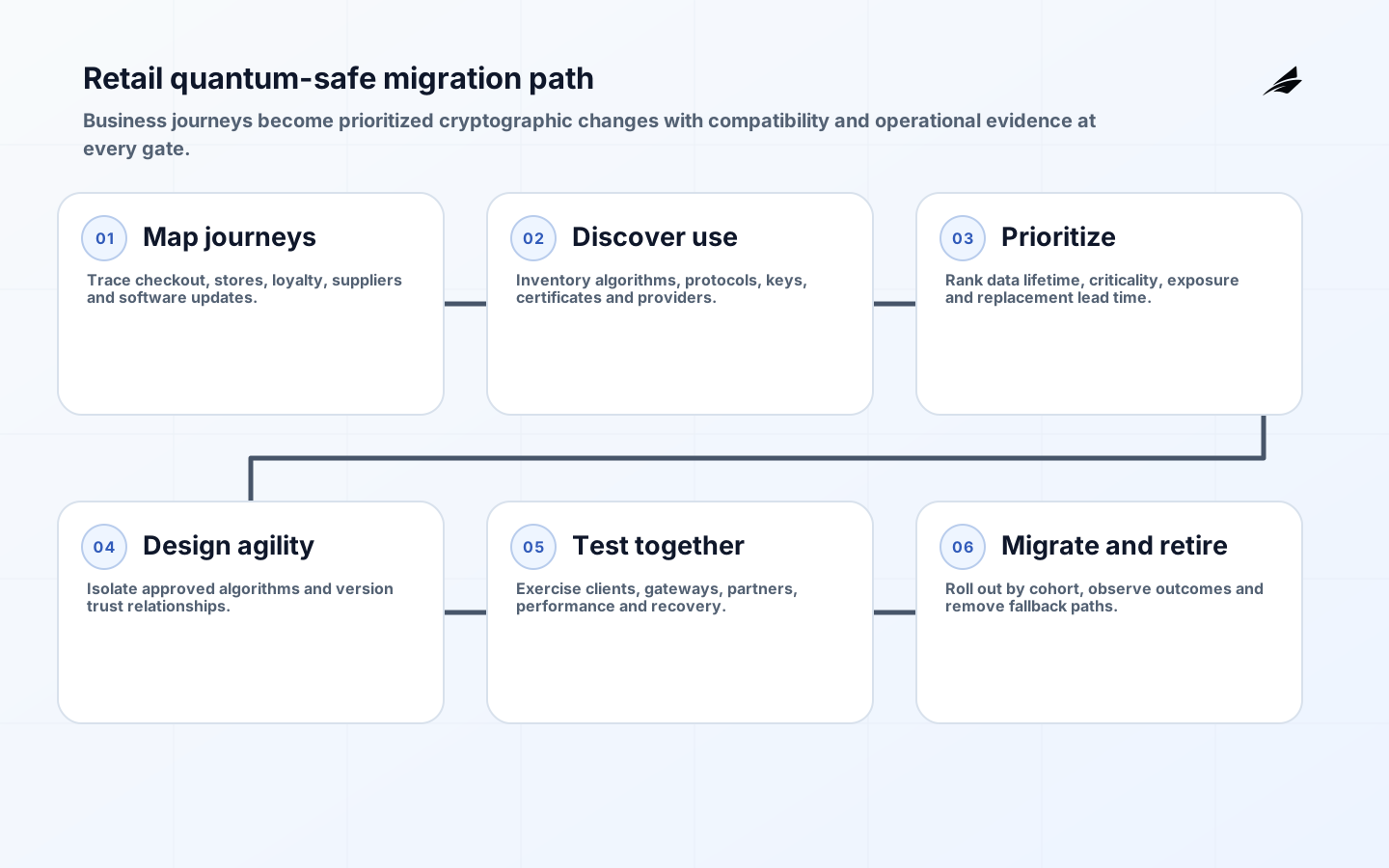
Quantum-safe transformation for retail is a multi-year change to the cryptography embedded in stores, ecommerce platforms, payment connections, loyalty systems, mobile applications, supplier integrations and corporate infrastructure. It is not a single algorithm upgrade. NIST finalized ML-KEM, ML-DSA and SLH-DSA in FIPS 203, 204 and 205 in August 2024, making standards-based implementation possible. Retailers should now identify where quantum-vulnerable public-key cryptography is used, decide which information and services need protection first, and build replacement paths that preserve transaction integrity and availability.
The central planning problem is dependency, not prediction. A retailer does not need to forecast the date of a cryptographically relevant quantum computer to know that long-lived confidential data and slowly replaced devices deserve attention. This guide complements the retail implementation checklist and retail quantum-safe FAQ. It focuses on scope, commercial choices, delivery evidence and the operational safeguards needed while classical and post-quantum mechanisms coexist.
Define the retail transformation scope from business journeys
Start with retail journeys whose failure has a clear consequence: authorize a payment, establish a customer session, redeem loyalty value, sign a software update, connect a store to headquarters, exchange orders with a supplier, administer a cloud account and recover a critical service. Trace each journey through applications, APIs, certificates, keys, hardware security modules, network appliances, managed services and external parties. Record where cryptography provides confidentiality, authentication, integrity or code-signing assurance. This turns an abstract cryptography program into a service map that business and technical owners can review together.
Separate information lifetime from system lifetime. Customer identity records, employee information, contracts and strategic data may remain sensitive long after a TLS session ends, creating a harvest-now-decrypt-later concern. Store appliances, payment terminals and warehouse equipment may remain deployed for years even when the data they handle is short-lived. Rank both dimensions, then add business criticality, exposure, replacement lead time and supplier readiness. The output should be a prioritized migration register, not a flat spreadsheet containing every certificate with the same urgency.
| Retail domain | Cryptographic dependency | Planning question |
|---|---|---|
| Ecommerce and mobile | TLS, identity tokens, API signatures | Can every client and edge service negotiate approved replacements? |
| Stores and payments | Terminal certificates, VPNs, payment gateways | Who controls firmware, certification and replacement timing? |
| Loyalty and customer data | Encryption, service identity, partner exchange | How long must confidentiality and integrity survive? |
| Software supply chain | Artifact signing and update verification | Can all deployed verifiers accept a new signature scheme? |
Build a cryptographic inventory that supports decisions
Discovery combines automated observation with authoritative records. Scan code repositories and binaries for cryptographic libraries and algorithm use; inspect certificate inventories, TLS telemetry, key managers, hardware security modules, network configurations and cloud services; and ask suppliers for machine-readable cryptographic capabilities where possible. Each record needs a business service, technical owner, data classification, algorithm, protocol, key or certificate lifecycle, implementation provider, environment and dependency chain. Record confidence and evidence date because discovery is never complete after one scan.
Do not confuse a certificate list with a cryptographic bill of materials. The inventory must reveal where an algorithm is implemented and what will break if it changes. A Java service may rely on a runtime provider, a gateway and a partner that each support different hybrid or final-standard combinations. A signed device update may depend on a bootloader that cannot be changed remotely. Test discovery results against representative journeys and procurement records, then create controls so new systems register cryptographic dependencies during design and deployment.
Design for crypto agility before widespread replacement
Crypto agility means an organization can replace algorithms, parameters, certificates, protocols and implementations without redesigning the business service. Isolate cryptographic choices behind maintained libraries or managed interfaces; remove hard-coded algorithm identifiers and key sizes; version message and signature formats; and allow trust stores to carry overlapping credentials during transition. Preserve downgrade protection and explicit policy. Agility is not accepting every available algorithm. It is the ability to move between approved choices with tested configuration, compatibility and rollback.
Use hybrid deployments only where the protocol, implementation and risk case are understood. Combining classical and post-quantum mechanisms can reduce transition uncertainty, but it also increases handshake size, certificate or message size, CPU work and interoperability complexity. Measure effects across mobile networks, edge gateways, store links and high-volume checkout paths. Keep a clear record of which component performs each primitive and how keys are derived. Avoid inventing proprietary combinations when standards-track protocol support or vendor-supported profiles are available.
Deliver migration in controlled retail waves
A practical first wave establishes governance, discovery coverage, procurement requirements and test environments. A second wave upgrades centrally controlled services with short dependency chains, such as internal service certificates or selected administrative paths. Later waves address partner-facing APIs, public channels, payment-connected systems and long-lived devices. Sequence around retail peaks and change freezes. Every wave needs compatibility tests, performance baselines, rollback or dual-operation rules, monitoring and a named authority who can stop migration if customer or transaction outcomes degrade.
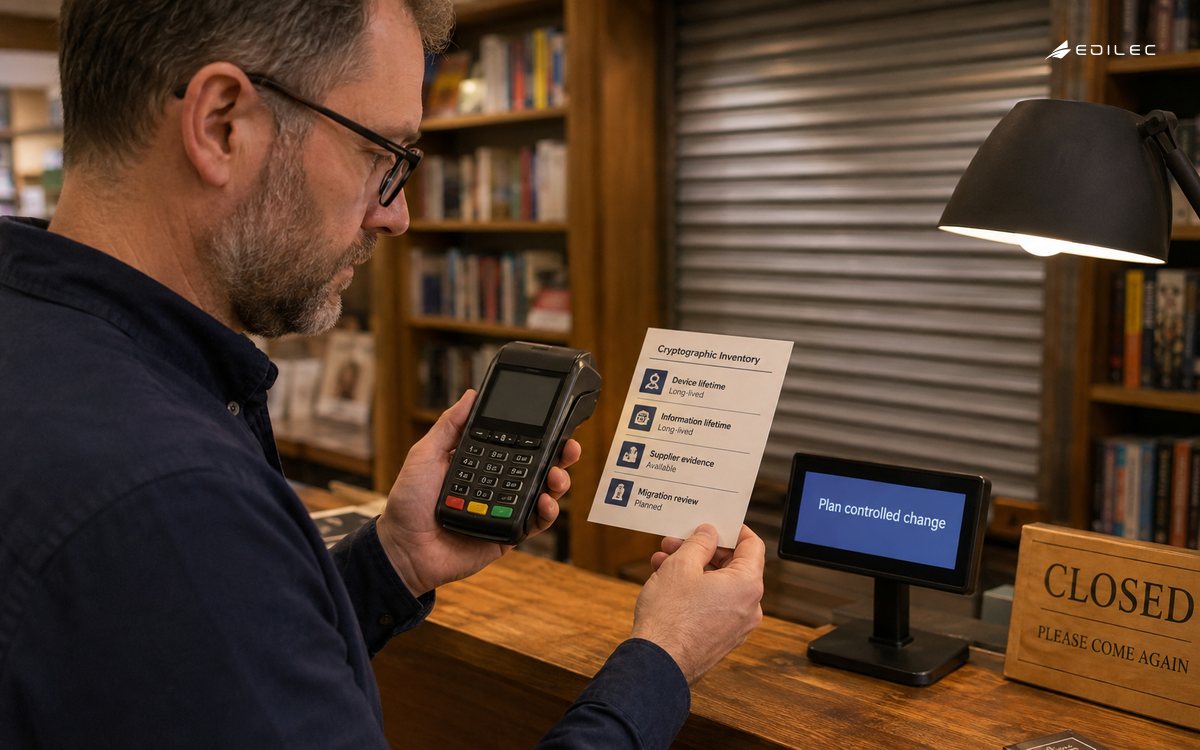
Build an interoperability laboratory that represents older clients, current browsers, mobile versions, gateways, load balancers, service meshes, hardware modules and partner endpoints. Test successful negotiation, rejected policy, certificate rollover, expired credentials, failed signature verification and mixed-version recovery. Capture packet and application evidence without exposing secrets. Production rollout should begin with observable cohorts and preserve a classical recovery path only for an explicitly time-bounded period. A permanent fallback silently defeats the migration objective.
| Delivery gate | Required evidence | Stop condition |
|---|---|---|
| Discovery coverage | Critical journeys mapped to algorithms and owners | Unknown cryptography in a critical transaction path |
| Interoperability | Representative clients and partners complete test scenarios | Downgrade, negotiation or verification ambiguity |
| Performance | Latency, throughput and resource impact within budget | Checkout or store connectivity breaches its target |
| Operations | Rotation, incident and rollback runbooks exercised | Support cannot identify or reverse a failed change |
Estimate cost from change surfaces and replacement constraints
The largest costs usually come from inventory work, dependency remediation, device replacement, protocol upgrades, partner coordination, testing and dual operation rather than algorithm code alone. Estimate by journey and asset cohort. Include engineering, specialized assessment, laboratory capacity, vendor upgrades, hardware security modules, certificates, network and compute impact, recertification, field service, support training and evidence retention. Separate one-time migration from enduring crypto-agility operations. A low initial quote that excludes partner testing or device lifecycle work is not a credible whole-program estimate.
Maintain a risk register covering hidden dependencies, immature protocol support, unsupported equipment, supplier claims without test evidence, performance regression, downgrade paths, key-management error and schedule conflict with business peaks. Treat regulatory or payment obligations as constraints to verify with accountable specialists, not slogans. Procurement should require algorithm transparency, standards-based roadmaps, update mechanisms, vulnerability handling, exportable records and exit support. Avoid locking the retailer into a proprietary control plane that makes the next cryptographic transition harder.
Operate the program with measurable acceptance
Assign an executive risk owner, cryptography architecture owner, service owners, security engineering, procurement, privacy, operations and supplier managers. The central team maintains standards, discovery methods and evidence; service owners remain accountable for customer and operational outcomes. Review coverage, migration readiness, exceptions, supplier commitments and tested recovery at a regular cadence. Report uncertainty honestly. Counting scanned hosts or purchased licenses is not evidence that critical retail journeys are safe to migrate.
Acceptance should prove that approved algorithms are used where intended, deprecated options are rejected, keys and certificates can rotate, observability identifies failures, and services recover within agreed limits. Sample the inventory against production telemetry. Re-run interoperability after library, device, protocol and supplier changes. Retire old keys, credentials and fallback configurations deliberately, with destruction or revocation evidence. The program is complete only when crypto agility becomes part of architecture, procurement, deployment and operational review rather than a temporary project team.
Key takeaways
- Prioritize retail journeys, long-lived information and slowly replaced assets rather than treating every algorithm instance equally.
- Build a living cryptographic inventory with owners, purpose, dependencies and evidence.
- Establish crypto agility and interoperability testing before broad production migration.
- Budget for suppliers, devices, testing, dual operation and operational evidence, not only new libraries.
- Retire fallback mechanisms after controlled waves so transition does not become permanent exposure.
Frequently asked questions
Must a retailer replace symmetric encryption immediately?
The urgent transition focus is generally public-key cryptography used for key establishment and digital signatures. Symmetric algorithms have different quantum-security considerations. Inventory them, verify adequate approved key strengths and follow applicable standards, but do not replace sound symmetric controls merely to label a system quantum-safe.
Can a retailer wait for every vendor to finish?
No. Vendor roadmaps matter, but the retailer can begin discovery, prioritization, procurement requirements, architecture decoupling and laboratory testing now. Where a critical supplier lacks a credible path, the program needs a replacement, isolation or risk-treatment decision with an owner and date.
Does quantum-safe mean the whole retail system is secure?
No. Post-quantum algorithms address specific cryptographic threats. Identity, authorization, software vulnerabilities, fraud, endpoint compromise, key protection and operational resilience remain essential. Migration must preserve existing controls and should not be presented as a substitute for a broader security program.
Conclusion
Quantum-safe transformation for retail is a disciplined dependency and lifecycle program. The useful outcome is not a declaration that algorithms changed; it is evidence that critical journeys can negotiate, authenticate, sign, recover and evolve under approved standards without disrupting customers or stores. Start with discovery and ownership, build crypto agility, test real compatibility, and move in controlled waves.
Retailers that begin with their most durable data and slowest replacement cycles gain time to influence suppliers and avoid rushed field changes. The same operating model also improves present-day certificate management, key rotation and incident response. That makes quantum readiness a practical resilience investment even while the exact threat timeline remains uncertain.