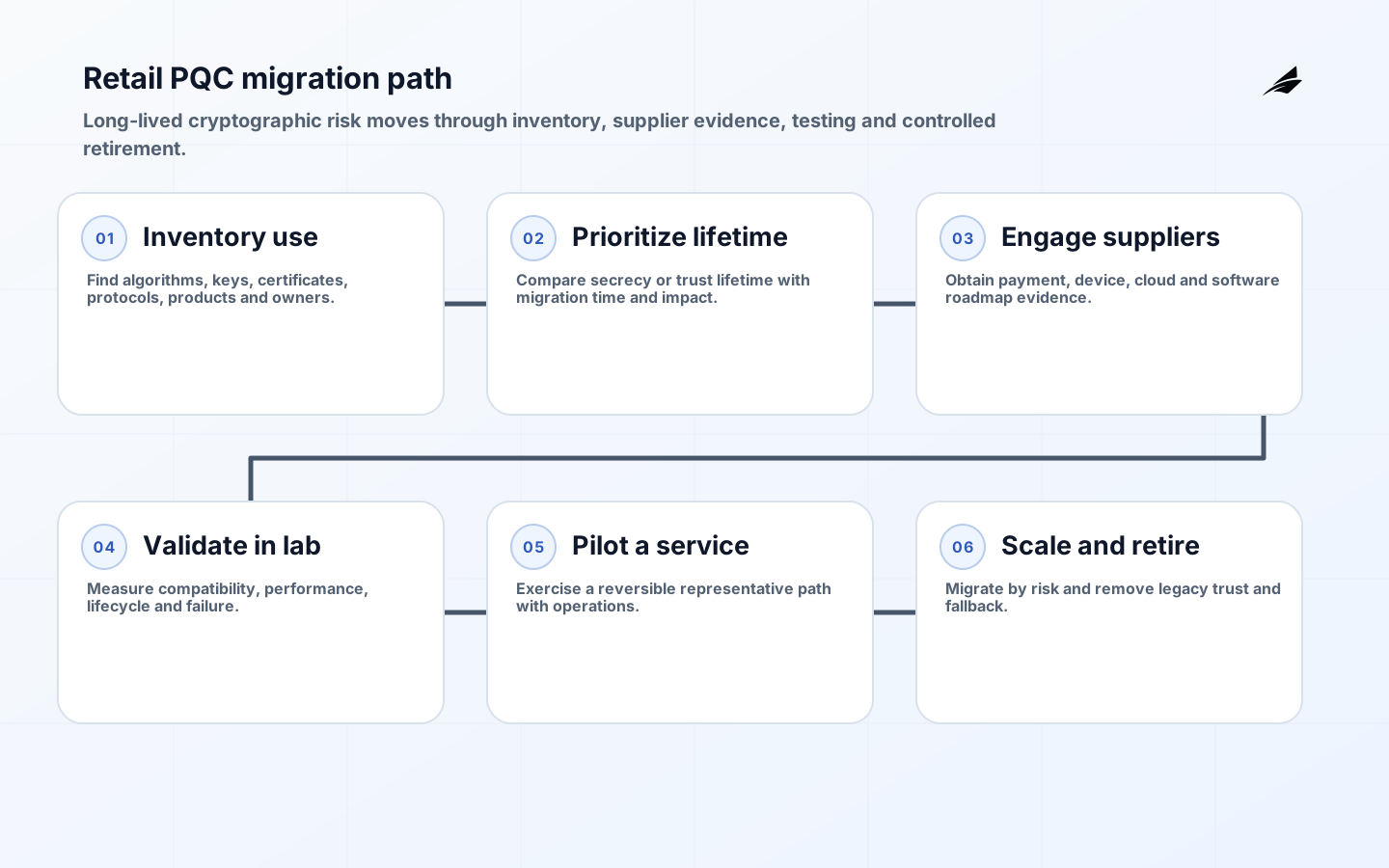
This post-quantum cryptography readiness for retail FAQ treats readiness as a multi-year dependency and migration program, not an urgent replacement of every certificate. Retailers depend on public-key cryptography across ecommerce, stores, mobile apps, identity, suppliers, payment connectivity, devices, code signing and long-lived business records. Readiness begins by finding those uses, understanding who controls them and prioritizing data or trust that must remain secure beyond the useful life of current algorithms. Migration then proceeds through supported products, protocols and carefully tested application changes.
NIST finalized FIPS 203, 204 and 205 in August 2024: ML-KEM for key establishment and ML-DSA and SLH-DSA for digital signatures. Those standards provide approved algorithm specifications, but they do not make every retail platform or payment product migration-ready. CISA, NSA and NIST advise organizations to create a roadmap, inventory cryptography, assess risk and engage vendors. Retail teams should avoid both complacency and unsupported claims that ordinary transport encryption is already “quantum safe.”
Why should retailers plan before a cryptographically relevant quantum computer exists?
Some customer, employee, legal and commercial data needs confidentiality for years. An adversary can collect encrypted traffic or archives now and attempt decryption later if current public-key protection becomes breakable. Signatures also matter: software, firmware, documents and identities may need trustworthy verification over long periods. Migration itself is slow because cryptography is embedded in protocols, hardware, certificates, libraries and supplier contracts. Planning early reduces the need for rushed, incompatible changes.
Risk is not uniform. A public product page encrypted in transit has different long-term consequence from identity recovery data, private customer records, acquisition documents, signing roots or firmware accepted by store devices. Define secrecy lifetime, signature lifetime, replacement time and impact. Prioritize where protected life exceeds plausible migration time, while maintaining current security hygiene. PQC planning does not excuse weak keys, exposed secrets, missing patches or broken authorization today.
| Retail domain | Cryptographic dependency | Readiness question |
|---|---|---|
| Ecommerce and mobile | TLS, APIs, tokens and certificates | Which endpoints and libraries can negotiate supported PQC or hybrids? |
| Stores and edge | Device identity, VPN, firmware signing | Can constrained hardware and trust roots be updated? |
| Payments | Acquirer, gateway, terminal and network protocols | Which changes are controlled by payment partners? |
| Enterprise identity | Federation, device certificates, privileged access | Which identity products publish migration roadmaps? |
| Data and documents | Encryption, keys and digital signatures | How long must confidentiality and verification remain valid? |
What belongs in a cryptographic inventory?
Record business service, data, protocol, endpoint, library or product, algorithm, key size, certificate authority, key location, owner, supplier, environment, expiry, update path and evidence source. Include TLS termination, service meshes, APIs, VPNs, SSH, code and firmware signing, document signatures, database and backup key wrapping, identity tokens, email and device enrollment. Inventory trust stores and root keys, not only leaf certificates. Mark unknown and externally controlled dependencies rather than guessing.

Combine discovery methods: configuration and code search, certificate scanning, network observation, cloud key inventories, software bills of materials, procurement data and supplier questionnaires. Each method has blind spots. Validate samples with service owners. Keep the inventory connected to asset and application records so it changes with releases. A one-time spreadsheet decays immediately; a useful inventory has automated evidence where possible and review for opaque appliances and contracted services.
How should payment and retail suppliers be handled?
Retail payment paths involve terminals, gateways, acquirers, processors, schemes, banks and hardware-security products. The retailer should not unilaterally alter a certified or contracted protocol. Map interfaces and responsibility, then ask each provider for standards dependencies, supported upgrade paths, hardware constraints, testing requirements and schedule. Record whether the retailer controls a TLS endpoint or only consumes a managed service. Align migration with current payment-security and compliance obligations.
Extend due diligence to ecommerce platforms, CDNs, identity providers, cloud services, POS vendors, device manufacturers, logistics networks and software suppliers. Ask for evidence, not a marketing badge: which standardized algorithms are planned, in which versions, under what configuration, with what interoperability and rollback? Require notice of material roadmap change and end-of-support. Avoid locking contracts to premature algorithm names where standards and implementation profiles continue to evolve; require standards-based crypto agility and transparent lifecycle support.
What does cryptographic agility mean in practice?
Crypto agility is the ability to identify and replace cryptographic mechanisms without redesigning the entire business service. Centralize policy and certificate lifecycle where appropriate, use maintained libraries and protocols, avoid custom cryptography, version interfaces and separate business data from algorithm-specific encodings. Preserve algorithm and key metadata needed to decrypt or verify retained records. Test rollover and coexistence. Agility is an architectural and operating property, not a configuration switch.
Plan for hybrid and transition modes only where the selected standards, products and interoperability profiles support them. Combining algorithms can reduce dependence on one mechanism, but it can also increase message size, latency, code paths and failure modes. Test load balancers, proxies, clients, hardware modules and observability end to end. Do not invent a home-grown hybrid. Use vendor-supported, standards-aligned implementations and keep a rollback that does not silently downgrade below approved policy.
| Migration gate | Required evidence | Do not proceed when |
|---|---|---|
| Inventory | Critical uses and owners are reconciled | Opaque payment or device dependencies remain unowned |
| Selection | Standardized, supported implementation is identified | Algorithm claim lacks product/version evidence |
| Lab | Compatibility, performance and failure are measured | Handshake, signature or key lifecycle is unexplained |
| Pilot | Representative channel and operations complete | Rollback or monitoring is absent |
| Scale | Supplier, support and recovery plans are approved | Mixed estate cannot be governed |
How should a retail PQC pilot be selected?
Choose a bounded service with representative technology, clear ownership and reversible impact. Internal service-to-service communication or a controlled signing workflow may be easier than a public payment path. Define what the pilot proves: library support, certificate issuance, key custody, handshake size, latency, device capacity, monitoring, rollback and support. Use test data and current standardized implementations. A successful demo between two laptops does not prove fleet or channel readiness.
Measure performance at realistic concurrency and constrained edges. Exercise certificate renewal, key rotation, mixed client versions, failed negotiation and disaster recovery. Confirm logs and monitoring understand new algorithm identifiers without exposing key material. Update threat models and runbooks. Record the resulting reusable pattern and gaps. The pilot should inform procurement and sequencing even if broad deployment waits for supplier support.
How should the roadmap be governed?
Give one accountable program owner authority to coordinate security, architecture, payments, legal, procurement, store technology and product teams. Maintain milestones for inventory coverage, high-risk dependency decisions, supplier evidence, pilots and migrations. Track standards and product changes through authoritative sources. Review risk at least after material architecture, acquisition or supplier change. Fund current cryptographic maintenance alongside future migration so the roadmap does not become a reason to defer expiring certificates or vulnerable libraries.
Define acceptance and retirement. New systems should disclose cryptographic dependencies and support approved agility requirements. Migrated systems need evidence that legacy algorithms, keys, certificates and fallback paths are removed where policy requires, while retained data remains usable. Preserve audit and legal verification needs. Communicate carefully: readiness is measured by inventory, decisions and tested migration capability, not a claim that the entire retailer is already quantum resistant.
Add quantum-readiness evidence to retail procurement
For new products, request a cryptographic dependency statement, supported algorithm and protocol versions, key and certificate lifecycle, update mechanism, hardware constraints, support dates and migration roadmap. Ask how the supplier will notify customers about cryptographic changes and vulnerabilities. For software, seek machine-readable component evidence where useful, while recognizing that an SBOM may not reveal runtime protocol configuration or hardware trust roots. Require exportable configuration and avoid custom algorithms.
Evaluate claims against the exact product version and deployment mode. “PQC ready” may mean a laboratory build, one library or a future roadmap rather than a supported configuration. Require interoperability and performance evidence relevant to the retailer’s clients and infrastructure. Contract outcomes should support standards-based change without forcing premature deployment. Procurement cannot predict every future standard, but it can reject opaque, unupdatable products that make any migration impossible.
Preserve current cryptographic operations during migration
Maintain certificate renewal, key rotation, revocation, signing and incident response while the program runs. Inventory owners must still handle leaked keys, expiring roots and deprecated protocols. Mixed classical and PQC estates create monitoring and support complexity, so dashboards and runbooks should identify negotiated algorithms and fallback without recording secret material. Migration should reduce long-term exposure without weakening present-day authentication or service availability.
Key takeaways
- Prioritize cryptographic uses by data lifetime, trust lifetime and migration time.
- Inventory algorithms, keys, protocols, products, owners and suppliers continuously.
- Coordinate payment and device changes through the responsible ecosystems.
- Build standards-based crypto agility and test coexistence and rollback.
- Use representative pilots to produce evidence and reusable migration patterns.
Frequently asked questions
Should a retailer replace RSA and elliptic-curve cryptography immediately?
Not indiscriminately. Build inventory and risk priorities, follow current standards and supported product guidance, and plan migration. Uncoordinated changes can break interoperability and compliance. Protect current systems while preparing.
Does quantum computing make symmetric encryption obsolete?
The main migration concern differs from the public-key algorithms used for key establishment and signatures. Symmetric security parameters may still require review. Follow authoritative algorithm and system guidance rather than applying one rule to every use.
Will cloud and payment providers handle everything?
No. Providers control important layers, but retailers own application dependencies, data-lifetime decisions, configurations, supplier governance and many endpoints. Obtain roadmaps and map responsibility for every critical interface.
Conclusion
Retail PQC readiness is the ability to see cryptographic dependence and change it safely. Build an owned inventory, identify long-lived risk, engage payment and technology suppliers, improve crypto agility and prove representative migration paths. That work creates value before quantum threats mature because it also reduces today’s certificate, key and unsupported-product surprises.