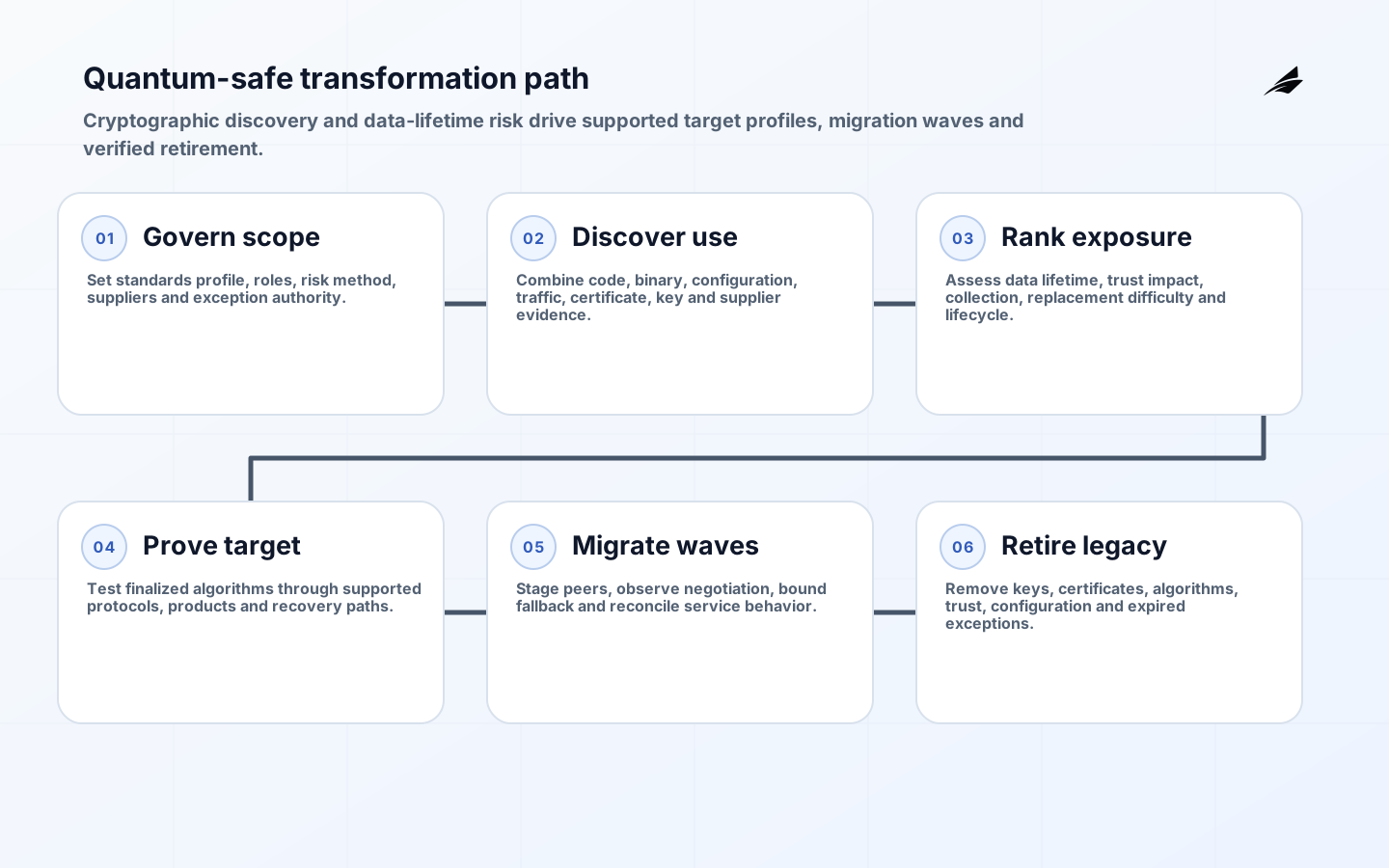
Quantum-safe transformation services help an organization find where quantum-vulnerable public-key cryptography is used, prioritize the resulting risk and migrate systems to supported post-quantum mechanisms. The work is broader than replacing one algorithm. Public-key cryptography appears in transport security, virtual private networks, identity, certificates, code and document signing, software updates, devices, backups and partner protocols. A safe transition must preserve interoperability and availability while proving that vulnerable dependencies are actually retired.
NIST finalized its first three post-quantum standards in 2024: FIPS 203 specifies ML-KEM for key establishment, FIPS 204 specifies ML-DSA, and FIPS 205 specifies SLH-DSA for signatures. CISA, NSA and NIST advise organizations to establish a quantum-readiness roadmap, inventory cryptographic use, assess risk and engage suppliers. This FAQ explains what a transformation engagement should deliver and how buyers can distinguish an operational migration from a presentation about future quantum computers.
What does quantum-safe transformation include?
The scope normally includes governance, cryptographic discovery, data-lifetime analysis, target standards, product and supplier readiness, laboratory interoperability, migration waves, operational monitoring and retirement. It should cover applications, infrastructure, operational technology and externally delivered products where relevant. The program needs business, security architecture, identity, network, platform, application, procurement and legal participation. One team cannot discover every embedded use or negotiate every partner change alone.
Define “quantum safe” precisely. It may mean using NIST-standardized post-quantum algorithms for applicable key establishment and signatures, while retaining approved symmetric algorithms with suitable key strengths. It does not mean that every security problem becomes quantum-related or that a product containing one new algorithm is fully migrated. Record target profiles by protocol and use case, including approved hybrid approaches, key sizes, certificate behavior, implementation validation and fallback rules. Follow sector and jurisdiction guidance in addition to general NIST material.
| Workstream | Primary output | Acceptance evidence |
|---|---|---|
| Governance | Scope, roles, risk method and standards profile | Approved decision rights and tracked exceptions |
| Discovery | Cryptographic bill of materials or use inventory | Reconciled coverage and owner for each material use |
| Prioritization | Risk-ranked migration backlog | Data lifetime, exposure and replacement difficulty recorded |
| Engineering | Tested target patterns and migration waves | Interoperability, performance, failure and rollback results |
| Retirement | Removed vulnerable paths and legacy trust | Runtime and configuration evidence with closed exceptions |
How is a cryptographic inventory created?
Combine multiple evidence sources. Scan source and binaries, inspect dependencies and cryptographic libraries, query certificate and key-management systems, observe network handshakes, review configuration, examine hardware and firmware, and ask suppliers. Record algorithm, purpose, protocol, implementation, key and certificate owner, data protected, environment, exposure, update path and replacement dependency. Tools produce candidates; domain owners must validate meaning. A certificate scan alone misses code signing, stored signatures, proprietary protocols and dormant recovery processes.

Treat inventory as a maintained data product. Give each item a stable identifier and evidence timestamp. Reconcile it with assets, services, software components and supplier records. Track unknowns rather than dropping them. Add discovery checks to procurement, architecture review and software delivery so new quantum-vulnerable dependencies do not enter while the program removes old ones. Inventory quality should be measured by coverage of critical services, ownership and verified purpose—not by raw algorithm counts.
Which systems should migrate first?
Prioritize where protected information must remain confidential for a long time, where communications are exposed to collection, and where migration will take years. The “harvest now, decrypt later” concern makes data lifetime important even before a cryptanalytically relevant quantum computer exists. Also prioritize trust anchors, code-signing and update paths whose compromise could affect many systems. Combine consequence, exposure, lifetime, algorithm use, supplier dependency, replacement difficulty and lifecycle date. Do not rank solely by current internet exposure.
Find opportunities tied to planned upgrades. A certificate-platform renewal, network refresh or product release may provide a safer migration window than a separate retrofit. Conversely, a long-lived device with no update path may require procurement or segmentation action years before algorithm retirement deadlines. Define compensating controls and expiry for systems that cannot yet migrate. The backlog should distinguish discovery uncertainty, product unavailability, protocol standardization, engineering work and business scheduling because each blocker needs a different owner.
How are target algorithms and protocols chosen?
Use finalized standards and supported protocol profiles appropriate to the organization. FIPS 203, 204 and 205 define algorithms, but applications need correct integration through protocols, libraries, modules, certificates and key-management systems. Verify parameter sets, implementation guidance, product support and applicable validation requirements. Avoid inventing cryptographic constructions or deploying candidates only because a library exposes them. Monitor NIST errata and standards updates, and keep the target profile versioned.
Hybrid key establishment or signatures can combine classical and post-quantum components during transition, but a hybrid is not automatically safer. The combiner, negotiation, downgrade behavior, certificate format, message size and operational recovery must be specified and tested. Define whether both components are required for acceptance and how failures are surfaced. Keep an exit path from the hybrid once ecosystem requirements stabilize. The objective is controlled interoperability, not permanent duplication of every cryptographic mechanism.
| Test dimension | Question | Evidence |
|---|---|---|
| Interoperability | Do all peers negotiate and validate the target profile? | Cross-product connection and failure matrix |
| Performance | What changes in handshake, signing, verification and memory? | Representative load and constrained-device results |
| Size | Can certificates, messages, storage and intermediaries carry larger artifacts? | Protocol and infrastructure boundary tests |
| Downgrade | Can an attacker or misconfiguration force a legacy path? | Negative tests and observable policy violation |
| Recovery | Can keys, trust and service be restored safely? | Rotation, rollback and disaster-recovery exercise |
What should suppliers be asked?
Ask suppliers for a product-specific roadmap: current cryptographic dependencies, planned standards and protocols, release dates, supported versions, hardware constraints, migration procedure, hybrid behavior, configuration evidence, validation and end-of-support. Require answers for signatures and update verification as well as encrypted connections. Determine whether the customer can inventory and configure the product or must trust a statement. Procurement terms should address notice of cryptographic changes, security updates, interoperability support and data or configuration export.
Treat a vague “PQC ready” label as a prompt for evidence. Readiness may mean only that an underlying library has experimental support. Ask whether the feature is production-supported, enabled by default, covered by service commitments and tested with the customer’s peers. Track suppliers as dependencies in the migration backlog and plan alternatives for products whose roadmap cannot meet risk or lifecycle needs. Supplier consolidation can create correlated migration delays; understand shared libraries, certificate services and hardware roots.
How should migration waves be delivered?
Start with a representative, reversible path such as an internal service using supported TLS components or a bounded signing workflow. Establish the classical baseline, then test the target profile across clients, servers, proxies, inspection tools, identity, monitoring and recovery. Include malformed, unsupported and downgrade cases. Use staged rollout with version and capability telemetry. Preserve a time-bounded fallback where necessary, but make its use visible and owned. A silent return to vulnerable cryptography defeats the migration objective.
For each wave, define entry evidence, change authority, rollback, communication and retirement. Update certificates, trust stores, key-management policy, code, devices and documentation as one controlled service change. Verify data exchange and signatures end to end. After release, observe actual negotiation and reject unexpected legacy paths. Remove obsolete keys, certificates, algorithms, configuration and administrative exceptions only after all required peers have moved. Keep evidence sufficient to explain what is protected, by which mechanism and since when.
What does cryptographic agility mean in practice?
Cryptographic agility is the ability to discover, replace and retire mechanisms without redesigning the entire business service. Centralize policy and library choices where that reduces fragmentation, but preserve application awareness of purpose and failure. Abstract algorithms behind reviewed interfaces rather than string-based configuration scattered across code. Keep certificates, keys and trust independent of application release where appropriate. Test rotation and algorithm changes regularly. An abstraction that hides negotiated behavior from monitoring is not agile; operators must know which path is active.
Maintain runtime telemetry for protocol versions, algorithm families, certificate chains and failures without logging secret material. Alert on prohibited or unexpected use and reconcile runtime observations with inventory. Review exceptions, supplier blockers and retirement progress at an executive risk cadence. Metrics should show critical-service coverage, owned inventory, target-profile adoption, legacy-path observations, tested recovery and closed dependencies. Counting systems “assessed” is insufficient if vulnerable production traffic remains.
Key takeaways
- Treat quantum-safe transformation as a multi-year migration of protocols, products, trust and operations.
- Build a maintained cryptographic-use inventory from code, configuration, traffic, keys and suppliers.
- Prioritize long-lived sensitive data, broad trust anchors and hard-to-replace systems.
- Use finalized standards through supported profiles and test size, performance, downgrade and recovery.
- Prove retirement through runtime and configuration evidence, not roadmap status.
Frequently asked questions
Is there one deadline for every organization?
No. Government, sector and customer requirements differ, and technology lifecycles vary. Use applicable mandates and standards, then prioritize by data lifetime, consequence, exposure and migration difficulty. Early inventory and supplier engagement are useful even when a final protocol profile is pending.
Must all symmetric encryption be replaced?
The main quantum migration concern is vulnerable public-key cryptography. Symmetric algorithms are affected differently and may remain appropriate with suitable key strengths and current guidance. Follow applicable standards rather than applying a blanket replacement rule.
Is quantum key distribution part of every transformation?
No. QKD requires specialized physical infrastructure and addresses selected key-distribution links. Post-quantum cryptography is deployable across conventional systems and is the broad migration path. Evaluate QKD separately for exceptional use cases.
Conclusion
A quantum-safe transformation is successful when an organization can identify its cryptographic dependencies, explain their risk, migrate through supported standards and show that vulnerable paths have been removed. The work combines asset and software knowledge, protocol engineering, supplier governance and operations. Starting with discovery and data-lifetime priorities creates useful progress now while preserving the flexibility needed as standards and products continue to mature.