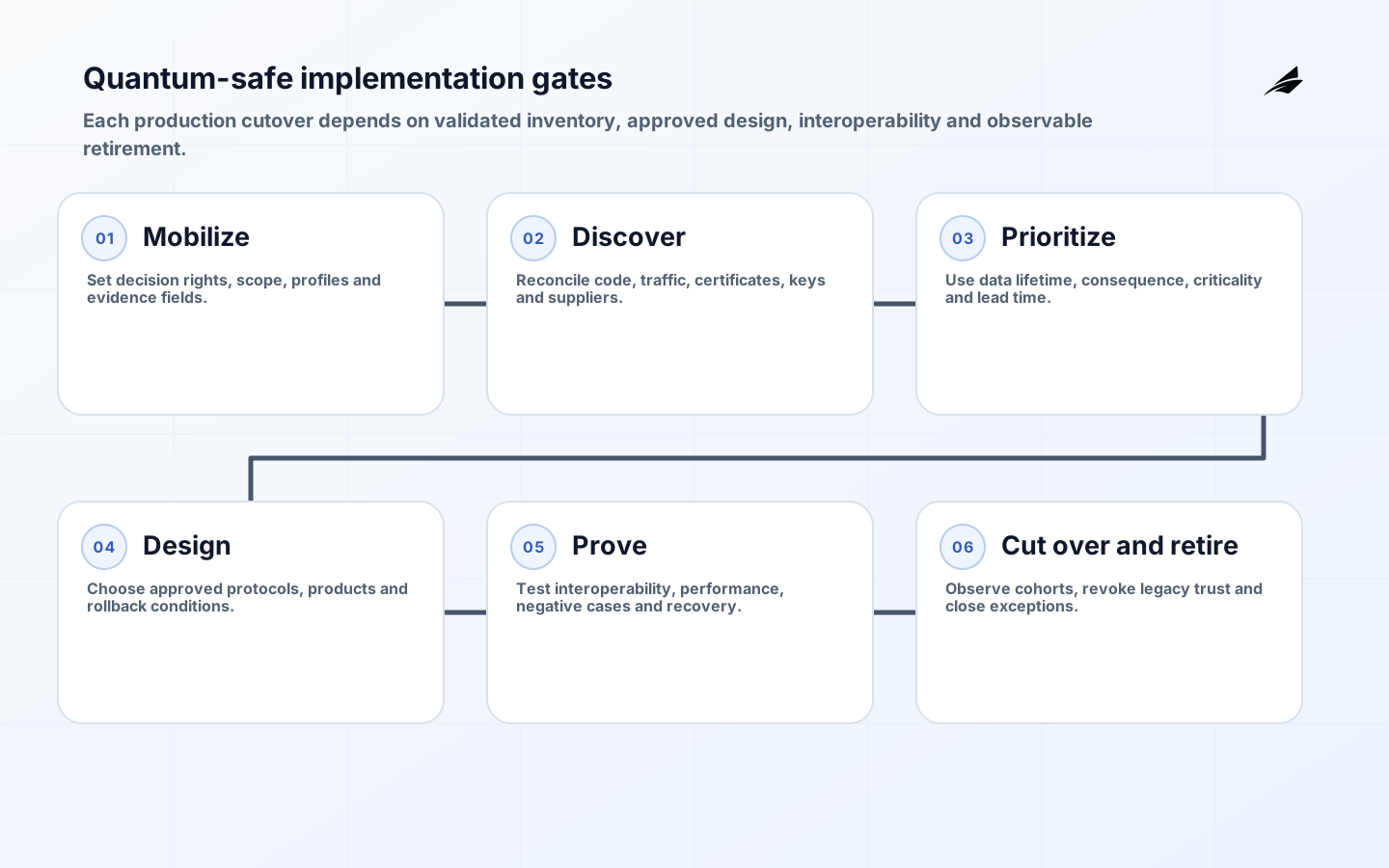
A quantum-safe transformation is an operational migration, not a single library upgrade. Public-key cryptography appears in network handshakes, certificates, identity protocols, signed software, document workflows, embedded devices, cloud services, hardware security modules and vendor-managed platforms. Teams therefore need a repeatable path from discovery to tested cutover. The immediate objective is not to predict when a cryptographically relevant quantum computer will exist. It is to remove avoidable uncertainty about where vulnerable algorithms protect long-lived information or critical trust relationships.
This implementation checklist begins after leadership has authorized a bounded program. It uses the finalized NIST standards: FIPS 203 specifies ML-KEM for key establishment, FIPS 204 specifies ML-DSA for digital signatures and FIPS 205 specifies SLH-DSA as a stateless hash-based signature alternative. Those standards define algorithms, but they do not choose products, protocols, parameter sets or migration sequences for an organization. Every deployment still requires supported implementations, protocol guidance, interoperability testing and review of current NIST errata.
Define what completion means before changing cryptography
Write acceptance criteria for a specific service or dependency. A useful statement identifies the protected business process, cryptographic function, approved target, fallback behavior, evidence and accountable owner. For example, a customer API migration is not complete merely because one server supports ML-KEM. Completion may require compatible clients, observable negotiation, tested failure handling, updated certificates or trust stores, rollback capability, performance evidence and removal of an unapproved legacy path.
| Readiness output | Minimum evidence | Acceptance question |
|---|---|---|
| Cryptographic inventory | Asset, algorithm, purpose, data and owner are linked | Can the team find every affected dependency? |
| Target architecture | Approved protocol, implementation and trust path are documented | Is the design deployable with supported products? |
| Interoperability result | Representative endpoints complete positive and negative tests | Do all required parties communicate safely? |
| Cutover record | Change, telemetry, rollback and residual exceptions are preserved | Can an independent reviewer reconstruct the decision? |
Step 1: Assign owners, authority and migration boundaries
Name a program owner who can resolve priorities across security, infrastructure, product engineering, procurement and business operations. Then assign technical owners for transport security, public key infrastructure, code signing, identity, key management, application libraries and embedded systems. Each owner needs authority to approve tests and schedule changes, while risk acceptance remains with the appropriate business or security authority. Record who can pause a rollout when authentication, integrity or availability is threatened.
Choose a first migration boundary small enough to observe but important enough to expose real dependencies. Suitable candidates include an internal API, a nonproduction code-signing chain or a controlled service-to-service connection. Avoid defining the boundary only by server name. Include clients, gateways, load balancers, certificate services, monitoring, recovery tools and vendors that participate in the trust path.
- Create one decision log for algorithm, protocol, product and exception approvals.
- Identify data owners who can assess confidentiality and integrity lifetimes.
- Give operations teams explicit rollback and incident-escalation authority.
- Track external dependencies whose migration dates are controlled by suppliers.
- Set evidence requirements before the pilot so test results remain comparable.
Step 2: Build a cryptographic inventory with operational context
Combine automated discovery with architecture review and owner interviews. Network scans can reveal certificates and negotiated algorithms, while code analysis can find cryptographic APIs and embedded constants. Configuration repositories expose protocol settings; key-management platforms reveal keys and certificates; software bills of materials help locate libraries; procurement records identify managed products. No single method sees runtime negotiation, dormant recovery systems, custom code and supplier-controlled cryptography equally well.
The inventory must explain why cryptography is present. RSA used for a short-lived test certificate is a different decision from RSA used to unwrap an archive key protecting records that must remain confidential for many years. Capture whether the dependency provides key establishment, encryption, authentication, signature verification or trust anchoring. Link it to data sensitivity, retention, exposure, availability needs and replacement constraints. NCCoE migration work emphasizes discovery because algorithm names without application context do not support prioritization.
| Inventory field | Example value | Why it matters |
|---|---|---|
| Business service | Claims-document archive | Connects technical work to accountable operations |
| Cryptographic function | Archive-key wrapping | Separates key establishment from signatures |
| Implementation location | Application library plus cloud key service | Identifies all components that must interoperate |
| Protected-data lifetime | Defined by the records owner | Informs exposure urgency without inventing a universal deadline |
| Change constraint | Reader software supplied to partners | Reveals coordination and backward-compatibility needs |
| Evidence source | Runtime trace and configuration record | Makes the inventory verifiable and refreshable |
Step 3: Prioritize by exposure, consequence and change difficulty
Rank inventory items using evidence rather than a single quantum countdown. Confidentiality priority rises when valuable encrypted information could be collected now and decrypted later, especially when its required secrecy extends well beyond the likely migration window. Integrity priority rises where signatures authorize software, financial instructions, identities or durable records. Operational urgency also depends on replacement lead time: constrained devices, partner protocols, offline trust anchors and unsupported products can require years of coordinated work.
A practical triage compares data lifetime, adversary interest, cryptographic function, service criticality, dependency count, vendor readiness and feasible compensating controls. Document uncertainty instead of converting assumptions into precise-looking scores. For example, a public website with rapidly replaceable certificates may be a useful interoperability pilot, while an offline archive containing long-lived sensitive data may deserve earlier risk treatment even if its migration is technically less visible.
| Priority signal | Higher-priority condition | Possible near-term action |
|---|---|---|
| Confidentiality lifetime | Information must remain secret through a long migration horizon | Reduce retention, strengthen access and plan PQC protection |
| Signature consequence | A forged signature could authorize code or a critical transaction | Map signing and verification chains |
| Replacement lead time | Hardware, protocol or partner changes are slow | Open vendor and standards work immediately |
| Inventory confidence | Ownership or implementation is unknown | Run targeted discovery before choosing a solution |
Step 4: Select supported targets, not algorithm names alone
Map each use case to its cryptographic function. ML-KEM establishes shared secrets; it does not replace every use of RSA or elliptic-curve cryptography. ML-DSA and SLH-DSA provide signatures, but their performance, key and signature sizes, implementation availability and protocol support differ. Select a parameter set only through an approved profile or documented security and interoperability decision. Do not design a proprietary protocol by placing algorithm outputs into an existing message without standards-based encoding, negotiation and downgrade protection.
Confirm that libraries, operating systems, network products, hardware security modules, certificate services and observability tools support the intended construction. Where a protocol ecosystem uses a hybrid classical and post-quantum mechanism during transition, define exactly how both components contribute, how peers negotiate, what happens when one component fails and when legacy-only operation is permitted. Hybrid deployment can manage transition risk, but it also adds states that must be tested and monitored.
Review current NIST publication notes and vendor documentation before implementation. A product claiming post-quantum support may expose an experimental algorithm name, a finalized FIPS algorithm or a protocol-specific hybrid construction; these are not interchangeable. Record the implementation version, validation status where required, supported parameter sets and upgrade path. Procurement claims must be translated into reproducible configuration and test evidence.
Step 5: Run an interoperability and performance pilot
Build a nonproduction environment that represents the complete path, including middleboxes, certificate validation, monitoring and failure handling. Test supported combinations rather than a single happy path. Capture handshake or verification results, message sizes, CPU and memory behavior, connection setup, retry patterns and application-level latency under representative load. The objective is not to publish a universal benchmark; it is to determine whether this implementation satisfies the service's own capacity and reliability requirements.
- Verify correct operation between every required client and server combination.
- Reject malformed keys, signatures, certificates and negotiation messages safely.
- Test legacy, hybrid and target-only modes where the transition design permits them.
- Exercise certificate renewal, key rotation, backup restoration and disaster recovery.
- Confirm logs distinguish negotiated algorithms without exposing secret material.
- Measure rollback and repeat the test after configuration or library changes.
Treat unexpected compatibility as a defect to explain, not a reason to weaken policy silently. A proxy that strips an extension, a verifier that accepts an unintended fallback or a monitoring tool that cannot parse a new certificate format can undermine the migration. Record the finding, owner, correction and retest. If a supplier blocks progress, preserve the affected assets and business consequences in the exception register.
Step 6: Execute a controlled production cutover
Use progressive exposure when the architecture permits it. Enable the target for a controlled cohort, observe negotiation and errors, then expand through explicit gates. Before each gate, verify capacity, client compatibility, incident coverage, rollback access and authoritative configuration backups. Freeze unrelated trust-path changes during the critical window. Operations staff should know which metrics indicate application failure, cryptographic fallback, certificate rejection or resource exhaustion.
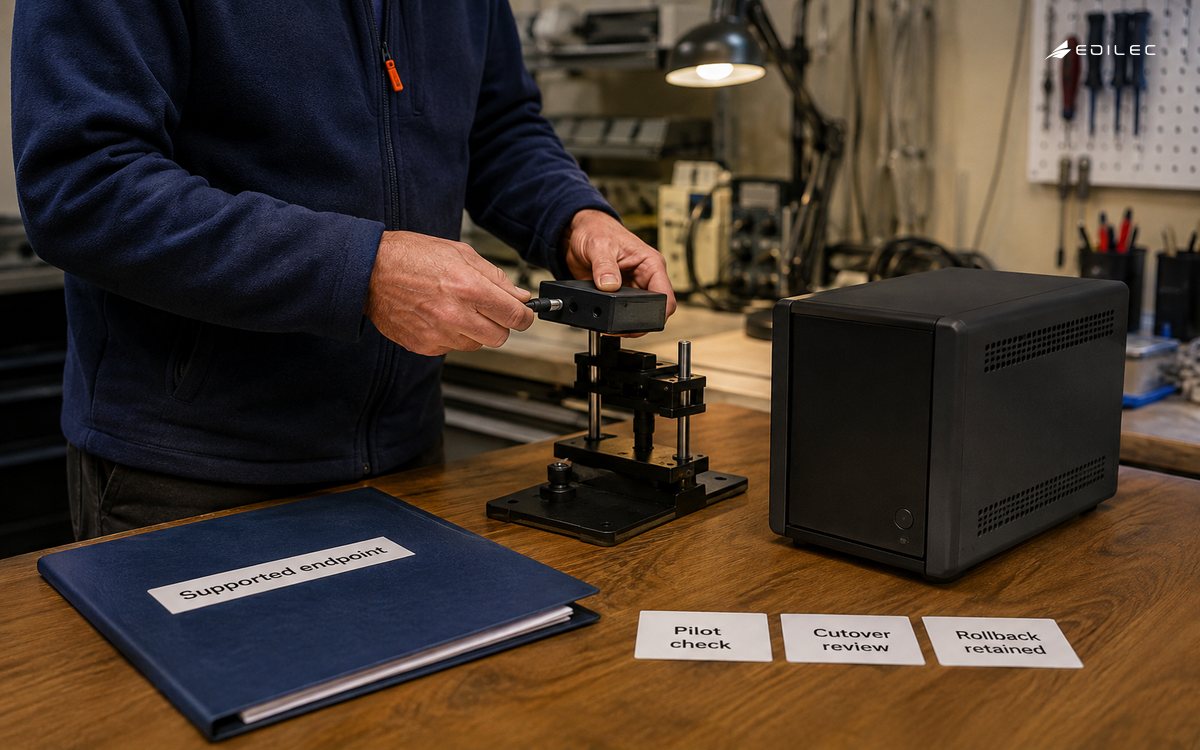
| Cutover gate | Required proof | Pause condition |
|---|---|---|
| Preproduction | Complete path passes interoperability and recovery tests | An essential dependency remains untested |
| Limited production | Expected algorithms negotiate and business transactions succeed | Silent fallback or unexplained validation errors appear |
| Expanded production | Capacity, reliability and support queues remain acceptable | Resource pressure threatens service objectives |
| Legacy retirement | Required clients use approved paths and exceptions have owners | A critical workflow still depends on the legacy mechanism |
Rollback must restore a known safe configuration, not merely re-enable every old algorithm. Define its security consequence and expiry. If rollback is used, preserve telemetry and investigate before another attempt. After stable operation, remove obsolete keys, disabled code paths and temporary privileges according to approved retention and destruction procedures. Update diagrams, runbooks, inventories and supplier records so the next cryptographic transition starts from accurate state.
Step 7: Turn the migration into durable crypto agility
NIST defines crypto agility as the capability to replace and adapt cryptographic algorithms across protocols, applications, software, hardware, firmware and infrastructure while preserving security and operations. Apply that idea to engineering controls: centralize approved policy where practical, separate business logic from cryptographic implementation, support versioned negotiation, automate inventory refreshes and test algorithm changes in delivery pipelines. Avoid hard-coded algorithm identifiers, unmanaged certificates and vendor interfaces that conceal configuration.
Schedule recurring inventory reconciliation and exception review. New services, acquisitions and vendor upgrades can reintroduce quantum-vulnerable dependencies after a successful project. Add cryptographic requirements to architecture reviews, software acquisition, asset onboarding and decommissioning. Track whether owners can identify cryptography, change it safely and prove the result. That operational capability matters more than a one-time declaration that an environment is quantum safe.
Key takeaways
- Begin with verifiable cryptographic discovery linked to business and data context.
- Use FIPS 203, 204 and 205 according to cryptographic function and supported protocols.
- Prioritize long-lived exposure, signature consequence and difficult dependencies.
- Test full trust paths, negative cases, recovery and fallback behavior.
- Retire legacy paths through controlled gates and maintain crypto agility afterward.
Frequently asked questions
Does installing a library that supports ML-KEM complete the migration?
No. The library must be integrated through an appropriate protocol and configuration, supported by every required peer and tested across negotiation, failure, monitoring, recovery and rollback. The organization must also address signatures, certificates, embedded cryptography and vendor services outside that library.
Should every legacy public-key algorithm be disabled immediately?
Not without dependency evidence. Abrupt removal can break authentication, recovery or partner connectivity. Inventory and test the trust path, introduce approved targets through controlled gates, monitor remaining use and give each temporary legacy exception an owner, justification, compensating control and retirement condition.
What is the best first post-quantum pilot?
Choose a bounded service with representative clients, observable traffic, cooperative owners and a safe rollback. It should expose real protocol and operational dependencies without placing an irreplaceable business process at risk. Use what the pilot reveals to improve inventory fields, test cases and cutover gates.
Conclusion
Quantum-safe implementation succeeds when an organization can trace cryptography from a business service to the exact protocol, product, key and responsible owner, then change that dependency without losing security or availability. Finalized NIST algorithms provide the foundation, while discovery, protocol support, interoperability and disciplined operations determine whether the migration works.
Start with one complete path and preserve its evidence. A tested inventory record, target design, negative-test result, production gate and legacy-retirement decision become reusable building blocks for the wider estate. The durable outcome is both a safer cryptographic posture and a demonstrated ability to handle the next cryptographic change.