Quantum-safe transformation services help an organization prepare systems, products and operations to use approved post-quantum cryptography where required. The work spans governance, cryptographic discovery, data and signature risk, architecture, standards profiles, vendor management, laboratory testing, deployment and retirement. A service should not promise that an enterprise becomes quantum safe through a scan or certificate replacement. Readiness must be demonstrated service by service across every producer, intermediary and consumer on the cryptographic path.
The business case is risk reduction under uncertainty. Long-lived confidential information may be collected now and decrypted later if capable quantum computing arrives. Long-lived signatures protect software, devices, documents and trust relationships. At the same time, premature or unsupported migration can introduce outages and weak implementations. A responsible engagement follows NIST standards and applicable sector guidance, improves visibility immediately, and uses controlled pilots before production change. It states which environments, protocols and obligations are outside scope.
Key takeaways
- Buy an evidence-producing migration capability, not a vague quantum-safe assessment.
- Scope cryptographic functions and dependency paths across applications, infrastructure, products and suppliers.
- Separate discovery, risk prioritization, laboratory validation and production rollout into acceptance gates.
- Estimate from asset diversity, embedded constraints, supplier readiness and assurance depth rather than endpoint count alone.
- Require standards, protocol, implementation, validation and customer-action detail from every provider.
- Make inventory ownership and crypto agility durable outcomes after the specialist engagement ends.
Define service scope and measurable deliverables
Start with business services, information classes and trust functions. Identify environments, regions, subsidiaries, products, operational technology, suppliers and shared platforms. Define whether the engagement covers discovery only, roadmap, prototypes, production engineering, program management or assurance. State authoritative guidance and applicable profiles. Success criteria might include verified coverage of selected critical paths, accepted risk prioritization, tested interoperability for a standards-based profile and a funded wave plan with named owners.

Deliverables should be maintainable artifacts: cryptographic data model, source inventory and confidence, dependency maps, data and signature longevity assessment, standards decision records, supplier evidence register, target patterns, test reports, migration backlog, cost model, control mapping and operating runbooks. A slide deck alone is not enough. Require import and export formats, repository ownership and methods so internal teams can update findings. Sensitive maps and keys must remain protected throughout collection and handoff.
| Work package | Core output | Acceptance question |
|---|---|---|
| Mobilize | Scope, governance and standards watch | Are decisions, owners and boundaries explicit? |
| Discover | Verified cryptographic usage graph | Can findings be traced to sources and services? |
| Prioritize | Risk cohorts and rationale | Do longevity, exposure and lead time drive order? |
| Design | Approved profiles and migration patterns | Are algorithms embedded in supported protocols? |
| Validate | Interoperability, performance and recovery report | Were complete paths and failures tested? |
| Migrate | Wave plan, evidence and retirement record | Are vulnerable paths removed and inventory updated? |
Specify discovery quality before buying tools
Discovery sources may include network observation, certificate stores, code and binary analysis, configuration, package manifests, key managers, hardware modules, device inventories and supplier attestations. Each technique sees only part of the problem. Define coverage, confidence, false-positive handling, unsupported protocols, encrypted observation constraints and manual validation. Tools should identify location and function, not only strings resembling algorithm names. Findings need timestamp, environment, service owner and evidence reference.
Require a normalized model that distinguishes key establishment, signature, symmetric encryption, hashing, randomness and certificate use. Connect producers and relying parties. A code-signing service cannot migrate independently of bootloaders and update verifiers. Include embedded and inherited cryptography from operating systems, cloud services and third parties. Reconcile results with asset, software and certificate inventories, and document residual blind spots. The provider should train internal owners to repeat scans and investigate deltas rather than retain exclusive knowledge.
Govern standards and target architecture
The architecture function should maintain approved profiles for functions and contexts: protocol, NIST standard, parameter, certificate or key format, library, hardware support, negotiation, telemetry and fallback policy. FIPS 203, 204 and 205 define core mechanisms; NIST SP 800-227 addresses KEM use, and transition guidance informs deprecation planning. Do not treat a primitive as a complete protocol. Implementation, integration and key management can fail even when the selected mathematics is standardized.
Design for agility with versioned interfaces, capability discovery, central policy references and automated lifecycle. Avoid hard-coded algorithm assumptions and fixed buffer sizes. Hybrid modes that combine classical and post-quantum components may help staged interoperability in supported protocols, but they increase complexity and are not automatically safer. Require a precise combiner, downgrade policy, failure behavior and retirement plan. Architecture review should include cryptographers or qualified implementers for novel or high-assurance decisions.
Evaluate transformation providers and technology suppliers
Assess the service team's cryptographic engineering, PKI, protocol, application, cloud, embedded, program and assurance skills against your estate. Ask for named experts, methods, tool limits, data handling, independent references, sample redacted outputs and knowledge-transfer plan. Verify the team can explain uncertainty and standards status without predicting a quantum deadline. Contracts should address confidentiality, vulnerability disclosure, subcontractors, intellectual property, evidence ownership, incident response and secure deletion.
Technology suppliers must identify product and version, supported standardized algorithms, protocol integration, implementation source, validation status, performance, hardware requirements, upgrade and rollback, telemetry, long-term support and roadmap dependencies. A trademarked quantum-safe label is not sufficient. Include customer responsibilities and licensing. Ask certificate authorities, network and inspection vendors, identity providers, device manufacturers, cloud providers and managed software suppliers how their parts interoperate; a connection fails at the least-ready component.
| Provider claim | Evidence to request | Risk if accepted untested |
|---|---|---|
| Complete discovery | Methods, coverage map and validated sample | Hidden code, device or supplier use |
| Standards compliant | Exact FIPS, parameter, protocol and version | Primitive used incorrectly or incompletely |
| Minimal performance impact | Workload, hardware and failure test results | Latency, fragmentation or capacity outage |
| Crypto agile | Exercised algorithm change and rollback | Abstraction without operable migration |
| Validated implementation | Certificate, module boundary and operating mode | Validation applies to another configuration |
| Turnkey migration | Customer, partner and relying-party actions | Unfunded dependencies block production |
Build a cost model around migration drivers
There is no credible universal quantum-safe transformation price. Discovery cost follows estate diversity, telemetry access, code and binary availability, protocols, device population, suppliers and validation sample. Engineering cost follows affected functions, supported product upgrades, custom code, certificate hierarchy, key hardware, constrained devices, data formats and partner coordination. Assurance cost follows criticality, regulated validation, performance scale, penetration testing and independent review. State assumptions and use ranges until discovery closes uncertainty.
Separate specialist services, internal staff, tools, laboratories, hardware refresh, software licenses, supplier charges, test environments, certificate and key operations, parallel support, change windows, monitoring and decommissioning. Include multi-year inventory and standards-watch operation. Avoid double counting modernization work that already replaces an affected system, but make PQC acceptance criteria explicit. Contingency should relate to named unknowns such as an unsupported appliance fleet or certificate ecosystem, not an unexplained percentage.
Manage delivery and transformation risks
Major risks include incomplete inventory, false urgency, immature products, implementation flaws, protocol downgrade, larger messages, performance loss, supplier delay, validation mismatch, key-management failure and stranded legacy. Treat known classical weaknesses separately and promptly. A future-focused program must not tolerate expired certificates, obsolete libraries or exposed keys today. Maintain a risk register with indicator, owner, treatment, trigger and evidence. Review concentration where many critical services depend on one library, certificate authority or network device.
Protect discovery data and test material. Use isolated laboratories with synthetic or approved data and controlled keys. Test malformed inputs and side channels according to assurance needs. Production pilots require change approval, monitoring, rollback and staffed response. Do not permit silent downgrade. Reconcile key and certificate lifecycle after rollback. Supplier roadmap slips should trigger alternatives, isolation or accelerated retirement. Legal and records teams should address historical signature validation and retained ciphertext before format or key destruction.
Use gated delivery from discovery to retirement
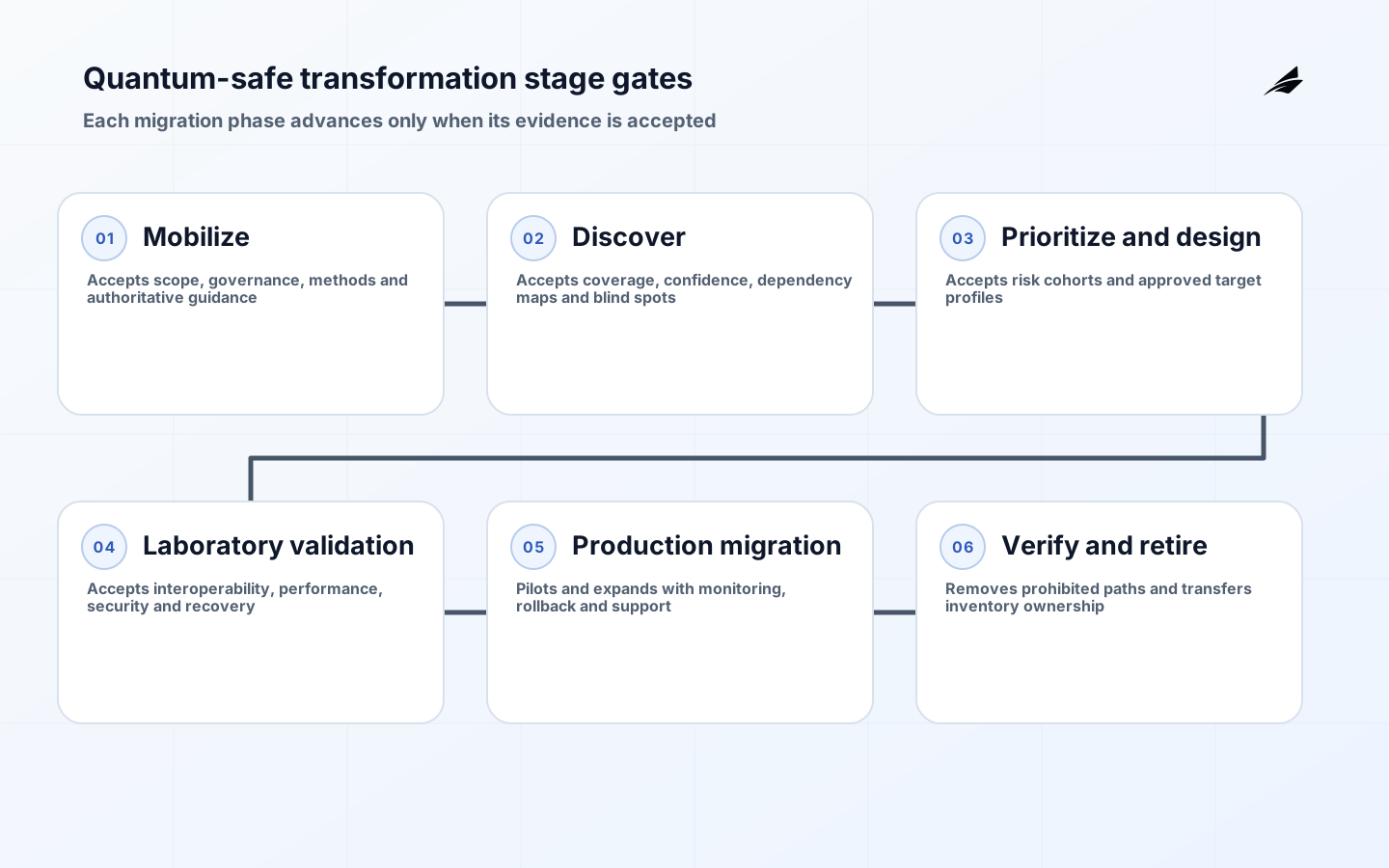
Gate one accepts governance, scope and methods. Gate two accepts inventory coverage and blind spots. Gate three accepts prioritization and target profiles. Gate four approves a laboratory pattern after interoperability, performance, security and recovery tests. Gate five pilots a bounded production service with mixed-version monitoring. Gate six expands by dependency cohort. Gate seven retires vulnerable paths and updates inventories, continuity plans, contracts and support. Every gate needs authority to pause when evidence fails.
Measure verified inventory coverage, unknown critical paths, supplier response, prioritized service ownership, tested patterns, migration lead time, downgrade attempts, failures by algorithm, performance against service objectives, retired vulnerable dependencies and exercised rollback. Avoid a single readiness percentage that merges discovery and deployment. Report current scope and confidence. The provider should leave automated reconciliation, standards watch, decision records and trained owners so the program can adapt to new standards and product releases.
Frequently asked questions
What does quantum safe mean in a services contract?
Define it narrowly. It should identify systems and functions that implement specified approved post-quantum standards through supported protocols and configurations, with tested dependencies and retirement of prohibited paths. Avoid an enterprise-wide label that lacks scope, date and evidence.
What should a first assessment accomplish?
It should establish governance, map critical services and long-lived risks, sample discovery methods, identify suppliers and blind spots, and produce a prioritized next phase. It should not claim complete migration from a short scan or recommend production algorithms without context.
Should organizations wait for vendors?
No. They can inventory, prioritize, set procurement requirements, upgrade unsupported technology and run standards-based pilots now. Production timing depends on supported implementations, applicable guidance and complete interoperability. Active supplier management is part of migration, not a reason to defer planning.
Conclusion
Quantum-safe transformation is a portfolio of evidence-backed changes across cryptographic dependency paths. Scope services around maintainable inventory, risk prioritization, standards governance, supplier commitments and tested migration patterns. Price the real engineering and operational work, expose blind spots and use gates that can stop unsafe rollout. A strong engagement leaves more than a report: it leaves owners, data, methods, contracts and an exercised ability to change cryptography again. That durable agility is the best protection against both quantum uncertainty and the next ordinary cryptographic transition.