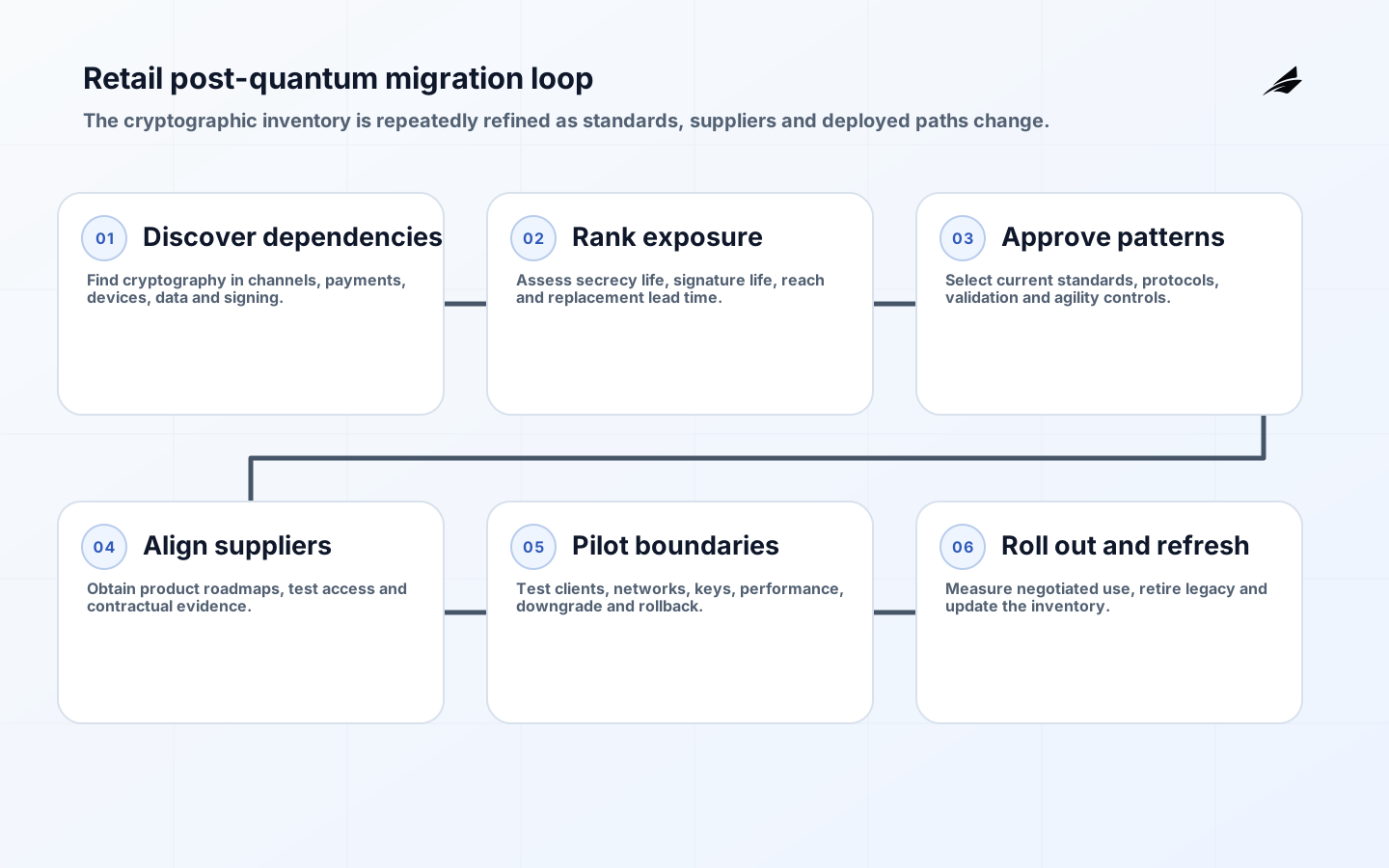
Post-quantum cryptography readiness for retail is a multi-year change program across customer channels, payment environments, stores, warehouses, devices, suppliers and long-lived data. It does not begin by replacing every RSA or elliptic-curve key with a new algorithm. It begins by finding where public-key cryptography is embedded, understanding the business and secrecy lifetime, and creating a controlled path to interoperable, validated products.
This checklist is for retail security leaders, enterprise architects, payment teams, infrastructure owners and procurement. Use the retail PQC scope and risk plan for program design, the retail PQC FAQ for stakeholder questions and the general PQC implementation checklist for broader controls.
Establish the retail migration program
Appoint an executive risk owner, cryptographic architecture lead and owners for ecommerce, payments, stores, identity, supply chain, data, infrastructure and procurement. Define the systems, brands, regions and joint ventures in scope. The joint CISA, NSA and NIST quantum-readiness roadmap recommends a project team, inventory, risk assessment and supplier engagement before migration.
Adopt milestones appropriate to the organization and regulators. The UK NCSC’s current migration timeline calls for discovery and an initial plan by 2028, highest-priority migrations and a refined roadmap by 2031, and broad completion by 2035. These are planning targets, not proof that every protocol and product is ready today. Review national and sector guidance relevant to each market.
| Program gate | Required evidence | Retail owner | Do not pass when |
|---|---|---|---|
| Governance | Charter, scope, risk owner and decision rights | CISO and architecture | PQC is only a research task |
| Discovery | Coverage and gap metrics for crypto inventory | Asset and platform owners | Certificates are the only inventory |
| Prioritization | Data lifetime, exposure and replacement score | Risk and business owners | Asset criticality is unverified |
| Supplier readiness | Product roadmap, dependencies and validation evidence | Procurement | Marketing term substitutes for detail |
| Pilot | Interoperability, performance and rollback results | Service owner | Lab success omits real clients |
| Rollout | Cohorts, telemetry, exception process and retirement criteria | Operations | Legacy use cannot be observed |
Build a cryptographic dependency inventory
Discover algorithms and protocols in source code, libraries, certificates, key-management systems, load balancers, APIs, mobile apps, POS terminals, payment devices, store networks, VPNs, Wi-Fi, software signing, firmware updates, EDI, backups, databases and supplier connections. Record purpose: key establishment, digital signature, identity, data protection or integrity. Symmetric encryption and hashing have different transition concerns from vulnerable public-key mechanisms.
For each instance capture owner, product and version, deployment, protocol, algorithm, parameters, key location, certificate authority, data protected, secrecy or signature-validity lifetime, external peers, update mechanism and replacement date. Include cryptography hidden inside managed services and appliances. Tag confidence and last verification so unknown coverage is visible rather than counted as compliant.
Prioritize retail exposure and long-lived data
Rank by how long confidentiality or authenticity must survive, current exposure, business consequence, exploitability, replacement lead time and supplier dependency. Customer identity records, employee information, contracts, loyalty histories and strategic data may need protection beyond a device’s current life. “Harvest now, decrypt later” risk matters where intercepted ciphertext remains valuable in the future.
Give special attention to roots of trust and signatures. Software, firmware, payment-device and store-appliance updates may be verified for many years. A vulnerable signing chain can outlive the application using it. Separate urgent hygiene such as obsolete protocols or unmanaged certificates from quantum transition; fix present weaknesses without waiting for PQC.
| Retail domain | Crypto dependency | Readiness test | Likely constraint |
|---|---|---|---|
| Ecommerce edge | TLS certificates and key establishment | Real browser, app, CDN and bot path tests | Interoperability and payload size |
| Payments | Terminal, gateway and processor cryptography | PCI scope and provider roadmap confirmed | Certified hardware and ecosystem timing |
| Store and warehouse | VPN, Wi-Fi, device identity and firmware | Representative low-power device pilot | Long replacement and offline windows |
| Identity | Federation, tokens and signing keys | Issuer, verifier and rotation compatibility | Many internal and partner consumers |
| Data exchange | Supplier APIs, EDI and file signatures | Both endpoints support controlled transition | External coordination |
| Code delivery | Artifact and firmware signatures | Build, HSM, verifier and recovery tested | Long-lived roots of trust |
Map standards to use cases, not slogans
NIST FIPS 203 specifies ML-KEM for establishing shared secrets. NIST FIPS 204 specifies ML-DSA for digital signatures; FIPS 205 provides a stateless hash-based signature alternative. These primitives are building blocks. Retail teams should use protocol and product profiles approved by the relevant standards body, platform provider or regulator rather than designing proprietary combinations.
Track errata, implementation guidance, validated modules and protocol standardization. Parameter and hybrid choices affect message size, latency, memory, hardware support and interoperability. Maintain an approved-pattern register with version, use case, validation requirements and prohibited uses. “Quantum safe” in a product name is not sufficient evidence.
Create cryptographic agility before mass rollout
NIST’s current crypto-agility guidance defines the capability to replace and adapt algorithms across protocols, applications, software, hardware and infrastructure while preserving security and operations. Centralize policy where feasible, separate business logic from algorithm selection, inventory consumers and automate certificate and key lifecycle processes.
Agility is controlled change, not arbitrary runtime selection. Prevent downgrade, unauthenticated negotiation and unsupported combinations. Version interfaces, expose negotiated algorithms in telemetry, define a rollback window and rehearse emergency retirement. Retain enough flexibility to adopt corrected implementations or additional standards without another estate-wide discovery.
Make supplier readiness contractable
Ask providers which components use quantum-vulnerable public-key cryptography, which NIST standards and protocol profiles they plan to support, whether hybrid modes are used, what validation exists, which hardware changes are required and when legacy algorithms can be disabled. Request testing access and release dependencies. Distinguish provider-controlled upgrades from customer configuration or device replacement.
Add inventory disclosure, roadmap updates, vulnerability notification, interoperability support, evidence access and exit obligations to procurement. For payment systems, involve the acquirer, processor, gateway, terminal vendor and assessor. Continue meeting applicable PCI standards; PQC planning does not replace present payment-data controls or authorize an unapproved cryptographic design.
Pilot at real retail boundaries
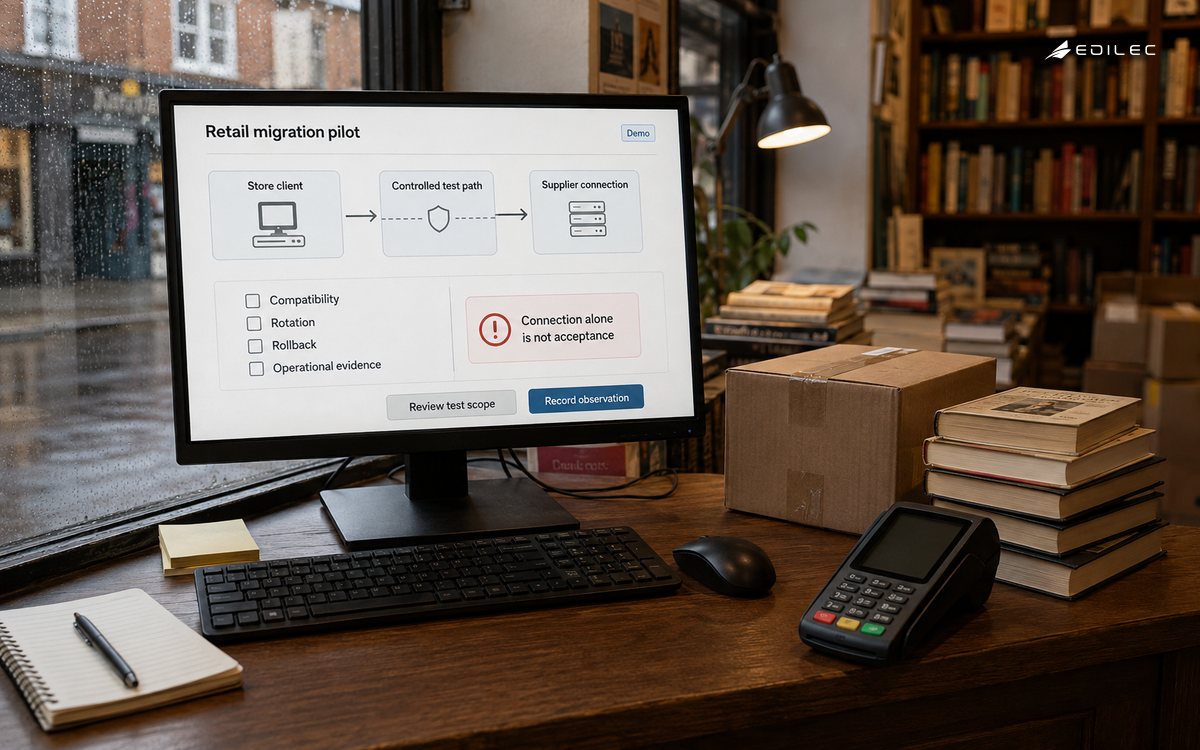
Choose a reversible, noncritical path that still represents real constraints: a staff portal edge, internal API, signed artifact or selected supplier connection. Include old and new clients, proxies, security inspection, HSM or KMS, certificate automation, observability and failover. Test handshake and signature sizes, latency, CPU, memory, throughput, connection reuse and error behavior under peak patterns.
Verify security properties and operational behavior, not just successful connection. Test downgrade resistance, certificate or key rotation, corrupted messages, expired credentials, rollback and loss of a PQC-capable dependency. Record exact versions and configurations. Feed results into architecture patterns and procurement requirements instead of declaring the entire enterprise ready.
Roll out by dependency cohort and verify retirement
Sequence cohorts around shared trust chains and communication peers. Start with systems the organization controls, then coordinate partner boundaries and hardware replacement. Use feature-controlled negotiation where supported, canary traffic, telemetry for actual algorithm use and explicit stop thresholds. Maintain incident procedures for interoperability failures and suspected implementation vulnerabilities.
Migration is incomplete while a service silently relies on a quantum-vulnerable path. Measure negotiated algorithms, outstanding certificates, legacy signatures, unsupported clients, supplier exceptions and assets awaiting replacement. Retire old keys and trust anchors through approved lifecycle procedures only after rollback dependence and record-retention duties close.
Run a formal exception register for assets that cannot meet the target pattern. Record business owner, vulnerable mechanism, protected data or signature, compensating controls, supplier dependency, next review and hard expiry. Group exceptions by root constraint so procurement and architecture can solve them collectively. An exception is not a permanent acceptance: telemetry must show whether its use is shrinking, and a material change in threat, validation or supplier support should trigger reassessment before the scheduled date. Report aged and newly created exceptions to the program risk owner, alongside forecast replacement cost and the business interruption window needed to close them.
- Charter the program and align milestones with market and regulatory guidance.
- Discover public-key cryptography across software, devices, data and suppliers.
- Rank use cases by secrecy life, signature life, exposure and replacement lead time.
- Approve standards-based patterns and build controlled crypto agility.
- Pilot complete client, network, key, protocol and operational paths.
- Roll out in observable cohorts, close exceptions and prove legacy retirement.
Key takeaways
- Retail PQC readiness starts with ownership and cryptographic dependency discovery.
- Prioritize long-lived data, signatures, exposed channels and slow-to-replace devices.
- Treat NIST algorithms as building blocks within approved products and protocols.
- Demand specific roadmaps and evidence from payment, cloud, device and software suppliers.
- Measure actual legacy use until vulnerable paths and trust anchors are retired.
Frequently asked questions
Should a retailer deploy PQC everywhere now?
No. Begin inventory, prioritization, agility and supplier work now, then deploy where protocols, products and assurance are mature for the use case. Premature proprietary changes can reduce security and interoperability. High-priority pilots should follow current authority and standards.
Does quantum risk make AES unusable?
The main transition focus is quantum-vulnerable public-key cryptography. Symmetric algorithms are affected differently, and approved key sizes and configurations remain a standards decision. Inventory symmetric use, but do not replace it blindly with a public-key migration plan.
Is PCI compliance the same as PQC readiness?
No. PCI standards govern current payment-security requirements, while PQC readiness prepares future cryptographic transition. The programs should share inventory and supplier evidence, but a future-ready claim does not establish present compliance and present compliance does not complete a PQC roadmap.
Conclusion
A retailer can make material post-quantum progress before every ecosystem component is ready. Build the inventory, rank durable risks, engineer agility, obtain supplier commitments and test real boundaries. Then migrate in observable cohorts using approved standards and preserve the ability to change again as protocols and implementations mature.