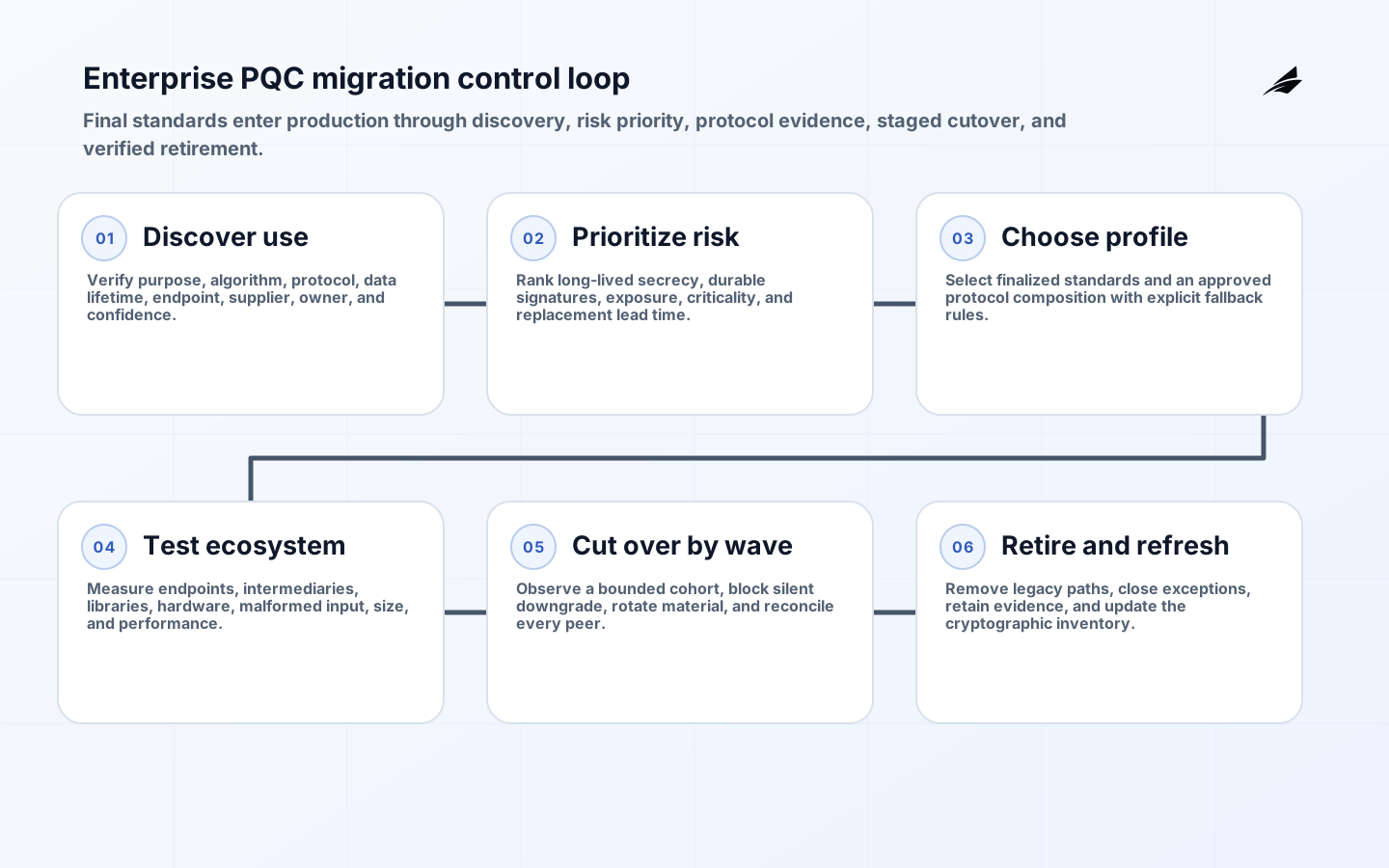
A quantum-safe transformation implementation checklist starts with an enterprise fact: public-key cryptography is embedded in protocols, products, certificates, code signing, identity, hardware, documents, backups, and supplier services. Replacing an algorithm in one TLS configuration does not complete migration. The program must discover dependencies, judge how long data and signatures need protection, select approved profiles, test interoperability and performance, sequence suppliers, and preserve a controlled fallback without normalizing insecure legacy use.
NIST finalized FIPS 203, 204, and 205 in August 2024, and its September 2025 SP 800-227 gives current recommendations for key-encapsulation mechanisms. NIST selected HQC for future standardization as a backup KEM, while ML-KEM remains the recommended general choice; additional signature candidates were still in evaluation in May 2026. Use the enterprise transformation scope guide, the technical migration checklist, and the enterprise PQC FAQ alongside this program view.
Establish quantum-readiness governance
Name an executive sponsor, accountable cryptography owner, security architect, enterprise architect, PKI and key-management leads, application and infrastructure representatives, procurement, risk, legal, privacy, records, and business-service owners. Define the standards authority, exception process, risk method, evidence repository, supplier escalation, and production approval. The team should govern both confidentiality and authenticity: future quantum capability threatens common public-key encryption and signature schemes used today.
Write a policy that distinguishes approved current algorithms, NIST-standardized post-quantum algorithms, experimental implementations, hybrid profiles, prohibited deployments, and time-bounded exceptions. Do not label a product “quantum safe” because a marketing page names one algorithm. Require the exact primitive, parameter set, protocol profile, library, validation status where required, key lifecycle, fallback behavior, interoperability evidence, and patch commitment. Revisit policy as standards and protocol profiles mature.
| Governance artifact | Required content | Approval evidence |
|---|---|---|
| Quantum-readiness charter | Scope, authority, funding, risk owners, reporting | Executive sponsor and accountable cryptography owner sign-off |
| Cryptography standard | Allowed algorithms, profiles, libraries, exceptions | Versioned review against current NIST publications |
| Migration register | System, dependency, owner, priority, target, status | Service owner confirms inventory and plan |
| Supplier requirement | Discovery, roadmap, update path, evidence, exit rights | Procurement and security acceptance |
| Exception record | Legacy need, exposure, compensating controls, expiry | Named risk owner and mandatory review date |
Build a cryptographic inventory with context
Combine network discovery, certificate and key inventories, source and dependency analysis, software composition records, configuration scanning, cloud and hardware inventories, PKI databases, API gateways, service meshes, VPNs, email, file formats, database features, signing systems, firmware update chains, and supplier attestations. Discovery tools have blind spots, especially for embedded, proprietary, dormant, client-side, and hardware cryptography. Pair automation with owner interviews and representative transaction tracing.
For each use, record business service, data or object protected, purpose, algorithm and parameters, protocol and version, library or product, key and certificate authority, endpoint, environment, owner, supplier, data lifetime, signature-verification lifetime, performance sensitivity, interoperability partners, replacement mechanism, and evidence confidence. A list of certificates is not a cryptographic bill of materials. Keep observations timestamped and distinguish verified configuration from inference.
Prioritize by exposure lifetime and migration difficulty
Prioritize confidential data whose secrecy requirement can outlive the plausible migration window, because encrypted traffic or archives collected now may be attacked later. Also prioritize roots of trust and signatures that must remain verifiable for years: software updates, firmware, identity credentials, legal records, long-lived devices, and code-signing chains. Add internet exposure, criticality, supplier readiness, asset lifespan, replacement lead time, and blast radius. Do not invent a single quantum-computer arrival date as the program’s business case.
Use waves. Wave zero establishes discovery, standards, test infrastructure, and procurement controls. Early waves target controllable systems with long-lived risk and supported profiles. Later waves address constrained devices, partner ecosystems, archived signatures, and hard supplier dependencies. Include “do not migrate yet” decisions where profiles or products are immature, but attach monitoring and a trigger. Premature custom cryptography creates a second migration problem.
| Priority signal | Higher urgency example | Required next action |
|---|---|---|
| Confidentiality lifetime | Sensitive record must remain secret for decades | Protect new exchange and storage paths with an approved migration plan |
| Authenticity lifetime | Firmware signature must verify through device life | Validate signature size, boot path, update, and rollback |
| Replacement lead time | Embedded fleet or contract changes take years | Start supplier and lifecycle action before protocol cutover |
| Exposure | Public protocol carries valuable persistent data | Test standardized or approved hybrid profile |
| Dependency concentration | One PKI or library serves many systems | Prove compatibility and staged rotation centrally |
| Evidence confidence | Scanner suggests unknown proprietary crypto | Assign manual verification and restrict unproven claims |
Test algorithms inside real protocols and products
FIPS 203 specifies ML-KEM for key establishment; FIPS 204 specifies ML-DSA signatures; FIPS 205 specifies SLH-DSA signatures. Standards define algorithms, not an automatic protocol migration. Use profiles approved for the organization’s jurisdiction and ecosystem. Test the full handshake, message, certificate, key, hardware, library, and operational path. Hybrid designs can combine classical and post-quantum mechanisms during transition, but only when a defined profile specifies composition and failure behavior.
Measure key, ciphertext, and signature sizes; handshake and verification latency; CPU and memory; bandwidth and fragmentation; connection setup; certificate-chain behavior; hardware acceleration; concurrency; storage; logging; error paths; and denial-of-service exposure. Test both endpoints, intermediaries, load balancers, proxies, inspection tools, HSMs, clients, and recovery tooling. Verify malformed-input handling and side-channel protections through maintained implementations rather than modifying primitives locally.
Build crypto agility instead of another hard-coded era
Separate business logic from cryptographic implementation through versioned interfaces and policy. Make algorithm identifiers, profiles, certificate chains, key metadata, and negotiation observable. Support controlled rotation of keys, certificates, libraries, and protocol configuration without rebuilding unrelated product code. Preserve the ability to discover where a primitive is used. Agility is not runtime selection of any algorithm a peer requests; accepted choices must remain allowlisted, policy-bound, downgrade-resistant, and testable.
Update secure development and procurement. Require cryptographic inventory changes in architecture review, dependency provenance, supported-algorithm documentation, vulnerability response, patch timelines, exportable evidence, and deprecation notices. Contracts should address supplier roadmaps and exit options without assuming a promised date equals implemented interoperability. Train engineering, operations, incident response, risk, and audit teams to interpret the new artifacts and avoid ambiguous terms such as quantum encryption.
Move a cryptographic dependency through controlled cutover
- Verify the cryptographic use, business owner, protected asset, lifetime, protocol, supplier, and current evidence.
- Select an approved target profile and define interoperability, performance, security, and rollback acceptance.
- Update maintained libraries and test every endpoint, intermediary, operational tool, and failure path in a lab.
- Deploy observability and release to a bounded cohort without permitting silent downgrade.
- Expand by measured waves, rotate affected keys or certificates, and reconcile every expected peer.
- Retire the legacy path, revoke obsolete material, update the inventory, close exceptions, and retain evidence.
Prove migration and prepare for failure
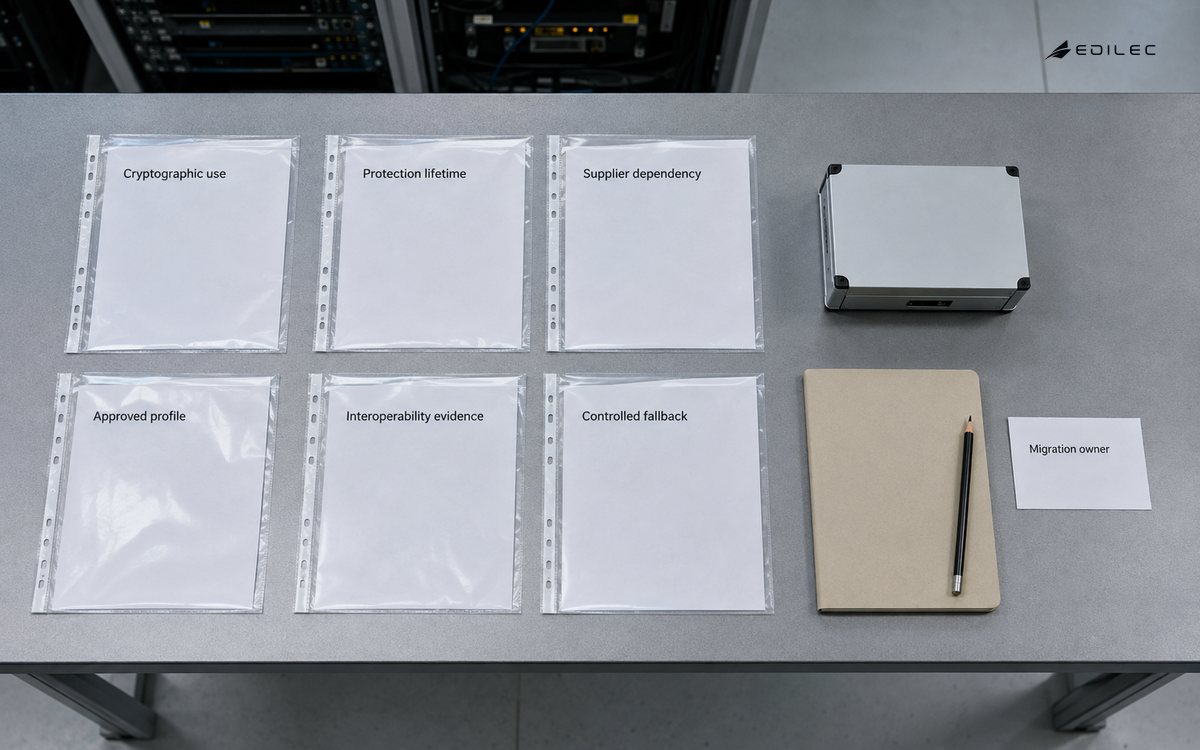
Acceptance evidence should include inventory before and after, approved target profile, implementation and dependency versions, test vectors, interoperability partners, performance results, malformed-input and downgrade tests, key lifecycle, monitoring, rollout metrics, rollback criteria, residual exceptions, and owner sign-off. An endpoint negotiating PQC in a demonstration does not prove that archived data, code signing, recovery, and every production client have migrated.
Exercise algorithm or implementation withdrawal. Identify how the organization would block a vulnerable profile, patch libraries, rotate keys and certificates, preserve service for critical peers, and communicate risk. Maintain an emergency classical fallback only where explicitly approved, observable, and time-bound; otherwise attackers may force the weaker route. Feed findings back into inventory confidence, supplier priorities, and architecture standards.
Key takeaways
- Govern post-quantum migration as an enterprise dependency program, not a TLS toggle.
- Inventory cryptography with business purpose, data lifetime, protocol, owner, and supplier context.
- Prioritize long-lived confidentiality, durable authenticity, exposure, and replacement lead time.
- Use finalized standards inside approved profiles and test complete systems for interoperability and performance.
- Build observable, downgrade-resistant crypto agility and close migration with retirement evidence.
Frequently asked questions
What is the enterprise deadline for becoming quantum safe?
There is no single universal date. Applicable government or sector roadmaps may set milestones, while business priority also depends on secrecy lifetime, asset life, migration lead time, and supplier readiness. Start inventory and planning now, use current finalized standards where supported, and maintain a versioned schedule tied to authoritative policy rather than a speculative quantum-computer prediction.
Must enterprises replace symmetric encryption and hashes?
The primary migration pressure is on widely used public-key mechanisms vulnerable to quantum algorithms. Symmetric and hash security is affected differently and may require stronger parameters for particular long-term profiles, but teams should follow applicable standards rather than replacing everything indiscriminately. Inventory purpose and parameters so the cryptography authority can make a specific decision.
What should a vendor quantum-readiness statement contain?
Ask for affected products and versions, cryptographic dependencies, exact standardized algorithms and protocol profiles, test and validation status, performance constraints, interoperability partners, update and rollback mechanism, key lifecycle, delivery milestones, support period, inventory evidence, and contingency if an algorithm changes. A generic commitment to “PQC support” is not enough for architecture approval.
Track program progress with coverage and risk measures rather than a count of PQC-enabled endpoints. Useful measures include inventory confidence, percentage of critical uses with an owner, long-lived exposures with an approved plan, supplier responses verified, profiles tested, peers interoperable, exceptions nearing expiry, legacy material retired, and time required to change a cryptographic policy. These measures reveal whether migration capacity is improving.
Conclusion
Quantum-safe transformation is manageable when the enterprise replaces uncertainty with inventory, ownership, and tested waves. Use current NIST standards as precise technical anchors, but plan around business lifetimes and real protocol ecosystems. Discover hidden dependencies, prioritize enduring exposure, demand supplier evidence, build crypto agility, and retire legacy paths deliberately. The outcome is broader than PQC adoption: it is an organization able to change cryptography again without losing control of its systems.