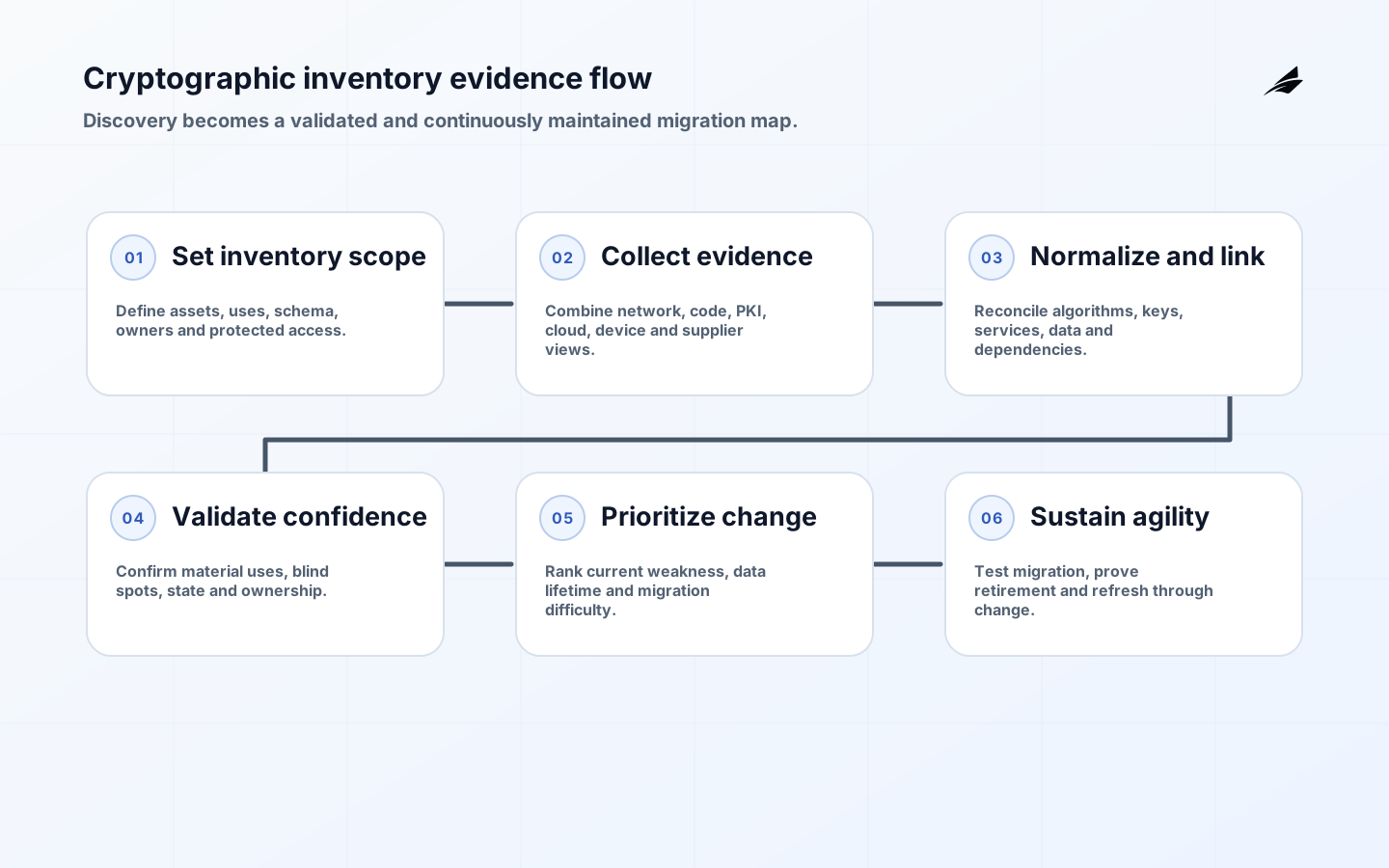
This cryptographic inventory assessment implementation checklist is designed for teams moving from research to an accountable delivery decision. Use the cryptographic inventory assessment guide, cryptographic inventory FAQ and infrastructure cybersecurity checklist for adjacent scope, implementation and operating questions. The practical standard here is evidence: named owners, explicit boundaries, representative tests and a route to stop or correct the system when assumptions fail.
A cryptographic inventory must show where cryptography is used, what it protects, who can change it and what depends on it. NIST’s Migration to Post-Quantum Cryptography project treats discovery and inventory as a foundation for prioritization, while final crypto-agility guidance defines agility as replacing or adapting algorithms across protocols, software, hardware and infrastructure while preserving security and operations. The assessment therefore needs validated relationships, not a flat list of certificates.
Define scope, owners and inventory schema
Set business scope across applications, APIs, identity, PKI, networks, cloud services, endpoints, operational technology, code signing, backups and third parties. Name an accountable cryptography program owner and local system owners. Design the schema before scanning: asset and service; business process; data or transaction protected; algorithm and parameters; protocol and library; certificate and key identifiers; key location and custody; provider; environment; external dependency; discovery method; confidence; last validated date; exposure; replaceability; and migration owner. Avoid collecting private key material. Define access controls because the inventory reveals sensitive architecture. Use stable identifiers so scanner observations, certificate records, source findings and owner attestations can be reconciled. Specify inclusion thresholds and an unknown state. An incomplete but confidence-rated inventory is more honest and useful than a spreadsheet that presents unverified coverage as complete.
Discover through multiple independent lenses
Combine active and passive network observation, certificate authority and key-management records, cloud and load-balancer configuration, software composition data, source and binary analysis, configuration repositories, endpoint telemetry, hardware security module records, API gateways, email, VPN, database encryption and supplier attestations. Each method sees only part of the estate. TLS scanning will not find embedded signing, application-level encryption or dormant recovery keys; source scanning may miss runtime negotiation and proprietary appliances. CISA’s automated discovery and inventory strategy emphasizes interoperability and shared inventory formats for post-quantum readiness. Pilot tools against a known test set, measure false positives and misses, record blind spots, and protect credentials used for discovery. Never probe fragile operational systems without owner-approved methods and safety constraints.
| Discovery source | Finds well | Common blind spot | Validation |
|---|---|---|---|
| Network observation | Negotiated protocols and certificates | Dormant or internal cryptography | Compare with service owner |
| Source and binary analysis | Libraries and algorithm calls | Runtime configuration | Exercise deployed path |
| PKI and key systems | Issued certificates and managed keys | Unmanaged local material | Reconcile deployment |
| Cloud configuration | Managed endpoints and encryption settings | Application-layer use | Trace workload ownership |
| Supplier attestation | Appliance and SaaS dependencies | Unverified detail | Request roadmap and evidence |
Normalize observations and validate relationships
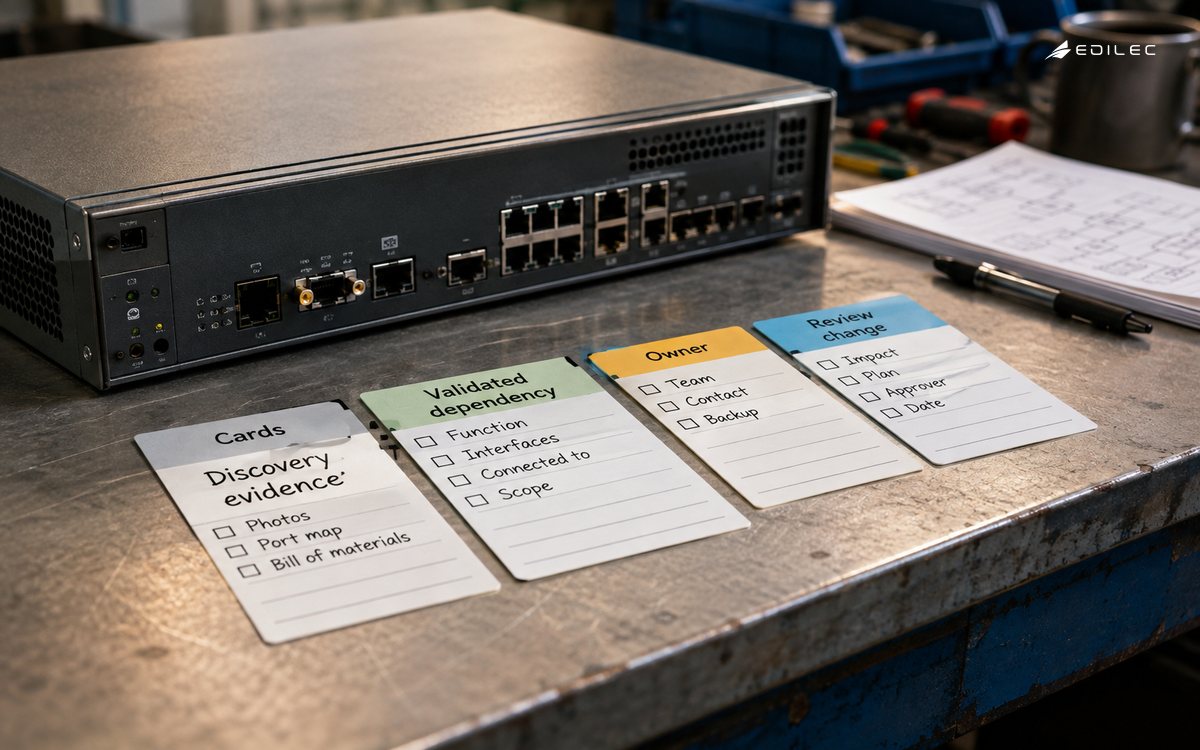
Normalize algorithm names, key sizes, curves, modes, protocol versions, certificate chains and provider labels into controlled values while retaining raw evidence. Deduplicate by relationship, not hostname alone: one service can negotiate several protocols and one certificate can be deployed across many endpoints. Correlate observed cryptography to business service, data sensitivity, software component and external dependency. Ask owners to validate high-impact entries with evidence rather than simply attesting that a row looks familiar. Sample known assets and intentionally planted cases to estimate coverage. Track confidence as confirmed, observed, inferred or declared, plus the date and method. Investigate disagreement between sources. Validate whether cryptography is active, dormant, fallback-only or required for recovery. This distinction prevents teams from prioritizing an unused library while overlooking a hard-coded partner protocol on a critical transaction.
Prioritize from consequence, exposure and migration difficulty
Risk scoring should consider the value and useful lifetime of protected data, business criticality, external exposure, algorithm and parameter status, key custody, implementation weakness, dependency depth, replacement lead time and compensating controls. Quantum risk is not the only concern: expired certificates, obsolete protocols, reused keys and weak random generation may require immediate action. NIST explains that the first three finalized post-quantum standards were published in 2024 and encourages transition planning, but algorithm replacement must preserve interoperability and operational safety. Create risk tiers with reasons and a decision owner, not a mathematically precise score unsupported by evidence. Prioritize long-lived sensitive data and hard-to-change trust anchors early because harvest-now-decrypt-later exposure and long migration lead times make waiting costly.
Convert inventory findings into a migration roadmap
For each priority relationship, identify target standard or protocol, prerequisites, vendor support, compatibility, performance, certificate and key lifecycle changes, test environments, rollback, procurement date and retirement evidence. CISA’s quantum-readiness guidance recommends a roadmap and engagement with technology vendors. Test protocol negotiation, message size, latency, hardware limits, logging, recovery and mixed-version behavior. Use hybrid approaches only where justified by current authority and interoperability requirements; document the security construction instead of assuming two algorithms automatically create safety. Update contracts and architecture standards so new purchases expose algorithm configuration, inventories and upgrade paths. Migration is complete only when legacy use is disabled, dependent systems are verified, keys and certificates are handled correctly, and old components cannot silently return.
| Priority factor | Question | High-priority signal | Owner action |
|---|---|---|---|
| Data lifetime | How long must secrecy hold? | Sensitive data remains valuable for years | Advance PQC planning |
| Exposure | Can attackers collect traffic or artifacts? | Internet-facing or widely distributed | Reduce and monitor |
| Criticality | What fails if trust changes? | Safety, revenue or identity dependency | Test continuity |
| Replaceability | How hard is migration? | Hard-coded or vendor-blocked | Start dependency work |
| Confidence | How certain is the record? | Critical unknown or stale evidence | Validate immediately |
Make cryptographic inventory a continuous control
Integrate updates with certificate issuance, key management, cloud configuration, software bills of materials, dependency scans, infrastructure changes, asset management, procurement and decommissioning. Trigger review when algorithms, provider services, protocols or threat guidance change. Monitor inventory age, unknown owner, unsupported algorithm, unapproved exception, expiring certificate, untested recovery and vendor roadmap gaps. Reconcile at a cadence proportionate to criticality and preserve evidence of owner review. Create an exception record with rationale, compensating controls, expiry and accountable acceptance. Feed confirmed inventory into architecture review and incident response so responders can identify affected trust relationships quickly. A quarterly scan followed by manual spreadsheet cleanup cannot keep pace with ephemeral services and software releases. Treat discovery tools as sensors feeding a governed system of record.
Define assessment acceptance evidence
Before closing an assessment, report coverage by asset class and method, confidence distribution, unresolved blind spots, critical unknowns, risk tiers, immediate remediation, migration dependencies, supplier gaps and next refresh. Demonstrate traceability from a business service to endpoint, protocol, implementation, certificate or key and accountable owner. Re-run discovery after selected remediation and prove that obsolete use disappeared without breaking required transactions. Exercise one certificate or algorithm change and one rollback in a representative environment. Have security, platform, application, procurement and business continuity owners approve the residual gaps they own. A count of discovered algorithms is not an outcome. The assessment is useful when leaders can fund a sequenced roadmap and engineering teams can identify exactly what must change, how they will test it and what evidence will prove retirement.
Protect the inventory and measure progress
Treat the inventory as sensitive security data. Restrict access, encrypt it, log exports and administrative actions, back it up and include it in incident response. Separate discovery and remediation credentials. Give executives aggregated risk while engineers receive relevant technical records. Review vendor data location, reuse, notification, deletion and return, and ensure discovery tooling does not introduce unsafe privileged agents or probes. Measure coverage with denominators by asset class and critical service, not a claim of completeness. Track confidence, unknown owners, stale validation, quantum-vulnerable use, currently disallowed configurations, blocked migrations, exceptions and retirement proof. Pair counts with age and consequence; a falling count is false progress if assets merely disappeared from sensors. Sample misses and test newly created services. Report risks removed, dependencies moved, interoperability failures and procurement improvements. The strongest agility measure is the time needed to identify affected relationships and complete a controlled cryptographic change while preserving operations.
Establish a review board with architecture, application, infrastructure, PKI, procurement, security and continuity representation. Review critical unknowns and blocked migrations frequently, then reassess inventory schema, tool coverage and priority rules at least annually or when standards and threat guidance change. Procurement should require machine-readable cryptographic information, supported algorithms, upgrade paths and notification of deprecation. Architecture review should reject new hard-coded or opaque dependencies without an exception. Incident lessons should update discovery patterns. This governance turns inventory from a one-time post-quantum project into a control that improves ordinary certificate, key, protocol, supplier and software lifecycle decisions.
NIST’s plain-language post-quantum overview also directs technology managers to inventory applications using encryption and engage vendors about replacement.
Key takeaways
- Inventory cryptographic relationships, not just certificates or algorithms.
- Use several discovery methods and publish their blind spots.
- Attach confidence, business context and owners to every material finding.
- Prioritize current weaknesses, data lifetime and migration difficulty together.
- Prove legacy retirement and keep discovery connected to normal change.
Frequently asked questions
Is a certificate inventory enough?
No. Certificates are important, but cryptography also exists in protocols, libraries, code signing, databases, backups, tokens, hardware and application logic. The inventory must connect these uses to systems and business processes.
Should the assessment scan production automatically?
Only with approved, tested methods. Active probes can disrupt fragile systems and may breach operating constraints. Combine safe observation, configuration evidence and owner validation, especially for operational technology.
Does finding RSA mean it must be replaced immediately?
Not by that fact alone. Determine its use, parameters, data lifetime, exposure, governing requirements, target support and migration lead time. Some current weaknesses may be more urgent, while long-lived sensitive data can justify early post-quantum action.
Conclusion
A cryptographic inventory assessment implementation checklist should produce a validated map of protection and dependency, not a scanner export. Scope the estate, combine discovery evidence, normalize and verify relationships, prioritize with business consequence, and turn findings into tested migration work. Continuous updates make that map the basis of real crypto agility.