Managed service vendor lock-in is the future cost and constraint created when a workload depends on a provider's data model, behavior, control plane, skills or contract. It is not automatically a defect. A managed database, event bus or analytics platform can remove patching, replication and capacity work while improving delivery speed and reliability. The architecture decision is sound when that value exceeds the lifecycle cost and the organization knowingly accepts, mitigates or funds the switching path. A rule to avoid all proprietary capability hides this tradeoff rather than resolving it.
The UK government's technical lock-in guidance explicitly recommends balancing cloud benefits against switching burden and monitoring where costs grow disproportionately. That is a better review posture than asking whether a service uses an open API. Standards can reduce syntactic work, but replacement may still require data conversion, consistency changes, operational rebuilding, retraining and a period of duplicate capacity. The review should price the business transition, not award portability points for familiar packaging.
Value the managed capability before scoring dependency
Describe the outcomes the service buys: time to first release, reduced on-call work, automatic backups, security updates, elastic scaling, regional recovery, compliance evidence, specialist performance or access to an otherwise unaffordable capability. Compare with a realistic self-managed or alternative service, including staff recruitment, platform engineering, licenses and incident risk. Do not value only monthly infrastructure. A proprietary service that removes a scarce operational burden can be the lower-risk decision even when its future replacement is expensive.
Set a decision horizon and workload criticality. Short-lived experiments can accept coupling that would be irresponsible for a system of record expected to operate for a decade. High switching cost matters more when pricing is volatile, the provider market is concentrated, data grows quickly or the service is central to many products. Record the assumptions that make today's value case true and triggers for re-review, such as volume, contract renewal, service deprecation or an architectural role expanding beyond its original boundary.
| Review dimension | Evidence of present value | Source of switching cost | Possible safeguard |
|---|---|---|---|
| Data service | Measured operations and reliability saved | Schema, semantics, volume and replication model | Open export plus restore test |
| Application integration | Delivery speed and fewer custom components | Provider SDKs, events and error behavior | Domain adapter and contract tests |
| Operations | Managed patching, scaling and recovery | Monitoring, incident and backup replacement | Provider-independent service objectives |
| People | Reduced specialist staffing need | Skills concentrated in one platform | Architecture records and targeted cross-training |
| Commercial | Discount and consumption flexibility | Commitments, egress, overlap and support | Renewal trigger and priced exit schedule |
Map coupling beyond API calls
Separate syntax, semantics, data and operations
Syntax coupling includes SDKs, resource definitions and query languages. Semantic coupling covers ordering, consistency, transaction boundaries, retries, identity propagation, time behavior and failure modes. Data coupling includes volume, format, keys, indexes, history and gravity around downstream users. Operational coupling includes deployment, monitoring, backup, recovery, support, quotas and incident access. Commercial and people coupling add contract commitments, licenses and scarce expertise. Score each layer because a wrapper around an SDK addresses syntax but cannot reproduce the service's consistency or recovery model.
Trace the critical business workflows that cross the service, then mark which features they actually use. A managed database may be replaceable for simple key-value access but difficult once the product relies on change streams, global transactions and provider-specific access policy. Feature-level mapping prevents two errors: rejecting the whole service because its catalog is proprietary, or assuming replacement is easy because the workload uses a nominally standard engine. Tie every high-coupling feature to delivered value and a named replacement concept.
Find concentration and one-way-door growth
Measure how many workloads, teams and authoritative datasets depend on the service. Shared adoption can improve skills and negotiated price, but it can also turn a component decision into portfolio concentration. Track data growth, number of proprietary features, cross-service joins and consumers of native events. Flag one-way doors: irreversible data transformations, identities controlled only in a provider tenant, encryption keys that cannot support export or retention periods longer than the feasible migration window.
Use the UK public-sector cloud guide to keep technical, commercial, security, operational and people questions in one decision. A portability review owned only by developers will miss termination rights and skills. A procurement review owned only by commercial staff will miss semantic compatibility and throughput. Give the architecture record joint owners and one accountable decision authority.
Prove that data can become useful elsewhere
Document export interfaces, formats, schema, metadata, consistency guarantees, throughput, cost, encryption keys and provider assistance. Produce an export at realistic scale and restore it into a neutral validation environment or plausible alternative. Reconcile counts, checksums, relationships, access labels and representative business queries. Include deleted and retained records, audit history and binary objects. An export is not portable if the receiving team cannot interpret it without undocumented provider state.
NIST SP 800-146 notes that portability depends on interfaces and formats while provider-specific resource definitions remain an obstacle. The NIST guidance supports testing workload and data movement rather than assuming a standard label resolves it. Measure full extraction time at projected end-of-horizon volume. If it exceeds the transition window, add incremental change capture, earlier archival tiers or a negotiated bulk-transfer mechanism before dependency grows further.
Model the functional and operational replacement
Choose the minimum equivalent business capability, not an identical product. Replacement options may include another managed service, self-managed open-source software, a simpler design, a purchased SaaS product or retirement of the feature. Map each used capability to keep, redesign, defer or remove. Estimate application changes, data transformation, security reapproval, performance tuning, user acceptance and temporary dual operation. Include the work to change neighboring systems that consume native events, metrics or identities.
Rebuild the operating model on paper and in a prototype for critical services. Who patches, scales, backs up, restores, rotates keys, manages quotas and responds at 02:00 after the switch? Which dashboards, service objectives, audit records and support contracts must change? Porting code while losing the managed service's recovery maturity is not equivalent. Conversely, the replacement may need less feature depth if workflows have changed. Price the target people and process, not only its compute bill.
| Switching-cost component | Estimation basis | Common omission | Acceptance evidence |
|---|---|---|---|
| Engineering change | Features and dependent workflows | Behavioral differences behind a compatible API | Prototype plus contract tests |
| Data movement | Projected volume and measured throughput | Indexes, history, keys and final synchronization | Timed restore and reconciliation |
| Transition operation | Parallel capacity and support period | Monitoring, incident access and rollback | Cutover game day |
| People and governance | Training, hiring and approvals | Loss of provider-specific operational automation | Named target owners and runbooks |
| Commercial | Egress, commitments, licenses and assistance | Discount loss and overlapping terms | Reviewed exit cost schedule |
Calculate total switching cost and time at risk
Estimate discovery, redesign, implementation, data conversion, validation, security approval, training, parallel run, egress, licenses, contract overlap, user migration and decommissioning. Add uncertainty explicitly and show cost at current and forecast volume. Model the opportunity cost of pausing product work and the operational risk during dual running. Switching cost is not merely the invoice for data transfer; engineering and coordination usually dominate for deeply integrated services.
The FinOps Foundation's architecting and workload placement capability calls for comparing placement options across cost, usage, impact and operating objectives. Apply that discipline to both the current managed service and its replacement. Include the savings and risk reduction delivered before a possible switch. A high exit estimate can be acceptable when present value is larger and safeguards keep the estimate visible. The unacceptable condition is an unowned, unmeasured liability that grows silently.
Choose safeguards proportional to switching exposure
Low exposure may need only an architecture record and contract review. Medium exposure may add domain adapters, portable source data, regular exports, contract tests and cross-training. High exposure may justify a replacement prototype, independently controlled backups, staged reduction of proprietary features or a scheduled migration. Active multicloud is one expensive safeguard, not the default. Select controls that address the identified layer of coupling; an abstraction layer is wasted if the real problem is petabytes of data or scarce operating skill.
Set approval conditions: owner, accepted switching range, export frequency, evidence date, re-review trigger and exception expiry. Put these in the same decision system as reliability and security risks. Reopen approval when the workload becomes a system of record, data crosses a volume threshold, new proprietary semantics are adopted, the provider changes terms or the service loses a viable alternative. Architecture governance should allow deliberate lock-in while preventing accidental expansion.
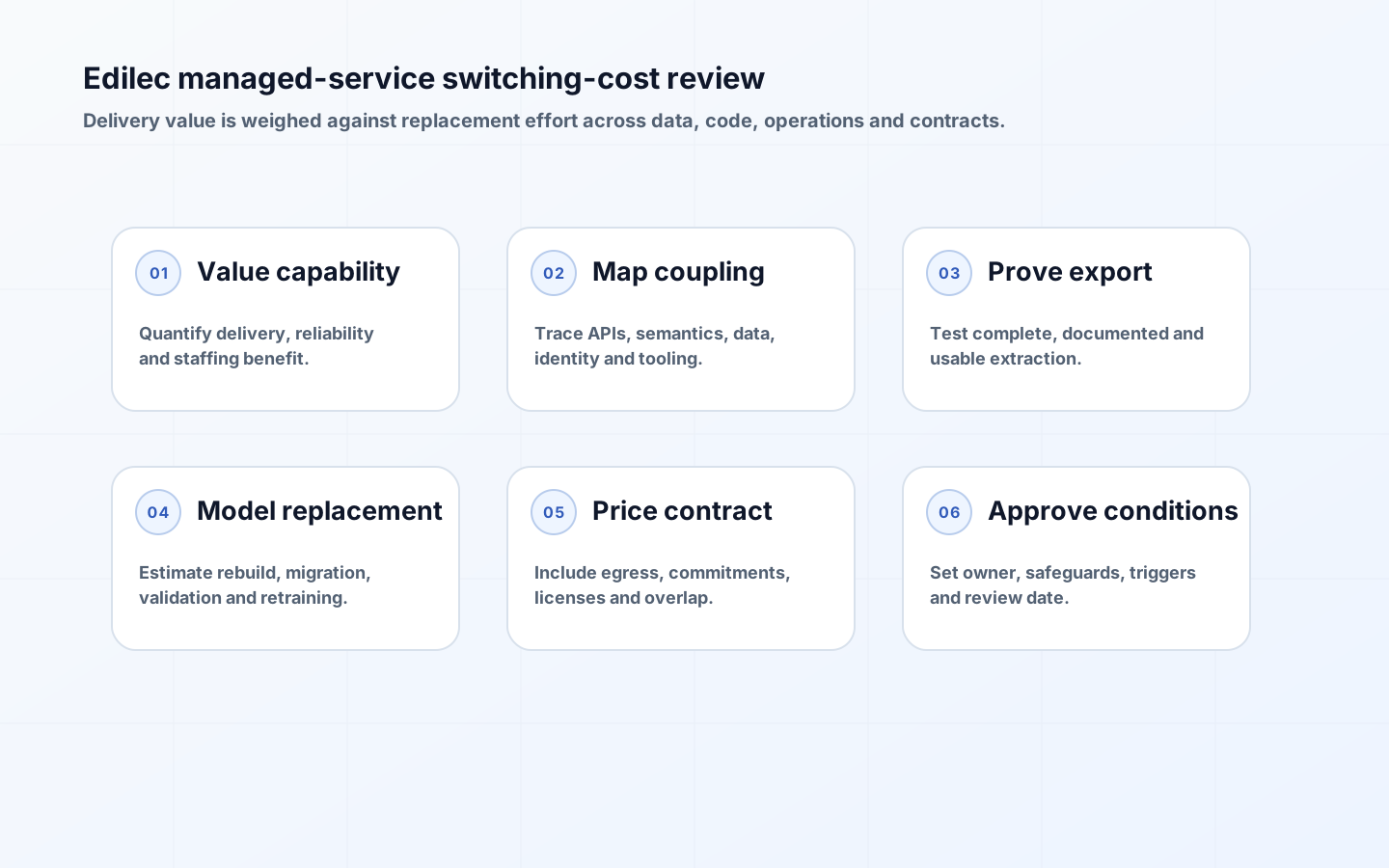
Use the six-stage Edilec managed-service review
Value the capability, map coupling, prove export, model replacement, price contracts and approve explicit conditions. The order matters: teams first understand what they gain, then decide which dependency is justified and which safeguard preserves a usable option. A failed export or unowned replacement is evidence to remediate, not a reason to disguise the service behind a generic interface.
Key takeaways for managed service reviews
- Treat lock-in as an investment decision by comparing managed-service value with total lifecycle exposure.
- Map semantic, data, operational, people and contractual coupling in addition to APIs.
- Prove that exported information restores with business meaning at projected scale.
- Estimate replacement operations, transition overlap and opportunity cost, not only egress fees.
- Approve proportional safeguards with owners, evidence dates and triggers for renewed review.
Frequently asked questions about managed service vendor lock-in
Does an open-source engine guarantee portability?
No. It can provide a plausible replacement, but versions, extensions, control planes, identity, backup behavior, scale and operational automation may differ. Test the used features and data path instead of relying on the engine label.
Should every provider API sit behind a wrapper?
Only when syntactic coupling is material and an adapter preserves a meaningful domain boundary. A wrapper cannot hide consistency, data gravity or operational behavior, and a generic lowest-common-denominator interface can erase the value that justified the service.
How often should switching cost be reviewed?
Review at contract renewal and after material changes in data volume, criticality, proprietary feature use, provider terms or available alternatives. High-exposure services also need periodic export or replacement evidence so estimates do not become stale.
Conclusion
Managed services are valuable precisely because they take on difficult work, and that value naturally creates dependency. Mature architecture does not deny the dependency; it makes the benefit, coupling, replacement and price explicit. With tested exports, realistic operational models and review triggers, leaders can adopt differentiated capability quickly without allowing today's acceleration to become an invisible future constraint.