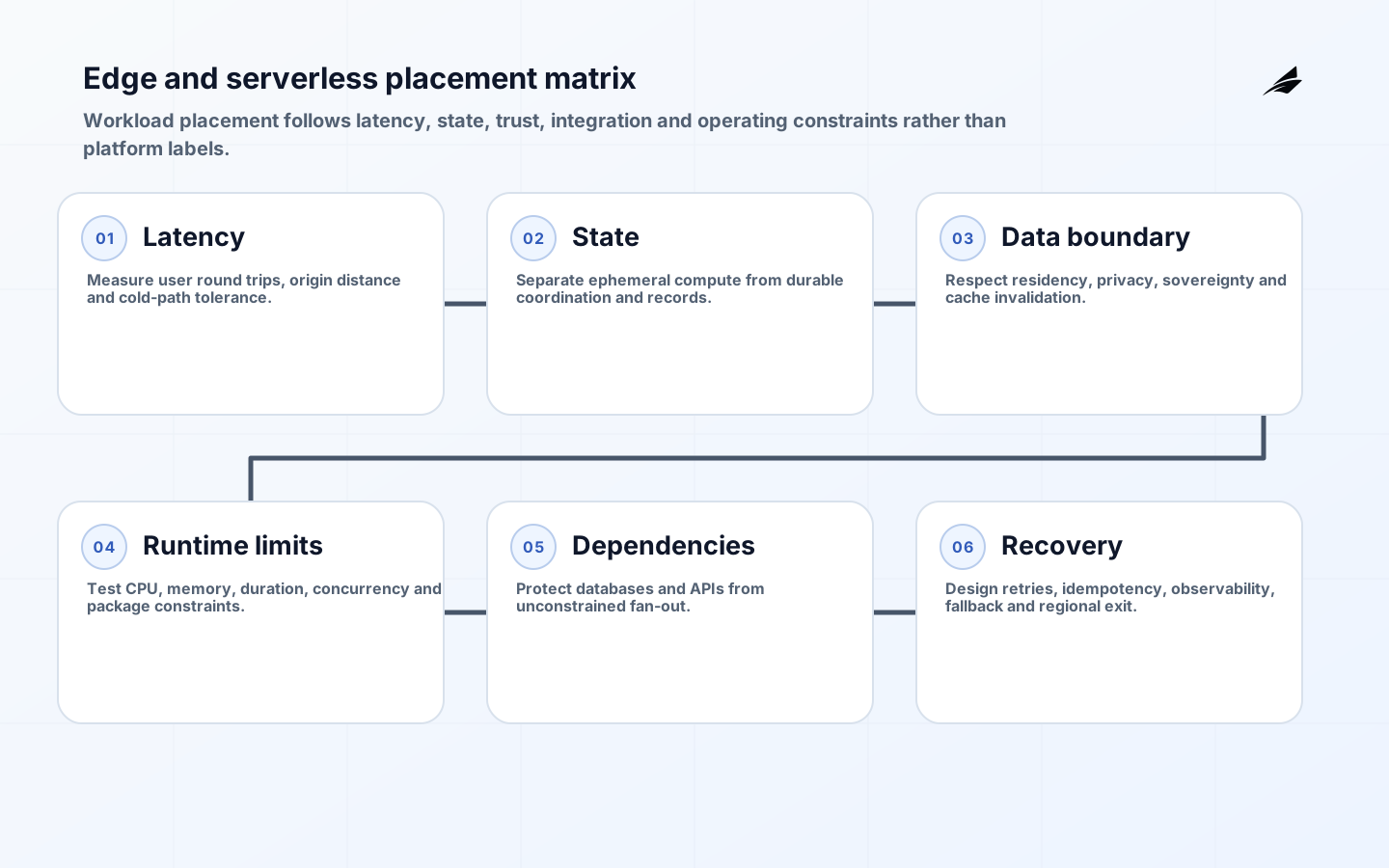
Edge and serverless architecture tradeoffs are workload-placement decisions, not a contest between fashionable platform labels. Edge runtimes execute code closer to users, devices or network ingress. Serverless functions and containers offer managed, event-driven compute with elastic capacity and usage-based charging. Both can reduce infrastructure work, and both impose constraints on state, duration, concurrency, deployment, observability and provider dependence. A dependable architecture often combines edge request handling with regional durable services.
This guide provides a decision method for APIs, personalization, authentication, media, IoT and asynchronous workflows. It complements the observability architecture guide and cloud cost visibility guide. Measure the whole customer path and failure behavior before choosing placement; a fast edge function that waits on a distant database may add complexity without reducing useful latency.
Start with latency, locality, state and consequence
Break the workflow into steps and measure where time is spent: network round trip, TLS, runtime initialization, dependency calls, queueing and data processing. Edge execution helps when a decision can be made from local request context, cached data or a globally distributed store. Examples include redirects, header normalization, bot controls, lightweight authorization checks and content selection. It helps less when every request synchronously calls a single-region transactional database.

Classify state as request-local, cached, session, durable workflow or authoritative transaction. Stateless compute is easy to move; durable state introduces consistency and recovery decisions. Define where data may be processed and stored, which region is authoritative, how replicas converge and what stale data can safely influence. Security and privacy constraints may prevent placing sensitive logic or data in every point of presence. Threat-model code, configuration, secrets, logs and deployment control.
| Workload | Likely placement | Reason and caution |
|---|---|---|
| Redirect or request normalization | Edge | Local decision; keep rules versioned and observable |
| Customer transaction | Regional service | Needs authoritative state, consistency and reconciliation |
| Image transformation | Edge or serverless | Parallel and cacheable; watch CPU and size limits |
| Webhook ingestion | Serverless entry plus queue | Absorb bursts; require idempotency and signature validation |
| Long business workflow | Durable orchestration | Needs timers, state, retries and human steps |
Treat runtime and scaling limits as architecture inputs
Managed platforms limit CPU, memory, execution duration, package size, connections, request body, subrequests, concurrency and deployment count. These values change by product and plan. Cloudflare publishes current Workers limits; AWS documents Lambda quotas. Read the exact region and plan documentation during design and verify limits in a load test. Never encode a transient number from a comparison article into a permanent architecture decision.
Elastic compute can overwhelm non-elastic dependencies. Set reserved or maximum concurrency, queue depth and backpressure according to database, API and downstream capacity. AWS explains that Lambda scales execution environments with concurrent requests until account or function limits apply. Azure Functions scaling varies by hosting plan and trigger. Model a traffic burst, event backlog and poison message. A platform that scales compute quickly can increase outage impact if every instance opens connections or retries the same failing dependency.
Design event delivery, retries and idempotency explicitly
Assume events may arrive more than once, late or out of order unless the chosen service contract proves otherwise. Give each business intent a stable identifier and store processed outcomes at the appropriate consistency boundary. Separate transport attempt from business operation. Validate signatures before parsing untrusted webhooks. Acknowledge only after the event is durably accepted. Route exhausted retries to an owned queue with payload reference, reason and replay controls.
Avoid using a short-lived function as an implicit workflow engine. Multi-step business processes need durable state, timers, compensation, human decisions and visible progress. Use a managed orchestration service or explicit workflow model, and keep activities idempotent. Do not hold open an HTTP request while waiting for long work; return an operation reference and provide status. Define cancellation and expiry. Recovery should replay from durable history without repeating completed side effects.
Operate globally distributed code with version and trace discipline
Deploy immutable versions through staged exposure. Separate code, configuration and secrets; validate each before promotion. Edge propagation may be gradual, so design compatibility across adjacent versions. Use canary routing by region, tenant or traffic percentage with a rapid kill switch. Keep the origin capable of safe fallback for security-critical routes where the platform supports it. Test that fail-open or fail-closed behavior matches business consequence.
Correlate request, edge decision, regional API, queue and worker with trace context that does not expose secrets. OpenTelemetry’s signal model distinguishes traces, metrics and logs; each answers a different question. Record version, region or point of presence, cold or warm path, dependency time, retries, throttling and result. Sample intelligently but retain complete evidence for errors and high-consequence commands. A global average can hide one region or runtime version failing.
| Signal | Decision it supports | Useful dimension |
|---|---|---|
| End-to-end latency | Whether placement improves the user outcome | Region, route and cohort |
| Cold-path rate | Whether initialization affects a critical journey | Version and runtime |
| Throttle or queue age | Whether capacity and backpressure are safe | Function and dependency |
| Duplicate suppression | Whether event delivery is contained | Source and operation type |
| Cost per outcome | Whether distributed execution is economical | Tenant, route and data transfer |
Protect secrets, data boundaries and supply chain
Give each function or service a narrow identity and permission set. Avoid shared broad credentials across hundreds of deployments. Use platform secret services and rotate without rebuilding unrelated code when possible. Validate untrusted input at the edge and again at the authoritative service. Protect deployment credentials, package provenance and dependency updates because a small global function can create a large blast radius. Separate tenant data in caches and include authorization context in cache keys where necessary.
Document data residency, transfer and logging behavior. Edge platforms may process requests in many locations even when durable storage is regional. Decide whether request bodies, identifiers or logs can leave the required boundary. Minimize telemetry and redact secrets centrally. Verify how deleted data leaves caches, replicas and provider logs. Supplier assurance is part of architecture: understand incident communication, region control, account recovery, evidence access and exit.
Evaluate cost and portability with representative traffic
Model requests, duration, memory, egress, storage operations, logs, build minutes, minimum capacity and support. Edge can reduce origin traffic and improve cache efficiency but increase invocation and observability cost. Serverless can be economical for variable workloads but less predictable for sustained high utilization or long processing. Calculate cost per customer outcome and include engineering time for platform constraints. Test low, normal, peak and abuse traffic.
Portability is a spectrum. Standard JavaScript, Web APIs, containers and OpenTelemetry reduce some coupling, while global data, queues, identity, orchestration and deployment controls remain provider-specific. Abstract only where a credible exit or multi-provider requirement justifies the cost. Retain business logic, data schemas, tests and runbooks in controlled repositories. Exercise export and a bounded fallback instead of claiming theoretical cloud neutrality.
Design cache correctness and origin fallback
Caching is often the largest source of edge performance and the largest source of subtle correctness risk. Define cache keys from every input that changes the response, including tenant, locale, authorization class and feature version where applicable. Never cache personalized or sensitive responses under a shared key. Set freshness, stale-while-revalidate and invalidation according to consequence. A stale marketing page and a stale entitlement decision have different tolerances.
Choose fail behavior per route. Static content may serve stale during origin outage; a security decision may need fail closed; a low-risk preference may use a bounded last-known value. Record which response path occurred so support can explain differences. Prevent retry storms when the origin returns: coalesce requests, use backoff and gradually rewarm. Test invalidation across regions and adjacent deployment versions.
Protect origin identity and capacity. Edge traffic should authenticate to the origin using rotated service credentials or platform identity, not a public bypass URL. Rate-limit by meaningful business and abuse dimensions, then preserve a route for trusted operational access. Ensure fallback does not skip web application firewall, authorization or tenant controls. If the edge provider fails entirely, DNS and certificate dependencies determine whether an alternate route is realistic.
Document cache and fallback behavior in customer-facing reliability commitments only at the level the system can prove. Monitor hit ratio beside correctness incidents, origin load and stale responses. An impressive hit rate can conceal a broken invalidation model. Review cache policy when data classification or product personalization changes.
Key takeaways
- Decompose the workflow and measure the full latency path before moving code.
- Keep durable business state and long workflows in explicit, recoverable systems.
- Use concurrency limits and backpressure to protect databases and APIs.
- Design for duplicate, late and ambiguous event outcomes.
- Include global deployment, data location, observability, cost and supplier exit in acceptance.
Frequently asked questions
Is edge rendering always faster for websites?
No. Static assets and cached pages may benefit, but personalized rendering can still wait on origin data. Measure real-user and synthetic performance by region, including cache misses and failure behavior.
Can an edge function write directly to the main database?
It can, but distant connections, credentials, pooling and consistency may make it fragile. A regional API or distributed data service is often safer. Use explicit authorization, idempotency and connection protection.
Should an edge architecture be multi-cloud?
Only when a material resilience, commercial or regulatory requirement justifies duplicated operations and data complexity. Preserve exit options first; active multi-provider delivery is a larger commitment.
Conclusion
Edge and serverless services are powerful placement tools when their limits and failure modes are explicit. Put latency-sensitive, low-state decisions close to requests; keep durable transactions and workflows where authority and recovery remain clear. A hybrid design grounded in measurement usually delivers more value than forcing every component into one execution model.