Cloud cost visibility is most useful when it gives a named team a safer, clearer way to make a recurring production decision. A launch creates temporary environments, new traffic patterns, vendor commitments, and shared platform use at the same time. Cloud cost visibility should allow a product, finance, and engineering owner to see what changed, what it supports, and what decision is available. This checklist starts from the service and its failure consequences, then turns that context into a bounded design, an operating test, and evidence for the next decision.
Model launch unit economics before traffic arrives
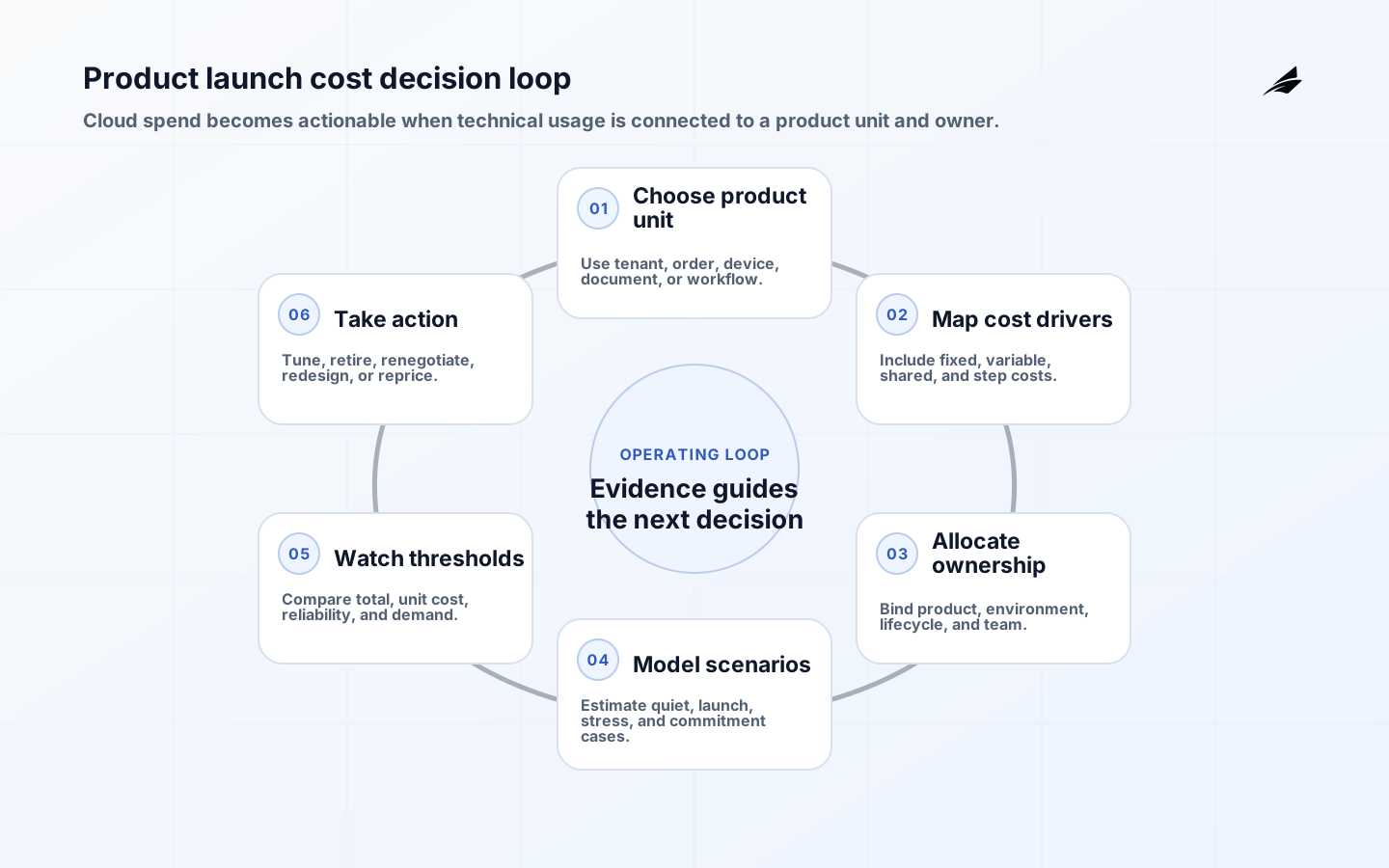
A launch budget should connect technical consumption to a product unit that leaders understand. Depending on the service, useful denominators include active tenant, completed order, processed document, generated report, connected device, or gigabyte retained. Estimate a quiet baseline, expected launch case, and stress case. Split costs that scale with activity from fixed platform commitments and step changes such as a larger database tier. Include observability, backups, egress, security tooling, preview environments, support vendors, and reserved commitments; compute and storage alone rarely explain the invoice. For container platforms, Kubernetes resource request and limit guidance explains how scheduling and enforcement depend on declared resource needs. The FinOps Framework treats cost management as a collaborative operating practice, which is why engineering assumptions and product forecasts should meet before launch rather than during the first budget dispute.

Define an owner and action for each threshold. A rising cost per completed workflow may trigger a query review, cache change, model-routing adjustment, retention decision, or price review; a rising total with stable unit cost may simply reflect healthy demand. Allocation metadata must answer product, environment, owner, and lifecycle, but not every shared charge can be tagged. Manage that metadata through reviewed configuration such as Kubernetes declarative objects instead of console-only convention. Publish the rule used for shared services and show unallocated spend rather than hiding it. AWS's cost allocation guidance distinguishes showback from chargeback and emphasizes accountability. Pair cost thresholds with a reliability boundary using Google SRE's SLO implementation guidance, so a cheaper design is not celebrated after it damages a customer objective. Edilec's cloud operations services can then optimize against a visible product outcome rather than an arbitrary percentage cut.
Key takeaways
- Start cloud cost visibility with a specific customer or business outcome and an accountable owner.
- Define the operational boundary before selecting tools, environments, or automation.
- Treat access, change history, and recovery evidence as part of the design, not audit paperwork added later.
- Run a realistic pilot with the people who will operate the service under pressure.
- Use results to improve a supported path instead of standardizing untested local practice.
What cloud cost visibility needs to solve
A billing export alone cannot explain whether a cost rise reflects customer demand, a mis-sized database, an abandoned preview environment, or a new logging volume. Early ambiguity hardens into allocation disputes when no one owns the mapping between spend and service.
| Decision area | Checklist question | Evidence that makes it real |
|---|---|---|
| Business outcome | Which customer action or control depends on cloud cost visibility? | A named service owner agrees on what healthy and harmful look like. |
| Operating boundary | What is included in the first cloud cost visibility implementation, and what is deliberately excluded? | Dependencies, data, identities, and exceptions are recorded. |
| Decision authority | Who can approve, pause, contain, and validate a material change? | Roles and escalation routes are usable outside normal office hours. |
| Recovery proof | How will the team know the business outcome is restored? | A rehearsal reaches customer or record validation, not only a green technical check. |
Set the first operating boundary
Do not begin cloud cost visibility as an organization-wide replacement program. Start with the launch service and its environments, major managed services, third-party commitments, and shared components. Define the allocation rule and data freshness for each before trying to attribute every small item precisely. Write down the assumptions that would invalidate the choice, including volume, availability, data handling, dependency behavior, and skills. This keeps the first implementation reviewable and prevents a useful control from becoming an open-ended platform promise.
Make the boundary usable by writing a short decision record. It should say why this scope was selected, which alternatives were considered, what evidence is still missing, and the date or event that will trigger reconsideration. For cloud cost visibility, a decision record is most valuable when it exposes a trade-off before it becomes an incident: a service may accept slower change in return for stronger evidence, or accept a narrower pilot in return for a faster learning cycle. The record should also identify the owner who can accept that trade-off; technical feasibility alone does not settle a customer or control consequence.
Design the cloud cost visibility operating path
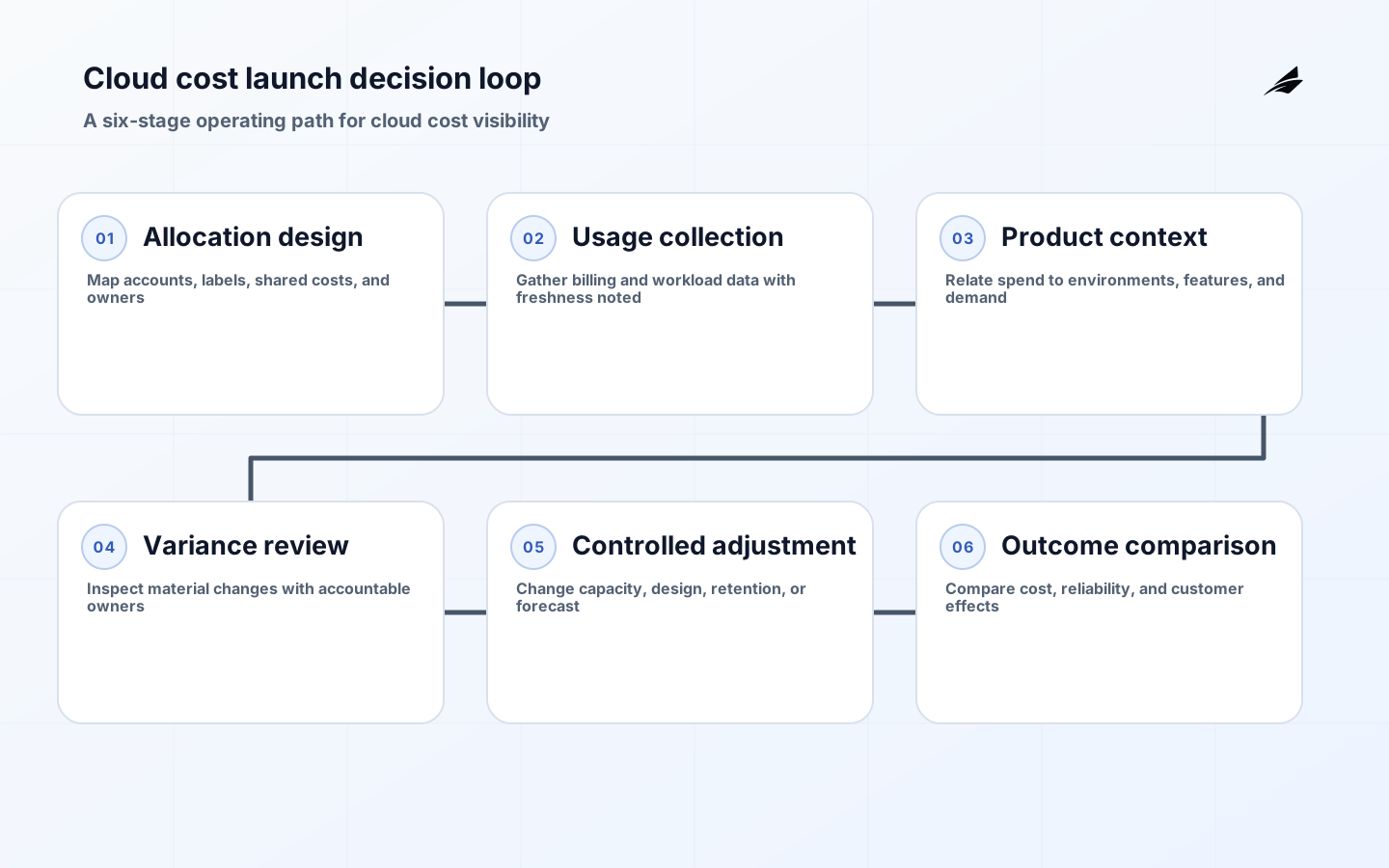
Align account or project structure, tags or labels, and service ownership with the product decision the team needs to make. Separate unit cost, committed baseline, variable demand, and shared allocation. Make exceptions visible where a service cannot be attributed reliably.
| Design element | Practical decision | Failure to prevent |
|---|---|---|
| Ownership | Name the service, platform, product, and control owners that have a decision to make. | A material issue waits while teams debate responsibility. |
| Change evidence | Keep the intent, reviewed revision, validation result, and exception decision together. | A responder cannot explain what changed or restore a known state. |
| Health evidence | Use customer and service signals with a stated observation window. | A technical success masks a damaged workflow. |
| Recovery boundary | State what can be reversed, what must be reconciled, and who confirms completion. | Traffic recovers while records, access, or downstream work remain wrong. |
Put cloud cost visibility controls in the normal workflow
Require cost-relevant metadata in infrastructure definitions, protect changes to budgets and commitments, publish a clear owner for unallocated spend, and set alerts at a level where someone can act. Avoid alerting only on the total bill, which often arrives after the useful decision window.
Design an exception path alongside the ordinary cloud cost visibility workflow. An exception request should identify the operational reason, the temporary control, the approving authority, the expiry date, and the work needed to return to the supported path. This is more useful than an informal emergency channel because it preserves speed while making accumulated risk visible. When the same exception recurs, ask whether the standard is too narrow, the service has an unaddressed dependency, or the team needs a distinct operating model. Do not normalize a workaround merely because it is familiar.
- Give routine work a documented self-service path and make exceptions visible to the owner of cloud cost visibility.
- Use scoped identity and short-lived access wherever the underlying platform supports it.
- Record meaningful approvals, overrides, and production changes with enough context for a later review.
- Keep a current runbook that names the signal, first action, escalation route, and business validation step.
- Review recurring friction as a design problem before adding another manual gate.
Pilot cloud cost visibility under realistic conditions
Run the model through a launch rehearsal or early release. Compare estimated and observed usage, intentionally create one tagged workload and one untagged workload, and verify that the right owner receives a usable explanation rather than a raw invoice line.
| Pilot question | How to exercise it | Decision enabled |
|---|---|---|
| Can the service be operated? | Have the nominated owners use the normal path without private administrator help. | Clarify ownership or reduce complexity before wider use. |
| Can a harmful change be contained? | Introduce a bounded failure or rejected condition and follow the stated response. | Improve stop conditions, access, or automation. |
| Can recovery be proven? | Restore the needed state and verify the actual customer or business workflow. | Accept the recovery objective or redesign the path. |
| Can the evidence be explained? | Ask a reviewer to reconstruct the decision from retained records and telemetry. | Fix gaps in traceability, monitoring, or documentation. |
Measure whether cloud cost visibility supports better decisions
Review allocation coverage, variance against a stated forecast, unit cost alongside service reliability, age of idle resources, data freshness, and time to resolve material anomalies. Cost reduction that degrades the customer path is not a complete outcome.
Set a review cadence that matches the rate and consequence of change. During an initial rollout, review evidence after meaningful releases, exercises, or exceptions while details are still available. Once the path is stable, use a regular service review to inspect trends, decisions that were deferred, and controls that no longer match the work. Keep the review small and action-oriented: each material signal should end with an owner, a due date where appropriate, or a recorded decision to accept the current risk. This turns cloud cost visibility into an operating practice rather than a checklist completed once and forgotten.
Frequently asked questions about cloud cost visibility
Should every cloud resource have a tag?
Most chargeable resources should carry enough metadata to join spend to an owner and purpose, but a tag policy needs practical exceptions. Shared or provider-managed charges may require a documented allocation rule instead.
How often should launch costs be reviewed?
Review frequently while usage and architecture are changing quickly, then settle into a cadence aligned to material decisions. The billing-data freshness should be stated so reviewers do not mistake a lagging view for current demand.
Keep cloud cost visibility current after the first rollout
The first accepted implementation is a baseline, not a permanent answer. Revisit cloud cost visibility when the service gains a new customer journey, regulated data class, region, integration, runtime, or dependency that changes the original assumptions. The review should begin with the evidence already collected: what operators had to do manually, which alerts did not lead to action, which approvals delayed an urgent decision, and whether recovery produced the intended business outcome. Update the owned service record, runbook, templates, and training materials together so that the documented path remains the path people can use. Where a change creates a new risk, repeat a focused exercise rather than relying on an old successful test. Confirm that replacement owners can perform the required actions and find the same evidence without oral handover. This maintenance work is deliberately modest: it preserves the value of cloud cost visibility by making operational knowledge durable as teams, systems, and responsibilities change.
Conclusion
Cloud cost visibility is a product operating capability, especially during launch. Establish ownership and allocation before scale, pair financial signals with service outcomes, and use anomalies to prompt a specific technical or demand decision.