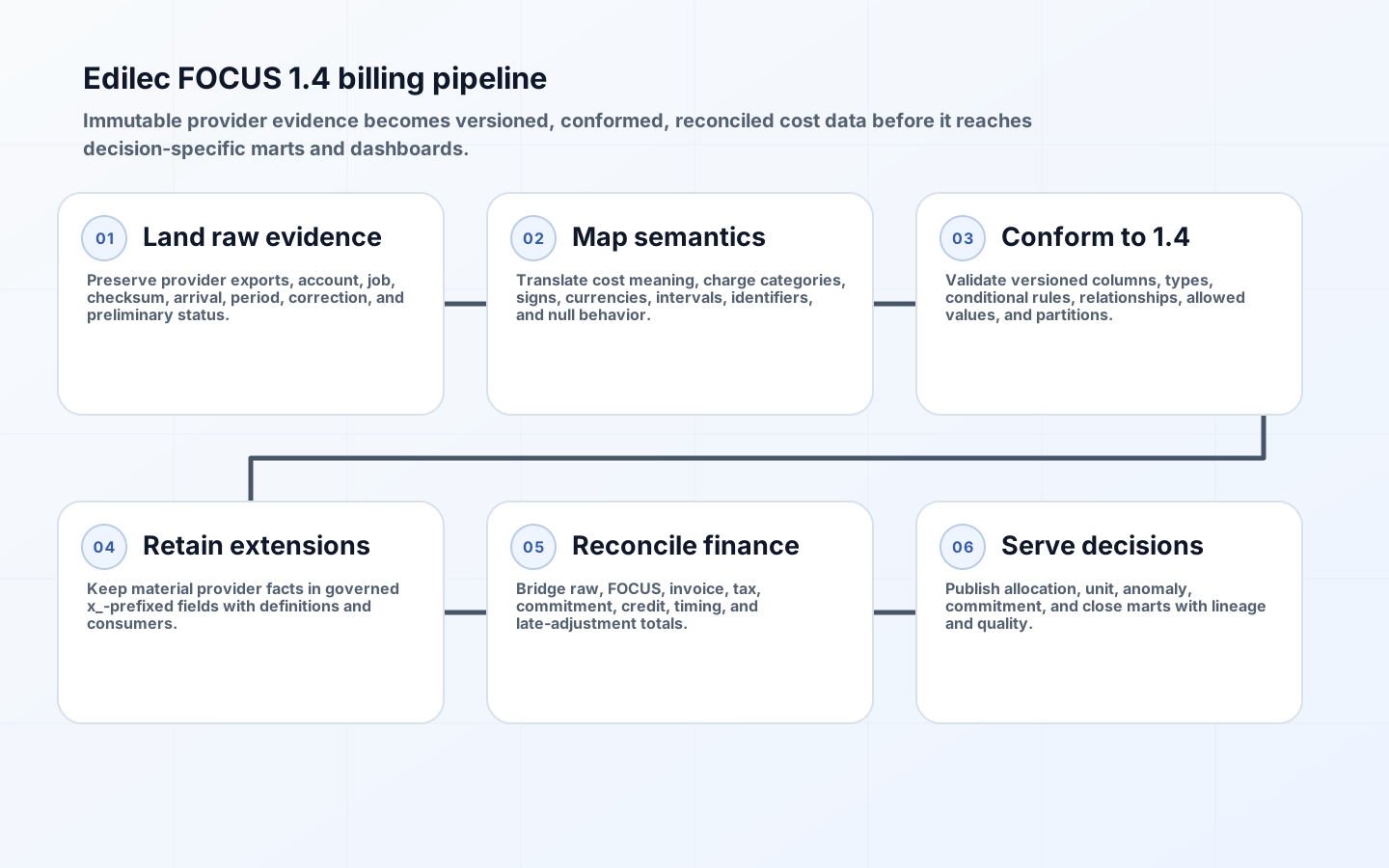
FOCUS gives multi-cloud billing teams a common schema and vocabulary, but normalization is not achieved by renaming provider columns and pointing a dashboard at the result. A durable implementation preserves raw exports, pins a specification version, validates types and conditional semantics, retains provider-specific facts as extensions, reconciles to invoices, and publishes governed analytical views. Dashboards come last because they amplify whatever meaning and errors the model contains.
As of July 13, 2026, FOCUS 1.4 is the current ratified release. The FOCUS 1.4 specification defines an open billing-data schema intended to support consistent FinOps capabilities across providers. Version 1.4 adds invoice-detail and billing-period datasets and expands contract-commitment representation. Implementations should record the exact version; “FOCUS compatible” without a version, generator, and conformance evidence is too vague for financial data.
Define a versioned FOCUS data contract
Set source scope, export cadence, latency expectation, specification version, generator version, currency policy, partition keys, correction behavior, retention, and period-close rules. Preserve immutable raw files with provider account, export job, object checksum, arrival time, and source billing period. Then create a normalized layer where each row can be traced back to its raw record. Never make a transformed table the only evidence for an invoice amount.
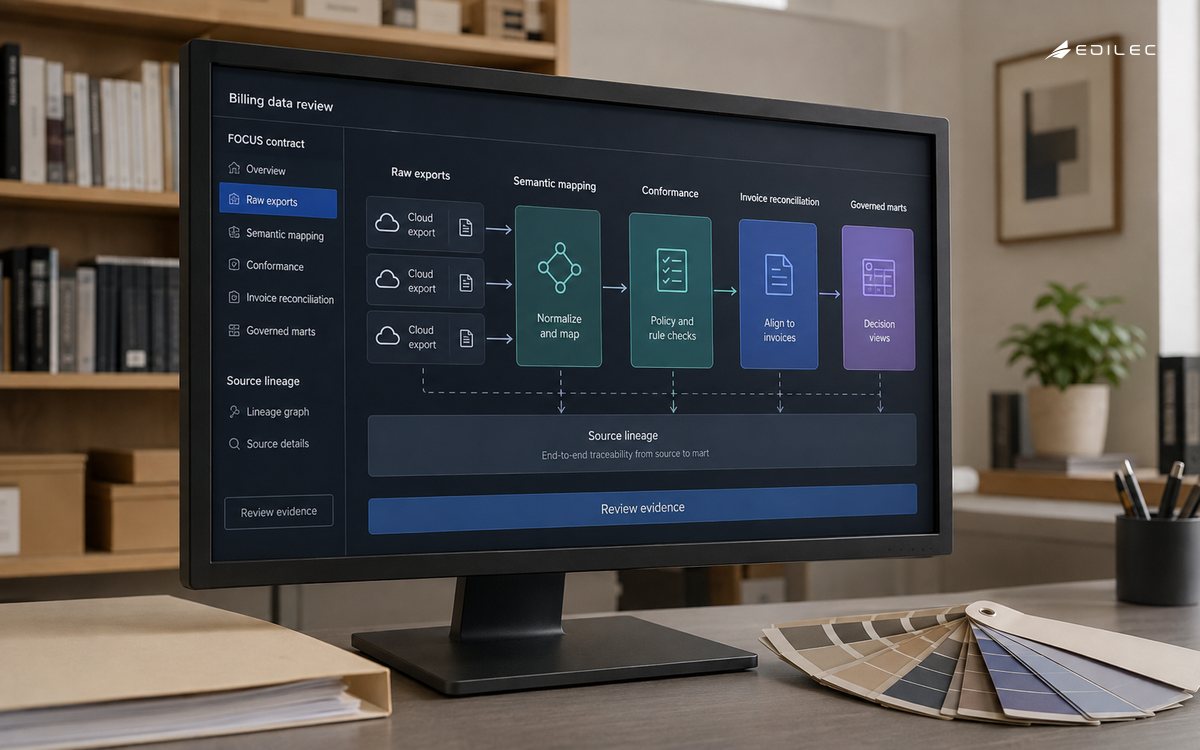
Declare the granularity you receive and do not manufacture missing detail. Some charges have resource identity and hourly usage; others are account-level fees, credits, taxes, support, marketplace transactions, or commitment effects. Use null where the specification requires absence rather than placeholder strings or zeros. Track preliminary versus final data and late adjustments. Reprocessing must be idempotent so a corrected export replaces or versions prior facts instead of duplicating cost.
| Layer | Purpose | Immutable fact | Primary test |
|---|---|---|---|
| Raw landing | preserve provider evidence | source object and checksum | completeness and duplicate detection |
| Conformed FOCUS | apply versioned common schema | source-row lineage | schema and semantic validation |
| Extension layer | retain provider detail | namespaced custom fields | no collision with standard columns |
| Reconciliation | bridge data to billing documents | variance classification | period and currency tie-out |
| Semantic marts | serve allocation and decisions | rule and rate version | metric reproducibility |
| Presentation | deliver scoped views | dashboard release | decision acceptance |
Map billing semantics, not similar-looking columns
For every provider field, document source definition, FOCUS target, transformation, data type, null rule, currency, sign, conditional applicability, and known loss. Cost concepts deserve special care: billed, effective, list, and contracted costs answer different questions. Credits, refunds, commitment fees, discounts, and corrections must retain their charge categories and relationships. A column called cost in two exports is not evidence that the amounts are comparable.
Use the official FOCUS columns library as a navigational aid and the normative specification as authority. Keep provider-specific data when it materially supports optimization, support, or reconciliation. FOCUS requires custom columns to use a consistent x_ prefix, preventing collision with future standard columns. Maintain a registry for each extension with provider, definition, type, consumers, privacy class, and removal condition.
Validate conformance and financial quality separately
Schema conformance checks names, types, ordering expectations, mandatory and conditional columns, allowed categories, identifier relationships, and null behavior for a pinned version. Financial quality checks completeness, duplicate rows, impossible intervals, currency consistency, sign patterns, account coverage, and source totals. A dataset can satisfy schema rules while omitting a provider export or mapping a credit incorrectly. Run both classes and quarantine failed partitions before they enter reports.
Test provider upgrades and generator changes against a golden set containing usage, purchases, refunds, credits, taxes, marketplace items, reservations, shared costs, and late corrections. Compare row counts and sums by currency, provider, account, charge category, service, and billing period. Track unknown categories and new extension columns. The official FOCUS dataset guidance lists current provider and dataset support, but your contract still needs evidence for the exact export you ingest.
| Gate | Example assertion | Failure action | Owner |
|---|---|---|---|
| File completeness | all expected accounts and periods arrived | hold partition and alert source owner | data engineering |
| Schema | required versioned columns and types pass | quarantine records | data engineering |
| Semantics | charge category and cost relationships are valid | review mapping | FinOps data owner |
| Reconciliation | scoped totals bridge to invoice | classify variance before close | FinOps and finance |
| Allocation | owner coverage meets threshold | publish unknown bucket | FinOps and platform |
| Presentation | metric reproduces from governed mart | block dashboard release | analytics owner |
Reconcile normalized data to invoices and commitments
Define reconciliation scope precisely: provider, billing account, billing period, invoice, currency, tax treatment, and cutoff. Bridge raw export totals to conformed cost, then to invoice detail. Name variances such as unbilled estimates, timing, tax, currency conversion, support fee, rounding, late credit, or missing account. Version 1.4’s invoice and billing-period work can improve this process, but no schema replaces the accounting decision about when a period is final.
Keep commitment purchases, eligible usage, applied discounts, and unused commitment economically distinct. Effective cost supports many analyses, while cash and invoice views may require billed cost and separate payment timing. Do not allocate savings twice by combining provider-amortized values with another internal amortization. Reconcile the commitment portfolio at its purchasing scope before distributing benefit to products, and preserve the policy version used for that distribution.
Publish semantic marts for decisions
Build narrow marts for allocation, unit economics, anomaly detection, commitments, and invoice close rather than one enormous dashboard table. Each metric needs formula, included charge categories, currency treatment, time grain, preliminary status, owner, and freshness. Provide raw-lineage drill-through and a version banner. A month-over-month chart should not combine a revised prior month with an incomplete current month without warning.
Operate ingestion as the FinOps Foundation’s data ingestion capability describes: collect, normalize, and make technology cost and usage data available to other capabilities. Monitor source lateness, conformance failure, reconciliation variance, extension growth, unknown owner cost, and query freshness. When FOCUS advances, run the new version beside the old, measure impact, migrate consumers, and preserve historical interpretation before retiring the prior model.
Design period reprocessing deliberately. Provider exports may restate earlier days, apply credits after usage, or finalize charges after preliminary records were queried. Partitioning only by ingestion date makes corrections difficult to find; partitioning only by usage date can hide when data changed. Keep both, plus a source record key and revision strategy. Recompute affected normalized partitions and dependent marts deterministically, then publish a revision event showing impacted periods and metrics. Finance can decide whether a closed period receives a true-up while analytical users still see corrected operational history.
Protect comparability during specification upgrades. Build a column-level impact report for additions, changed conditions, categories, datasets, and extension collisions. Materialize the old and new versions from the same raw sample, run reconciliation and decision queries, and explain differences by provider. Consumers should declare the version they accept rather than reading an unversioned latest view. After migration, retain mapping documentation and test fixtures even if the old table expires. FOCUS is intentionally iterative; version discipline lets an organization benefit from that evolution without silently changing historical economics.
The FOCUS cloud cost specification should also have a named data-product support model. Document freshness and reconciliation objectives, incident severity, on-call ownership, provider escalation paths, and consumer change notices. A missing account export can materially distort allocation even though the warehouse is technically available. Track completeness by expected account and day, publish preliminary status through the serving layer, and block formal close when required evidence is absent. Give consumers a machine-readable version and quality manifest so scheduled reports can reject incomplete periods rather than relying on a dashboard banner that automation never sees.
Document rounding and currency at every aggregation boundary. Retain source currency and provider precision, convert with an approved rate and date when a reporting currency is needed, and avoid rounding rows before summation. Small line differences can become material at scale. Reconciliation should explain translation and rounding explicitly, while decision marts expose the currency basis so teams do not compare nominal amounts from different currencies or exchange-rate dates.
Key takeaways
- Pin FOCUS 1.4, generator versions, source exports, and correction semantics in the data contract.
- Preserve immutable raw billing evidence and source-row lineage through every transformation.
- Map cost meaning, signs, currency, categories, and nulls rather than matching names mechanically.
- Test schema conformance, financial quality, and invoice reconciliation as separate gates.
- Serve decisions from governed marts and migrate FOCUS versions through parallel comparison.
Frequently asked questions
Can FOCUS replace raw provider billing exports?
No. Preserve raw exports for lineage, support, audit, and remapping. FOCUS is the normalized contract built from that evidence.
Are provider-specific extensions a failure?
No. They are appropriate for material facts outside the common schema when namespaced, documented, governed, and kept separate from standard meaning.
Why not start with the dashboard?
Presentation makes ambiguous definitions look authoritative. Establish lineage, semantics, quality, reconciliation, and metric contracts first so the dashboard reports trustworthy facts.
Conclusion
FOCUS reduces bespoke multi-cloud billing work by providing common structure and language. Its value appears when teams implement it as a living financial data contract: raw evidence below, conformance and reconciliation in the middle, and decision-specific marts above. Build that foundation before dashboards, and provider changes become governable model updates instead of unexplained chart movement.