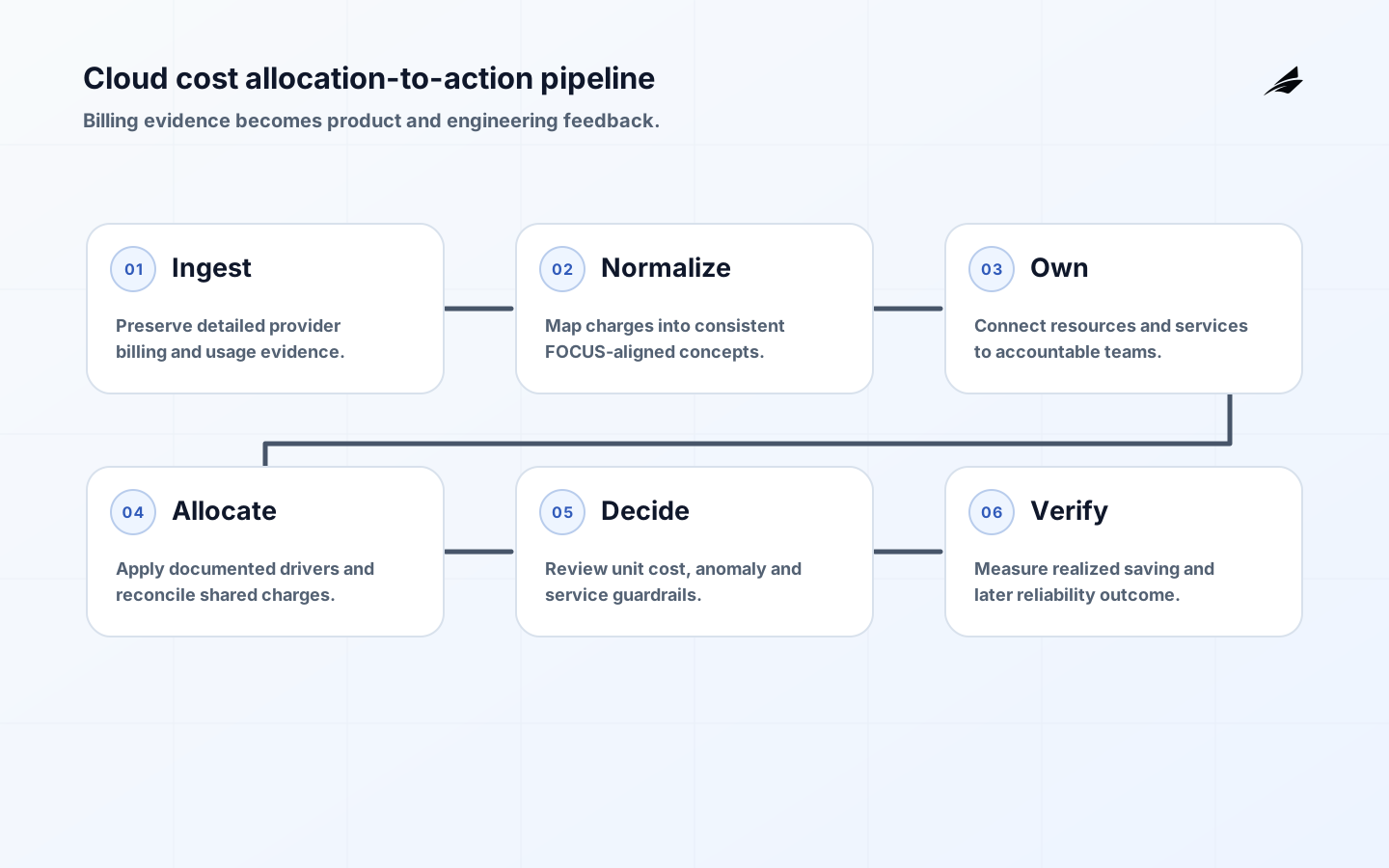
Cloud cost visibility for software teams means connecting billed charges to products, environments, customers or capabilities closely enough that an owner can make a responsible decision. A provider invoice answers what was charged. Engineering needs to know which service behavior, resource choice or demand pattern caused it; finance needs reconciliation; product leadership needs unit economics; operations needs to see whether a cost change also affects reliability. One dashboard cannot answer those questions without a governed data and allocation model.
The work is part of FinOps, a shared operating practice rather than a periodic cleanup by finance. Teams should normalize cost and usage, establish ownership, allocate shared services transparently, define decision-relevant unit measures and verify savings against service outcomes. Related operational foundations include service-level objectives and backup and restore testing.
Build a reconciled cost and usage foundation
Ingest detailed provider billing exports with charge period, service, resource, account, region, pricing category, commitment, credit, tax and currency fields. Preserve raw records and transformation versions. Reconcile the transformed dataset to invoices and document timing differences. FOCUS defines vendor-neutral dimensions and metrics that can reduce cross-provider ambiguity; adopting its concepts also makes internal allocation rules easier to explain. Do not overwrite raw provider meaning to force a pretty unified chart.

Join billing to an ownership catalog containing product, service, team, environment, criticality and lifecycle. Tags help but are not a complete source of truth: some charges are untaggable, tags change, and shared services serve several products. Measure coverage and route unowned spend to a visible queue. Apply effective dates so a team transfer does not rewrite historical accountability. Keep billing period and usage period distinct where providers report them differently.
| Data layer | Purpose | Control |
|---|---|---|
| Raw billing | Preserve provider charge evidence | Immutable import and invoice reconciliation |
| Normalized cost | Use consistent concepts across sources | Versioned FOCUS-aligned mappings |
| Ownership | Connect resources and services to accountable teams | Catalog and coverage review |
| Allocation | Distribute shared cost using documented drivers | Method ID, ratio and reconciliation |
| Decision view | Support product and engineering action | Metric definition, freshness and owner |
Allocate shared costs without hiding uncertainty
Directly assign costs when a resource belongs to one product. Allocate shared platforms through a driver that reflects consumption or benefit: request count, compute time, storage, active tenant or another measurable unit. Publish the method, source, period and unallocated remainder. FOCUS 1.3 includes fields for split allocation details and ratios; the governing principle is that allocated records reconcile to the origin charge and the method remains inspectable.
Do not force all shared cost into false precision. Keep an explicit shared or unallocated category while instrumentation improves. Review allocation with platform and consuming teams so it does not create perverse behavior. A flat equal split may be adequate for a small common service, while a high-cost data platform may need measured drivers. Chargeback changes incentives and should follow trusted showback, stable ownership and a dispute process.
Handle Kubernetes and shared compute carefully
Kubernetes bills are usually attached to nodes, storage, load balancers and managed control-plane services, while teams think in namespaces, workloads and products. OpenCost defines a vendor-neutral method for allocating cluster cost. Collect requests, usage, workload ownership and cluster metadata, then decide how idle capacity is assigned. Requests influence scheduling and reserved capacity; actual usage helps diagnose efficiency. Both are needed to explain cost.
Kubernetes documentation explains that requests guide scheduling and limits constrain resources. Missing or inflated requests can increase node capacity; limits can affect performance. Optimize with service evidence: right-size from representative history, account for peaks and failover, and observe throttling, latency and restarts after changes. Moving cost from one team to an unallocated cluster bucket is not a saving.
| Decision | Cost signal | Service guardrail |
|---|---|---|
| Right-size workload | Requested, used and idle CPU/memory | Latency, throttling and error objectives |
| Change commitment | Stable eligible usage and effective rate | Demand uncertainty and exit risk |
| Retire resource | No owner or observed use | Dependency and recovery check |
| Move data tier | Storage, request and transfer cost | Durability and retrieval objective |
| Allocate platform | Documented consumption driver | Reconciliation and dispute review |
Create unit metrics tied to product behavior
Total spend is useful for finance but weak for engineering diagnosis. Define units such as cost per active tenant, completed order, document processed, gigabyte retained or successful workflow. Choose a denominator representing delivered value and record exclusions. Decompose the unit into major service components so a change can be explained. Watch both total and unit cost: a falling unit cost can coexist with unaffordable growth, and a rising unit cost may reflect a temporary migration.
Link cost changes to deployments, traffic, pricing, incidents and architecture decisions. Use consistent time and currency treatment. Amortize commitments when the decision requires effective consumption cost, while preserving billed cash views. Do not mix list, billed and amortized cost without labels. Unit measures need a business and technical owner because their meaning crosses domains.
Turn anomalies into owned action
Detect unexpected change at the narrowest actionable dimension: service, product, account, region or workload. Compare against seasonality, release and demand context. Route the alert to an owner with amount, rate of change, likely drivers and a safe investigation link. Avoid alerting on every small resource. A useful anomaly process distinguishes data delay, planned change, demand growth, incident and waste.
Track recommendation status, expected savings, implementation cost, service risk and verified result. Savings are the difference from a defensible baseline after the change, not the sum of tool recommendations. Include avoided cost separately from reduced bill. Review regressions after optimization. A cheaper system that misses recovery or performance objectives transfers cost into customer and operational harm.
Establish a shared cloud cost operating model
Finance owns reconciliation and accounting treatment; a FinOps or platform function owns normalized data and practice; product and engineering owners decide changes; procurement manages commitments and commercial terms; executives set value priorities. Hold regular reviews at the cadence of the decision. Teams need self-service views and clear escalation, while central experts maintain allocation and metric standards.
Measure allocation coverage, unowned cost, forecast error, anomaly response, recommendation realization and unit trends. Preserve access controls because cost data can expose customer, architecture and commercial details. Test pipelines and annotate restatements. Good visibility creates informed conversation; it should not become a leaderboard that punishes teams for shared architecture they cannot control.
Deliver cloud cost visibility in practical stages
First reconcile one provider account and publish billed, effective and amortized cost definitions. Next establish ownership for the largest charges and expose unowned spend. Then select one shared platform and document an allocation driver with consumers. Finally add a product unit metric and a verified optimization loop. Each stage should produce usable evidence and a coverage measure. Avoid delaying all value until a perfect enterprise taxonomy is complete.
Treat the pipeline as a financial and operational data product. Test schema changes, duplicates, currency, credits, late records and allocation sums. Keep source snapshots and transformation code under change control. Publish freshness and restatement notes. Restrict access to detailed resource, customer and pricing data. A monthly executive chart can be broad, while engineering drill-down remains scoped to owned services.
Set acceptance criteria for cost decisions
A team-level view is ready when totals reconcile to the normalized source, ownership coverage is known, shared allocations sum to their origin, definitions are published and an owner can trace a material movement to resources or usage. A unit metric is ready when numerator and denominator use compatible periods and populations. An optimization is complete only after the bill and service guardrails confirm the expected outcome.
Review edge cases such as refunds, credits, marketplace charges, taxes, support fees, data transfer, commitment utilization and resources spanning products. Decide whether each belongs in product economics, shared overhead or a separate view. Consistency matters more than pretending there is one universally correct allocation. Document judgment so future teams can reproduce or deliberately change it.
Set a review date for each allocation method and unit metric. New architecture, pricing and customer behavior can make a once-reasonable driver misleading. Compare allocated totals with observed consumption and ask consuming teams whether the result supports decisions. Version material changes and avoid silently restating prior periods. Transparent evolution preserves trust while the technology estate and business model change.
Key takeaways
- Reconcile detailed cost data before building team dashboards.
- Connect spend to durable ownership and publish allocation methods.
- Treat Kubernetes requests, usage and idle capacity as different signals.
- Use unit metrics that represent delivered product value.
- Verify savings after implementation against service guardrails.
Frequently asked questions
Are tags enough for cloud cost allocation?
No. Tags support direct ownership but do not cover all charges, history or shared services. Combine them with account structure, resource relationships, service catalog and documented allocation. Monitor coverage and make unallocated cost visible.
Should teams be charged back immediately?
Usually begin with showback so teams can validate ownership and methods. Chargeback should follow reliable data, understood incentives and a dispute process. Premature charging encourages arguments and local optimizations that may harm shared value.
Does a cost tool solve FinOps?
A tool can normalize, allocate and detect, but owners still decide product value, architecture and commercial commitments. Establish the operating model and definitions with the tooling. Automated recommendations without context are a work queue, not realized value.
Conclusion
Cloud cost visibility becomes useful when a charge can be traced to an accountable product decision. Normalized data, transparent allocation, unit economics and service-aware verification turn billing into engineering feedback. The goal is not simply a smaller bill; it is better value from technology spend.
Start with one product and reconcile its direct and shared costs. Publish the method, connect it to one value unit and review changes with the owning team. That focused loop will expose the data and governance work needed to scale.