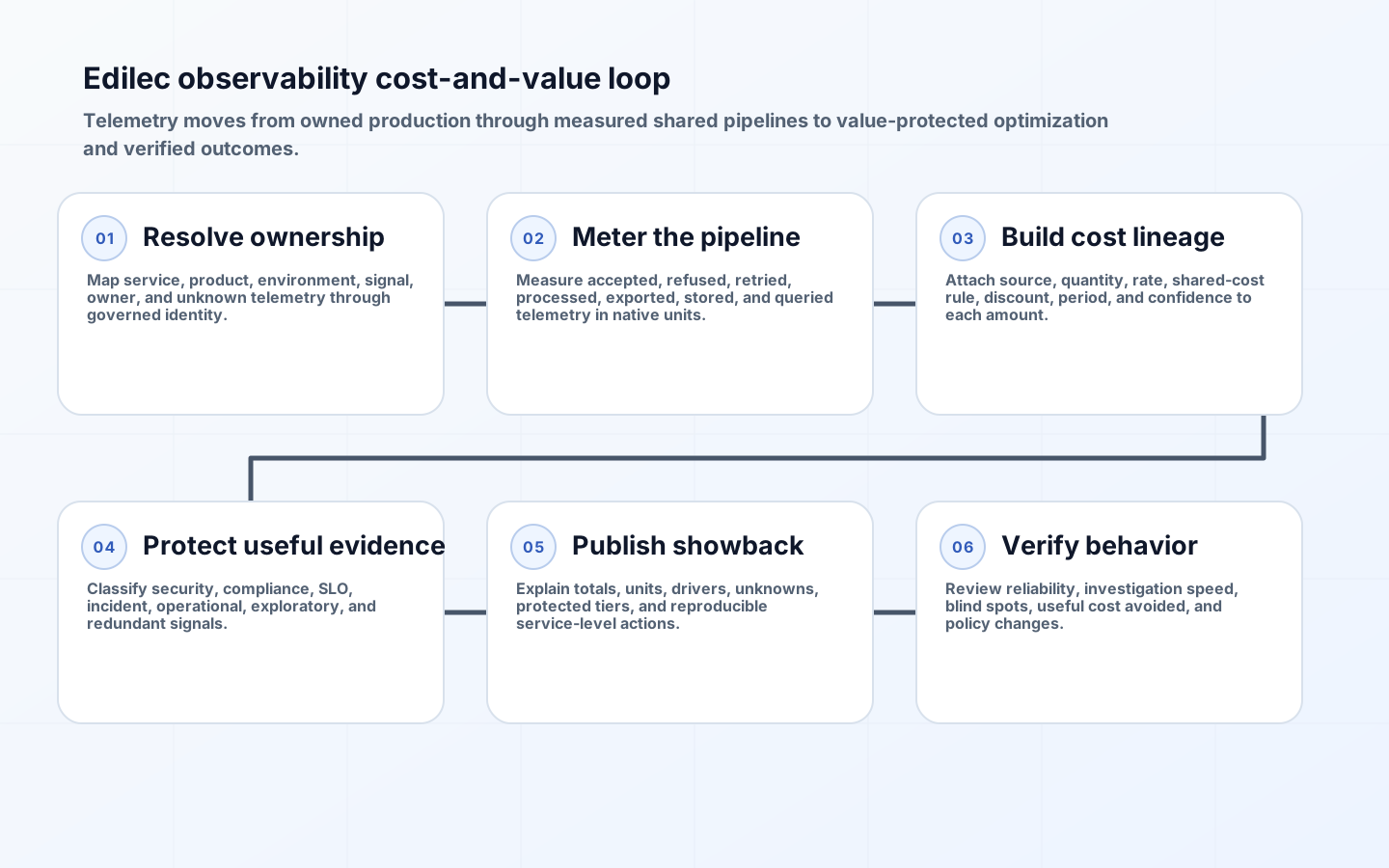
Observability cost allocation should answer who creates telemetry, what shared machinery processes it, and whether the resulting evidence changes an engineering decision. It should not reward a team for deleting the logs that reveal fraud, the spans that shorten an outage, or the metrics that protect a service objective. A defensible model separates visibility from billing, uses stable service ownership, and exposes cost drivers before it applies financial consequences. The result is a conversation about signal design and operating value, not a contest to emit the fewest bytes.
The FinOps allocation capability distinguishes allocation strategy, tagging strategy, and shared-cost strategy. Telemetry needs all three. Resource attributes connect records to products and environments; pipeline measurements explain ingest, processing, storage, and query demand; policy decides how common collectors, control planes, and retained incident evidence are treated. Start with showback because it lets teams challenge lineage and definitions before accounting turns estimates into charges.
Define the observability allocation contract
Write a contract at the grain where action is possible: service, product, environment, signal, and day is usually more useful than a single monthly team total. For each amount retain source system, measured quantity, rate version, allocation rule, owner, and confidence. Keep raw provider invoices and backend bills intact, then reconcile modeled totals to them. A difference caused by discounts, minimum commitments, delayed usage, or currency conversion must be visible as a named variance rather than silently spread across services.

Ownership must come from a governed catalog or deployment metadata, not an optional label remembered by individual developers. Resolve aliases, renamed services, shared clusters, and unowned streams in a quarantine report. Do not default unknown telemetry to the platform team: doing so hides the quality problem and gives producers no incentive to fix identity. Set a deadline after which unknown cost is escalated to the owning portfolio, while retaining the original unallocated category for auditability.
| Layer | Useful quantity | Attribution basis | Important caveat |
|---|---|---|---|
| Production | events, samples, spans or profile bytes | service and environment resource identity | record count alone ignores event size |
| Transport | received and exported bytes | measured pipeline traffic | retries must not look like new business demand |
| Processing | CPU, memory and queue occupancy | work attributable to signal pipelines | tail sampling and transforms create shared work |
| Storage | compressed bytes over retention time | signal, tier and retention class | compression differs by data shape |
| Query | scanned bytes or execution time | user, dashboard, alert or service | background rules and investigations need separate classes |
| Shared control | fixed platform and support cost | published shared-cost policy | allocation is a policy choice, not a measured fact |
Meter the telemetry pipeline before pricing it
Instrument collectors, gateways, queues, and backends as a production data system. The OpenTelemetry guidance on Collector internal telemetry exposes accepted, refused, sent, failed, queued, and resource-use signals. Join those measurements with backend usage exports and cloud bills. Distinguish original payload from retransmission, accepted data from dropped data, and hot retention from archive. Without these distinctions, a backend incident that causes retries can be misreported as producer growth.
Rates should correspond to controllable drivers. Logs may be priced by compressed ingest and retained bytes, metrics by active series or samples, traces by spans and retained trace bytes, and profiles by samples or stored profile data. Never pretend these units are interchangeable. A common currency total is useful for finance, while native units tell engineers what to change. Publish both, with a rate card version and an example calculation that a service owner can reproduce from source exports.
Classify signal value and protection
Create value tiers before recommending reductions. Protected evidence includes security audit trails, regulated records, billing proof, and signals tied to service objectives or tested incident procedures. Operational evidence supports routine diagnosis and capacity decisions. Exploratory telemetry has a named hypothesis and expiry. Redundant or ownerless data is a removal candidate. Tiering does not prove that every protected event must stay at maximum detail; it establishes who may change it and what evidence is required.
Use telemetry transformations to remove unnecessary attributes, normalize identity, or route records, but treat transformation configuration as code. Test representative payloads, preserve a rollback version, and monitor drops and errors. High-cardinality identifiers can be valuable in traces yet damaging as metric labels. Move detail to the signal where it can be queried efficiently rather than applying a universal ban that destroys correlation.
| Situation | Preferred action | Proof required | Avoid |
|---|---|---|---|
| Duplicate signal | retire one producer or route | same decisions remain possible | charging both teams indefinitely |
| High-volume debug logs | sample, aggregate or shorten retention | incident replay still succeeds | blanket production disablement |
| Rare critical traces | retain with targeted or tail policy | failure cases remain discoverable | randomly losing every rare error |
| Unused dashboard series | expire after owner review | no alert, SLO or runbook dependency | equating no recent query with no value |
| Mandatory evidence | protect and allocate transparently | control owner and retention basis | forcing a service to opt out for savings |
Use showback as a behavior design tool
A useful monthly statement shows total cost, native consumption, change versus a comparable period, top drivers, unknown ownership, protected tiers, and concrete actions. Compare a service with its own history and architecture, not with an unrelated low-traffic service. Add unit views such as telemetry cost per successful workflow or per million requests when the denominator is stable. The unit economics capability emphasizes linking technology cost to value; a falling telemetry bill with longer incidents is not an efficiency gain.
Delay chargeback until lineage coverage, reconciliation, and dispute handling are mature. When chargeback is appropriate, fund mandatory shared evidence centrally or show it separately so product teams are not penalized for controls they cannot alter. Set savings guardrails: no change may weaken an SLO, security control, audit obligation, or validated incident workflow without its owner’s approval. Review major reductions after thirty and ninety days for new blind spots, longer diagnosis, or increased query failures.
Run a recurring cost-and-value review
Meet with observability, FinOps, security, finance, and rotating service owners. Review reconciliation variance, unknown telemetry, the largest rate-normalized changes, collector losses, backend commitments, and the outcomes of recent reductions. Separate price variance from quantity variance and architecture variance. A vendor rate change calls for procurement or tiering work; a volume jump may reflect a release; a query-cost jump can reveal a broken dashboard variable. Assign one owner and due date to each accepted action.
Treat the model itself as versioned production logic. Backfill a sample period before changing rules, publish the impact by owner, and allow disputes supported by evidence. Preserve historical statements under their original definitions so trend lines are not silently rewritten. Success measures include allocation coverage, reconciliation accuracy, unknown-cost age, useful cost avoided, protected-signal incidents, and time from a statement to a verified engineering action. Total spend alone cannot tell whether the system got wiser or merely quieter.
Test the policy with concrete scenarios before launch. Price a normal release, an accidental debug-log surge, a security investigation that temporarily increases retention, a collector outage with retries, and a quiet service whose fixed alerting controls remain necessary. Ask whether each statement identifies the correct owner, distinguishes price from quantity, and recommends an action that preserves required evidence. Backtesting catches formulas that appear fair in aggregate but penalize the team responding to an incident or reward a producer for exporting malformed data that the backend rejects. Publish these scenarios as acceptance fixtures so a future rate, backend, or allocation change must produce an explainable difference.
Set a correction path for individual teams. A service owner should be able to trace a statement to telemetry identity and pipeline measurements, submit evidence of a mapping error, see who decides, and receive a versioned correction. Track dispute themes; repeated ownership or unit disagreements signal a contract defect, not difficult customers. This feedback keeps showback credible as services split, merge, and move between platforms.
Key takeaways
- Allocate at a service, environment, signal, and time grain that maps to an owner and a decision.
- Preserve native telemetry units alongside money so engineers can identify controllable drivers.
- Protect security, compliance, SLO, and proven incident evidence before optimizing volume.
- Reconcile modeled cost to invoices and expose shared cost, retries, discounts, and unknown identity separately.
- Use showback first and judge savings against reliability and investigation outcomes, not bytes alone.
Frequently asked questions
How should shared collector cost be allocated?
Use measured traffic or processing demand for the variable portion and a published policy for fixed control-plane and support cost. Show both components separately; a proportional formula does not make fixed cost physically attributable.
Should teams pay for required audit telemetry?
They should see its cost, but direct chargeback can create the wrong incentive when teams cannot remove it. Many organizations centrally fund mandatory evidence or report it as a protected shared category.
What is the best telemetry unit metric?
There is no universal unit. Use native signal drivers for engineering and a stable business denominator, such as successful workflows, only when it supports a defined decision and has trustworthy data.
Conclusion
Observability cost allocation works when every amount has lineage and every optimization keeps a decision in view. Meter the pipeline, classify value, publish reproducible rates, and protect evidence whose absence would cost more than its storage. That turns showback from a pressure campaign into a shared instrument for reliability, architecture, and financial judgment.