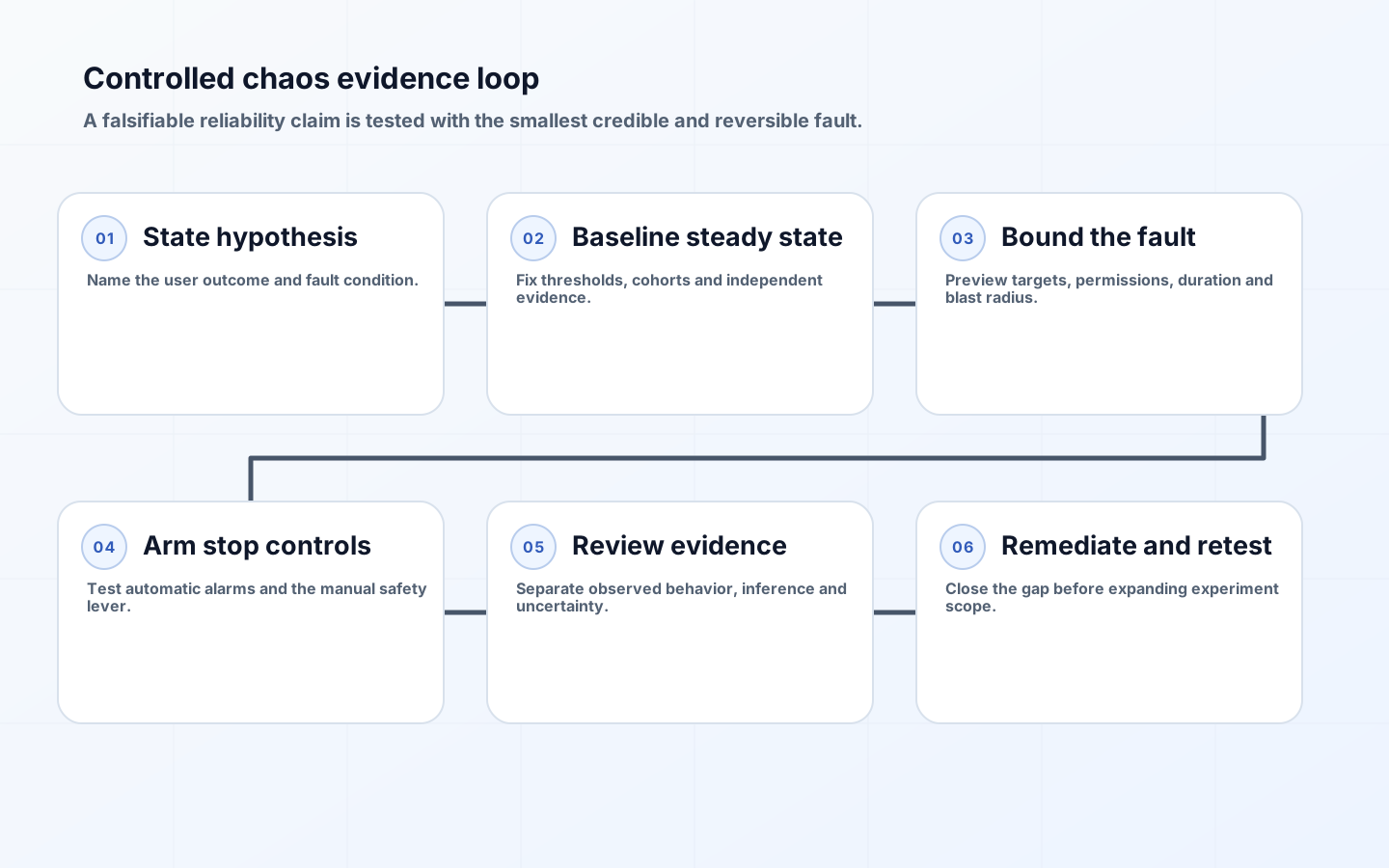
Good chaos engineering experiment design begins with a claim about behavior, not a fault-injection menu. “Terminate a node” is an action. “Checkout success remains above its agreed threshold when one application node disappears during peak load” is a hypothesis that can be disproved. The distinction keeps the exercise connected to user outcomes and produces evidence that architecture and recovery controls actually work.
Managed fault services make disruptive actions easier to execute, but they do not decide whether the target is safe, the metric is meaningful, or the result warrants confidence. A disciplined program defines steady state, models the failure, limits blast radius, installs independent abort controls, observes the complete system, and converts findings into owned remediation before expanding scope.
Start with a specific reliability claim
Choose a risk from architecture review, incident history, dependency change, or an untested assumption. State the user journey, fault condition, expected behavior, and measurable boundary. For example: while one availability zone cannot reach the database writer, authenticated reads continue within 800 milliseconds and no acknowledged write is lost. This claim contains a scope, impact, and correctness property; a generic claim that the service is resilient does not.
List assumptions that could invalidate the test: synthetic traffic differs from production, a failover has already occurred, the target set is empty, or the monitoring path shares the injected fault. Record expected mechanisms such as routing, retries, circuit breaking, leader election, and queueing, but measure external behavior. Passing because the fault never reached a live target is not resilience evidence.
| Experiment element | Weak version | Testable version | Evidence |
|---|---|---|---|
| Hypothesis | The service survives | Eligible checkout success stays above 99% during one-zone loss | Journey SLI compared with control window |
| Fault | Add latency | Add 300 ms and 2% packet loss between API and payment client | Resolved targets and injection logs |
| Steady state | Dashboards look normal | Latency, success, queue age, and integrity stay in bounds | Timestamped queries and thresholds |
| Abort | Operator will watch | Alarm stops injection when safety or error boundary is crossed | Independent alarm and tested stop path |
| Learning | Discuss results | Create owned work with retest criterion | Decision record and follow-up run |
Define steady state in user-visible outputs
Select a compact set of indicators: successful eligible transactions, latency percentile, data-loss or duplication checks, queue age, and perhaps saturation of a critical resource. Establish a baseline over a comparable control period and state acceptable variation. Internal CPU and replica counts explain behavior, but they should not be the only proof that the system still delivers its outcome.
Avoid a single average. A small cohort, region, or tenant can fail while the global mean looks healthy. Segment only by dimensions needed to detect the expected blast radius and keep the query stable before the run. Confirm that telemetry arrives independently of the component being faulted. When testing the telemetry pipeline itself, use an external canary or secondary evidence path.
Design the smallest fault that can disprove the hypothesis
Use a fault that resembles a credible event: process termination, network latency, packet loss, dependency errors, quota exhaustion, storage pause, clock behavior, or capacity reduction. Start with one variable where possible so the result is interpretable. Scope targets by explicit identifiers or tightly controlled tags and preview the resolved set immediately before execution. Dynamic queries can capture newly created resources, so permissions and previews must match the intended boundary.
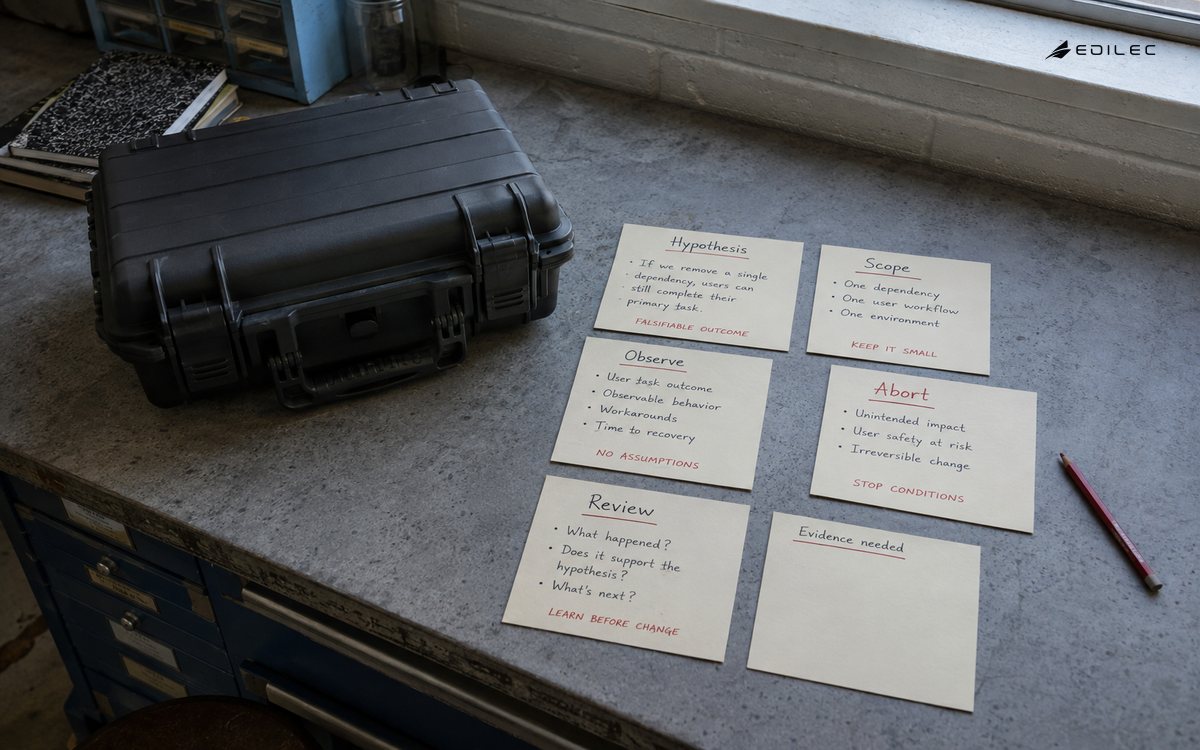
Progress from a test instance to one replica, one cell, a small percentage of traffic, and only then a wider production scope. Production experiments offer representative behavior, but the principle is to minimize blast radius, not to treat production as the first environment. Expansion should require a previous pass, reviewed evidence, healthy rollback controls, and approval proportional to potential harm.
Control access with least-privilege experiment identities. Separate permission to define faults from permission to execute them, and restrict identities to the target resources and actions. Protect safety systems from the injected fault. A stop alarm that depends on the same credentials, network, region, or monitoring pipeline under test may fail exactly when needed.
Install automatic stop conditions and a manual safety lever
Translate unacceptable impact into machine-evaluated conditions: critical journey success below threshold, unexpected data mutation, blast radius beyond target cohort, queue age beyond recoverable bounds, or an unrelated production incident. Test the alarm and stop action before injecting the fault. Define who can use the manual stop, how to verify termination, and what recovery action follows. Stopping injection does not necessarily restore a dependency or undo side effects.
Set abort thresholds tighter than disaster thresholds because the purpose is learning, not proving how much harm the organization can absorb. Include a time limit and a condition for missing telemetry. If evidence becomes unavailable, default to stopping. Pause experiments during incident response, major releases, known capacity risk, or when required operators are unavailable.
| Safety layer | Control | Validation before run | Failure response |
|---|---|---|---|
| Target boundary | Explicit resource scope and percentage | Preview exact targets | Cancel if scope differs |
| Permissions | Least-privilege experiment identity | Dry-run authorization and audit trail | Revoke identity or engage safety lever |
| Impact boundary | Automatic SLI and integrity alarms | Trigger alarms without fault | Stop injection and enter incident process |
| Time boundary | Maximum action and experiment duration | Verify service-side timeout | Terminate and confirm targets recover |
| Human boundary | Named commander and observers | Rehearse communications and manual stop | One person stops; another assesses recovery |
Run with an observable and reproducible timeline
Capture experiment template version, target resolution, configuration, software release, traffic conditions, start and stop times, fault action state, alarm transitions, and operator interventions. Announce the run to incident and service owners without creating a game in which responders are judged. Decide whether the on-call team knows in advance based on the learning objective, but never conceal an experiment from the safety and command roles responsible for stopping it.
Compare the experimental cohort with a control where feasible. Watch both the hypothesis metric and mechanisms expected to preserve it. A pass with excessive retries, near-full queues, or long recovery may expose little user impact today but narrow safety margin. Record surprises, including beneficial behavior, and avoid changing several controls during the run unless the experiment explicitly studies operator response.
Turn the result into bounded confidence
A pass supports only the stated hypothesis under recorded conditions. It does not prove the service is resilient to every zone event or future release. Store the evidence and expiry conditions: architecture change, traffic growth, dependency upgrade, monitoring change, or elapsed review period. Automate repeatable low-risk experiments in delivery or scheduled operations once target and abort controls are mature.
A failed hypothesis is useful only when it changes the system. Classify the gap as architecture, configuration, capacity, observability, process, or assumption. Assign remediation with owner and due date, define the expected evidence, and schedule a retest. Do not expand blast radius to gather more dramatic proof after the boundary has failed.
Hold a short experiment review even after a pass. Ask whether the targets actually experienced the fault, whether steady-state indicators had enough sensitivity, whether hidden manual intervention preserved the result, and whether the control cohort was comparable. Record confidence-lowering observations such as missing spans, an unexpectedly quiet traffic class, or a stop alarm that nearly triggered. A pass with weak exposure or weak measurement should be marked inconclusive and redesigned, not promoted as proof. Share the result with service owners in language that separates observed behavior from inference. Preserve raw queries and timestamps long enough for independent review, while excluding secrets and customer payloads from the experiment record. Track near misses as findings even when no formal threshold was crossed; they reveal narrow margins that traffic growth or a slower recovery could consume.
Key takeaways
- Write a falsifiable user-outcome hypothesis before choosing a fault action.
- Baseline steady-state indicators and ensure the evidence path is independent.
- Preview targets, minimize permissions, and expand blast radius only after reviewed passes.
- Use automatic abort conditions, time limits, and a rehearsed manual safety lever.
- Treat each result as bounded evidence and close findings with a retest.
Frequently asked questions
Must chaos experiments run in production?
Production can provide the most representative traffic and dependencies, but begin where the risk is acceptable and controls can be verified. Progressively expand. A production run is justified by the hypothesis and safety case, not by a maturity badge.
How is a chaos experiment different from a game day?
A chaos experiment tests a specific steady-state hypothesis with controlled variables. A game day may rehearse a broad scenario, coordination, and recovery. A game day can contain several experiments, but combining many faults may make causal interpretation harder.
Is an aborted experiment a failure?
An abort can show that a safety control worked and that the hypothesis did not hold within the intended boundary. Investigate the evidence. The program fails when teams ignore the result, cannot explain target scope, or repeat the run without remediation.
Conclusion
Controlled chaos is evidence-driven reliability engineering. Begin with a precise claim, expose it to the smallest credible fault, stop automatically before unacceptable harm, and preserve a reproducible timeline. Repeated experiments then build confidence that is specific, current, and connected to improvements rather than confidence based on an uneventful past.