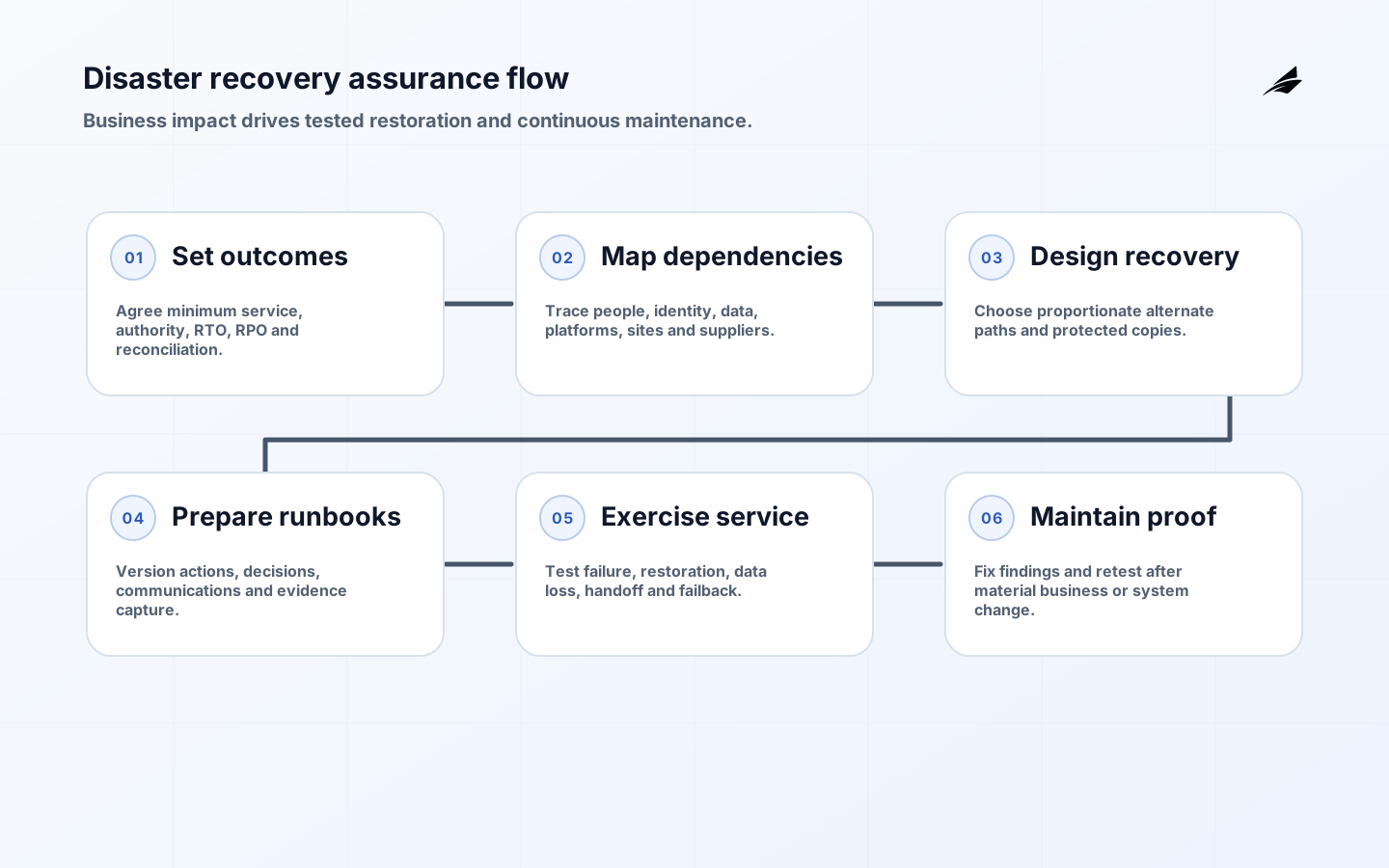
A disaster recovery planning implementation checklist is useful only when it proves that a business service can be restored after realistic disruption. Backups, standby infrastructure and a long runbook are inputs, not recovery outcomes. The plan must connect business impact to restoration order, maximum acceptable data loss, dependencies, authority, communications and a verified return to normal operation. It should cover cyber incidents, cloud or facility failures, destructive changes, unavailable suppliers and loss of key people. The objective is not an impossible promise that nothing fails; it is a controlled way to recover the most important work within an accepted boundary.
Begin with the business disaster recovery guide, use the DR planning FAQ for RTO and RPO questions, and align technical restoration with the backup and restore operations playbook. NIST SP 800-34 Rev. 1 describes contingency planning as a lifecycle that includes policy, business impact analysis, preventive controls, recovery strategies, plan development, testing and maintenance. Adapt that lifecycle to the organization rather than copying a generic template.
1. Define recovery outcomes and authority
Name an executive owner for continuity, a business owner for each critical service and a recovery lead with authority during an event. State what counts as a disaster, who declares it, who can activate alternate processing, and who approves data loss or extended downtime. Define communication channels that do not depend on the failed system. Record staff, customer, regulator, insurer, supplier and leadership notification duties with decision owners. A contact list is not enough; identify role substitutes and how identities are verified when normal collaboration tools are unavailable.
Write measurable outcomes for complete business services. Recovery time objective is the target duration to restore an agreed level of service. Recovery point objective is the maximum targeted period of data that may be lost, expressed relative to the disruption. Neither is a guarantee or a substitute for impact analysis. Add a maximum tolerable outage, minimum viable service, backlog processing target and data-reconciliation standard. Approval should show that business owners understand the cost and operational consequences of the chosen targets.
2. Complete a business impact and dependency analysis
Map customer and operational journeys, not only applications. For each time band of outage, estimate safety, legal, financial, customer and operational impact. Identify seasonal or deadline-sensitive periods and manual alternatives. Then trace the people, facilities, identities, networks, compute, data stores, queues, keys, certificates, DNS, code repositories, deployment systems, telemetry and external suppliers needed to deliver the minimum service. A recovery plan for an application is incomplete if the identity provider, secrets service or payment partner it needs cannot recover in the same window.
Validate dependency information with technical owners and recovery exercises. Configuration databases and diagrams often omit runtime calls, one-off scripts and human approvals. Use telemetry, infrastructure definitions, restore logs and interviews to reconcile the map. Classify dependencies as required before activation, required during degraded operation or deferrable until full restoration. Prioritize shared dependencies whose failure blocks many services, and define how resource contention is resolved when multiple services recover simultaneously.
| Decision | Required evidence | Acceptance test | Owner |
|---|---|---|---|
| Service priority | Impact by outage duration | Business owner approves order | Continuity lead |
| RTO | Timed end-to-end recovery target | Exercise meets minimum service | Service owner |
| RPO | Replication and backup evidence | Known-loss scenario reconciles | Data owner |
| Dependencies | Validated service map | Shared component unavailable in exercise | Architecture owner |
| Authority | Declaration and change rights | Out-of-band activation drill | Incident commander |
| Return to normal | Reconciliation and failback plan | Backlog clears without duplicate effects | Operations owner |
3. Select a recovery strategy that can meet the targets
Choose strategy per service: restore from backup, pilot light, warm standby, active-passive or active-active. Greater readiness generally increases cost and operating complexity. AWS describes these patterns in its disaster recovery guidance; Azure likewise recommends aligning the design with workload targets in its recovery guidance. Validate provider assumptions, quotas, regional service availability, licensing, network capacity and data residency. Multi-region architecture is not automatically resilient when both regions share identities, deployment errors or corrupt replicated data.
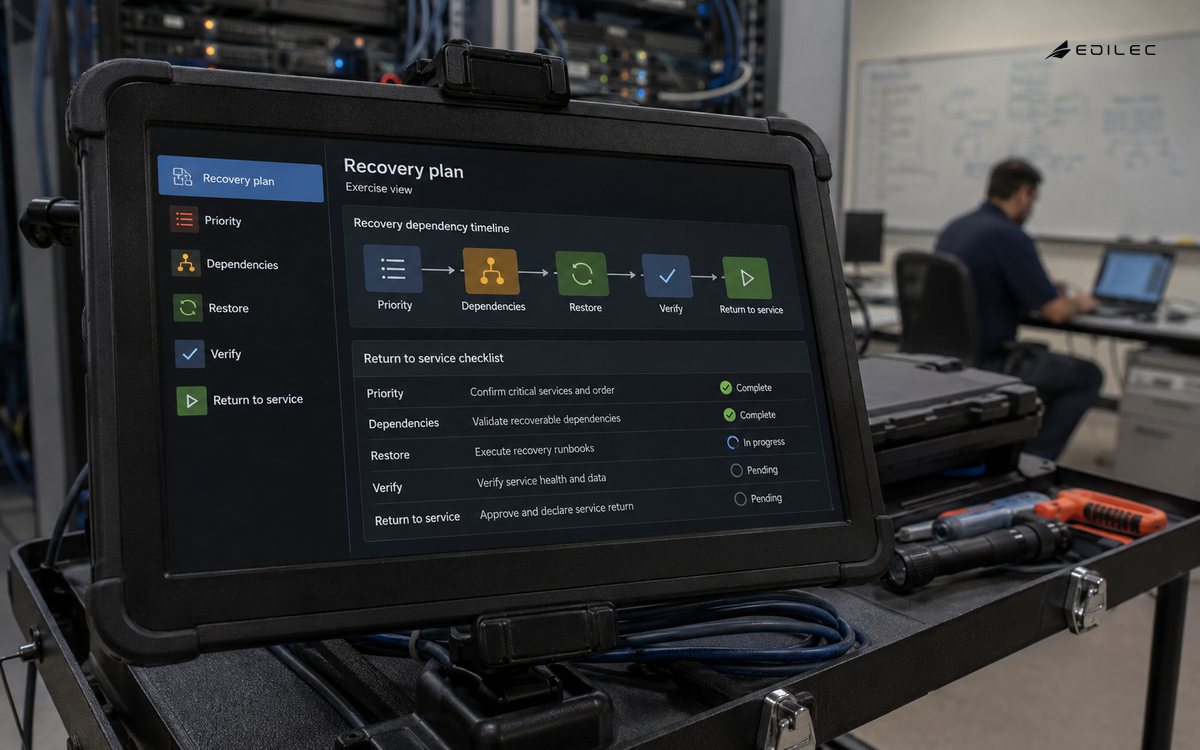
Engineer alternate paths with infrastructure as code, immutable artifacts and controlled configuration. Protect the recovery environment from the same administrative compromise as production. Use separate credentials, deletion controls and protected logs where risk warrants it. Decide which data is replicated continuously and which is restored from independent copies. Replication improves availability but can propagate corruption or malicious deletion. Recovery design needs both operational redundancy and recoverable historical state.
4. Make data restoration and reconciliation explicit
Inventory datasets by authoritative source, classification, owner, retention, backup method, encryption key, restore procedure and dependency order. Use the backup and restore planning guide to define copies before build. Monitor backup completion, but also restore sampled data into an isolated environment and verify application-level meaning. A successful storage restore does not prove that schemas, keys, indexes, permissions or related event streams are consistent.
Document reconciliation for the gap between the recovery point and the failure. Identify transactions that may be missing, duplicated, reordered or externally completed. Define sources of truth and human review for ambiguous cases. Protect backups using least privilege, immutability or offline separation appropriate to the threat. CISA's StopRansomware Guide advises organizations to consider third-party and managed-service-provider risks and formalize backup security requirements. Ensure a provider cannot silently make every recovery copy vulnerable through one identity path.
5. Write executable runbooks and communications
A runbook should state prerequisites, inputs, commands or automation, expected results, decision points, stop conditions, rollback, evidence capture and escalation. Keep it in a location available during the assumed failure. Automate repeatable work, but require human decisions where the system cannot assess business impact or irreversible data consequences. Version runbooks with the architecture and assign a maintainer. Remove obsolete steps after exercises; conflicting copies are dangerous under pressure.
Prepare short communication templates for activation, status, customer impact, workarounds, restoration and closure. State what is known, unknown, being done and due next. Separate operational coordination from public communication, and preserve an event log. Include vendors in the plan with contract contacts, severity routes and fallback when their portal is unavailable. A recovery team loses time when it discovers during an outage that only a departed employee can open a priority case.
6. Exercise scenarios and record recovery evidence
Use a progression of review, tabletop, component restore, partial failover and full service exercise. NIST SP 800-84 provides guidance for test, training and exercise programs. Choose scenarios that challenge assumptions: unavailable identity, corrupted data, compromised administrator, failed region, missing specialist or supplier outage. Announce some exercises for safety and run selected drills with limited notice once the capability is mature. Never test production destructively without explicit safeguards and authority.
Measure declaration time, access readiness, execution time, achieved service level, actual data loss, reconciliation, communication cadence and recovery-resource capacity. Record manual interventions, incorrect steps and near misses. An exercise that misses the target is valuable if it reveals a fix before a real incident; hiding the miss defeats the program. Assign remediation owners and dates, then retest material findings. Report tested scope accurately instead of claiming that one database restore validates an entire business service.
| Exercise type | Question answered | Evidence captured | Common limitation |
|---|---|---|---|
| Tabletop | Do roles and decisions make sense? | Timeline, decisions and gaps | Does not prove technical restoration |
| Backup restore | Can selected data be recovered? | Duration, integrity and key access | May omit application dependencies |
| Component failover | Does a technical alternate work? | Routing, health and rollback | May not test customer journey |
| Service recovery | Can minimum service resume? | RTO, RPO and reconciliation | Cost and coordination are substantial |
| Cyber recovery | Can clean assets be restored safely? | Isolation, identity and forensic controls | Scenario must protect live evidence |
| Failback | Can normal operation resume? | Data merge and backlog handling | Often skipped after successful failover |
7. Maintain the recovery capability
Review the plan after architecture, supplier, data, identity, staffing and regulatory changes, not only on an annual calendar. Tie runbook checks to release and infrastructure change where practical. Monitor backup age, restore success, replication lag, certificate expiry, recovery capacity, unresolved exercise findings and contact validity. Reassess targets when business volume or customer promises change. Retire recovery assets with the service so forgotten standby environments do not become unpatched attack paths.
Govern recovery cost against accepted impact. Track storage, standby capacity, licenses, network, exercises and specialist support. Look for shared capabilities that improve several services, while guarding against a shared failure domain. Executive review should decide target changes, accepted gaps and investment; technical teams should not silently absorb a business decision that an objective is unaffordable. Keep evidence available for internal assurance without exposing sensitive architecture broadly.

Key takeaways
- Define minimum business service, RTO, RPO, reconciliation and authority together.
- Trace every critical service through identity, data, network, suppliers and human dependencies.
- Use redundancy for availability and protected historical copies for recoverability.
- Exercise complete scenarios and report the exact scope and result.
- Treat findings, architecture changes and staff turnover as triggers to maintain the plan.
Disaster recovery planning FAQ
What is the difference between backup and disaster recovery? Backup creates recoverable copies of data or configuration. Disaster recovery coordinates people, technology, decisions and communications to restore an agreed service. A backup is one dependency of that capability.
Should RTO and RPO be identical for every system? No. Set them from business impact and dependency needs. Uniform aggressive targets waste money; uniform relaxed targets can leave a critical service exposed.
How often should recovery be tested? Match cadence to criticality and change rate. Test high-risk components after material changes and exercise complete critical services regularly. A yearly tabletop alone is weak evidence for a rapidly changing platform.
Does multi-cloud eliminate disaster recovery risk? No. It may reduce dependence on one provider, while adding identity, data, networking and operational complexity. Use it only when the tested benefits justify those new failure modes.
Conclusion
Complete this disaster recovery planning implementation checklist with evidence, not checkmarks. Define the service and consequences, map dependencies, choose proportionate recovery patterns, protect and restore data, rehearse authority and communications, and verify the full journey under stress. A maintained plan makes disruption manageable because the organization already knows what it is trying to recover, who can decide, and how success will be proven.