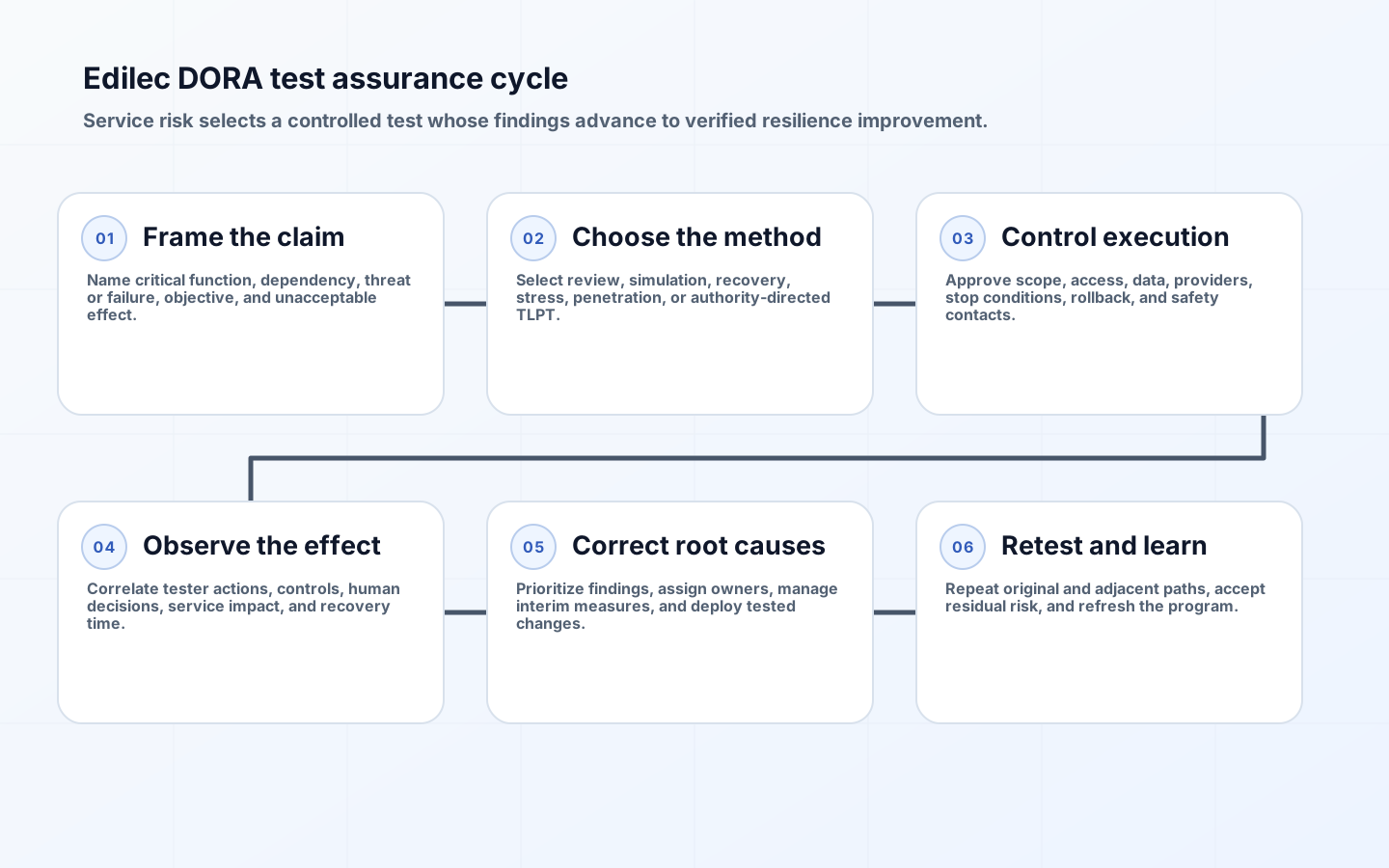
DORA resilience testing is a risk-based program for proving that ICT systems, processes, and controls can prevent, withstand, respond to, and recover from disruption. It should combine vulnerability assessment, scanning, open-source analysis, network and physical-security assessment, gap analysis, scenario testing, compatibility and performance testing, end-to-end testing, penetration testing, and other appropriate techniques. The point is not to maximize test count. It is to select credible failure and attack conditions for critical or important functions, observe control behavior, correct weaknesses, and verify the correction.
DORA distinguishes the general digital operational resilience testing program from advanced threat-led penetration testing for financial entities designated by competent authorities. The EIOPA DORA overview links both Level 1 and technical standards, including the final TLPT regulation. Build one governance system that can classify exercises, protect production, manage testers and providers, preserve evidence, and track remediation, while applying the heightened scope, independence, threat-intelligence, red-team, blue-team, and authority requirements where TLPT applies.
Design the DORA resilience testing program around services
Inventory critical or important functions and map supporting applications, infrastructure, data, locations, people, and ICT third parties. For each service, identify resilience claims: recovery objective, maximum tolerable disruption, data-loss tolerance, security boundary, detection expectation, manual fallback, and communications. Link claims to risks and test methods. A payment service relying on identity, messaging, databases, cloud regions, fraud controls, and telecoms needs scenarios that cross those dependencies; isolated component tests cannot prove end-to-end resilience.

Set an annual program approved by accountable management, with scope rationale, frequency, environments, independence, tester competence, production safeguards, data handling, provider participation, acceptance criteria, and remediation rules. Use change and incident triggers to add tests between cycles. The security-review guide provides release-oriented review mechanics; DORA testing adds entity-wide function criticality, recurring assurance, supervisory expectations, and advanced testing where designated.
Select test methods from risk and control claims
Choose the least disruptive method that can produce credible evidence, then escalate when uncertainty remains. Configuration review can prove a setting exists, but not that failover works. Tabletop discussion can expose decision gaps, but not actual recovery time. Component penetration testing can find exploitable flaws, but not whether crisis communication reaches customers. Combine methods deliberately. Include successful and failed control paths, degraded dependencies, stale data, unavailable staff, compromised credentials, corrupted backups, and provider outages.
| Decision | Suitable method | Acceptance evidence | Common blind spot |
|---|---|---|---|
| Can a service restore within objective? | End-to-end recovery exercise | Measured restoration and data-loss point | Database restore without upstream dependencies |
| Can attackers cross a trust boundary? | Penetration or adversarial test | Attempt path, prevention or detected effect | Testing only external perimeter |
| Can teams manage a crisis? | Scenario simulation and communications drill | Timed decisions, messages and escalation | Discussion with no operational injects |
| Can capacity withstand stress? | Performance and failover test | Sustained load, degradation and recovery | Average load rather than peak or dependency loss |
| Are vulnerabilities corrected? | Targeted retest and regression | Original path blocked without harmful regression | Ticket closed after code merge |
Control production testing and test data
Define rules of engagement for every intrusive exercise: authorized systems, identities, time windows, techniques, prohibited actions, stop conditions, monitoring coordination, emergency contacts, rollback, data minimization, evidence transfer, and destruction. Use synthetic or minimized data where possible. If production is necessary for realism, isolate transactions, cap volume, protect customers, and pre-authorize containment. Testers must never infer permission from technical access. Record exact assets and versions so findings can be reproduced and retested.
Separate testing from malicious activity without blinding defenders. Depending on the objective, blue teams may know the window but not the scenario; operational safety contacts must always be reachable. Protect credentials and payloads as sensitive material. Monitor testing for unexpected side effects and pause when thresholds are exceeded. Provider environments require contractually agreed authority. The vendor-access guide helps issue attributable, time-bounded tester and provider access.
Govern threat-led penetration testing separately
TLPT is intelligence-led, controlled testing of live production systems supporting critical or important functions. It uses threat intelligence to develop realistic scenarios and red-team activity to test people, processes, and technology, with blue-team response included. Competent authorities identify which financial entities must perform it, generally on the DORA cycle unless the authority changes frequency. Do not relabel an ordinary penetration test as TLPT. Apply the final TLPT regulatory technical standard and authority direction.
Establish a control team independent enough to manage scope, secrecy, risk, provider involvement, evidence, and authority liaison. Select qualified internal or external testers under applicable independence and competence conditions. Define critical functions, production systems, threat-intelligence scope, scenarios, flags, risk assessment, communication channels, and closure documents. Include relevant ICT third-party systems directly or through pooled or alternative arrangements accepted under the framework. Document exclusions because an untested provider dependency can undermine the critical function even when internal systems are well exercised.
Capture evidence that supports a resilience decision
Each test record should contain objective, risk, function, scope, exclusions, method, environment, dates, testers, rules, expected result, actual result, artifacts, control response, limitations, findings, severity, and approvals. For recovery, preserve timestamps from disruption through business validation. For attack simulation, record the path and achieved effect without retaining unnecessary customer data. For tabletop exercises, capture decisions, delayed actions, conflicting authorities, unavailable information, and whether external communications were accurate.
Grade outcomes against predefined acceptance criteria rather than tester opinion alone. A service may technically recover but miss its business objective; a control may detect an intrusion after the red team already achieved a prohibited effect. The audit-log guide supports event reconstruction. Correlate tester actions, platform events, alerts, human decisions, and business effects on a common timeline, then protect evidence under a defined retention and access policy.
| Stage | Required decision | Evidence | Closure blocker |
|---|---|---|---|
| Finding validation | Is weakness reproducible and material? | Path, preconditions, effect and affected function | Unverified scanner result |
| Root cause | Which control or assumption failed? | Technical and process analysis | Symptom-only patch |
| Remediation plan | Who will reduce risk by when? | Owner, milestone, interim control and due date | No accountable service owner |
| Retest | Does correction stop original and adjacent paths? | Versioned repeat and regression result | Code merged but not deployed |
| Residual acceptance | Is remaining exposure tolerable? | Business rationale, authority and review date | Tester alone accepts risk |
Remediate, retest, and learn across the program
Route findings into one governed backlog linked to function, risk, test, affected assets, owner, due date, and interim measure. Prioritize business effect and exploitability, not test label. Major weaknesses need management visibility and time-bound escalation. Retest the exact conditions and nearby variants on the deployed correction. The vulnerability-management guide offers prioritization mechanics; resilience closure additionally asks whether service continuity, detection, decision-making, and provider coordination improved.
Aggregate recurring causes across exercises: incomplete inventories, fragile identity dependencies, inaccessible backups, unclear authority, alert gaps, missing provider contacts, or unrealistic objectives. Feed lessons into risk assessment, architecture, contracts, continuity plans, training, and the next test plan. Track overdue remediation, retest success, objective misses, recurrence, coverage by critical function, production incidents that reveal untested scenarios, and time from test to verified closure. Counting tests completed can reward shallow activity.
Assure tester independence and program quality
Maintain competence criteria for each method, conflict checks, rotations where appropriate, quality review, and secure handling obligations. Internal testers should not validate controls they designed without independent challenge. External contracts should define deliverables, evidence ownership, confidentiality, notification, subcontracting, retest, and deletion. Procurement should evaluate technical capability and financial-sector safety, not select solely on day rates or a generic certification. The financial entity remains accountable for the program even when execution is outsourced.
Internal audit or another assurance function should review whether scope follows risk, critical functions receive adequate coverage, exclusions are approved, production safeguards work, findings close, and management reporting is candid. Sample a completed test back to source evidence and forward to remediation deployment. Also compare real incidents with tested scenarios. Material failures in supposedly tested paths reveal design, execution, acceptance, or change-management weaknesses and should reshape the program rather than be explained away as unique.
Coordinate the test calendar with major releases, migrations, provider renewals, and business peaks. Testing too early can assess an obsolete design; testing immediately after an unproven migration can add operational danger; postponing every exercise for delivery convenience leaves the highest-risk change untested. Establish risk-based windows and a documented deferral authority. When a service changes after a successful test, perform impact analysis to decide which claims and scenarios need regression. Keep a coverage matrix by critical function, threat, failure mode, dependency, and test date so management can see meaningful blind spots. This matrix should distinguish a discussion exercise from a live technical result instead of treating both as equivalent coverage.
Test emergency decision rights as deliberately as technology. Inject a situation in which the safest containment breaches an availability objective, a provider refuses an action, customer communication may expose the investigation, or restoration data is incomplete. Require participants to identify who can decide, what evidence they need, which stakeholders must be consulted, and how the decision is recorded. Delayed authority is itself a resilience weakness. Improvements may involve delegated limits, pre-approved containment options, alternate executives, contractual clauses, or better business-impact data. Retest the decision path in a later exercise; updating a contact list does not prove that the organization can make a difficult tradeoff under time pressure.
Key takeaways
- Start from critical functions, dependencies, risks, and explicit resilience claims.
- Choose complementary methods that can prove the decision at hand.
- Control production access, data, side effects, and stop authority through written rules.
- Treat TLPT as a distinct authority-governed, intelligence-led production exercise.
- Close findings only after deployed correction, targeted retest, and accountable residual-risk decision.
- Measure coverage, recurrence, objective misses, and remediation rather than test volume.
DORA resilience testing FAQ
Must every financial entity conduct TLPT?
No. Competent authorities identify entities required to perform TLPT under DORA criteria. All in-scope financial entities still need a proportionate digital operational resilience testing program.
Must all resilience testing occur in production?
No. Select environments based on risk and evidence needs. Some end-to-end and TLPT work requires production realism, while many tests are safer and effective in representative non-production environments.
When is a test finding closed?
Closure requires verified correction or an authorized residual-risk decision. A ticket, design, or merged change without deployment and retest is incomplete.
Conclusion
A mature DORA testing program converts service risk into controlled evidence and verified improvement. It chooses realistic methods, protects live operations, includes material providers, distinguishes TLPT, and follows weaknesses through remediation and retest. That discipline shows not merely that exercises occurred, but that the financial entity learned to withstand disruption.