Ephemeral environments best practices begin with an uncomfortable fact: temporary infrastructure is permanent until an automated control proves otherwise. A preview deployment created for a pull request may leave load balancers, databases, DNS records, volumes, secrets, identity bindings, observability streams, and third-party sandboxes behind after the application namespace disappears. The result is not merely cloud waste. Abandoned endpoints expand attack surface, copied data exceeds its purpose, and shared dependencies make tests interfere with one another.
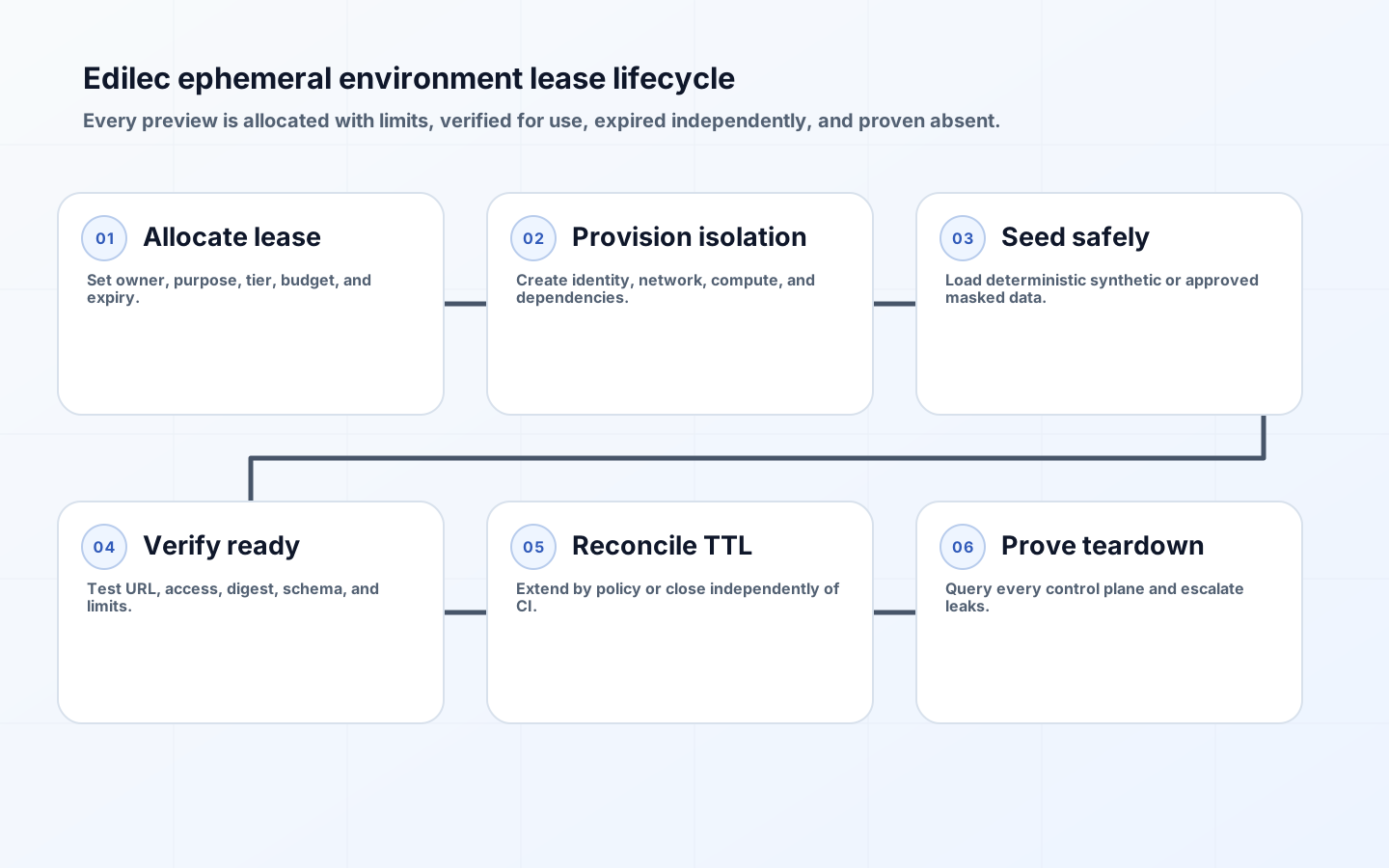
Treat each environment as a leased product instance with an owner, purpose, budget, expiry time, and complete resource inventory. Creation and destruction are equally important workflows. The environment is ready only when tests can discover its URL and dependencies; it is destroyed only when the controller has verified that owned resources are absent or deliberately retained. Pull-request events are useful lifecycle signals, but a time-to-live reconciler must clean up environments even when webhooks fail, branches are force-deleted, or CI stops midway.
Define the ephemeral environment contract
Specify allowed triggers, maximum lifetime, extension policy, service tier, data class, dependency strategy, budget, owner, and cleanup obligations. Use a stable environment ID derived from repository and change number rather than a branch name that may contain unsafe characters or later change. Attach created_at, expires_at, owner, repository, change_id, cost_center, and managed_by labels to every resource that supports them. Keep an authoritative registry because cloud tags alone cannot express resources in SaaS systems or detect an object that failed before labels were applied.
| Tier | Use | Isolation | Default TTL |
|---|---|---|---|
| UI preview | Visual and product review | Shared APIs with synthetic tenant | 24 hours after last update |
| Integration | Service contracts and migrations | Dedicated namespace and database schema | 48 hours |
| Security review | Authentication and policy changes | Dedicated identity and restricted network | 72 hours with approval |
| Performance | Representative load test | Dedicated compute and data generator | Test window plus 4 hours |
| Manual extended | Customer or compliance review | Explicit owner and budget | Seven days, renewable |
Choose isolation boundaries by failure consequence
A Kubernetes namespace is a useful ownership boundary for namespaced objects, but it is not a security perimeter by itself. The Kubernetes namespace documentation describes namespace scoping; cluster-wide resources, external databases, object storage, DNS, cloud identities, and hosted services still need explicit ownership. For low-risk previews, a shared cluster with one namespace per environment may be efficient. Untrusted code, privileged workloads, cluster-scoped operators, or regulated data may justify a separate account, project, virtual cluster, or full cluster despite higher startup cost.
Default-deny ingress and egress, then allow only required paths. Kubernetes NetworkPolicy provides network controls when the network plugin enforces it, but also isolate identities, secret paths, queues, caches, and database tenants. Never let a preview use production write credentials. Give each environment a workload identity with least privilege and short-lived credentials. Restrict human access, log administrative changes, and ensure a pull request from an untrusted fork cannot obtain repository or environment secrets.
Seed safe, deterministic test data
Prefer generated fixtures that represent real distributions, edge cases, and relationships without carrying personal or commercially sensitive data. Version seeds with schema migrations so an environment can be recreated deterministically. When a production-derived subset is materially necessary, apply an approved de-identification pipeline before it enters the preview boundary, minimize fields and rows, record the source snapshot, and set a shorter retention period. Masking identifiers is insufficient if free text, rare attributes, or joinable keys can re-identify people.
Select a dependency pattern per service. Fully dedicated dependencies maximize isolation but cost more and start slowly. Shared dependencies are cheaper but require tenant keys, quotas, deterministic cleanup, and protection against cross-environment messages. Virtualized dependencies or service simulators are fast but can miss protocol and behavior differences. A practical environment often mixes them: dedicated application and schema, shared managed broker with unique topics, simulated payment provider, and a contract-tested external sandbox. Document what the preview cannot prove.
Create the environment as a resumable transaction
The controller creates a registry record first with state creating and an expiry time, then applies infrastructure from a reviewed template. Every step must be idempotent because CI can retry after interruption. Record resource identifiers as they are created, not only at the end. Apply schema migrations, seed data, deploy immutable artifact digests, run health and contract tests, and publish the URL. GitHub deployment environments can associate deployments, URLs, protection rules, variables, and secrets, but the infrastructure registry remains responsible for the wider lifecycle.
| Phase | Required evidence | Timeout action | User-visible state |
|---|---|---|---|
| Allocate | Registry ID, owner, expiry | Retry or mark cleanup required | Creating |
| Provision | Resource inventory and desired-state revision | Invoke compensating destroy | Creating |
| Initialize | Migration and seed result | Preserve logs, begin teardown | Failed |
| Verify | Health, smoke, access checks | Block URL publication | Failed |
| Ready | URL, digest, limits | TTL reconciler monitors | Available |
| Destroy | Absence checks and retained exceptions | Escalate leaked resources | Closed |
Enforce TTL and cost before resources exist
Set expiry at allocation and enforce it through an independent reconciler that lists the environment registry on a schedule. Activity may extend a lease within policy, but a build should not extend it forever merely by retrying. Notify the owner before expiry and allow an authenticated, auditable extension with a maximum. Hard-stop idle compute where practical while retaining enough state for a short resume window. Delete expired environments even if the originating repository, branch, or user no longer exists.
Apply quotas and defaults at admission. Kubernetes ResourceQuota limits aggregate namespaced resource consumption and object counts; pair it with requests, limits, and storage controls. Set maximum database size, log retention, object count, external API spend, and concurrent environments per team. Display estimated and actual cost by environment ID. Cost anomaly alerts should reach both the owner and platform team. A preview that needs production-scale capacity should use an explicit performance tier with a scheduled window rather than silently escaping ordinary limits.
Verify complete destruction
Teardown first marks the lease closing so no new deployment can race with deletion. Revoke credentials and inbound routes early, then destroy managed resources in dependency order. Handle deletion protection and finalizers through approved automation rather than broad administrator bypasses. Remove DNS, certificates, queues, topics, buckets, snapshots, database tenants, webhooks, feature-flag segments, and vendor sandboxes as well as compute. Preserve only audit metadata, logs required by policy, and explicitly approved diagnostics, each with its own retention.
After deletion, query each control plane by environment ID and reconcile billing data that can arrive later. A namespace deletion request is not proof that volumes or external load balancers vanished. Mark destroyed only after absence checks pass; otherwise create a leak incident with resource identifiers and cost exposure. Run a daily orphan scanner that compares tagged and discoverable resources with active registry entries. Track creation success, time to ready, median and maximum lifetime, extension rate, cost per review, teardown duration, leaked-resource count, and time to revoke access.
Plan for lifecycle races. A new commit may arrive while the previous environment is closing, two workflow attempts may provision the same change, or a reviewer may request an extension after revocation starts. Use a generation number and compare-and-set state transitions in the registry. Provisioning may act only on the current generation; teardown marks the lease closing before deleting anything; extension is rejected or creates a new generation once closing begins. Serialize destructive operations per environment ID and make stale jobs exit without touching newer resources. This state machine prevents an old CI retry from recreating infrastructure after the TTL controller has correctly removed it.
Test the destroy workflow continuously with a disposable reference environment. Seed one resource of every supported class, including an external webhook and retained volume, then expire the lease and verify expected deletion or retention. Inject a failed finalizer, revoked cloud permission, unavailable vendor API, and duplicate close event. The reconciler should retry safely, keep access revoked, preserve evidence, and escalate with exact leaked identifiers. A cleanup path exercised only after real reviews close is too easy to break through provider or template changes.
Ephemeral environments key takeaways
- Create a lease with owner, purpose, expiry, tier, and budget before provisioning.
- Choose namespace, account, data, identity, and dependency isolation according to consequence.
- Use generated data by default and govern any production-derived subset as sensitive data.
- Make creation idempotent and record resource IDs throughout the transaction.
- Enforce TTL through an independent reconciler, not only pull-request events.
- Prove teardown through cross-system absence checks and recurring orphan scans.
Ephemeral environments FAQ
Should every pull request receive an environment? Usually not. Use path, label, ownership, or explicit-request rules so documentation-only and low-value changes do not allocate infrastructure. A queue and concurrency limit protect the platform during bursts.
Is one Kubernetes namespace enough isolation? It is a useful logical boundary, but security also depends on RBAC, network policy enforcement, identities, cluster-scoped resources, and external services. Higher-risk changes may need a stronger boundary.
Can an environment survive after its pull request closes? Yes, through a time-bounded approved extension. The lease registry remains authoritative, records the new owner and reason, and the maximum lifetime still applies.
Conclusion
A preview environment is valuable when it gives reviewers realistic evidence without creating a parallel estate. Leased ownership, fit-for-risk isolation, safe data, transactional provisioning, admission-time budgets, independent expiry, and verified destruction make that possible. Build the cleanup path with the same care as creation, and ephemeral environments can improve feedback while remaining predictable in cost and exposure.