Kubernetes multi-tenancy models are choices about shared authority, not merely cluster count. Namespaces share one API server and worker fleet. Virtual clusters give tenants separate Kubernetes control-plane views while commonly synchronizing workloads onto a host cluster. Dedicated clusters separate the control plane and, depending on infrastructure, the data plane as well. Each boundary solves some forms of interference while leaving others to identity, network, node, storage, quota, and operational controls.
The right unit is the tenant risk profile. An internal product team with trusted platform conventions is different from a customer running arbitrary controllers, and a regulated workload with independent audit and encryption boundaries is different again. Classify tenant trust, API autonomy, data sensitivity, workload privilege, performance predictability, geographic needs, recovery objectives, and expected lifetime. Then choose the least complex model that meets those explicit requirements, with an escalation path when a tenant outgrows it.
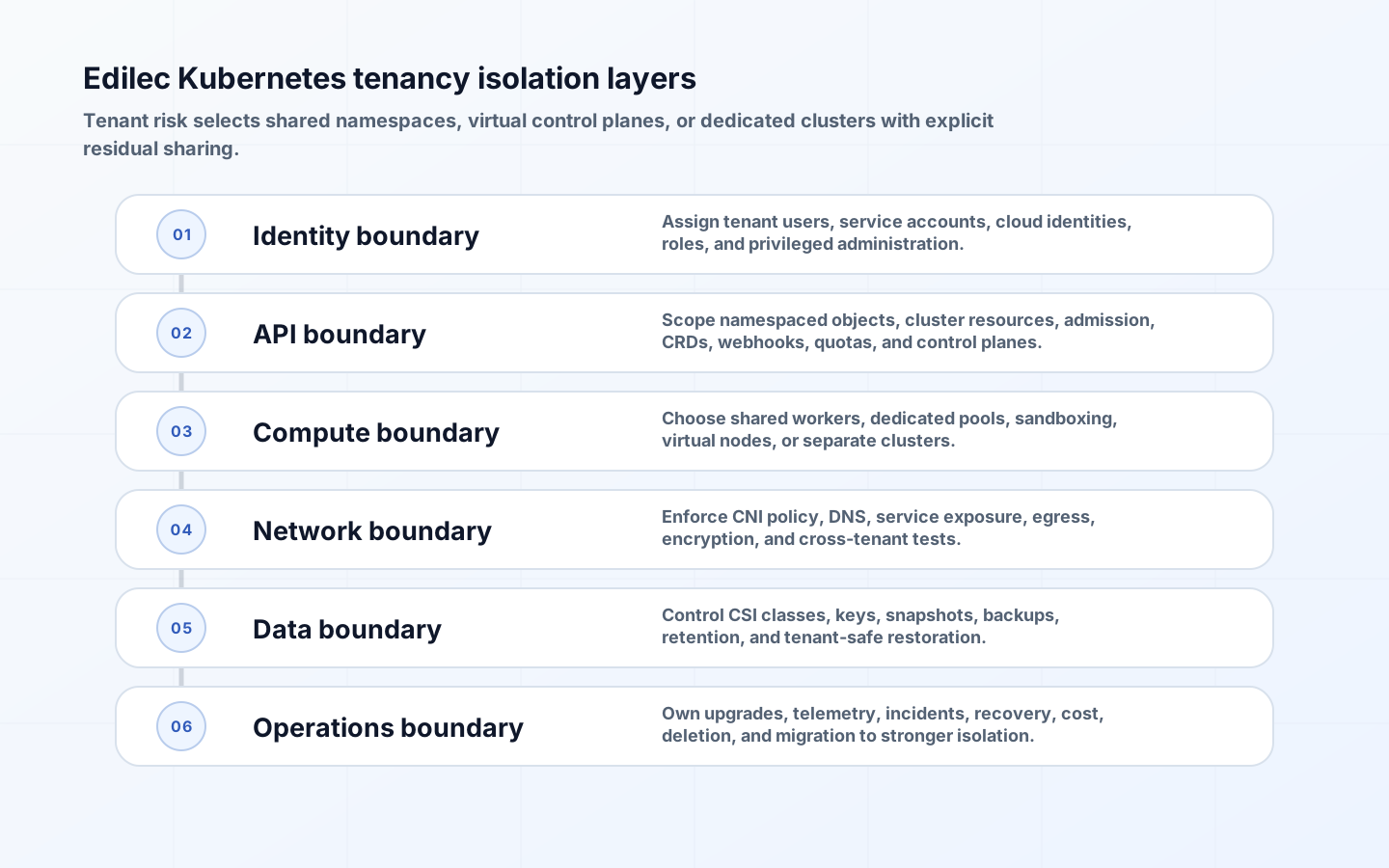
Define the tenant boundary across six layers
Map identity, API objects, admission and policy, compute, network, storage, and operations for one tenant. State which components are shared, who administers each, and how a compromise or mistake could cross the boundary. Include cluster-scoped resources, CRDs, webhooks, operators, DNS, service accounts, secrets, node kernel, CNI, CSI, observability, backups, and cloud identities. A model name is not evidence; the boundary document should show an attacker or noisy workload path and the control that interrupts it.

| Dimension | Namespaces | Virtual clusters | Dedicated clusters |
|---|---|---|---|
| Kubernetes API | Shared control plane | Per-tenant virtual control plane | Independent control plane |
| Cluster-scoped API autonomy | Platform-owned and restricted | Broad tenant API view within sync limits | Full, policy-bounded ownership |
| Worker isolation | Shared unless node pools or sandboxing added | Often shared host workers unless separated | Can be fully separate |
| Failure scope | Control-plane issue affects all tenants | Host or sync layer can affect many tenants | Mostly tenant-local, plus shared cloud dependencies |
| Operating cost | Lowest baseline | Middle; extra control planes and sync operations | Highest fleet and platform overhead |
| Best fit | Trusted teams with bounded API needs | Teams needing cluster-like autonomy on shared infrastructure | Strong isolation, customization, or regulatory boundary |
Use namespaces for trusted, constrained tenants
Namespaces isolate names and scope many controls, including Roles, RoleBindings, ResourceQuotas, LimitRanges, and NetworkPolicies. The Kubernetes multi-tenancy guide recommends namespace-based segmentation while emphasizing that quotas cannot protect every shared resource. Build tenant provisioning that creates namespaces, identities, default-deny network policy, quotas, limits, pod security labels, allowed registries, cloud identity bindings, logging metadata, and ownership labels as one transaction.
Namespace tenancy is weakest where tenants need cluster-scoped CRDs, admission webhooks, custom API servers, storage classes, node changes, or broad operator privileges. One API overload, webhook outage, or dangerous cluster role can affect everyone. Use policy to block host namespaces, privileged containers, unsafe volume types, host ports, unrestricted load balancers, and untrusted node selectors. Kubernetes namespace guidance notes that production workloads should not rely on the default namespace; lifecycle automation should create a named boundary with an owner.
Use virtual clusters for API autonomy on shared infrastructure
A virtual control plane can give each tenant an API server, controller manager, and data store while a synchronization layer maps selected resources to a host cluster. This reduces conflicts over CRDs, webhooks, and cluster-scoped names and lets tenants use familiar cluster tooling. The vCluster architecture documentation describes a virtual control plane and syncer, with deployment choices that can add dedicated or private nodes. Evaluate the selected project rather than assuming every virtual cluster has the same boundary.
The host remains a critical trust layer when workers, CNI, CSI, or synchronization are shared. Test unsupported or translated API fields, admission order, host visibility, secret handling, service networking, storage classes, node representation, upgrades, backup, restore, and failure of the sync component. Decide who upgrades tenant control planes and what version skew is supported. Virtual clusters are an operating model, not just a namespace plus API server; each additional tenant control plane creates monitoring, backup, certificate, and lifecycle duties.
Use dedicated clusters for strong boundaries and special platforms
Dedicated clusters are appropriate when tenants require independent control-plane availability, custom networking or storage, strict release timing, high privilege, distinct geographic or account boundaries, or evidence that shared kernels and host control planes are unacceptable. Separation is only as real as the surrounding cloud design. Clusters in one account may still share identity administrators, image registries, DNS, CI credentials, keys, transit networks, or management tooling. Document those higher-level shared dependencies and protect the fleet control plane.
The tradeoff is fleet entropy. Many clusters multiply upgrades, add-ons, policy distribution, observability, backup, capacity buffers, certificates, and incident paths. Standardize cluster classes with supported version windows and immutable provisioning rather than hand-maintained snowflakes. Allocate platform overhead honestly. A tiny dedicated cluster may have lower workload density and higher idle cost, but that premium can be rational when it buys a required failure or trust boundary.
| Trigger | Namespace response | Virtual-cluster response | Dedicated-cluster response |
|---|---|---|---|
| Tenant needs CRDs and webhooks | Platform curates shared versions | Tenant owns virtual API extensions | Tenant owns cluster policy |
| Untrusted privileged workload | Reject or sandbox on isolated nodes | Host controls still required | Separate worker and cloud boundary |
| Independent Kubernetes upgrade | Not available | Possible within compatibility window | Full release independence |
| Strict noisy-neighbor objective | Quota plus dedicated pool | Dedicated host nodes may be added | Independent capacity |
| Tenant-specific outage containment | Limited by shared control plane | Improved API isolation; host remains shared | Strongest cluster-local containment |
Build a tenancy control plane and exit path
Create a tenant catalog with model, owner, trust level, namespaces or clusters, quotas, identities, data class, allowed privileges, network posture, recovery objective, upgrade channel, costs, and expiry. Provision through an API with policy checks and tested deletion. Provide tenants with clear responsibility for workloads while the platform retains enforceable boundaries. NetworkPolicy requires a supporting CNI; the NetworkPolicy reference explains additive ingress and egress semantics, so test isolation with traffic rather than assuming object presence means enforcement.
Design migration between models before it is urgent. Keep workload packaging, secrets delivery, storage export, DNS, observability, and identity portable. A namespace tenant promoted to a virtual or dedicated cluster needs new service addresses, policy objects, data movement, and rollback. Use admission inventories and API discovery to identify dependencies on shared operators or CRDs. Chargeback should expose the cost of isolation without pressuring teams to select a weaker boundary than their risk requires.
Test tenant backup, recovery, and platform failure
Recovery boundaries often reveal hidden sharing. For namespace tenants, test restoration of namespaced objects, secrets, persistent data, and identity bindings without overwriting another tenant or requiring broad cluster-admin access. For virtual clusters, back up the tenant control-plane data store and the host-side workload state needed by the implementation; restoring one without compatible synchronization metadata can produce conflicts. For dedicated clusters, prove cluster recreation from code and application data restoration into a clean control plane.
Run failures at each shared layer: API saturation, admission webhook outage, DNS failure, CNI policy error, CSI slowdown, node compromise, observability loss, and platform-controller upgrade. Record which tenant classes are affected and whether their administrators can worsen or contain the event. A virtual API outage may be tenant-local while a host CNI outage is not. Dedicated clusters can still fail together through one fleet pipeline, cloud account, registry, or certificate authority.
Set evidence requirements per model. Namespace tenancy needs regular RBAC and policy tests, quota saturation tests, network probes, and cluster-scoped access review. Virtual clusters add sync compatibility, tenant API backup, and host escape-path review. Dedicated fleets add conformance, version skew, configuration drift, and per-cluster recovery tests. Review the model when a tenant requests new privilege, deploys a materially different workload, crosses a cost threshold, or changes regulatory scope; tenancy is a lifecycle classification, not a permanent provisioning label.
Key takeaways
- Choose a tenancy model from tenant trust, autonomy, data, privilege, and failure requirements.
- Namespaces need identity, policy, quota, network, and node controls; they are not security boundaries alone.
- Virtual clusters isolate API control planes but may still share host workers and infrastructure.
- Dedicated clusters strengthen boundaries while multiplying fleet operations and idle capacity.
- Define escalation and migration paths so tenants can move when their risk or autonomy changes.
Frequently asked questions
Is a namespace a complete security boundary?
No. It scopes many controls but shares the API server, nodes, kernel, and often network and storage infrastructure. Defense in depth and tenant trust assumptions remain necessary.
Does a virtual cluster require shared nodes?
No. Some architectures can assign dedicated nodes, but the exact data-plane and host-control boundaries depend on the implementation and configuration.
Should every team receive a dedicated cluster?
Not automatically. Dedicated clusters are justified by isolation, customization, or lifecycle needs; otherwise their operational and capacity overhead may exceed the value.
Conclusion
Multi-tenancy is the deliberate placement of trust and failure boundaries. Namespaces are efficient for constrained, trusted users; virtual clusters add API autonomy while preserving shared infrastructure options; dedicated clusters maximize independent control at a higher operating cost. Make the choice per tenant class, validate every shared layer, and preserve a practical route to stronger isolation when requirements change.