Karpenter vs Cluster Autoscaler is primarily an operating-model decision. Both react to unschedulable pods and add nodes, and both can remove unneeded capacity. Cluster Autoscaler selects among preconfigured node groups and changes their size. Karpenter commonly works from broader NodePool constraints and creates individual node claims that fit pending workloads. That difference changes who defines instance choices, how capacity is diversified, how nodes are refreshed, and how often consolidation can disrupt running applications.
Kubernetes now describes both as SIG Autoscaling-sponsored node autoscalers in its node autoscaling overview. The page also emphasizes provider coverage: Cluster Autoscaler has integrations across many clouds, while Karpenter integrations are fewer and provider-specific. Begin with supported infrastructure and organizational ownership. A sophisticated provisioning model is irrelevant if the provider integration, networking, identity, image, or support path does not meet production requirements.
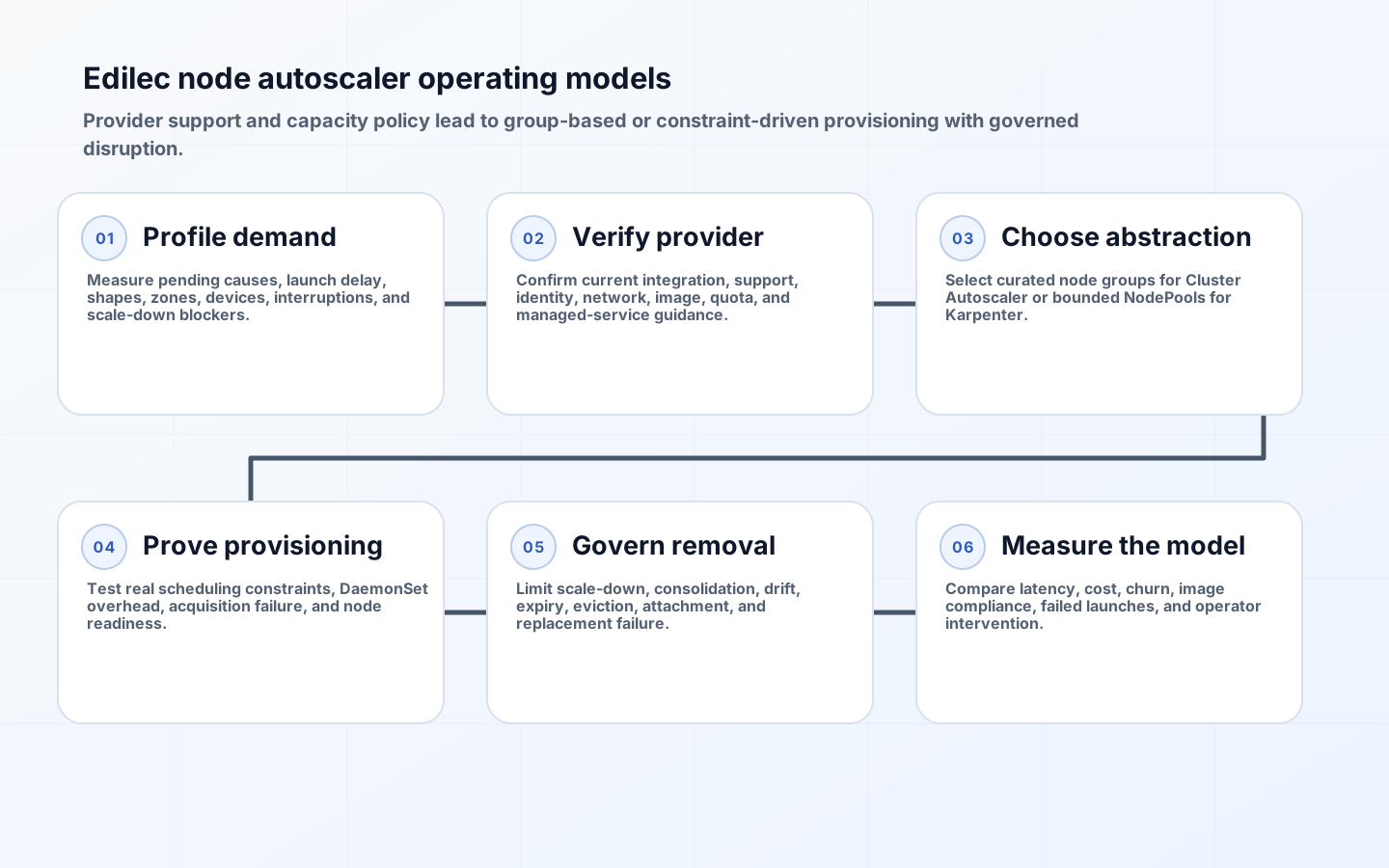
Define node autoscaling requirements in six stages
Measure pending-pod causes, demand shapes, node launch time, instance availability, zonal constraints, interruption exposure, workload startup, and current scale-down blockers. Inventory every scheduling input: requests, taints, tolerations, node affinity, topology spread, pod affinity, extended resources, host ports, volumes, architecture, and operating system. Then name the capacity products the platform permits, the maximum disruption rate, and who owns node image refresh. These facts reveal whether a small catalog of stable groups is a feature or an artificial constraint.

| Dimension | Cluster Autoscaler | Karpenter | Decision implication |
|---|---|---|---|
| Capacity abstraction | Preconfigured node groups | Constraint-driven NodePools and NodeClaims | Choose explicit catalog or dynamic selection |
| Provider reach | Broad upstream integrations | Fewer provider integrations | Verify target platform first |
| Instance selection | From group templates and expanders | Resolved per pending workload within constraints | Dynamic fleets need stronger policy bounds |
| Node lifecycle | Autoscaling is core scope | Provisioning, expiry, drift and disruption integrated | Clarify image and refresh ownership |
| Consolidation | Removes unneeded nodes within group model | Can delete or replace underutilized nodes | Karpenter may create more planned churn |
Choose Cluster Autoscaler for governed node groups
Cluster Autoscaler fits environments where teams already operate managed node groups or equivalent provider groups with reviewed images, launch templates, capacity types, and change controls. The upstream Cluster Autoscaler project documents provider integrations, expanders, balancing, scale-down rules, and version-specific flags. Each group should represent nodes with equivalent scheduling properties; incorrect templates or mixed shapes can make simulation differ from the node that actually arrives.
The benefit is legibility. Capacity owners can reason about a bounded set of groups, prewarm selected pools, and align upgrades with provider tooling. The cost is combinatorial growth when workloads require many CPU, memory, GPU, architecture, zone, disk, or purchasing variants. A pod that fits no configured group remains pending regardless of available cloud offerings. Audit NotTriggerScaleUp and scale-down-blocking events, group minimums and maximums, provider quotas, and expander outcomes rather than assuming every Pending pod should trigger capacity.
Choose Karpenter for constraint-driven provisioning
Karpenter's maintainer documentation models operator policy through NodePools and provider-specific node classes, then creates NodeClaims for computed capacity. Broad instance constraints can improve availability and packing because the controller may choose among many compatible types instead of waiting for one group. That flexibility needs guardrails: allowed architectures, zones, generations, capacity types, instance categories, maximum resources, images, subnets, security groups, and workload isolation must be intentionally bounded.
Karpenter also owns more of node lifecycle. Drift can replace nodes when resolved configuration changes; expiry can enforce maximum age; consolidation can delete or replace nodes to improve the fleet. This can simplify patching and optimization, but it makes disruption policy part of everyday provisioning. Operators must understand NodePool budgets, termination grace, pod disruption budgets, do-not-disrupt controls, and provider interruption handling. Dynamic is not synonymous with unattended.
Design capacity diversity without unpredictable fleets
A node autoscaler can only choose capacity allowed by workload constraints and platform policy. Remove unnecessary instance-type pinning from pods, use requirements that express capability, and keep zonal storage or accelerator needs explicit. For on-demand and interruptible capacity, separate workloads by tolerance and recovery ability. Diversification should reduce acquisition failure without introducing images, kernels, local disks, or network limits the application has never tested. Maintain a published node capability contract and continuously sample new permitted shapes.
Reserve baseline capacity where latency objectives cannot absorb node launch, and use dynamic capacity for elastic increments. Include DaemonSet overhead, kubelet reservations, pod density, IP address availability, and topology constraints in usable-capacity calculations. An instance with sufficient raw CPU may still be infeasible because it lacks pod IPs or a required device. Compare the autoscaler's simulation with actual post-launch scheduling and investigate every mismatch.
| Scenario | Evidence to collect | Cluster Autoscaler focus | Karpenter focus |
|---|---|---|---|
| Sudden scale-out | Pending-to-Ready time and failed launches | Group selection and max size | NodeClaim selection and fleet diversity |
| Zone capacity shortage | Alternative capacity success | Other groups and expander behavior | Requirement breadth and offering availability |
| Quiet-period scale-down | Nodes removed and pods moved | Scale-down utilization and blockers | Consolidation decisions and budgets |
| Node image update | Age and version distribution | Managed-group rollout process | Drift and replacement cadence |
| Stateful or protected pods | Eviction and attachment timing | Scale-down exclusions and PDBs | Termination flow and disruption controls |
Govern consolidation and node disruption
Node removal is a workload change. Karpenter's disruption documentation describes candidate selection, scheduling simulation, replacement pre-spin, tainting, eviction through the Eviction API, and NodePool disruption budgets. Cluster Autoscaler has its own scale-down eligibility and provider behavior. For either controller, test PDBs, local storage, long termination grace, static pods, volume detach, and workload topology. One blocked pod can retain an expensive node, while an overly permissive policy can create churn.
Set a service-level disruption ceiling independent of cost targets. Measure voluntary node terminations, replacement failures, evictions, application error during moves, unconsolidatable reasons, and stranded capacity. Schedule aggressive consolidation away from critical periods where possible. Keep emergency controls to pause scale-down or narrow a NodePool, but rehearse how capacity recovers after the pause. Savings estimates must include the performance and engineering cost of movement.
Migrate node autoscalers without competing ownership
When changing controllers, create an ownership matrix for every node group, NodePool, provider resource, discovery tag, service account, and scale-down authority. Start the target controller on a new, distinctly labeled capacity pool and prevent it from adopting or deleting legacy nodes unintentionally. Route one workload class to the new pool, test scale-out and scale-down, then expand. Keep both systems' events and cloud activity in one timeline so unexpected node creation has an attributable writer.
Do not switch provisioning and consolidation simultaneously. First prove that pending pods receive correct nodes across zones, capacity types, volumes, architectures, and special devices. Then enable removal conservatively with narrow budgets. Compare total node cost, pending duration, failed launches, application evictions, image compliance, and operator interventions over equivalent demand periods. A lower bill with longer queueing or uncontrolled churn is not an improvement.
Plan rollback before transferring the final workloads. Retain compatible legacy group definitions and controller manifests, but scale their minimums deliberately to avoid double capacity. Document how to pause the new controller, preserve its existing nodes, and restore provisioning authority without both controllers racing. Node labels and workload affinities used during migration need expiry dates; otherwise temporary separation becomes permanent scheduling complexity.
Security review should cover cloud permissions and supply chain as well as scheduling. Grant only the instance, networking, tagging, launch-template, and termination actions the integration needs, scoped to owned resources. Pin controller images, validate CRDs and webhooks, protect NodePool or group policy from application namespaces, and alert on capacity outside approved constraints. A node autoscaler is a privileged infrastructure actuator whose compromise can create cost, availability, and code-execution impact.
Finally, test control-plane and provider API failure. The cluster should retain running nodes when reconciliation pauses, surface pending demand clearly, and avoid a termination loop after connectivity returns. Rate limits, expired credentials, webhook outages, and stale offering data need distinct alerts. Document the minimum viable manual capacity procedure for a controller outage, including how operators add a reviewed node without corrupting later autoscaler ownership.
Key takeaways
- Verify provider integration and support before comparing features.
- Use Cluster Autoscaler when curated node groups are the desired capacity contract.
- Use Karpenter when broad constraints and integrated node lifecycle provide material value.
- Bound dynamic choice with tested images, instance capabilities, quotas, and isolation rules.
- Treat consolidation, drift, and scale-down as governed workload disruptions.
Frequently asked questions
Can both node autoscalers run in one cluster?
They can manage distinct capacity, but overlapping ownership is risky. Use clearly separated groups or pools, labels, and permissions, and prove that one controller does not remove capacity expected by the other.
Is Karpenter limited to one cloud?
No, but integrations are provider-specific and fewer than Cluster Autoscaler's. Confirm current support, maturity, and managed-service guidance for the target cloud.
Will either autoscaler fix inaccurate pod requests?
No. Both reason from workload requests and constraints. Poor requests can cause waste, unexpected packing, or failed scheduling and should be corrected separately.
Conclusion
Choose the node autoscaler whose capacity abstraction matches how the platform should be governed. Cluster Autoscaler turns a reviewed catalog of node groups into elastic capacity. Karpenter turns bounded scheduling requirements into individual nodes and manages more of their lifecycle. Either can be reliable when requests, constraints, provider limits, and disruption are observable; neither compensates for an undefined capacity contract.