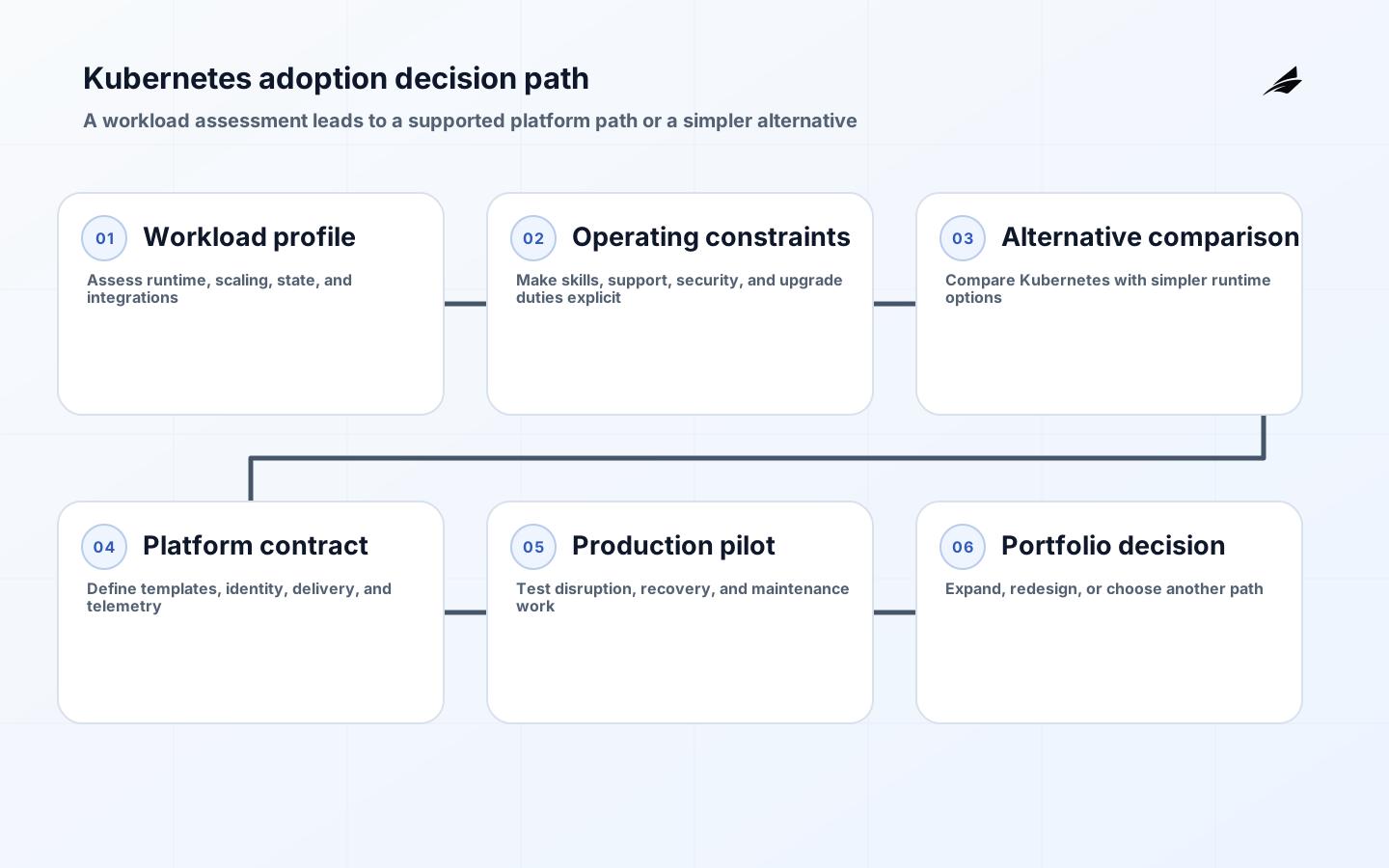
Kubernetes decision making is a planning and operating capability, not a tool purchase. Assess workload and operating responsibility before committing to a cluster; a simpler managed runtime is often the sounder option. The useful first step is to connect a real client or customer outcome to an owner, a technical boundary, and evidence that the team can use when normal delivery is interrupted.
Key takeaways
- Start Kubernetes decision making from the business or customer outcome that can be harmed, then select controls proportionate to that consequence.
- Name the service owner, operating authority, and fallback decision before automation obscures the handoffs.
- Pilot a narrow real path, including controlled failure and recovery, before standardizing it for every team.
- Measure the evidence that changes the next decision rather than collecting activity metrics for their own sake.
What Kubernetes decision making needs to solve
Kubernetes offers portable workload primitives and control, but introduces lifecycle, networking, policy, observability, upgrade, and response responsibilities. Capability alone is not a reason.
| Decision area | What to decide | Why it matters |
|---|---|---|
| Outcome and owner | Identify the critical journey, accountable service owner, and consequence of failure for kubernetes decision making. | Technical choices need a customer and operational context. |
| Scope boundary | Assess service count, scheduling needs, state, portability, and support capacity. Compare managed Kubernetes with application platforms and container services against the same objectives. | A bounded first release can be tested and supported. |
| Evidence | Choose the health, change, access, and recovery record required for kubernetes decision making. | Teams should not reconstruct important facts during an incident. |
| Authority | Set who can approve, pause, contain, and verify a material change. | Fast action depends on clear decision rights. |
Set a practical scope and architecture
Assess service count, scheduling needs, state, portability, and support capacity. Compare managed Kubernetes with application platforms and container services against the same objectives. Build the first version around one meaningful service path and document its dependencies, access model, data handling, and expected failure behavior. A concise service brief should describe what healthy looks like to a customer, where the important state lives, and which assumption would require the design to change. This keeps architecture choices anchored to a supportable result rather than a broad platform promise.
| Planning artifact | Minimum content | Evidence of readiness |
|---|---|---|
| Service brief | Customer outcome, owner, critical journey, and consequence of interruption | Product and service owners agree what healthy means. |
| Dependency map | Data, identity, integrations, limits, and likely failure paths | The team can describe expected behavior when a critical dependency is slow or absent. |
| Operating contract | Routine changes, access, alerts, escalation, and recovery authority | A responder can act without first discovering ownership. |
| Change record | Intent, risk, validation, stop conditions, and recovery option | Review distinguishes a known trade-off from an unknown risk. |
Design the operating path for Kubernetes decision making
Kubernetes decision making starts by comparing operational obligations with the workload benefit. A product with many independently deployed services, repeatable container needs, and a staffed on-call rotation may justify common scheduling, identity, and policy controls. A small API with predictable traffic and one deployment path may be better served by a managed application runtime. Ask who owns cluster upgrades, network policy, ingress, image admission, node capacity, secret rotation, incident response, and the developer templates that make those duties usable. The answer must remain true after the initial implementation team moves on.
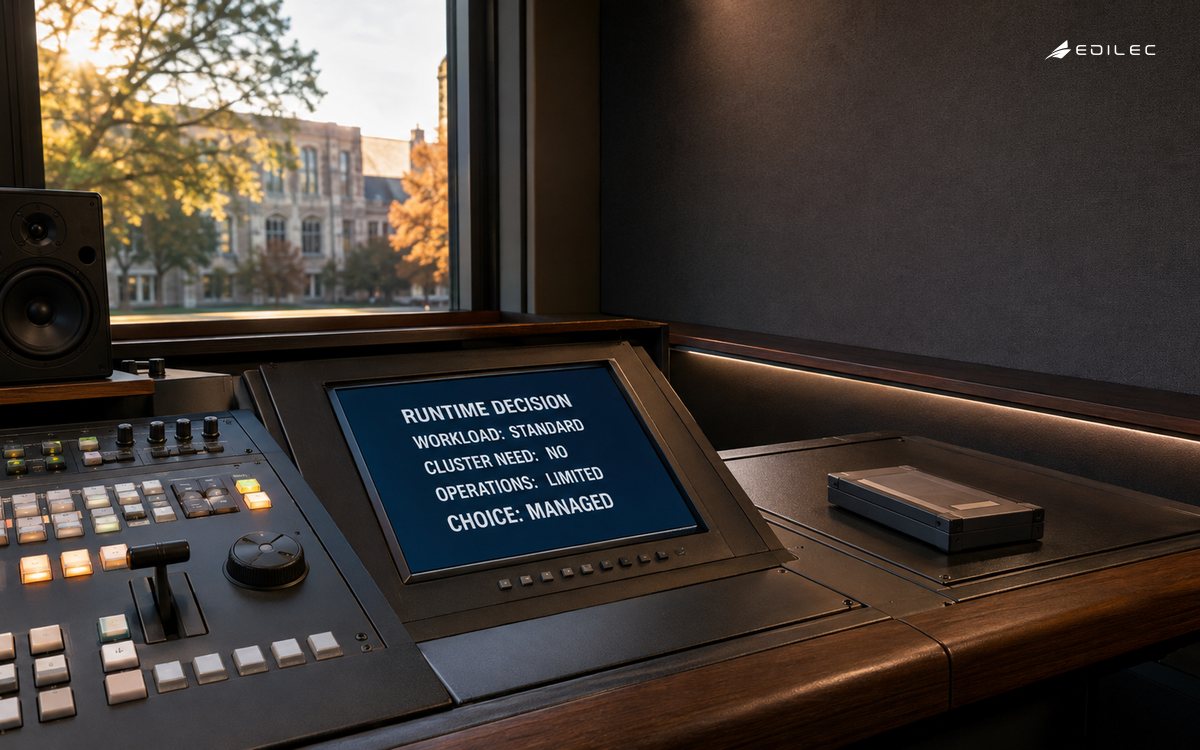
Compare Kubernetes with a simpler runtime honestly
| Decision criterion | Acceptance check | Operating risk |
|---|---|---|
| Workload fit | The pilot needs scheduling, service discovery, or policy capabilities unavailable in the simpler option. | A cluster is adopted for familiarity while adding needless operational surface. |
| Support model | Named people can complete an upgrade, diagnose networking, and handle a degraded node scenario. | Managed control planes still leave workloads and configuration without effective support. |
| Developer path | A team deploys a representative service using maintained templates and least-privilege identity. | Every workload invents manifests and permissions that drift from the intended standard. |
| Exit option | The architecture documents portable interfaces, data movement, and provider-specific dependencies. | A platform decision becomes difficult to revisit because assumptions were never recorded. |
Put controls where the work happens
Version a supported workload template with resource requests, health checks, identity, logging, and a release path. Treat cluster upgrade and add-on compatibility as owned product work.
- Give every material alert, approval, exception, or recovery decision a named owner and escalation route.
- Keep changes to access, configuration, and production state reviewable and traceable.
- Document pause and fallback conditions in the normal workflow, not only in an incident binder.
- Exercise recovery and access paths with the people who will use them in production.
- Treat repeated exceptions as feedback on the supported operating contract.
Pilot the path before scaling it
Pilot with a manageable service that benefits from consistency. Exercise rollout, scaling, disruption, access review, and version planning; compare its on-call burden with simpler alternatives.
| Pilot question | How to test it | Decision enabled |
|---|---|---|
| Can customers complete the critical path? | Use a representative workflow and service signal. | Proceed, redesign, or narrow scope based on outcome evidence. |
| Can the team operate it? | Have actual service and support owners perform routine work. | Clarify ownership, improve documentation, or reduce complexity. |
| Can the team recover it? | Introduce a controlled fault or failed change and follow the runbook. | Fix recovery gaps before wider exposure. |
| Can the team govern it? | Review access, audit history, cost or capacity, and exceptions. | Accept the operating model or add focused controls. |
Measure decisions, not activity
Metrics for kubernetes decision making should reveal whether the intended service outcome is holding and whether the team can make a timely operating decision. Establish a baseline before the pilot and attach context to material changes. Do not use a single number as a verdict on people; use it to locate the next improvement while the evidence is fresh.
| Metric | What it reveals | Review use |
|---|---|---|
| Customer outcome | Completion, success, or timeliness for the critical journey | Compare against the agreed service objective. |
| Detection and response | Time to recognize, own, contain, and verify a material problem | Improve routes, authority, and runbooks. |
| Control adherence | Changes using the supported, evidenced path | Investigate exceptions and friction. |
| Recovery confidence | Recent exercises that reached business validation | Prioritize untested or unreliable services. |
Frequently asked questions about Kubernetes decision making
Is Kubernetes required for containers?
No. Containers also run on managed application platforms, container services, and virtual machines. Kubernetes is an orchestration choice.
Should we self-manage?
Only with clear justification and sustained capacity for control-plane, node, security, and upgrade duties. Managed offerings often provide a better start.
What makes a good pilot?
Choose a relatively simple workload with engaged ownership, clear health signals, and real delivery needs, not the most critical stateful system.
A practical checklist for Kubernetes decision making
- Confirm the service owner, support contact, and authority to pause or contain a material issue.
- Keep the decision record, current configuration, dependency map, and verification evidence discoverable to the people on call.
- Run a controlled exercise before wider rollout and record the actual time to detect, act, and verify recovery.
- Review exceptions and repeated manual steps; they identify where the operating contract needs improvement.
- Set a review date after significant product, dependency, staffing, or compliance change.
Kubernetes evaluation should include the invisible work: image registry access, certificate rotation, DNS, ingress, network policy, secrets, audit logging, backup of cluster state where relevant, and the compatibility of add-ons during upgrades. Ask who sees alerts for these layers and who can fix them at an inconvenient hour. A cluster is an operating system for workloads, not a deployment target alone.
Keep the plan alive after launch
Make the comparison fair. Price and staff the simplest alternative with its own monitoring, identity, release, and recovery needs, then compare the total operational burden with a managed Kubernetes path. A decision to delay Kubernetes can be an excellent architecture outcome when it gives the team a more reliable route to customer value while preserving the option to adopt it later.
Make Kubernetes decision making survive real handoffs
The enduring test for Kubernetes decision making is whether a capable person who was not present for the original design can make the next safe decision. Keep workload fit, cluster responsibilities, and the comparison with simpler runtimes in a concise operating record that is linked from the normal delivery and support path. The record should distinguish facts from assumptions, name the current owner, and say what evidence is needed before an exception becomes a permanent change. During a staff change, vendor incident, or urgent customer request, this clarity is more valuable than a polished architecture diagram because it shows who may act and how success will be verified. Review the record after every meaningful release or incident. Remove instructions that are no longer true, add the context that responders had to discover, and turn recurring verbal advice into a visible control or supported workflow. This review habit prevents the service from quietly depending on a few people who remember why an old decision was made.
| Handoff item | Question to answer | Owner check |
|---|---|---|
| Current state | What version, configuration, and operating condition is in effect for Kubernetes decision making? | A named owner can locate the evidence quickly. |
| Decision boundary | Which action can proceed routinely, and which needs escalation? | Authority matches the service consequence. |
| Verification | What customer, technical, and operational signals confirm the action worked? | The result is recorded before work is declared complete. |
| Review trigger | Which change, incident, or date requires the plan to be revisited? | The operating record remains current. |
Conclusion
Kubernetes decision making creates value when it becomes a dependable operating capability rather than another layer of tooling. Start with one accountable service path, make failure and recovery concrete, and use pilot evidence to decide what deserves standardization. That is a plan clients can fund, operate, and improve without relying on untested assumptions.