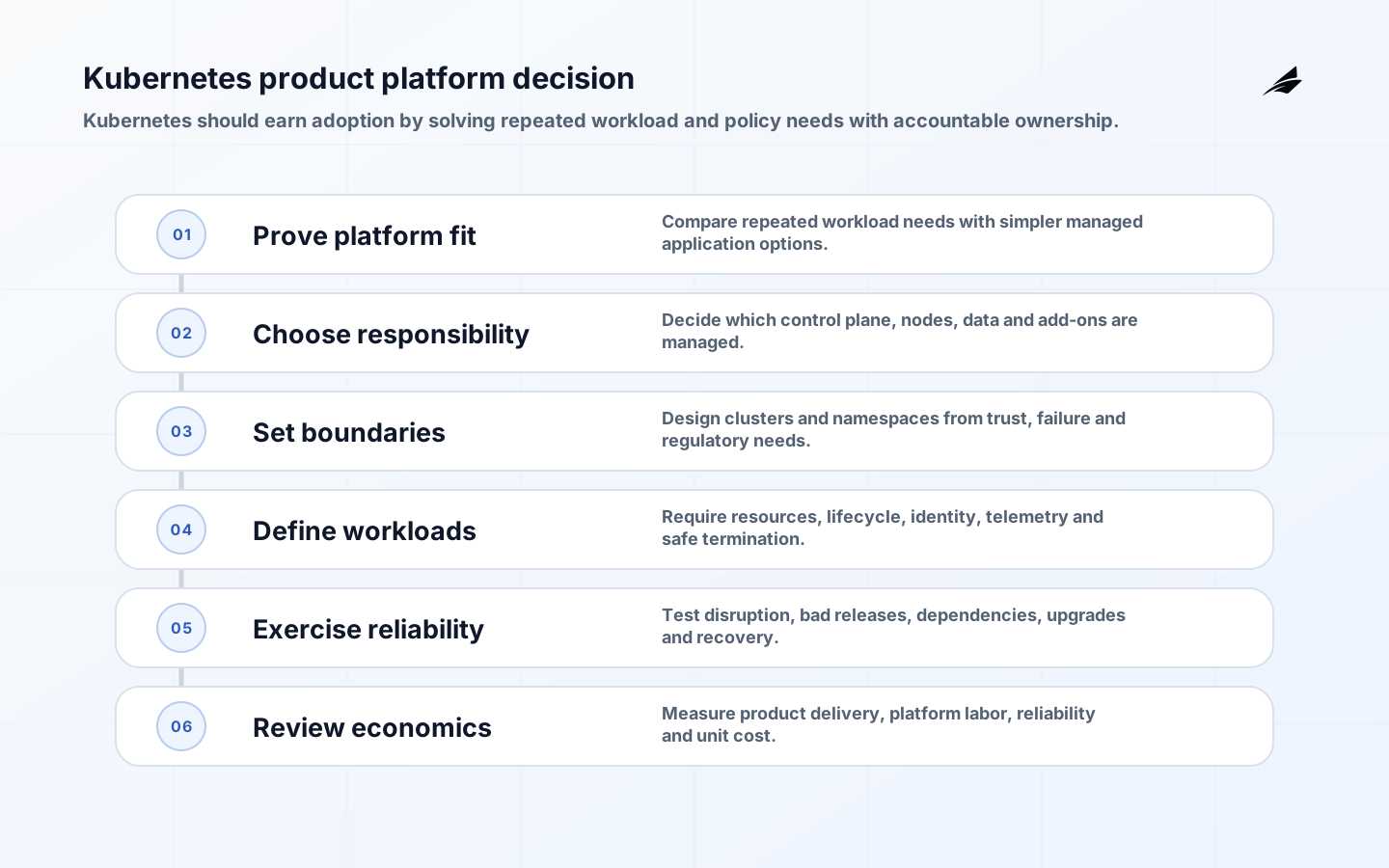
Kubernetes can provide a consistent control plane for scheduling containers, declaring desired state, isolating workloads and extending platform policy. It also introduces clusters, controllers, networking, storage, identity, upgrades and a large configuration surface. A growing product should adopt it when those capabilities solve repeated operational problems and the organization can own the platform. Team enthusiasm or anticipated scale alone is not a sufficient reason.
This guide frames the decision from product and operations evidence. It connects with infrastructure as code standards, incident response for web platforms and secrets management across environments. The comparison should include managed application platforms, serverless containers and virtual machines. Kubernetes is one operating model among several, not the definition of modern engineering.
Which product signals justify Kubernetes?
Useful signals include many independently deployed services, diverse runtime or scheduling needs, repeated environment inconsistency, platform policy that must apply across teams, and enough workload scale to benefit from shared automation. Batch jobs, event consumers, long-running services and specialized compute can share a declarative platform. Kubernetes may also provide portability at the workload layer, although managed services, identity and networking still create provider dependencies.
Weak signals include one or two services, a small team without platform ownership, a product still searching for fit, or a desire to copy a larger company. A managed application platform often provides deployment, certificates, scaling and logs with less work. Compare time to safe release, incident burden, compliance needs and unit cost using a representative service. The best choice is the simplest platform that meets the product’s operating requirements.
| Condition | Kubernetes signal | Simpler option signal |
|---|---|---|
| Service count | Many independent deployments and policies | Few tightly coupled services |
| Workload diversity | Services, jobs and specialized scheduling | Standard stateless web workload |
| Team capacity | Named platform ownership and on-call | Application team already overloaded |
| Control needs | Consistent admission, identity and network policy | Provider defaults meet requirements |
| Scale pattern | Shared capacity and frequent changes | Stable predictable demand |
How much of the platform should be managed?
Managed Kubernetes usually removes control-plane installation and parts of availability, patching and backup, but the customer still owns workload configuration, identities, network exposure, node choices, upgrades, policy and incident response according to the service agreement. The Kubernetes production guide highlights availability, scale, access, nodes and resource limits as deliberate production concerns. Compare provider responsibility line by line rather than assuming managed means operated.
Prefer managed databases, queues, object storage and identity services when their operating model and exit constraints fit. Running every dependency inside the cluster increases stateful recovery work. Self-managed clusters are justified only when control, environment or provider limitations outweigh the operational burden. Document unsupported version windows, regional architecture, control-plane endpoints, node images, add-ons and upgrade responsibility before selecting a service.
How should clusters and tenant boundaries be designed?
Use clusters as security, failure, administration or regulatory boundaries—not as folders. Separate production from development where consequence warrants it. Additional clusters can reduce blast radius and support regional or customer isolation, but they multiply upgrades, policy, observability and cost. Namespaces are useful organizational boundaries but do not provide every form of hard multi-tenancy. The official multi-tenancy guidance distinguishes namespace and virtual-control-plane approaches and their tradeoffs.

Define identity for humans and workloads, namespace ownership, quotas, network policy, admission controls and privileged exceptions. Prevent application teams from receiving cluster-admin for convenience. Shared controllers and custom resources can affect every namespace, so review extension privileges carefully. Keep platform components in a compatibility matrix with Kubernetes versions. Every boundary should have a reason, owner and tested failure assumption.
What must each workload declare?
A deployable workload needs resource requests and limits based on measurement, readiness and startup behavior, graceful termination, disruption tolerance, service account, network needs, configuration, secrets, storage and observability. Kubernetes schedules from requests and enforces limits according to resource type; unrealistic values cause poor placement, throttling or eviction. Defaults can protect the platform, but teams must learn from actual use and revise them.
Use readiness to control whether a pod receives traffic, startup probes for slow initialization and liveness only when restart can repair the fault. A bad liveness probe can create an outage loop. Handle SIGTERM, stop new work, drain connections and complete or return jobs before the grace period expires. Define idempotency for queue consumers because pod restarts and redelivery are normal. Do not store critical mutable data in an ephemeral filesystem.
| Failure exercise | Expected behavior | Acceptance signal |
|---|---|---|
| Pod terminated during request | Traffic drains and retry is safe | No lost or duplicate business action |
| Node unavailable | Replicas reschedule within objective | Service SLO maintained or degrades safely |
| Dependency slows | Timeout and circuit control bound damage | Queue and latency recover after fault |
| Bad release | Progressive rollout stops automatically | Known-good version or feature state restored |
| Region lost | Documented failover or controlled outage | Data and routing reconcile after recovery |
How should delivery and policy be standardized?
Provide a paved path: versioned deployment templates, image build, registry, signed artifacts, configuration validation, secret references, policy checks, progressive rollout and standard telemetry. Infrastructure as code should create clusters and platform services reproducibly, while GitOps or another controlled deployment mechanism records desired state. Avoid forcing every application team to understand every controller. The platform contract should be small enough to learn and explicit enough to support.
Admission policy can prevent privileged containers, mutable image tags, unapproved registries, missing resources and unsafe host access. Introduce policy in audit mode, measure violations and provide fixes before enforcing. Exceptions need owner, reason and expiry. Protect deployment identities and separate production authority. A manifest passing schema validation is not production-ready unless the workload behavior, dependencies and recovery have been tested.
What reliability and security work remains?
Plan control-plane and node availability, pod distribution, autoscaling, DNS capacity, certificate lifecycle, registry dependency, backups and add-on failure. Pod disruption budgets limit voluntary disruptions but do not guarantee application availability; replicas, topology and dependency design still matter. Test upgrades and node replacement in a production-like environment. Observe desired versus available replicas, pending pods, restarts, saturation, admission failures and service-level indicators.
Follow the Kubernetes security checklist with workload-specific threat modeling. Use supported versions, least privilege, restricted pod security, network policy, image provenance, secret encryption, audit logs and protected API access. Limit metadata and cloud credential exposure. Scan images, but also patch base images and redeploy. Runtime detection must route to responders who understand cluster and application context. Back up and restore both cluster state and application data according to ownership.
How should cost and platform ownership be measured?
Measure allocatable capacity, requests, actual use, idle allocation, autoscaling delay, managed-service fees, data transfer, observability and platform labor. Namespace or tenant allocation requires consistent labels and shared-cost rules. Aggressive bin packing can harm reliability; excessive requests waste capacity. Use workload classes and headroom policies tied to service objectives. Unit cost per transaction, tenant or job can inform decisions better than total cluster spend.
A platform team owns product-like capabilities, documentation, support, upgrades and a roadmap. Application teams own workload behavior and service outcomes. Security and infrastructure functions own defined controls, not every incident by default. Publish service levels for platform requests and incidents. Review whether Kubernetes continues to reduce lead time and inconsistency. Some workloads may move to simpler managed services over time; platform success is not measured by keeping every workload in the cluster.
Pilot Kubernetes for growing products with one real service
A Kubernetes for growing products pilot should move a representative service through build, policy, deployment, scaling, disruption, incident and upgrade. Choose a service with an actual dependency and traffic pattern, not a hello-world container. Measure developer setup, release lead time, failed deployment recovery, platform support effort, compute use and service reliability. Run the same service on the strongest simpler alternative so the decision reflects evidence rather than familiarity with one tool.
Require a written decision after the pilot. It should state which capabilities Kubernetes materially improves, which new risks it introduces, the minimum platform team, managed-provider responsibilities, cluster boundaries and a twelve-month cost range. Identify workloads that should not migrate. If the organization cannot staff upgrades, security response and workload support, the responsible outcome may be to use a managed application platform now and preserve container portability for a later decision. Revisit the decision when workload or team conditions materially change, and record the operational evidence that triggered reconsideration.
Key takeaways
- Adopt Kubernetes for repeated workload and policy needs, not fashion.
- Prefer managed responsibility where it genuinely removes operational work.
- Design clusters from failure and trust boundaries.
- Give every workload an explicit resource, lifecycle, identity and recovery contract.
- Measure platform labor and product outcomes alongside compute cost.
Frequently asked questions
How many services are required before Kubernetes makes sense?
There is no threshold. Workload diversity, policy needs, deployment frequency and platform capacity matter more than count. A benchmark with one representative service and a simpler managed option is more useful than an arbitrary number.
Does Kubernetes provide multi-cloud portability?
It can standardize container scheduling and some APIs, but storage, networking, identity, observability and managed dependencies remain different. Portability should be tested for the specific recovery or negotiation goal rather than assumed from manifests.
Should each product team run its own cluster?
Only when isolation, autonomy or failure requirements justify the added operations. Shared clusters with strong namespace controls can be efficient; dedicated clusters can reduce blast radius. Make the choice from trust, scale and ownership evidence.
Conclusion
Kubernetes is valuable when it turns repeated operational needs into a supported platform contract. It is costly when it merely relocates complexity from application code into cluster configuration. Growing products should compare alternatives, adopt managed responsibility deliberately and prove one workload through deployment, failure, recovery and cost. Continued use should earn its place through better delivery and dependable operations.