A shared SaaS control plane centralizes tenant onboarding, configuration, placement, policy, metering and administration. That unified experience is valuable, but it can become a global failure domain when every application request queries it synchronously or when one malformed control action reaches every tenant environment. Sound SaaS control plane architecture separates authoritative intent from the regional application plane that serves tenant work. The control plane may be unavailable while existing, previously authorized service continues within explicit freshness and risk limits.
AWS distinguishes management functions from the tenant-facing application plane in Control plane vs. application plane. Use that distinction as a dependency rule: control publishes desired state; application planes consume a validated projection. Avoid a bidirectional mesh in which serving paths need live global responses and local components mutate global catalog records opportunistically.
Classify control functions by outage consequence
Inventory tenant registration, identity configuration, entitlement, placement, provisioning, billing, support access, feature policy and maintenance. For each operation, decide whether an outage should allow, queue or reject it. Existing data reads might continue on cached entitlement; a new administrator grant should fail closed; usage events can buffer; destructive offboarding should pause. This decision table becomes the degradation contract and prevents incident-time improvisation.
| Control action | During control outage | Application-plane input | Recovery behavior |
|---|---|---|---|
| Existing tenant request | Continue within freshness bound | Signed tenant and policy snapshot | Revalidate current version |
| New tenant onboarding | Queue or reject clearly | None until placement commits | Resume idempotent workflow |
| Privilege increase | Fail closed | Last-known grants only | Require fresh approval |
| Emergency access removal | Use independent revocation path | High-priority deny update | Confirm every regional projection |
| Usage metering | Buffer durably | Local event log | Replay with deduplication |
Publish versioned, monotonic intent
Store authoritative tenant state durably with an immutable change record. Project compact regional views through queues or replication and make consumers idempotent. Every snapshot needs tenant, version, effective time, schema and integrity protection. Reject version rollback unless a specific recovery workflow authorizes it. Keep policy evaluation local where possible, using signed inputs that can be audited back to the controlling change.
Microsoft's control-plane considerations note that these systems can be mission critical and require deliberate reliability and isolation. Treat the catalog and workflow engine as an application: backups, restore tests, capacity limits, deployment rings, security boundaries and service objectives all apply. A managed database does not remove workflow corruption or unsafe bulk mutation.
Keep existing application service statically stable
Regional planes should cache the tenant mapping, isolation policy, product entitlement and routing data needed for normal work. Define maximum staleness by field; a branding setting can be older than a revoked credential. Include emergency denial distribution separate from ordinary change when risk requires it. When freshness expires, degrade narrowly: deny the affected operation rather than stopping unrelated tenant traffic.
Split global and regional control responsibilities carefully
A global plane can own tenant identity, placement and fleet policy while a regional or stamp controller provisions local resources and runs maintenance. Microsoft's control-plane approaches describe catalog and lifecycle processes as the core. Keep ownership singular for each field. Use commands with correlation IDs and expected versions, not shared database writes by several controllers. Regional completion events update global workflow state asynchronously.
More controllers increase coordination and debugging cost. Introduce a regional controller only when latency, scale, sovereignty or failure independence requires it. Document what happens if the global plane sees a command pending while the region completed it. Reconciliation should inspect observed local state before retrying, preventing duplicate infrastructure or tenant resources.
Constrain administrative and deployment blast radius
Separate control resources from tenant resources and use scoped identities for each stamp or region. Bulk tools must require target previews, maximum cohort size, approval for broad changes and automatic stop conditions. Roll out catalog schema, policy and provisioning changes through representative tenants. A logically centralized plane should still execute bounded waves. Preserve tenant context in every command, trace and audit event.
Isolation remains necessary even with dedicated application stacks. AWS's silo isolation guidance explains that unified onboarding and operations surround separate tenant environments. Ensure shared control credentials cannot freely cross those silos; broker temporary, tenant-scoped authority and retain an authoritative action result.
Recover by reconciliation, not blind replay
After outage, compare desired, projected and observed state. Resume workflows from durable checkpoints, deduplicate commands, and quarantine conflicts such as two placement decisions. Prioritize security revocations and routing repair before low-risk customization. Keep change restricted until lag and conflict thresholds return to normal. Verify representative tenants and record the point at which new mutations are reopened.
| Control-plane failure | Containment test | Required signal | Recovery gate |
|---|---|---|---|
| Catalog unavailable | Existing regional service continues | Snapshot age and cache hit | Catalog restored and reads verified |
| Bad policy published | One wave stops before fleet | Decision denials by version | Rollback projection confirmed |
| Duplicate provisioning command | No duplicate resource is created | Idempotency key and observed state | Workflow reconciled |
| Region disconnected | Local serving and buffering continue | Projection lag and queue depth | Ordered catch-up complete |
| Admin credential compromised | Scope limits affected tenants | Actor, targets and temporary grants | Credential revoked and changes reviewed |
Design the control-plane outage as a product state
Tell operators which actions remain safe
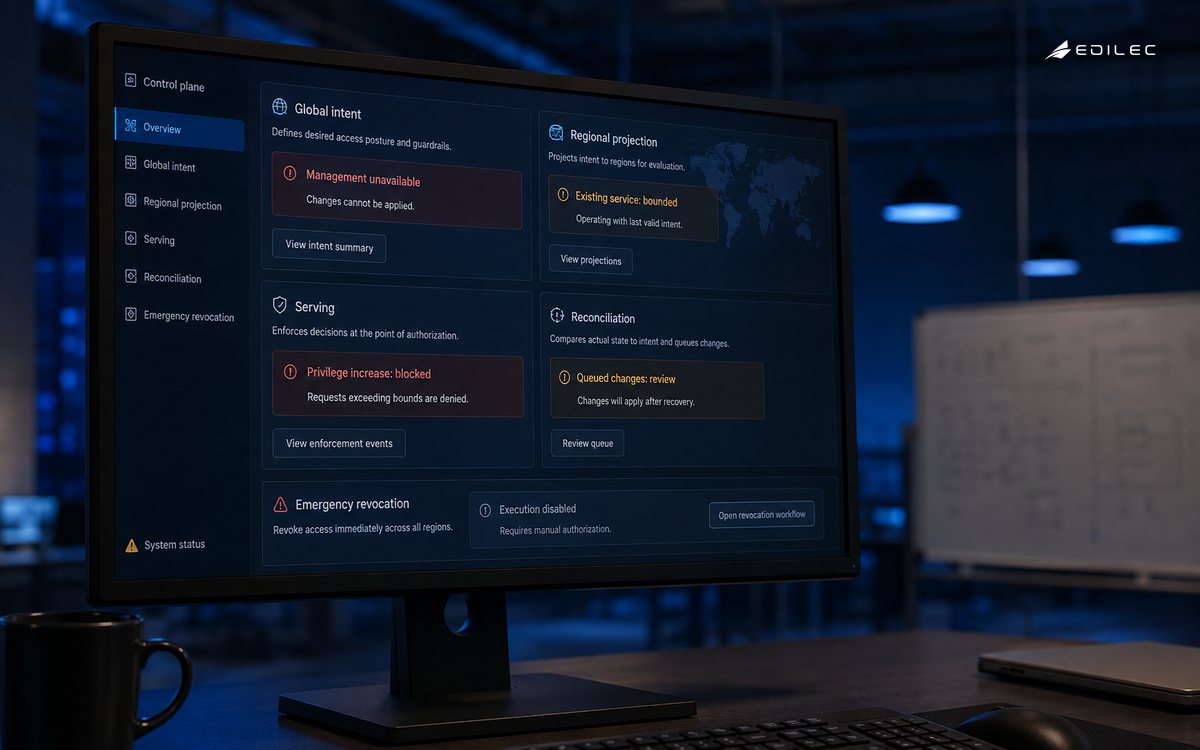
An administrative interface should not show a normal enabled button when the authoritative workflow cannot finish. Surface projection version, regional reachability and action-specific status. Existing-user access might continue, a plan downgrade might queue, and a key rotation might be rejected because stale authorization is unacceptable. Return a stable operation identifier and truthful state such as accepted, waiting for authority, applied regionally or requires review. This prevents support staff from repeating commands and creating duplicate work during recovery.
Prepare customer communication by capability, not by the broad phrase control-plane incident. State whether serving traffic, onboarding, configuration changes, billing views or support access is affected. Give queued changes an expected review path without promising an unsafe completion time. Internally, identify who can enter restricted mode, pause bulk automation, approve emergency tenant changes and reopen mutations. The incident commander needs a map of authoritative and projected state, not merely a dashboard of service processes.
Prove that last-known-good state remains bounded
Test with the control plane disconnected long enough to cross token, certificate, policy and entitlement freshness thresholds. Confirm that low-risk existing operations continue only for their approved window and that privilege increases or newly revoked tenants do not slip through. Exercise the emergency revocation channel separately because it must work when the ordinary publisher is impaired. Measure oldest projection, tenants by stale version, rejected high-risk actions and volume of queued intent.
Recovery completion requires business invariants, not an empty queue. Compare desired and observed tenant resources, entitlements, routing and billing state; isolate conflicts; and sample actions that were issued near the outage boundary. Only then reopen change and retire temporary access. A post-incident review should ask whether an application-plane dependency unexpectedly called the shared plane, whether queue capacity was adequate and whether operators understood the restricted-mode contract. Those findings improve the next degradation policy.
Capacity-plan restricted mode explicitly. Regional caches need enough storage and key lifetime for the longest approved isolation, while command buffers need quotas by action and tenant. Define what happens when either fills: compact superseded desired state, preserve high-value commands, or reject new changes with a durable customer-facing status. Never let a full retry queue consume the database or connections that keep existing tenants serving. A degradation design that works only for a short control-plane restart is not protection against a prolonged regional separation.
Version the degradation policy with the control-plane schema. A new field must declare whether it is safe when stale, must fail closed, or can be queued for reconciliation. Compatibility tests should run an older regional projection against the new application release before fleet rollout. This stops an apparently harmless schema change from turning a future management outage into a tenant-serving failure.
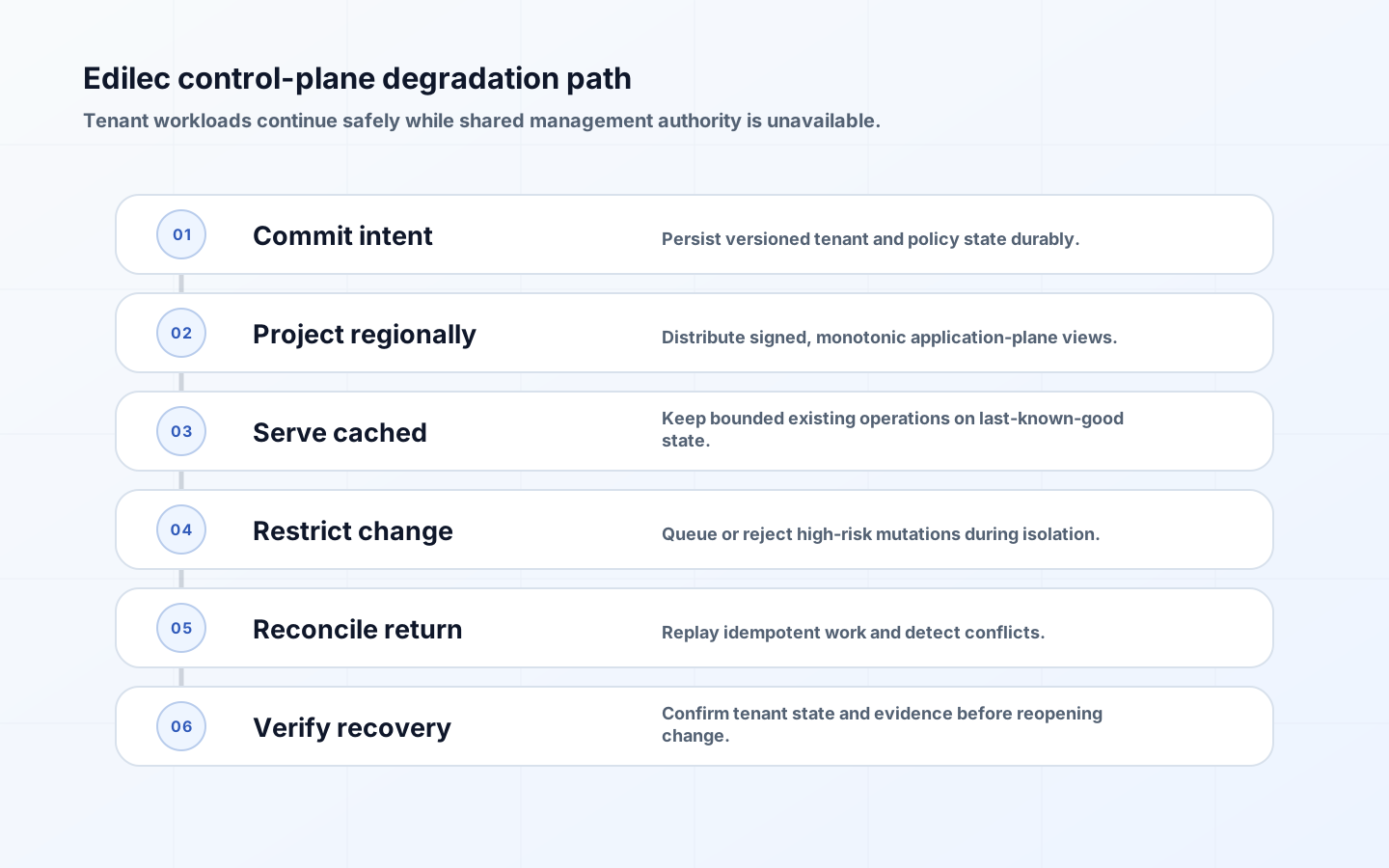
Use the six-stage Edilec control-plane degradation path
Commit intent, project it regionally, serve cached state, restrict unsafe change, reconcile return and verify recovery. Test the path quarterly with real serving dependencies and a safe tenant cohort, not only a control-plane health check.
Key takeaways
- Separate authoritative management intent from the tenant-serving application plane.
- Classify every control action as continue, queue or reject during outage.
- Project signed, versioned state and enforce field-specific freshness.
- Scope identities, bulk operations and deployment waves by tenant, stamp or region.
- Reconcile desired and observed state before replaying incomplete workflows.
Frequently asked questions
Should the control plane be global?
Global ownership can simplify placement and tenant lifecycle, while regional projections and controllers improve serving independence. Choose one owner per datum and minimize controller count.
Is cached authorization safe?
It can be for bounded existing operations when state is signed, versioned and fresh enough. Privilege increases and stale high-risk decisions should fail closed, with an emergency revocation channel.
Does its RTO match the application RTO?
Not necessarily. Existing application traffic may continue while onboarding or administration is unavailable. Define separate objectives by capability.
Conclusion
A shared plane should unify intent without becoming a synchronous global dependency. Versioned regional projections, bounded administrative authority and reconciliation let tenant workloads remain useful during management failure. The architecture is successful when outage behavior is predictable enough to test before the control plane is needed for recovery.