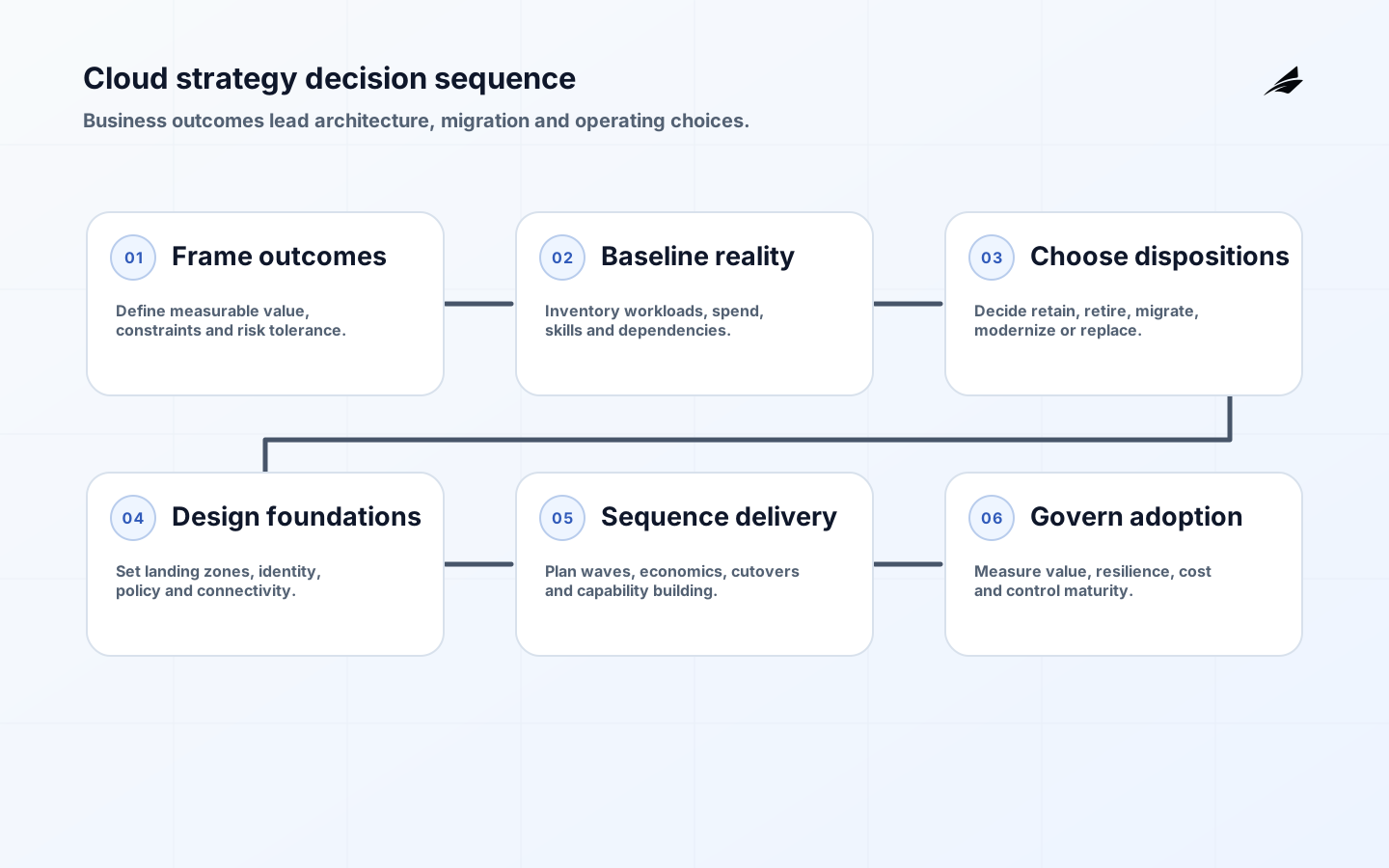
Cloud strategy and consulting should turn uncertain technology choices into a small set of owned business decisions. A useful engagement explains why cloud is relevant, which workloads should change, what foundation and capabilities are required, how economics behave under realistic demand, and how delivery will be governed. It does not assume that migration is the answer for every system. This guide defines the scope, cost drivers, risks and delivery plan buyers should expect from credible cloud advisory work.
Pair this guide with the cloud strategy implementation checklist and cloud strategy FAQ. The cloud computing consulting delivery guide provides broader implementation context, while the cloud advisory strategy plan focuses on decision governance. Agree which questions this engagement must answer before agreeing how many workshops it contains.
What cloud strategy and consulting should cover
Begin with business outcomes and constraints: growth, release speed, resilience, market entry, data use, workforce capacity, data-center exit, supplier risk, regulatory duties and sustainability. Define a baseline and target measure for each claimed outcome. Microsoft’s current Cloud Adoption Framework strategy guidance starts with assessment, motivations, objectives, team and organizational preparation and treats strategy as iterative. That is a better model than a one-time target-architecture presentation.
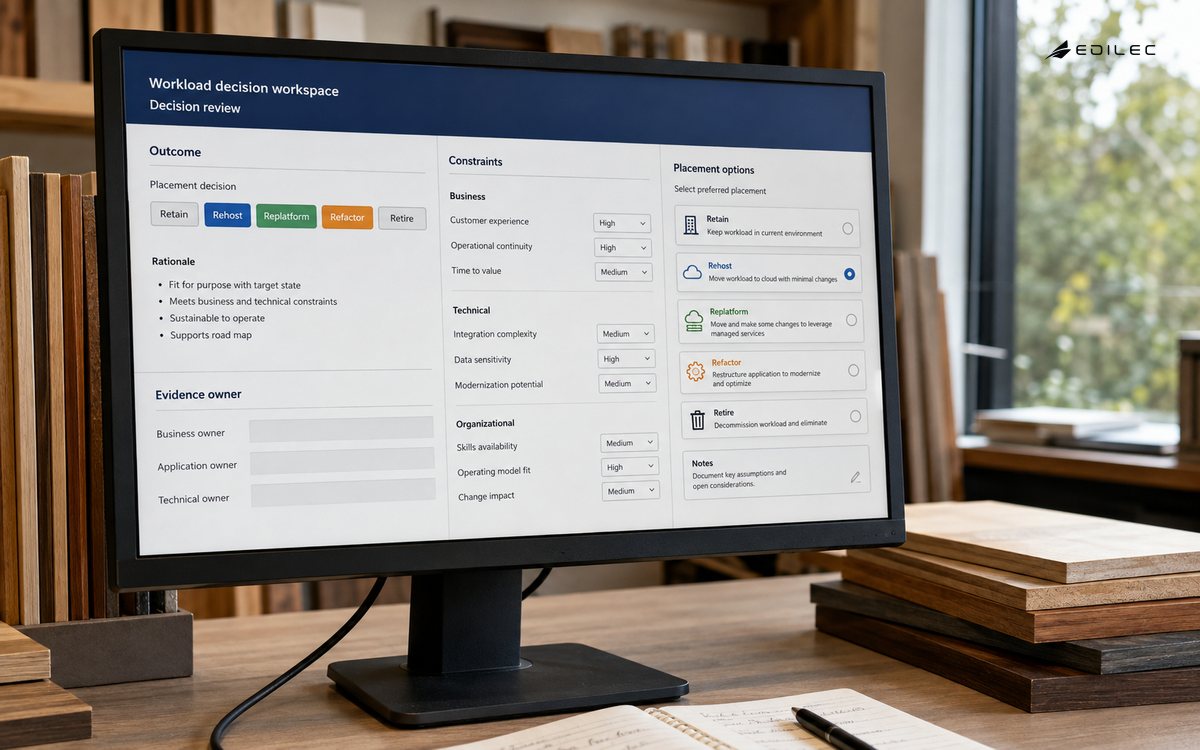
Scope the estate using business capabilities and dependencies, not server counts alone. Inventory applications, data, interfaces, users, critical periods, technology, contracts, cost, support ownership, recovery needs and known change. Include SaaS and shadow services where they affect identity, data or integration. Define geographic and legal boundaries. Note concurrent programs that may change the baseline. Record confidence and evidence for each finding so later estimates do not present assumptions as discovered facts.
| Advisory workstream | Decision it must resolve | Expected artifact |
|---|---|---|
| Business case | Which outcomes justify change and how will value be measured? | Outcome map with baseline, target and owner |
| Portfolio | What happens to each workload and in what order? | Evidence-backed disposition and dependency map |
| Platform | Which shared capabilities and boundaries are required? | Landing-zone and connectivity decisions |
| Security and risk | Which obligations, threats and tolerances shape design? | Control responsibility and risk treatment plan |
| Economics | What drives one-time and recurring cost? | Scenario model with assumptions and sensitivity |
| Operating model | Who builds, governs and runs the estate? | Roles, capability plan and service model |
Make workload dispositions evidence-based
For each workload, compare retain, retire, replace, relocate, rehost, replatform and refactor options. Labels vary across frameworks, so define them in the engagement. Evaluate product roadmap, business fit, technical condition, data gravity, latency, licensing, provider support, security, recovery, skills and exit constraints. An application should not be refactored merely because it is old, or rehosted merely because a data-center deadline is urgent. State the trigger that would change the recommendation.
Sequence workloads by dependency and learning value. An early wave should be meaningful enough to validate identity, networking, delivery and operations but not concentrate existential risk. The AWS Cloud Adoption Framework organizes transformation through business, people, governance, platform, security and operations perspectives. Use those perspectives to expose readiness gaps around each wave. A technically portable workload may still be a poor early candidate if ownership, testing or business acceptance is weak.
Design a minimum viable cloud foundation
Define organization and account hierarchy, identity federation, privileged access, network topology, name resolution, logging, policy enforcement, encryption, key management, secrets, image and artifact controls, deployment paths, backup, recovery and cost allocation. Keep provider-neutral outcomes separate from provider-specific implementation. The NIST Cloud Computing Reference Architecture identifies actors including consumer, provider, broker, auditor and carrier; mapping those roles helps clarify service intermediation and assurance without pretending all clouds implement them identically.
A landing zone is a governed product, not a static prerequisite. Offer approved patterns and automated account vending so teams can move quickly without bypassing controls. Microsoft’s Azure landing zone design principles warn that complicated subscription processes can encourage unmanaged alternatives. Define how platform changes are versioned, tested, communicated and adopted by workloads. Include break-glass access, policy exceptions and evidence export from the first release.
Model cloud cost and commercial choices
Separate advisory, foundation, migration, remediation, dual-running, exit and recurring operating costs. Build consumption scenarios from workload demand, storage growth, data transfer, availability design, logs, security services, support and licensing. Show low, expected and high cases and the assumptions that move them. Include tax, currency and contractual commitments where relevant. Compare against the avoidable portion of current cost, not an allocated total that will remain after migration. Quantify internal staff and change-management effort as well as supplier fees.
Design cost accountability before deployment. The FinOps Framework treats FinOps as collaboration across engineering, finance and business. Decide allocation metadata, shared-cost treatment, budgets, anomaly response, forecasting and unit economics. Commitment discounts should follow stable usage evidence and ownership. A forecast is not a promise of savings; it is a decision model that must be reconciled against actual consumption and business value after each wave.
| Risk | Early evidence | Practical treatment |
|---|---|---|
| Unclear value | Objectives have no baseline or accountable owner | Define measurable outcome and stop condition |
| Dependency surprise | Inventory conflicts with network or transaction records | Trace representative business journeys |
| Foundation delay | Every workload needs a custom platform exception | Deliver paved patterns and automated provisioning |
| Cost overrun | Estimate omits logs, transfer, support or dual running | Use scenario model and reconcile actuals |
| Operational gap | Migration team has no production on-call plan | Prove runbooks and ownership before cutover |
| Lock-in | Data export, replacement and contract exit are untested | Design portability according to business risk |
Structure the consulting delivery plan
Run discovery through evidence review, interviews, system queries and workload workshops. Publish a decision log after each cycle, including options, tradeoffs, owner and due date. Validate recommendations with business, security, finance, architecture and operations representatives. Deliver in increments: outcome frame, estate baseline, workload dispositions, foundation decisions, economics, operating model and roadmap. Prototype high-uncertainty assumptions such as connectivity, database compatibility or recovery instead of resolving them through optimistic prose.
The Google Cloud Adoption Framework describes organizational themes such as learn, lead, scale and secure. Whatever framework is selected, convert maturity language into funded actions, accountable roles and acceptance evidence. Define consulting acceptance by decisions resolved and artifacts usable by delivery teams. Include handover sessions, editable models, source inventories and open assumptions. Recommendations should identify the next irreversible decision and preserve alternatives until evidence justifies closing them.
Govern adoption and measure realized value
Create a cross-functional cloud governance forum with authority over strategy, platform policy, portfolio sequence, material exceptions and investment. Keep architecture review proportional and time-bound. Track outcome measures such as release lead time, recovery performance, unit cost, control coverage and decommissioned legacy cost, alongside delivery measures such as wave completion. Separate migrated from modernized. Record whether projected value was realized, delayed, displaced or disproved, and update the portfolio rather than defending the original business case.
Review strategy quarterly and after material provider, regulatory, business or incident changes. Reassess workloads as products evolve. Monitor concentration, skills and exit readiness. Keep a current view of data location, critical suppliers and inherited controls. A strategy is current only if teams can use it to decide the next workload, foundation investment and risk treatment; a polished document that no longer affects decisions is historical evidence, not governance.
Specify capability building as delivery work. Identify which platform engineering, security, reliability, data, FinOps, sourcing and product skills are required by each adoption wave, then decide whether to hire, train, partner or consume a managed service. Set a knowledge-transfer outcome and prove internal teams can make routine decisions without consultant dependence. Update role descriptions, on-call expectations, funding and performance measures so the organization does not ask legacy project structures to operate cloud products indefinitely. Supplier help is most valuable when it leaves reusable patterns and stronger customer judgment.
Include compliance and data decisions early. Map data categories, residency, retention, encryption, access, evidence and deletion requirements to candidate services and regions. Confirm which assurances are inherited and which controls remain with customer teams. Where regulation is interpreted rather than explicit, record legal advice, assumptions and review triggers. Test evidence export from the proposed foundation before scaling. A control that exists only in a provider portal but cannot be associated with the relevant workload, period and configuration will be costly to defend during audit or incident investigation.
Key takeaways
- Define measurable business outcomes before selecting migration targets.
- Make every workload disposition traceable to evidence, dependencies and a change trigger.
- Treat the landing zone and operating model as products that evolve with adoption.
- Model full one-time and recurring economics with uncertainty and accountable unit measures.
- Accept advisory work when it resolves decisions and equips delivery, finance and operations teams.
Frequently asked questions
How long should cloud strategy consulting take?
A bounded portfolio assessment may take weeks; a complex regulated estate can require iterative work over months. Duration should follow decisions, evidence access and portfolio scale. Time-box discovery, publish confidence levels and begin validating high-risk assumptions early rather than waiting for a single final report.
Should the strategy require multicloud?
Only where a business, regulatory, resilience or product requirement justifies the added capability and operating cost. Portability is not binary. Decide which data, interfaces, skills and recovery options need independence, then test those properties. Using two providers without an executable failover or exit path does not create resilience.
What should a consulting proposal price?
It should price scope drivers such as applications, interviews, regions, data domains, regulatory contexts, financial modeling and proof-of-concept work. Ask for deliverables, assumptions, customer dependencies, team roles and change control. Avoid comparing day rates without normalizing the questions and artifacts included.
Conclusion
Cloud strategy and consulting create value when they improve decisions, not when they maximize migration volume. Anchor the engagement in outcomes, evidence-backed workload choices, an operable foundation, realistic economics and continuous governance. The result should be a roadmap the organization can execute and revise as evidence changes.