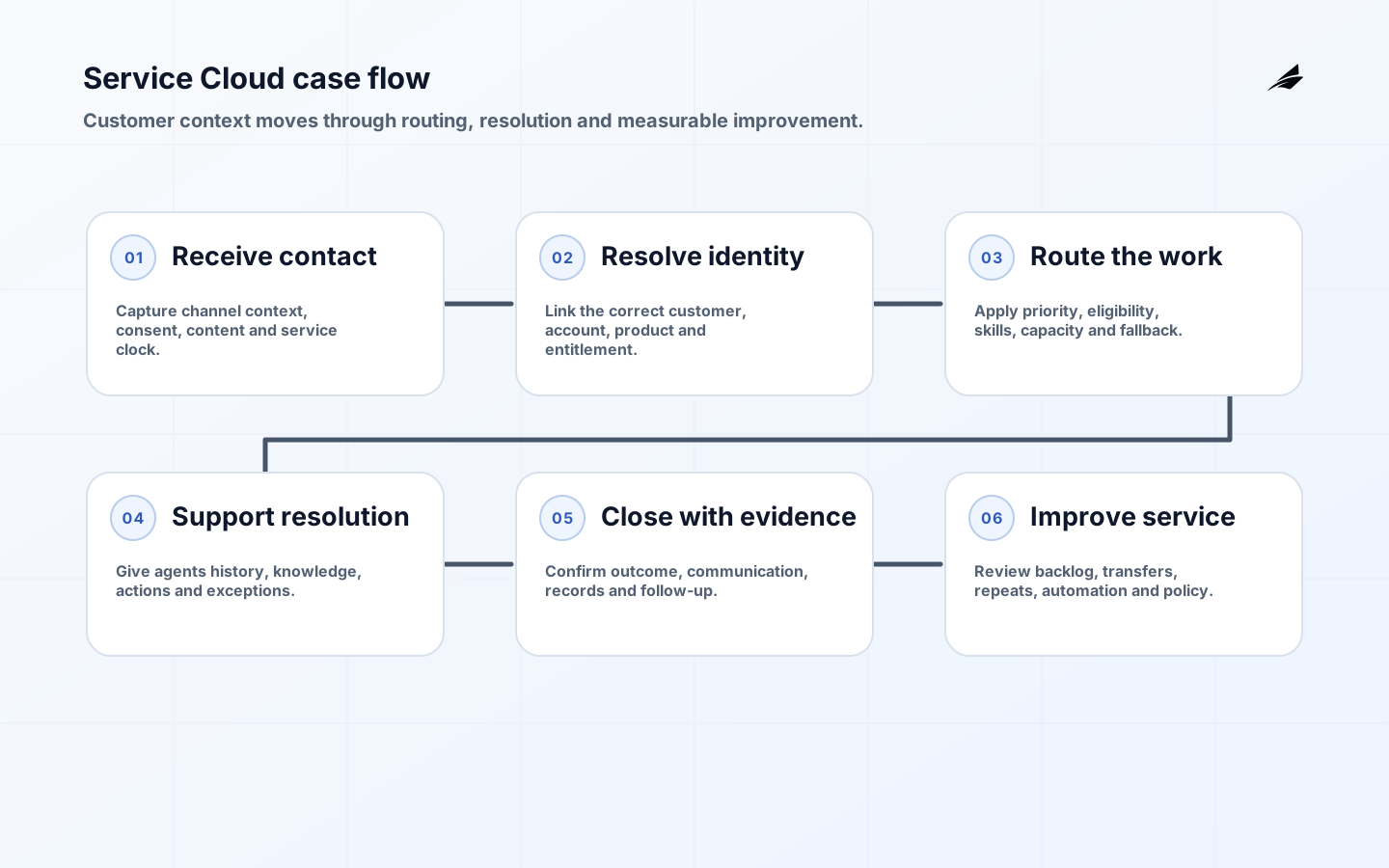
Salesforce Service Cloud design translates customer-service policy into case data, channels, routing, agent work, knowledge, automation, integrations and measurable operations. A successful implementation is not a console configuration project. It must preserve customer context, assign work fairly, protect sensitive records, support exceptions and improve service without creating an org that is expensive to change. This guide gives sponsors and architects a delivery plan for those decisions.
Use it with the Service Cloud implementation checklist, the Service Cloud design FAQ and the related platform Service Cloud design guide. Product editions and features change; confirm current Salesforce entitlements and release behavior in the target org before finalizing scope.
Start Service Cloud design with service outcomes
Define customer journeys and service promises before objects and flows. Identify contact reasons, channels, languages, service hours, priority rules, entitlements, escalation, regulated interactions and closure criteria. Baseline volume, arrival patterns, transfers, backlog, resolution, repeat contact, satisfaction and cost. Name owners for service policy, operations, data, security, Salesforce platform and integrations. An implementation cannot resolve policy conflicts hidden behind the phrase “best practice.”
Salesforce Well-Architected describes healthy solutions as Trusted, Easy and Adaptable. Use that as a trade-off frame. A routing flow must protect data and operate reliably, be understandable to service administrators and agents, and change when products or staffing evolve. A design that optimizes only speed may damage fairness, maintainability or compliance. Record consequential decisions and the evidence behind them.
| Design area | Decision to settle | Acceptance evidence |
|---|---|---|
| Case model | What constitutes one case and how related interactions are represented | Representative lifecycle records and reporting reconciliation |
| Channels | Which inquiries create or update work and how identity is resolved | Channel-specific happy, duplicate and failure tests |
| Routing | Priority, eligibility, capacity, skills, overflow and rerouting | Simulation plus live pilot under realistic arrival patterns |
| Knowledge | Authoring, approval, audience, search, feedback and retirement | Findability and correct-use evaluation with agents |
| Automation | Rules, approvals, exception and recovery paths | Versioned flows, negative tests, monitoring and rollback |
| Operations | Objectives, support ownership and release controls | Dashboards, runbooks, access review and incident exercise |
Design the case and customer data model
Define the unit of work. Decide when a new contact creates a case, attaches to an open case, becomes a child issue or remains an interaction. Establish statuses with operational meaning, required transitions, reopen behavior, closure and retention. Avoid a status for every team habit; workflow state should support decisions and reporting. Define account, contact and identity resolution carefully so service agents do not merge unrelated people or expose one customer’s case to another.
Salesforce’s Support Overview Data Model shows relationships among Case, Account, Contact, Email Message, Entitlement, Milestone, Knowledge, Incident, Problem and other service objects. Use standard objects and relationships where they fit because platform capabilities and upgrades understand them. Add custom fields and objects for real domain concepts, not to reproduce an external schema field-for-field. Document system of record, synchronization, deletion and conflict rules.
Design channels, queues and Omni-Channel routing

Normalize channel intake without erasing channel context. Email, messaging, voice, web and API sources have different identity, concurrency and response behavior. Define spam, duplicate and abandoned-contact handling. Preserve original content and consent where required while keeping the case summary usable. Decide how after-hours work, language, product, region, entitlement and high-risk content affect routing and service clocks.
Salesforce’s queue routing documentation explains that Omni-Channel considers queue priority, waiting time, agent availability and capacity, then applies the configured routing model. Model work-item size and agent capacity from real effort rather than equating every case. Define presence, decline, timeout, rerouting and supervisor intervention. Test what happens when no qualified agent is available or all eligible agents reach capacity.
Use skills or advanced flow routing only when the decision requires it. Salesforce’s Omni-Channel Flow guidance supports dynamic routing to queues, skills, representatives or bots across supported channels. Keep criteria observable and versioned. Provide a default route and reason codes for unmatched work. Monitor distribution, transfers, aging and overrides to detect unfair or brittle rules. Routing is workforce policy expressed as software.
- Create a routing decision table with priority, eligibility, skill, capacity, service clock, overflow and exception behavior.
- Replay a production-shaped sample of arrivals against the proposed logic before pilot.
- Test no-agent, wrong-skill, declined, timed-out, interrupted and after-hours scenarios.
- Give supervisors a controlled way to inspect, reassign and explain routing decisions.
- Separate agent availability from authorization; presence never grants data access by itself.
- Version routing changes and compare transfer, backlog, resolution and workload distribution after release.
Design the agent workspace and knowledge experience
Observe agents handling common and difficult contacts. Put identity, entitlement, case history, product context, next actions and relevant knowledge in a coherent sequence. Reduce repeated entry and context switching. Use conditional fields only when they support a downstream decision. Define save, validation and failure behavior so work is not lost. Include keyboard, screen-reader, zoom and high-volume use in acceptance; dense service work requires accessibility and predictable focus.
Knowledge needs product ownership. Define article types, audiences, source experts, approval, localization, effective dates, feedback, review and retirement. Measure successful use and case outcomes, not article count. Search terms should reflect customer and agent language. Preserve the article version used in a regulated or consequential response when necessary. If generative assistance drafts answers, ground it in approved sources, show citations and require review based on risk.
Automate case work without hiding decisions
Automate deterministic work first: classification from explicit inputs, acknowledgement, entitlement checks, milestone calculation, task creation, field derivation and approved notifications. Give every flow or rule an owner, purpose, entry condition, output, exception path, monitoring and version. Avoid overlapping assignment, flow, Apex and integration logic that updates the same field unpredictably. Publish a decision map so administrators can find where behavior lives.
Bots and AI agents need a bounded role. Define supported intents, knowledge, data permissions, actions, handoff, disclosure, transcript, evaluation and fallback. Never let a confidence score silently close consequential cases. Test ambiguous language, unsupported requests, prompt injection, stale knowledge, sensitive data and service outages. Route to a human with collected context intact. Track containment only alongside correct resolution, repeat contact, complaints and escalations; deflection alone can reward poor service.
Build a least-privilege security model
Define personas for agents, supervisors, knowledge authors, administrators, integration users, contractors, customers and automated agents. Map object, field, record, channel and administrative access. Salesforce’s secure architecture guidance emphasizes authentication, authorization, session and data security and recommends documented security personas and matrices. Use permission sets and groups deliberately, private external defaults where appropriate, and dedicated integration identities.
Classify case content, attachments, transcripts and knowledge. Apply encryption, retention, legal hold, deletion, masking and export rules based on actual obligations. Limit support impersonation and emergency access; log and review its use. Test record visibility with positive and negative personas. Ensure customer portals cannot infer another user’s case through identifiers, search or files. Separate production from lower environments and govern copied data. Review access after organizational and supplier changes.
Plan integrations, migration and resilience
Inventory identity, telephony, messaging, email, order, product, entitlement, billing, field service, data and analytics integrations. For each, define direction, source of truth, identifiers, latency, volume, authentication, retry, idempotency, monitoring and data owner. Prefer asynchronous patterns when immediate response is unnecessary. Do not make case save depend on several remote systems. Queue work, expose stale context and give agents a safe fallback.
Clean and profile source data before migration. Map statuses, owners, accounts, contacts, attachments, email threading, entitlements and audit history. Rehearse with production-shaped volume, reconcile control totals and sample linked records, then obtain business sign-off. Define whether open and closed cases move and how old links redirect. Maintain a rollback or read-only fallback until critical service operations are accepted.
Salesforce’s resilient architecture guidance notes that continuity extends beyond platform availability to external identity, integrations and installed solutions. Design degraded operations for SSO failure, telephony outage, delayed order data and unavailable knowledge. Export or replicate the minimum data needed for continuity where policy permits. Rehearse manual intake, backlog reconciliation and recovery.
| Measure | Operational definition | Design question |
|---|---|---|
| First response | Eligible case creation to meaningful human or approved automated response | Are intake, clocks and routing working? |
| Resolution | Creation to verified outcome, segmented by contact reason | Where do policy and dependency delays occur? |
| Transfer rate | Cases reassigned after initial acceptance | Are routing and agent context accurate? |
| Reopen or repeat contact | Resolved cases requiring renewed work within the agreed window | Was resolution complete and clear? |
| Backlog age | Open work by priority and aging band | Can capacity meet service promises? |
| Automation exception | Automated attempts requiring correction or manual recovery | Is automation safe and maintainable? |
Sequence delivery and adoption
Start with one service line and a representative set of contact reasons. Configure the minimum case model, routing, workspace, knowledge, integrations and dashboards needed for complete resolution. Pilot with trained agents and supervisors, maintain side-by-side support for critical issues, and hold daily defect and policy reviews. Expand after routing, data, permissions and operating ownership stabilize. Avoid launching every channel and business unit on one date.
Train by role and scenario, not feature tour. Agents need practice with exceptions, handoff, knowledge feedback and outages. Supervisors need queue, capacity, reassignment and escalation. Administrators need configuration standards, testing and release management. Establish a center of enablement without making it a bottleneck. Use sandbox strategy, source control, peer review, automated checks and controlled deployment. Review Salesforce seasonal release notes against custom behavior and regression scope.
Estimate cost and control delivery risk
Cost drivers include users and editions, channels, telephony, digital engagement, knowledge, AI features, data volume, integrations, migration, security, localization, environments, testing, training and support. Separate subscriptions and consumption from implementation and ongoing administration. Require entitlement assumptions and a worked volume model. Custom code can be appropriate for differentiating needs, but include build, test, security, release and upgrade cost in the decision.
Major risks are unclear service policy, weak identity resolution, overcustomization, conflicting automation, excessive permissions, poor migration data, underestimated routing complexity, ungoverned AI and missing operational ownership. Maintain a decision and risk log with owners and dates. Contract for accepted outcomes, customer dependencies, data and code ownership, documentation, knowledge transfer, incident support and exit. Keep configuration, source, test evidence and runbooks in customer-accessible systems.
Key takeaways
- Start Salesforce Service Cloud design from customer journeys, service policy and measurable outcomes.
- Use a coherent case model and standard platform capabilities before adding custom objects or overlapping automation.
- Treat Omni-Channel routing as an observable workforce policy with capacity, exceptions and supervisor controls.
- Design least privilege, integration failure, migration reconciliation and continuity before broad rollout.
- Pilot one complete service line, measure outcomes and expand through governed configuration and reusable patterns.
Frequently asked questions
How much Service Cloud customization is too much?
Customization is excessive when standard features could meet the need, administrators cannot explain behavior, several mechanisms compete, releases require broad regression or upgrades become risky. Require a business outcome and decision record for custom code. Measure maintenance and incident cost, and periodically retire extensions whose original need has disappeared.
Should every case use skills-based routing?
No. Queue-based routing is simpler and often sufficient. Use skills when qualification materially affects outcome and the skill data can be maintained. Test sparse skills, capacity, fallback and fairness. Complex routing does not fix unclear ownership or insufficient staffing and can make backlog behavior harder to understand.
Should Salesforce be the customer system of record?
That depends on enterprise data ownership. Service Cloud needs enough reliable customer context to serve and authorize work, but another master may own legal identity, product, order or billing. Define authoritative fields, synchronization, conflict and outage behavior. Avoid uncontrolled bidirectional updates where neither system has a clear decision right.
Conclusion
Salesforce Service Cloud design succeeds when platform configuration faithfully expresses a clear service operating model. Define case and customer data, route work with observable rules, give agents usable context, secure every persona and make integrations resilient. Deliver one complete journey, learn from real operations and keep architecture adaptable. That creates a service platform teams can improve instead of a collection of automations they are afraid to touch.