This Salesforce Platform and Service Cloud FAQ is for teams deciding how to turn customer contacts into controlled, measurable service work. Salesforce provides flexible records, automation, routing, knowledge and integration capabilities, but a dependable service operation still requires deliberate choices about case boundaries, identity, ownership and failure handling. The platform should make the service model visible rather than conceal unresolved process questions behind configuration. A useful design starts with what the customer needs completed, identifies the evidence an agent needs to act, and records the outcome in terms that service leaders can audit and improve.
The answers below complement Edilec's Platform Service Cloud delivery plan and Salesforce implementation checklist. They draw on the Salesforce Well-Architected framework, which frames healthy solutions as trusted, easy and adaptable. Those qualities are practical acceptance criteria: protect stakeholders and data, let users complete work without avoidable friction, and preserve the ability to change channels, integrations and policies without destabilizing the entire service.
What belongs in Platform and Service Cloud?
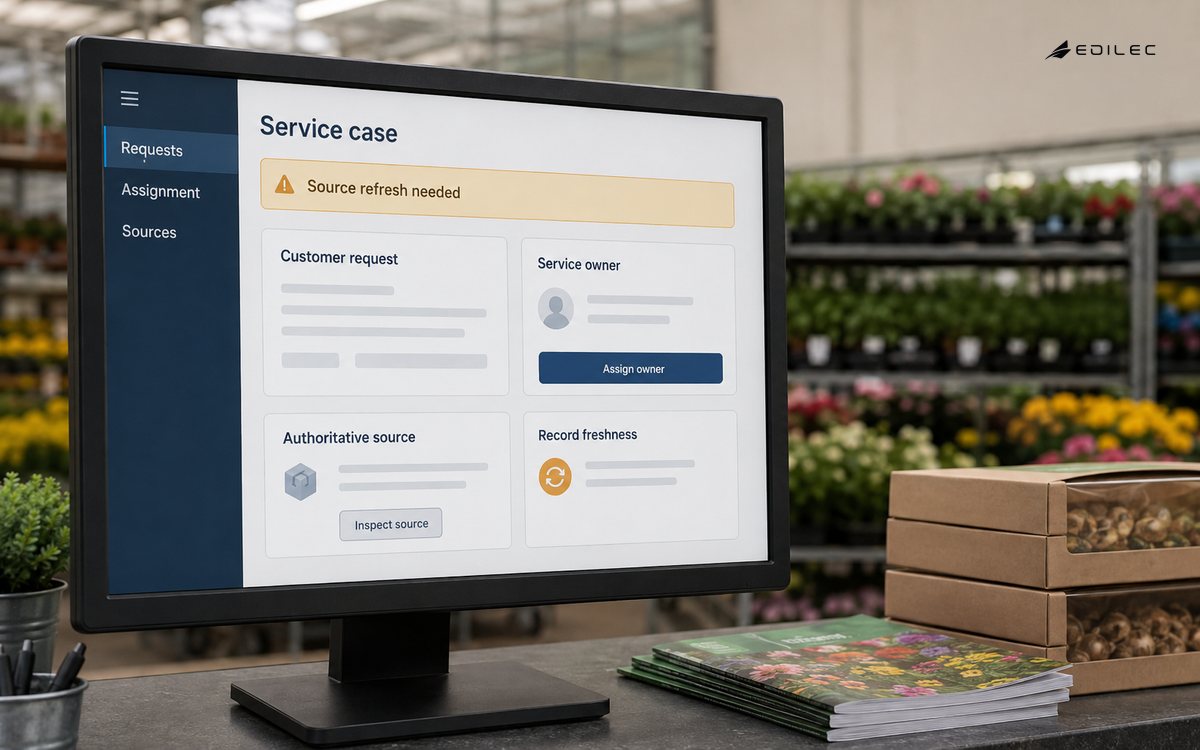
Service Cloud should own the service-work record: the request, conversation context, assignment, milestones, disposition and customer communication. Salesforce Platform can extend that model with custom applications, objects and automation where the business process is genuinely distinctive. It should not automatically become the master for orders, policies, assets or billing merely because agents need to see those facts. Keep authoritative data in its owning system, expose provenance and freshness, and copy only what is needed for continuity, performance or reporting. This boundary reduces reconciliation work and makes a stale integration visibly different from an absent customer record.
Use standard capabilities where their lifecycle and semantics match the service. Customization is justified when it expresses a durable business distinction, not a temporary team preference. Before adding a field, object or flow, identify its owner, retention rule, reporting purpose and behavior when upstream data is unavailable. A custom application also creates testing, documentation and release obligations. If those obligations have no accountable owner, the feature is technical debt at launch. The related AWS platform implementation checklist is useful when Salesforce participates in a wider cloud platform rather than operating as an isolated SaaS estate.
| Capability | Place it in Salesforce when | Keep or govern elsewhere when | Acceptance evidence |
|---|---|---|---|
| Case and interaction | It represents attributable customer-service work and its lifecycle. | A channel platform must preserve raw media or high-volume transcripts. | Replay tests retain source, threading, owner, clock and outcome. |
| Customer profile | Agents need a service view assembled from approved sources. | CRM, identity or master-data services own the golden record. | Every displayed attribute exposes source and freshness. |
| Automation | Logic is transactionally close to the case and maintainable in the chosen tool. | A cross-system process needs durable orchestration and replay. | Failures produce a visible state, owner and recovery action. |
| Knowledge | Content supports agent or customer decisions with review governance. | Regulated policy remains in its controlled publishing repository. | Articles show audience, owner, version and review date. |
| Analytics | Operational measures can be derived reliably from service records. | Enterprise metrics require governed data across multiple domains. | Definitions reconcile to source events and named owners. |
How should cases and Omni-Channel routing be designed?
Define intake separately for email, messaging, telephony, web forms and APIs. Each channel has different identity assurance, retry behavior, attachment risk and outage signals. Preserve the original event and a stable correlation identifier before normalizing common fields. Matching rules should state when an interaction updates an existing case, creates a new case or enters an ambiguity queue. Aggressive matching can expose one person's information to another; conservative handling can be reconciled later. Customer consent and permitted response channels also belong in the intake contract rather than being inferred from how a request arrived.
Omni-Channel routing is capacity and authority management, not just queue assignment. Salesforce documents that routing evaluates queue priority, age, representative availability and capacity in its Omni-Channel queue guidance. Define skills, work-item capacity, priorities, fallback queues and bounded rerouting for each request family. A successful route ends when a qualified person can accept and act, not when an owner field changes. Monitor time to qualified ownership, rejection, transfer and oldest-item age so a configuration defect cannot hide inside an average response time.
How should data and integrations be structured?
Choose an integration pattern from the business timing and recovery requirement. A synchronous request-reply call is appropriate when an entitlement check must succeed before an agent commits an action. Fire-and-forget or event-driven processing is safer when downstream work can complete later and must survive temporary outages. Batch synchronization suits bounded reporting or reference-data needs but requires an explicit freshness expectation. Salesforce's integration patterns guide distinguishes these scenarios and should be used to document why a pattern was selected, not merely which connector product was purchased.
Every interface needs a schema owner, authentication method, least-privileged integration identity, timeout, retry ceiling, idempotency key and reconciliation path. Record whether a remote action is pending, confirmed, rejected or unknown. Do not show a blank order panel as evidence that no order exists when the real condition is a timeout. Bulk behavior matters because backlog replay can exceed Salesforce limits even when one transaction works. For material decisions, retain the automation version, inputs, output and human override so service teams can explain what occurred without reconstructing it from scattered logs.
Which security and compliance controls matter most?
Start with role-to-task mapping and grant record, field and action access through maintainable permission sets and groups. Administrative visibility often masks sharing defects, so test with realistic least-privileged personas, account hierarchies, partner relationships and delegated supervisors. Protect privileged identities with stronger authentication and monitor exports, API use, report subscriptions and permission changes. The NIST Cybersecurity Framework 2.0 provides outcome language for governance, protection, detection, response and recovery that can connect Salesforce controls to enterprise risk ownership.
Classify case messages, transcripts, recordings, attachments and free text before choosing retention. Minimize sensitive data in unstructured fields because discovery, redaction and deletion are difficult there. Define legal hold, regional residency, sandbox masking and breach response. Knowledge and message templates also need version control because inaccurate instructions can be an operational or regulatory incident. Auditability is not unlimited retention: keep enough evidence to establish who accessed or changed a record and why, while applying lawful deletion and minimization rules. Service accounts need named ownership, credential rotation and decommissioning just like human accounts.
How should migration, testing and release work?
Migrate by customer journey and operational slice, not by object count alone. Profile legacy data, agree the system of record, map values semantically and quarantine records that cannot be transformed safely. Reconcile counts, relationships, attachments, ownership and open service clocks. A technically successful import can still fail if active complaints lose conversation history or queue responsibility. Rehearse cutover with realistic volume, freeze rules and rollback criteria. Some changes, such as outbound messages or transformed records, require forward correction rather than a simple deployment rollback, so the cutover plan must name both paths.
End-to-end tests should cover uncertain identity, duplicate contacts, malformed attachments, entitlement changes, queue saturation, agent absence, integration latency, partial remote success, transfer, escalation, closure and reopening. Verify the customer's message, the agent's view, the supervisor's signals and the retained audit trail. Include accessibility and keyboard operation in high-frequency console tasks. Release first to a bounded queue with production support present, compare outcomes against a baseline and expand only when routing, data quality, error recovery and service measures are stable. Training completion alone is not proof that the operating path works.
| Decision area | Question for the design review | Operational measure | Failure response |
|---|---|---|---|
| Intake | Can every event be attributed, deduplicated and replayed? | Duplicate rate and failed-ingestion age | Hold originals in controlled triage and replay by identifier. |
| Routing | Can qualified capacity absorb priority demand? | Time to qualified owner and transfer rate | Use an owned fallback queue without resetting clocks. |
| Integration | Can agents distinguish no data from unavailable data? | Timeouts, unknown outcomes and reconciliation lag | Expose status, stop unsafe action and reconcile. |
| Release | Can the team restore service after a bad configuration? | Change failure and recovery time | Disable the affected automation and use a tested manual path. |
| Outcome | Does closure represent a customer result? | Reopen, repeat contact and unresolved exceptions | Review disposition quality and correct the service design. |
What operating model keeps the service healthy?
Assign a product owner for the customer-service capability, a platform owner for Salesforce health, and named owners for data, security, integrations and service operations. Their review should combine backlog aging, breached milestones, routing failures, integration errors, knowledge gaps, customer repeat contact and change health. Separate demand surges from process defects: a product incident generating thousands of cases needs upstream correction, not permanent queue capacity. Maintain exercised runbooks for channel outage, permission failure, integration degradation, large-scale misrouting and Salesforce service disruption.
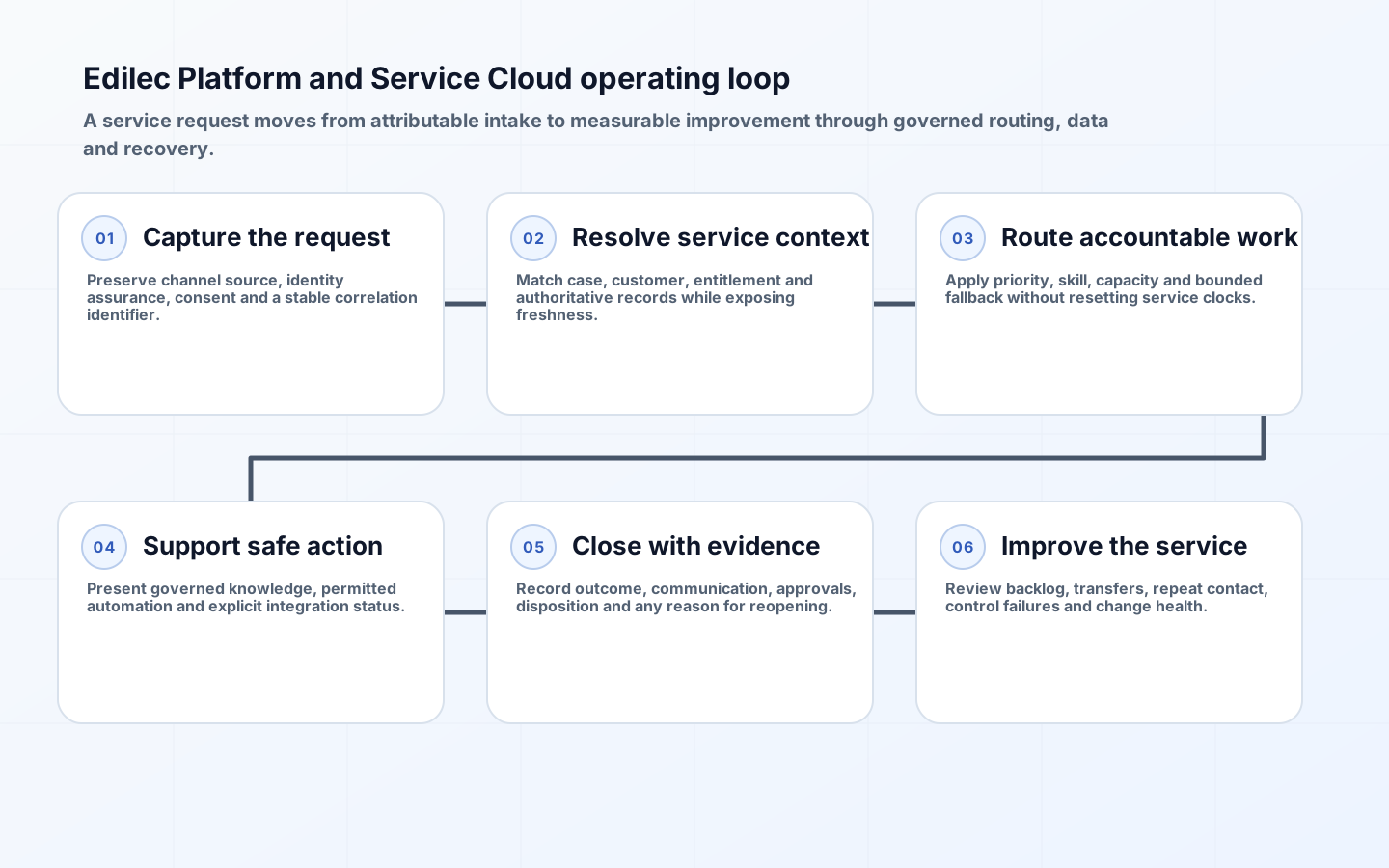
Measure user-visible results as well as platform availability. Useful indicators include time to qualified ownership, customer waiting time excluding agreed pauses, first-contact resolution by request family, transfer rate, repeat contact, reopen rate and unresolved high-impact exceptions. Segment results by channel, language, region and accessibility need where lawful and meaningful. Track change lead time, failure rate and recovery alongside service outcomes so fast platform delivery does not quietly degrade customer work. The purpose of the operating model is to create evidence for decisions: what to improve, what to stop and where control or capacity is insufficient.
Platform and Service Cloud takeaways
- Put service work and its outcome in Salesforce while preserving authoritative ownership of customer, order and policy data.
- Design each channel's identity, retry, consent and failure behavior before normalizing intake.
- Treat Omni-Channel as a capacity-and-authority system with visible fallback and transfer controls.
- Select integration patterns by timing, ownership and recovery, then expose uncertain states to agents.
- Test complete customer journeys with least-privileged users, realistic volume and production failure scenarios.
- Operate Service Cloud as a product measured by customer outcomes and change health.
Frequently asked questions
Is Service Cloud a separate platform from Salesforce Platform? Service Cloud is a customer-service product built on Salesforce Platform. The distinction matters commercially and functionally, but architecture should focus on licensed capabilities, standard service objects and the custom platform extensions the organization will own. Validate current editions and entitlements with Salesforce rather than assuming a feature shown in a demo is included.
Should every customer interaction create a case? No. The organization should define which interactions create attributable work, which update existing work and which remain informational. The rule must preserve the original event, handle ambiguity safely and support channel-specific consent, identity and retention requirements.
When is custom Apex preferable to Flow? Use the simplest maintainable mechanism that satisfies transaction, volume, observability and testing requirements. Apex is appropriate when logic or scale cannot be handled safely in Flow, but it introduces code ownership and release obligations. The design record should explain the boundary and the recovery behavior.
Conclusion
A sound Salesforce Platform and Service Cloud implementation makes customer work attributable from contact to outcome. Its value comes from a controlled case boundary, capacity-aware routing, governed data, recoverable integration, least privilege and visible service ownership. Teams that answer these questions with testable evidence can use Salesforce flexibility without turning flexibility into ambiguity, and can evolve the service as customer channels, policies and demand change.