A Service Cloud design FAQ should answer how customer contact becomes accountable work, not merely which Salesforce features are available. Good design preserves the original interaction, resolves identity and entitlement, routes the request to qualified capacity, supports an agent with current evidence and records a defensible outcome. The difficult questions involve ambiguity: duplicate messages, shared accounts, sensitive attachments, unavailable integrations, overloaded queues and work crossing organizational boundaries. Architecture must make those conditions visible and recoverable while keeping the high-frequency agent journey efficient.
Salesforce describes healthy Customer 360 solutions as trusted, easy and adaptable in its Well-Architected framework. Those qualities require business and platform decisions together. This FAQ is written for service leaders, product owners, architects, administrators, integration teams, security teams and operations. It complements the Service Cloud scope, cost and delivery plan and the implementation checklist, which carry these answers into project evidence.
How should the Service Cloud case model be designed?
Model a case around one service outcome and accountable lifecycle. Define the event that creates work, request families, status meaning, completion evidence, reopen rules and exceptions. Do not use status values as a loose activity log. Separate waiting for the customer, waiting for another team and active agent work so service clocks and bottlenecks remain interpretable. Record channel, original event, contact confidence, account, asset, order, entitlement and reason, but avoid copying entire source systems into the case. Each copied attribute needs provenance and freshness.
Use record types and specialized fields where processes genuinely differ in identity, authority, milestones or retention. Too many types fragment reporting and automation; one universal process hides important controls. Define deterministic matching for follow-up messages and stable external identifiers for retrying channels. Preserve uncertain matches instead of merging aggressively. Parent-child or related-case patterns can represent one incident affecting many customers, but each customer's communication, entitlement and private details must remain controlled. Test closure and reopening because those transitions often distort resolution measures.
| Case decision | Design question | Acceptance evidence |
|---|---|---|
| Case boundary | When does contact create, update or relate to existing work? | Replay tests for new, duplicate and ambiguous interactions |
| Identity | What may an agent see or do before verification? | Channel-specific least-privilege scenarios |
| Lifecycle | What does each status mean and who owns waiting time? | State-transition rules and reporting reconciliation |
| Completion | Which outcome, notice and evidence close the request? | Closed-case samples with accountable owner |
| Reopening | When is a new issue distinct from failed resolution? | Rules that preserve customer history and metrics |
How should Omni-Channel routing and capacity work?
Routing should express ownership, qualification, priority and capacity. Start with request families and the authority needed to resolve them. Define queues as accountable work pools, skills as maintained qualifications and capacity as realistic concurrent cognitive load. A complex investigation should cost more capacity than a simple status request. Specify what happens when no qualified agent is available, an agent rejects work, a queue is closed or a skill is misconfigured. Salesforce messaging configuration supports an explicit fallback queue in Omni-Channel routing setup; every channel needs similarly visible failure behavior.

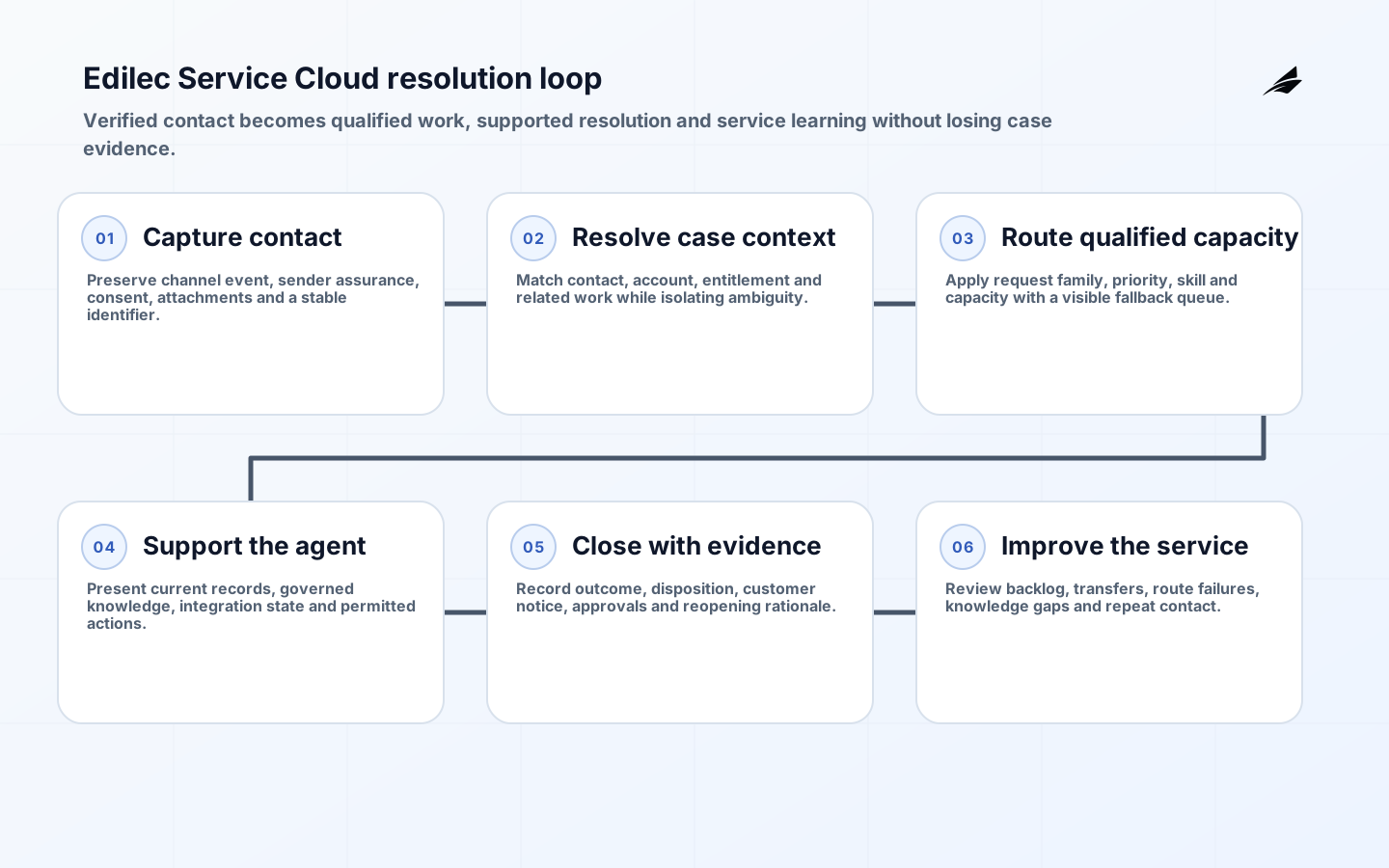
Measure time to qualified ownership separately from time to first automated acknowledgement. Preserve priority and service clocks through transfers. Supervisors need controlled ways to rebalance work, assist an agent and escalate an urgent case without destroying ownership history. Set bounded rerouting to prevent work from cycling. The six-stage Edilec Service Cloud resolution loop at this heading follows verified intake through capacity-aware routing, agent support, controlled resolution and operational learning. Its purpose is to make the complete service path reviewable, including fallback rather than only the happy route.
Where should customer data and knowledge live?
Keep authoritative customer, contract, order, billing and asset records in their owning systems unless there is a deliberate master-data decision. Service Cloud can cache the fields agents need for responsiveness and continuity, but label source and freshness. Decide how identity and account hierarchies are resolved and how restricted relationships affect sharing. Minimize sensitive free text; structured dispositions and protected note areas are easier to govern. Attachments, transcripts and recordings need classification, scanning, access, retention and deletion rules distinct from ordinary case metadata.
Treat knowledge as an operational product. Every article needs an owner, audience, applicability, effective date, review date and retirement path. Separate customer-facing instructions from internal diagnostics. Search analytics can reveal vocabulary gaps, while case outcomes reveal whether an article actually resolves work. Macros, flows and AI assistance should reference governed content and show agents the relevant evidence. When policy changes, identify affected active cases and templates. Do not assume publication approval makes content permanently correct.
What integration and automation patterns are appropriate?
Choose integration by timing, ownership and recovery. Use synchronous calls only when the agent or workflow cannot proceed without a current answer and the dependency can meet the required latency. Use asynchronous messaging for durable updates that can complete later. Define schemas, correlation identifiers, timeouts, idempotency, retry limits and dead-letter ownership. Salesforce's integration patterns guidance provides a vocabulary for remote process invocation, data synchronization and event-driven needs. The business design must still state what an agent sees when the dependency is stale or unavailable.
Use Flow, Apex and external orchestration according to complexity, scale, transaction boundaries and maintainability. Version material decision logic and capture which version produced an action or message. Bulk-test automation for imports and backlog replays. Make irreversible actions explicit, authorized and idempotent. If automation partially succeeds, preserve what changed and route recovery to a named owner. Customer communications should retain the template version and actual content sent. A blank integration panel must never imply that an order or entitlement does not exist when the lookup failed.
| Integration condition | Preferred behavior | Agent-facing state |
|---|---|---|
| Current answer required | Bounded synchronous call with timeout and correlation | Available, unavailable or stale, never ambiguous blank |
| Update can complete later | Durable event or queue with idempotent consumer | Pending state and expected follow-up |
| Upstream retry | Deduplicate on stable event identifier | One case with preserved source attempts |
| Partial transaction | Compensate or route reconciliation with exact completed steps | Named exception and accountable owner |
| Extended outage | Controlled intake buffer and tested replay | Honest continuity message and queue visibility |
How should security, privacy and compliance be applied?
Map each persona to required records, fields and actions. Use permission sets and groups with reviewable ownership instead of accumulating broad access in profiles. Test sharing as real agents, partners and supervisors; administrator testing hides boundary defects. Strengthen privileged access, monitor exports and API identities, and separate emergency administration. The Salesforce Security Guide documents platform mechanisms, while the organization's policy determines lawful purpose, segregation and approval.
Define retention and redaction for messages, recordings, transcripts, attachments, audit history and integrated copies. Consent to one contact channel does not automatically authorize another use. Mask production data in nonproduction environments and restrict diagnostic logs. Create incident procedures for misdirected communication, exposed attachments, unauthorized case views and compromised integration identities. Align enterprise outcomes with the NIST Cybersecurity Framework, then test Service Cloud-specific paths through prevention, detection, response and recovery. Privacy deletion must be reconciled with legal hold and mandatory service records.
How should migration, release and ongoing operations be managed?
Migrate only data needed for service, law or reliable reporting. Profile quality before mapping, preserve source identifiers and reconcile counts plus business totals. Open cases need special handling because ownership, conversations, milestones and pending actions must remain coherent at cutover. Rehearse channel switching, backlog import and rollback or forward correction. Pilot with a representative queue and compare transfer rate, reopen rate, time to qualified ownership, case age and customer outcome. Training completion is not production acceptance; operators and agents must demonstrate real scenarios.
Operate Service Cloud with product ownership. Review queue health, route failures, integration exceptions, knowledge gaps, automation errors, security findings, releases and customer outcomes together. Assign runbooks for channel outage, platform degradation, bulk misrouting, permission error and downstream failure. Measure by request family and customer segment so averages do not hide poor service. Schedule capacity and license review, archive obsolete configuration and keep sandboxes representative without uncontrolled data. Each improvement should link an observed problem to a change and a later effectiveness check.
Service Cloud design takeaways
- Define the case boundary, outcome, identity and exception lifecycle before configuring Salesforce.
- Route by accountable ownership, qualification, priority and realistic capacity with explicit fallback.
- Keep authoritative business data in owning systems and expose provenance and freshness to agents.
- Select integrations by timing and recovery, and make unavailable or stale states unmistakable.
- Apply least privilege, retention and incident controls to the complete agent and customer journey.
- Accept and operate Service Cloud using real scenarios and customer-outcome measures.
Frequently asked questions
Should every customer interaction create a case? No. Create accountable work when the interaction requires service handling, evidence or follow-up. Informational events can remain interaction records, while related messages may update an existing case. Define this by channel and request family.
Is a single global Service Cloud org always best? No. A single org can simplify identity and reporting, but legal boundaries, mergers, scale, operating independence or release conflicts may justify separation. Compare data, integration, governance and support consequences rather than applying a universal rule.
When should Service Cloud use custom code? Use it when transaction, scale, integration or maintainability needs cannot be met safely with declarative tools. Custom code requires versioning, tests, security review, observability and an owner; declarative automation needs equivalent lifecycle discipline.
Conclusion
Strong Service Cloud design makes customer work attributable from contact to outcome. Cases represent a clear service boundary, routing expresses capacity and authority, integrations fail honestly, data remains governed and operations learn from real results. Answering these architecture questions before build reduces configuration churn and gives service leaders a platform they can measure, control and adapt as channels, products and customer expectations change.