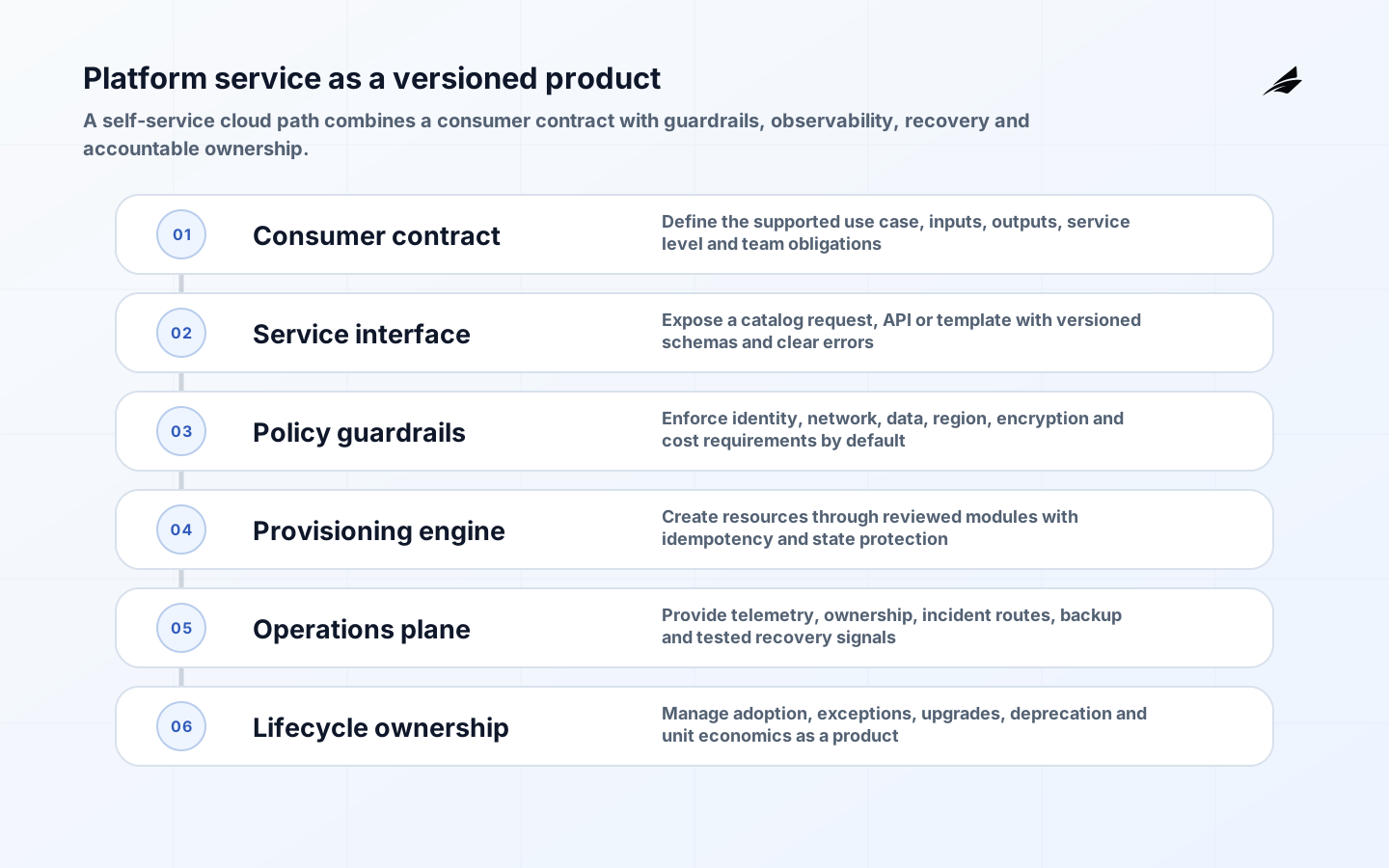
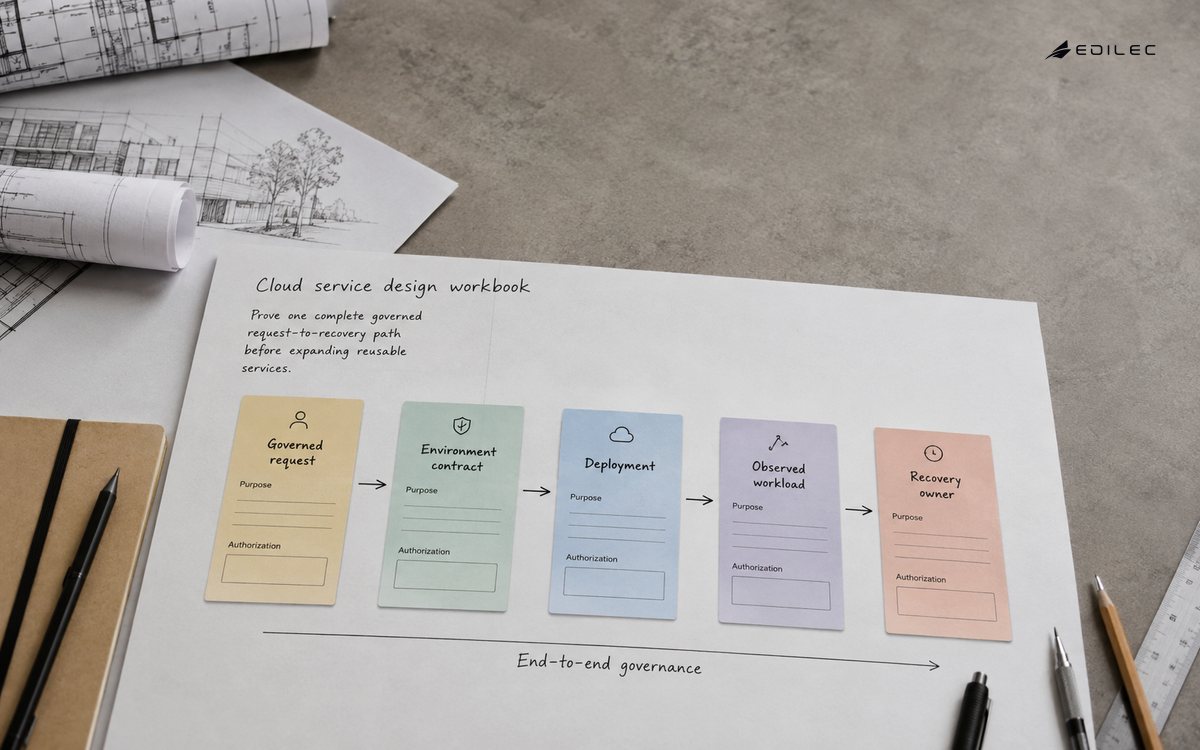
Platform Service Cloud design needs an exact operating definition before a team selects tools or promises outcomes. Start with one complete paved path from a governed environment request to observable workload recovery, and use it to define reusable environment and deployment products. Use the Cloud Platform Service Design Implementation Checklist: Contracts, Guardrails and Operations to define contracts, guardrails, and operations. Evaluate evidence, architecture, delivery, controls, measurement, cost, and ownership before scaling the platform.
Set the exact scope and decision boundary
Begin with one complete paved path from governed environment request to observable workload recovery. Observe representative normal, ambiguous and failed cases. Record who initiates work, which source owns each fact, who may approve the outcome and what makes an action hard to reverse. In a platform team designing reusable environment and deployment products, scope is complete only when operators can state what remains outside the service and how that work proceeds. Write acceptance criteria for evidence, response, escalation and recovery. This prevents a broad label such as cloud platform service design from hiding several different products with incompatible authority and risk.
Map the people affected by the decision and invite review from those who operate, govern or experience it. Separate facts from assumptions, and give every unresolved assumption a test. If the service touches regulated records, money, access, safety, employment or public claims, involve the relevant domain and governance owners before design. The first release should demonstrate one complete path from intake to retained evidence. Automating isolated steps can make a local metric look better while increasing reconciliation and uncertainty elsewhere. In cloud platform service design, the evidence remains tied to this article’s named workflow and accountable owner.
Build architecture around authority and ownership
The operating architecture spans account and identity control plane, versioned environment and deployment contracts, shared network, artifact and telemetry services, workload ownership, exceptions and platform support. Each layer needs a named owner, versioned contract, least-privilege access and observable failure behavior. Keep recommendation separate from authoritative state change. Validate current identity, policy and record version before any consequential action. Preserve enough source context for a reviewer to understand the result without exposing unrelated sensitive data. A dependency outage should create a visible, recoverable queue rather than silent loss or repeated side effects.
| Architecture area | Required decision | Release evidence |
|---|---|---|
| account and identity control plane | For this design choice, name the accountable owner, supporting evidence, exception route, and next measurable check. | Approved owner and data-flow |
| versioned environment and deployment contracts | Within this design choice, name the accountable owner, supporting evidence, exception route, and next measurable check. | Authorization and negative tests |
| shared network, artifact and telemetry services | When implementing this design choice, name the accountable owner, supporting evidence, exception route, and next measurable check. | Versioned interface and retry contract |
| workload ownership, exceptions and platform support | Before releasing this design choice, name the accountable owner, supporting evidence, exception route, and next measurable check. | Dashboard, alert and recovery procedure |
Deliver through six evidence-bearing stages
Delivery should retire uncertainty in a deliberate order. Start with the riskiest evidence and permission questions, not the most impressive interface. Make every stage produce an artifact that another person can inspect and a decision to continue, revise or stop. Pilot with representative exceptions, preserve the current operating route and set volume or authority limits. Expansion should follow demonstrated quality, safe recovery and sustainable review workload rather than a launch date or adoption target. In cloud platform service design, the evidence remains tied to this article’s named workflow and accountable owner.
- Map recurring developer journeys and current delivery friction.
- Define control-plane, workload and ownership boundaries.
- Publish one versioned environment and deployment contract.
- Onboard representative teams through documented self-service.
- Exercise quota, dependency, rollback and recovery scenarios.
- Expand the catalogue from measured demand and support evidence.
Design controls for realistic failure modes
Controls must match consequence and reversibility. Suggestions can usually tolerate experimentation that state-changing tools cannot. Apply deterministic policy around probabilistic components, constrain service identities and record the model, rule, source and human decision used. Test stale data, missing owners, contradictory evidence and dependency failure. A manual fallback counts only when ordinary operators can use it under pressure. The table focuses review on failures specific to platform service cloud design, rather than a generic security checklist.
| Failure mode | Control response | Signal to review |
|---|---|---|
| Portal without product contracts | Define APIs, lifecycle, support and error behavior behind the interface. | Manual steps per provisioned environment |
| Shared dependency blast radius | Set objectives, isolation and recovery for central services. | Platform-caused workload incidents |
| Forced platform mismatch | Maintain a governed escape route and review repeated exceptions. | Shadow delivery paths |
| Unallocated platform cost | Separate shared foundations, labor and workload consumption. | Unowned or unexplained spend |
Measure outcomes and full operating cost
Track lead time to a usable environment; successful deployments and rollback; platform-caused incidents and restoration; developer adoption, support load and exceptions. Establish a baseline before the pilot and review distributions, not only averages. Sample accepted, corrected, escalated and failed cases so teams can identify whether the cause was source evidence, policy, interface behavior, reviewer capacity or downstream execution. Pair speed and adoption with quality, harm, support effort and recovery. A favorable metric is not a benefit if work or risk has merely moved to another team or stakeholder.
Separate landing-zone foundations, platform product engineering, shared-service consumption, support and workload migration. Forecast adoption, logging and security volume; compare the platform with duplicated team-owned foundations rather than a zero-cost alternative. Keep one-time discovery and integration distinct from recurring operation. A commercial proposal should state data rights, source and configuration access, incident support, subcontractors, export and transition assistance. Review the model after representative usage, because pilot volume rarely predicts exception handling, telemetry retention or support load at scale.
Rehearse operation before expanding authority
Run one normal case and then interrupt it with the first two failure modes in the table. Ask an operator who did not build the service to locate the evidence, identify the accountable owner, choose a safe fallback and resume without duplication. Revoke a service identity and verify that no hidden credential remains. Then restore the affected state from the documented record. For platform service cloud design, this rehearsal tests whether the system is understandable and recoverable, not merely whether its preferred path can complete in a demonstration.
The release packet should include the approved scope, ownership map, data and authority model, interface versions, evaluation sample, control tests, support route, cost baseline and rollback procedure. Temporary exceptions need an owner and expiry. Handover is complete when internal teams can operate, investigate and change the service using editable artifacts. Questions raised during the exercise become backlog items, and high-consequence ambiguity must be resolved before increasing volume, autonomy or stakeholder exposure. In cloud platform service design, the evidence remains tied to this article’s named workflow and accountable owner.
Rehearse a representative operating scenario
The operating rehearsal for platform service cloud design should follow one representative case across account and identity control plane and versioned environment and deployment contracts. Stop after every transition and ask which record is authoritative, which identity is acting, whether the rule is current and whether retrying can create a duplicate result. Introduce missing evidence and a delayed dependency. The operator must be able to identify the owner, explain why the case paused and continue through a documented fallback without private coaching.
Next, simulate portal without product contracts and shared dependency blast radius. Verify that monitoring exposes the problem before users discover it indirectly, that the retained evidence supports diagnosis and that containment does not broaden permissions or damage unrelated work. Record elapsed time, manual steps and unresolved ambiguity. Add the scenario to regression evidence so the next release is tested against the exact failure rather than a simplified happy path.
The acceptance packet for Platform Service Cloud Design: Scope, Cost, Risks and Delivery Plan should contain the approved boundary, ownership map, source and interface versions, permission tests, evaluation sample, support route, cost baseline and recovery procedure. Give those artifacts to someone who did not build the service. Their ability to operate a normal case, diagnose a stale input and choose a safe fallback demonstrates that the service is transferable. Temporary exceptions require an owner, compensating control and expiry before authority or volume increases.
Key takeaways
- Name one decision, outcome and accountable owner.
- Preserve authoritative source evidence and explicit permission boundaries.
- Pilot with realistic exceptions and a usable fallback.
- Measure correction, risk and human workload with speed and cost.
- Expand only when the service is observable, supportable and recoverable.
Frequently asked questions
- What should discovery produce? A bounded service definition, authority map, representative cases, risk register, architecture options, evaluation plan, cost range and explicit exclusions.
- How long should a pilot run? Long enough to include ordinary work, realistic exceptions and a controlled recovery exercise. Evidence coverage matters more than a universal number of weeks.
- Can a vendor own the outcome? A vendor can deliver and operate agreed components, but the organization retains accountability for policy, data use, affected people and business decisions.
- What is the safest first release? A read-only or recommendation capability with inspectable evidence is often safer than immediate state-changing automation, provided it addresses a useful decision.
- How is success demonstrated? Compare the baseline with completed outcomes, correction, exceptions, failures, operating cost and stakeholder impact, then review representative cases behind the aggregate.
Conclusion
Platform Service Cloud Design: Scope, Cost, Risks and Delivery Plan should leave an organization with a service it can explain, operate and improve. The essential work is to narrow the decision, preserve evidence, separate recommendation from authority and test recovery before scale. Cost and value must include integration, review and long-term ownership. When those conditions are met, the service can remove avoidable work or improve judgment without hiding responsibility inside a platform, provider or polished interface.