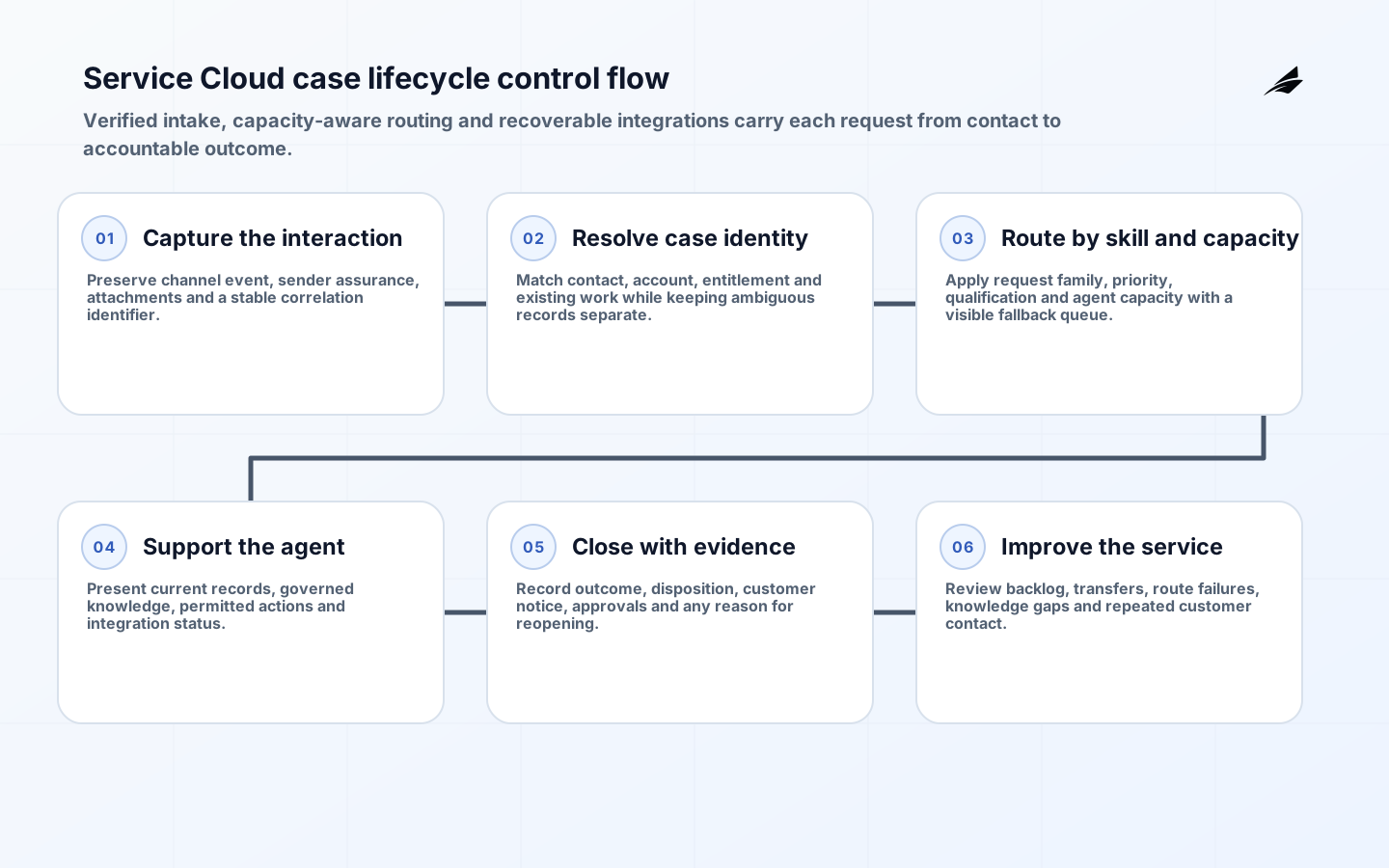
A service cloud design implementation checklist should start with the customer-service outcome, not a list of Salesforce objects or setup screens. A reliable design turns an email, call, chat session, web form or API request into one attributable case; routes that work to a qualified person; preserves the evidence behind decisions; and closes the loop with the customer. The difficult work sits between those moments: duplicate intake, uncertain identity, entitlement checks, queue congestion, integration failures, sensitive attachments and work that crosses teams. Treating those conditions as design inputs produces a service operation that remains understandable after launch.
This checklist focuses on a Salesforce Service Cloud implementation, including case management, Omni-Channel routing, knowledge, automation and connected systems. It complements the service cloud design scope and delivery plan and the service cloud design FAQ. The objective is an acceptance record that business owners, administrators, integration engineers, security teams and support leaders can use together.
Define the service outcome and case boundary
Write one service statement for each material request family. State who asks for help, the event that creates work, the evidence an agent needs, the decision or action the service may perform and the recorded state that means the request is complete. A password-reset enquiry, product return and regulated complaint should not share a vague lifecycle simply because each is represented by a Case record. Their identity checks, response clocks, approvals and retention obligations differ. These distinctions determine record types, queues, skills, milestones and escalation paths.
Decide how related contacts, accounts, assets, orders and entitlements are resolved. Document what happens when identity is unknown, two contacts share an address, an account hierarchy changes, or an inbound message refers to an existing case. The matching rule must favor explainable handling over aggressive merging. A duplicate can be reconciled; an incorrectly merged complaint can expose private information and damage the audit trail. Record the source channel, original message, correlation identifiers and every material status transition.
| Design decision | Question to settle | Acceptance evidence |
|---|---|---|
| Case boundary | When should a new interaction update an existing case rather than create another? | Replay tests show deterministic matching, safe ambiguity handling and preserved originals. |
| Completion | Which business result closes the case, and who may reopen it? | Closed records contain outcome, disposition, customer notice and accountable owner. |
| Identity | What proof is required before showing data or performing an action? | Channel-specific tests demonstrate verification and restricted pre-verification views. |
| Entitlement | Which service level, product or contract applies? | Milestones and routing use the current authoritative entitlement record. |
| Exception | Which condition leaves normal processing? | Exception queues expose reason, owner, due time and recovery action. |
Design channel intake as a controlled record
Map email-to-case, web-to-case, messaging, telephony and API intake separately. Each channel has different sender assurance, payload limits, attachment risks, threading behavior and failure signals. Normalize common fields only after preserving the original event. Validate required values, sanitize rich content, scan attachments and assign an ingestion status before routing. If an upstream channel retries, use its stable event identifier to prevent duplicate cases. If Salesforce is unavailable, the channel needs a durable holding path and an explicit replay procedure.
Consent and customer preference belong in the intake contract. An agent should be able to see whether a response may use email, messaging or telephone and whether a verified channel is required for sensitive details. Do not infer consent from the channel that happened to create the case. For integrations, record the system that supplied each customer or order attribute, its effective time and the last successful synchronization. That provenance lets an agent distinguish current evidence from a stale copy.
Build Omni-Channel routing around capacity and authority
Omni-Channel can route work by queue, skill, priority and agent capacity, but configuration cannot compensate for an undefined operating model. Define which request families each team owns, the skills that qualify an agent, the capacity cost of different work items and the rule for interrupting lower-priority work. A complex investigation should consume more capacity than a simple status enquiry. Supervisors also need a visible method to rebalance work without bypassing ownership or silently resetting service clocks.

Model absence, after-hours coverage, transfers and rejected work. A route is successful only when a qualified agent accepts the item and has the records and permissions required to act. Track queue age separately from active handling time. Set bounded reroute behavior so a misconfigured skill does not bounce a case indefinitely. Escalation should create a named action with context, not merely raise a priority value. This is also where the implementation should distinguish supervisory assistance from transfer of case accountability.
| Routing condition | Required behavior | Operational signal |
|---|---|---|
| No qualified agent | Hold in a visible fallback queue and notify the queue owner. | Oldest item age and count by missing skill. |
| Agent at capacity | Preserve priority and wait without repeated reassignment. | Capacity utilization and assignment rejection rate. |
| Transfer between teams | Carry conversation, evidence, service clock and ownership reason. | Transfer count, transfer latency and return rate. |
| Urgent safety or fraud issue | Use a dedicated escalation path with stronger authority. | Acknowledgement time and unresolved urgent items. |
| Routing configuration failure | Stop unsafe automation and move work to controlled triage. | Fallback volume and rule-evaluation errors. |
Control case data, knowledge and agent guidance
Keep the case record focused on service work while authoritative customer, order, asset and billing data remain in their owning systems. Replicate only what agents need for latency, continuity or reporting, and label copied fields with freshness. Avoid creating parallel customer truth inside Salesforce because reconciliation becomes a permanent operating burden. Field-level security, sharing rules and restriction rules should reflect the sensitivity of the data, not just the convenience of a team hierarchy. Sensitive notes and attachments need narrower access than ordinary case metadata.
Knowledge articles should be governed as operational instructions. Assign an owner, review date, audience and product or policy applicability. Separate public answers from internal diagnostic procedures. When a policy changes, identify affected articles and active cases rather than relying on agents to notice. Search analytics can reveal missing vocabulary, but publication still requires subject-matter review. Agent prompts, macros and flows should reference controlled content and should not conceal irreversible actions behind a single convenience button.
Engineer integrations and automation for failure
Choose an integration pattern according to timing, ownership and recovery. A synchronous API may be appropriate for an entitlement check that must complete before an agent acts; an event or queue is safer for updates that can be processed asynchronously. Define schemas, timeouts, retry limits, idempotency keys and dead-letter handling. Display integration state to agents in plain language. A blank order panel must not look like proof that no order exists when the actual cause is a timeout.
Use Flow, Apex and external services with clear boundaries. Put deterministic policy checks in versioned logic, keep credentials outside automation definitions and use named integration identities with least privilege. Bulk behavior matters because a rule that works for one case can exceed limits during a backlog replay. Capture automation version and decision outcome on material actions. For customer-facing messages, retain the template version and actual content sent so disputes can be reconstructed.
Apply security and privacy controls to the agent journey
Map each role to the records, fields and actions required for its tasks. Avoid broad profiles that accumulate permissions as teams change. Use permission sets and groups with an approval and review process, strengthen authentication for privileged roles, and monitor exports, report subscriptions and API access. Test sharing with realistic account hierarchies and partner relationships; administrative visibility can hide defects that ordinary agents will encounter. Service accounts require lifecycle ownership, rotation and alerting just like human identities.
Define retention, deletion, legal hold and redaction for case messages, transcripts, recordings and attachments. Minimize sensitive data in free-text fields because it is difficult to classify and govern. Sandbox copies need masking and controlled access. Establish an incident path for an incorrectly addressed message, exposed attachment or unauthorized case view. The security design should preserve enough audit history to explain who saw or changed a record while honoring lawful deletion and minimization requirements.
Test end-to-end service scenarios before release
Build tests around customer journeys rather than isolated configuration components. Include new and returning customers, uncertain identity, duplicate messages, attachments, entitlement changes, queue saturation, agent absence, integration timeouts, partial updates, transfer, escalation, closure and reopening. Test with least-privileged personas and realistic data volume. Verify what the customer receives, what the agent sees, what supervisors can measure and what remains in the audit trail. Accessibility and keyboard operation belong in acceptance testing for every high-frequency console workflow.
Release configuration through controlled environments with source tracking, peer review and a deployment record. Rehearse rollback for automation and routing changes, but recognize that data migrations or outbound messages may require forward correction rather than simple rollback. Use a pilot queue and compare handling time, transfer rate, backlog, reopen rate and customer outcomes against the baseline. Do not expand because users completed training; expand when service evidence shows that the new operating path is stable.
Operate Service Cloud as a customer service product
Assign product ownership for the service operation, not only platform administration. Weekly review should combine backlog aging, breached milestones, route failures, integration errors, knowledge gaps, reopen reasons and agent feedback. Separate demand growth from process defects. If one product release generates a surge, the remedy may be product correction rather than more agent capacity. Maintain runbooks for channel outage, Salesforce degradation, integration failure, permission error and large-scale misrouting, and exercise them with the people who will respond.
Measure customer result alongside platform health. Availability is necessary, but a healthy API does not prove that cases reach the right team or that customers receive accurate answers. Useful service indicators include time to qualified ownership, time waiting for customer input, first-contact resolution by request family, transfer rate, repeat contact and unresolved high-impact exceptions. Review metrics by segment carefully so aggregate improvement does not hide failure for a language, region or accessibility need.
Service cloud implementation takeaways
- Define case outcomes, identity requirements and exception ownership before configuring objects or flows.
- Preserve original channel events and use stable identifiers to prevent duplicate work.
- Treat routing as capacity and authority management, with explicit fallback and escalation behavior.
- Keep authoritative business records in their owning systems and expose freshness to agents.
- Test failure, least privilege, accessibility and recovery through complete customer journeys.
- Operate the platform with customer-outcome measures as well as technical telemetry.
Frequently asked questions
How detailed should a Service Cloud implementation checklist be? It should be detailed enough to produce testable evidence for each request family, channel, role, integration and failure path. A checklist that says only “configure routing” or “enable knowledge” cannot support acceptance because it does not define expected behavior.
Should every channel create the same case process? Shared lifecycle states can help reporting, but channel-specific identity, threading, consent, attachment and outage behavior must remain explicit. Normalize only where the business meaning is genuinely the same.
When should a team use custom Apex instead of Flow? Use the simplest maintainable mechanism that meets volume, transaction, testing and observability requirements. Custom code is justified when the logic, scale or integration behavior cannot be expressed safely in Flow, but it also carries a stronger testing and ownership obligation.
Conclusion
A successful Salesforce Service Cloud implementation makes customer work attributable from intake to outcome. The durable design is not a collection of features; it is a controlled case lifecycle with verified identity, explainable routing, governed data, recoverable integrations, safe automation and visible operational ownership. Completing this checklist with real scenarios gives the delivery team a release test and gives service leaders an operating model they can continue to improve.