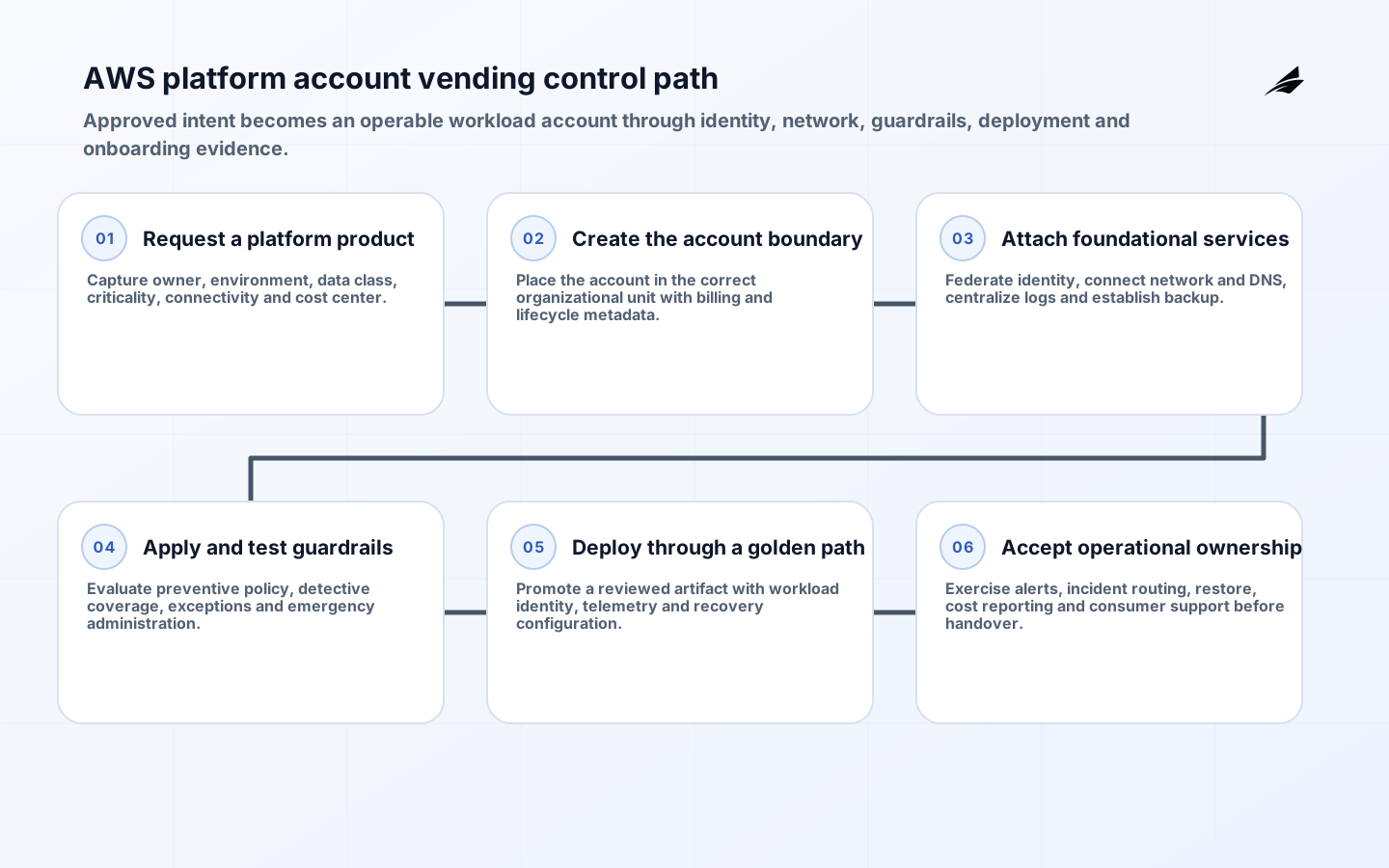
An AWS platform service implementation checklist should produce a secure, repeatable way for teams to obtain accounts, deploy approved infrastructure and operate workloads without rebuilding cloud foundations for every project. The platform is not merely AWS Control Tower or a Terraform repository. It combines a multi-account operating model, identity, network and DNS, preventive and detective controls, observability, cost attribution, reusable products and a team responsible for their lifecycle. Its quality is measured by safe developer outcomes and recoverable operations.
This guide interprets “AWS platform service cloud” as an internal platform built on AWS. It complements the AWS platform service scope and delivery plan and AWS platform service FAQ. Use the checklist to create a foundation backlog, product acceptance tests and operating agreements before onboarding production workloads.
Define platform customers and measurable outcomes
Identify the product teams, data teams, regulated workloads and shared-service operators the platform serves. Interview them about account lead time, deployment friction, audit evidence, connectivity and incident handoffs. Define outcomes such as a production-ready account within one business day, a tested deployment path, complete cost allocation and a known recovery owner. Avoid adoption counts without quality: many accounts can be created while teams still bypass the platform because approved paths do not meet their needs.
Publish a service catalog that distinguishes supported products, preview capabilities and one-off consulting. For each product, name the owner, consumer, interface, service objective, support hours, security baseline, cost model and deprecation policy. Establish an exception process with expiry and remediation ownership. A platform that promises every AWS service immediately will either create unmanaged risk or become a slow approval queue.
| Platform product | Consumer promise | Acceptance evidence |
|---|---|---|
| Workload account | Isolated account with identity, logging, budget and baseline controls. | Automated conformance test passes before handover. |
| Network attachment | Approved connectivity, DNS and egress pattern for the workload class. | Route, resolution, segmentation and failure tests pass. |
| Deployment path | Reviewed pipeline with artifact provenance and environment promotion. | Sample service reaches production and rolls back under test. |
| Data service | Encryption, backup, retention and observability defaults. | Restore and access-control evidence is recorded. |
| Operational onboarding | Alerts, ownership, runbooks and incident routing are active. | Synthetic fault reaches the accountable team. |
Design the multi-account and organizational-unit model
Use AWS accounts as isolation, billing and policy boundaries. Define organizational units according to control requirements and lifecycle, not the current reporting chart. Separate security, logging, network and platform tooling from workload accounts. Distinguish production from development where blast radius and access differ. Reserve an approach for acquisitions, sandboxes, suspended accounts and regulated workloads. Document who may move accounts and how service control policies change during that move.
Start with a small foundational structure and version its rationale. Overly deep organizational-unit trees make policy inheritance difficult to predict. Apply preventive controls at the highest level where the requirement is truly universal; apply narrower controls closer to the workload class. Test policies against account-vending and break-glass scenarios before enforcement. The account inventory should include owner, environment, data class, cost center, criticality, lifecycle state and platform version.
Establish identity, network, DNS and egress foundations
Federate workforce access through a central identity provider and AWS IAM Identity Center. Map access packages to job functions, require stronger authentication for privileged roles and keep emergency access separately controlled and monitored. Prefer temporary role sessions to long-lived IAM users. Workload identities need the same rigor: narrow trust policies, scoped permissions, rotation or federation, and evidence of which service assumed which role. Permission boundaries can constrain delegated administration but require tests and ownership.
Choose network patterns from workload communication and inspection needs. Decide where ingress, egress, shared services, private endpoints, transit connectivity and hybrid links live. Plan address space and DNS before mass account creation. Centralization can improve control, but it can also create a shared bottleneck and obscure ownership. Test route convergence, endpoint policy, name resolution, throughput and loss under failure. Record who approves external exposure and who operates certificates, firewall rules and domain changes.
Codify guardrails and evidence
Translate organizational requirements into preventive, detective and responsive controls. Service control policies set maximum permissions but do not grant access. AWS Config, Security Hub and service-specific telemetry can identify drift, while automation can remediate selected conditions. Classify controls by consequence and confidence before enabling automatic repair. A response that detaches a route or deletes a resource may cause greater harm than the original finding if ownership and exceptions are unclear.
Every control needs an objective, scope, implementation, test, exception path and evidence owner. Keep the baseline in version control and test it against representative accounts. Store findings centrally with account and resource context, but route remediation to the team able to fix the source definition. Measure time to resolve by control family and recurring source, not only total findings. Platform releases should include a control-impact report and a staged rollout across noncritical accounts.
| Control class | Example | Release approach |
|---|---|---|
| Preventive | Deny unsupported Regions or public storage configuration. | Simulate policies, test platform roles and stage by organizational unit. |
| Detective | Identify unencrypted resources or missing required tags. | Verify coverage, ownership and false-positive handling. |
| Responsive | Open a remediation task or apply a reversible safe setting. | Require idempotency, bounded retries and rollback evidence. |
| Recovery | Restore configuration, data or platform dependency after failure. | Exercise against stated recovery time and data-loss objectives. |
| Financial | Require allocation metadata and surface abnormal spend. | Test attribution and route anomalies to accountable owners. |
Build golden paths as versioned platform products
Select a few common workload patterns such as a containerized API, event consumer, scheduled data job or static web application. Package account, network, identity, deployment, telemetry, secrets and backup defaults into a documented path. Keep escape hatches explicit. A golden path should reduce cognitive load without hiding material architecture choices. Consumers need to know service limits, failure behavior, data residency, cost drivers and how to request a capability change.
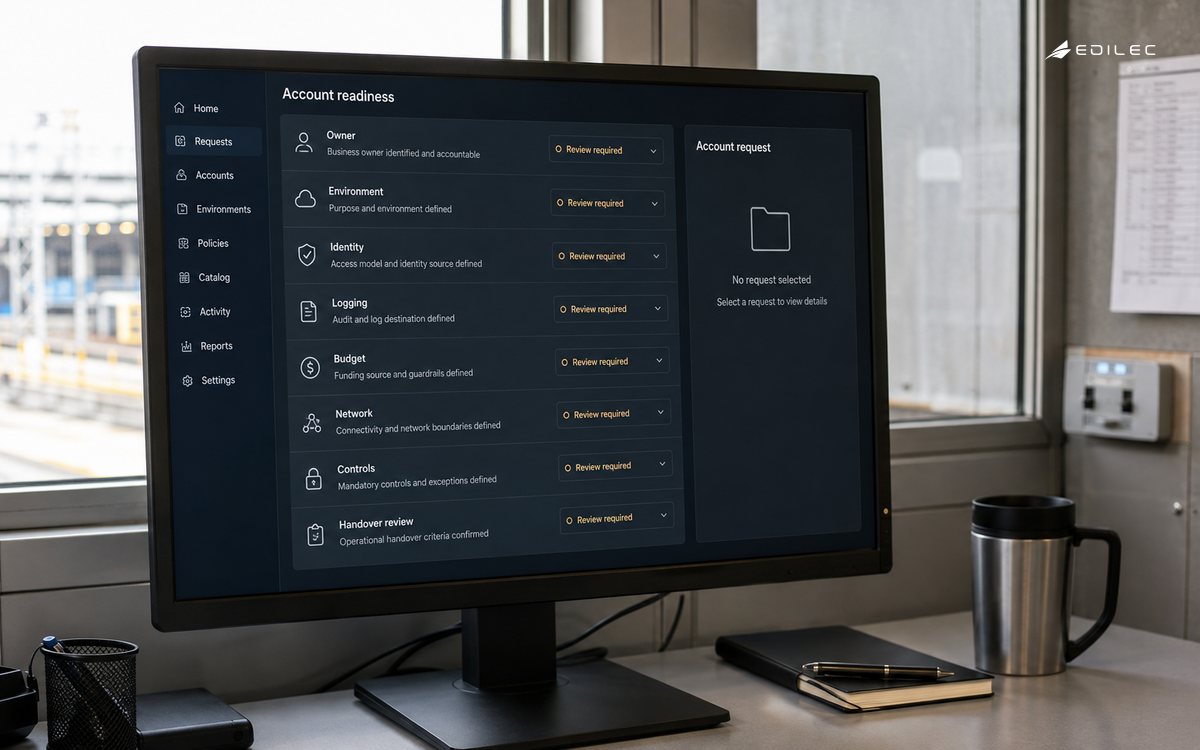
Expose self-service through declarative inputs with schema validation and policy feedback before deployment. Generate pull requests or plans that teams can review. Track product version in deployed resources so upgrades can be targeted. Test backward compatibility and migration between versions. Adoption improves when the platform team treats product teams as customers: publish roadmaps, measure failed provisioning, observe time to first successful deployment and retire paths that no longer provide value.
Integrate observability, incident response and recovery
Centralize security and platform logs with protected retention while keeping workload teams able to query their own evidence. Standardize account, service, environment, version and correlation attributes. Define platform service indicators for account vending, identity federation, network connectivity, deployment paths and shared telemetry. A green central dashboard is not sufficient if one workload cannot publish logs or resolve private DNS. Use synthetic checks from representative accounts.
Write ownership boundaries for AWS service events, platform defects and workload incidents. The platform team may restore a transit gateway while the application team manages customer recovery. Establish incident channels, severity, communications and evidence preservation. Rehearse identity-provider failure, control-plane impairment, lost connectivity, logging interruption, compromised automation credentials and accidental policy deployment. Confirm emergency access and rollback without depending on the failed component.
Make cost and capacity part of the platform contract
Require account and resource allocation metadata that maps to an accountable product or cost center. Provide curated cost views, budgets and anomaly routing. Shared services need a documented allocation method so consumers can understand their contribution. Guardrails should prevent obvious waste without blocking valid scale. A fixed instance-size policy is usually less useful than product defaults, demand visibility and review of persistent underutilization.
Platform economics include engineering labor, support, security tooling, network transfer, log retention and the cost of exceptions. Measure the cost to provide each platform product and the consumer effort it removes. Capacity planning should cover quotas, IP space, centralized inspection, build runners and API limits. Review sustainability through utilization and architecture choices, but do not trade away resilience or recovery evidence for a superficial resource reduction.
Onboard workloads through evidence-based waves
Pilot with a workload that exercises identity, networking, deployment, telemetry and recovery but can tolerate learning. Define entry requirements and acceptance criteria with its owner. Capture every manual workaround as platform backlog or an explicit consumer responsibility. After the pilot, onboard varied workload classes rather than cloning the easiest case. Expansion should depend on provisioning success, control conformance, incident readiness and consumer feedback.
For existing AWS estates, discovery and remediation precede enrollment. Importing accounts without understanding root access, organization history, networks, logging and external dependencies can break production. Create a transition plan for each account, compare its controls with the target baseline and schedule risky policy changes separately. Do not declare migration complete until operations, cost, backups, contacts and emergency access have moved to the new model.
AWS platform implementation takeaways
- Treat the platform as a product with named consumers, promises and lifecycle ownership.
- Use accounts and organizational units as deliberate isolation and policy boundaries.
- Federate people, constrain workloads and test emergency identity paths.
- Codify controls with objectives, exceptions, staged release and accountable evidence.
- Build a small catalog of complete golden paths instead of shallow support for every service.
- Onboard workloads only after observability, incident, recovery and cost ownership are proven.
Frequently asked questions
Is AWS Control Tower the complete platform? No. It helps establish and govern a landing zone, but teams still need identity integration, network products, deployment paths, observability, cost practices, support and a product operating model.
How many AWS accounts should an organization use? Use enough accounts to create meaningful isolation, ownership and billing boundaries without making operations unmanageable. The answer follows workload and control needs, not a universal number.
Should guardrail remediation always be automatic? Automate only when detection is reliable, the change is safe and reversible, and ownership is clear. High-impact or ambiguous findings should create a controlled task with evidence rather than an immediate destructive action.
Conclusion
An AWS platform service becomes valuable when teams can move from approved intent to an operable workload through a dependable path. A deliberate account model, federated identity, tested connectivity, versioned controls, usable golden paths and practiced operations turn cloud foundations into an internal product. The checklist should leave behind conformance evidence and an upgrade mechanism, not a one-time landing-zone project.