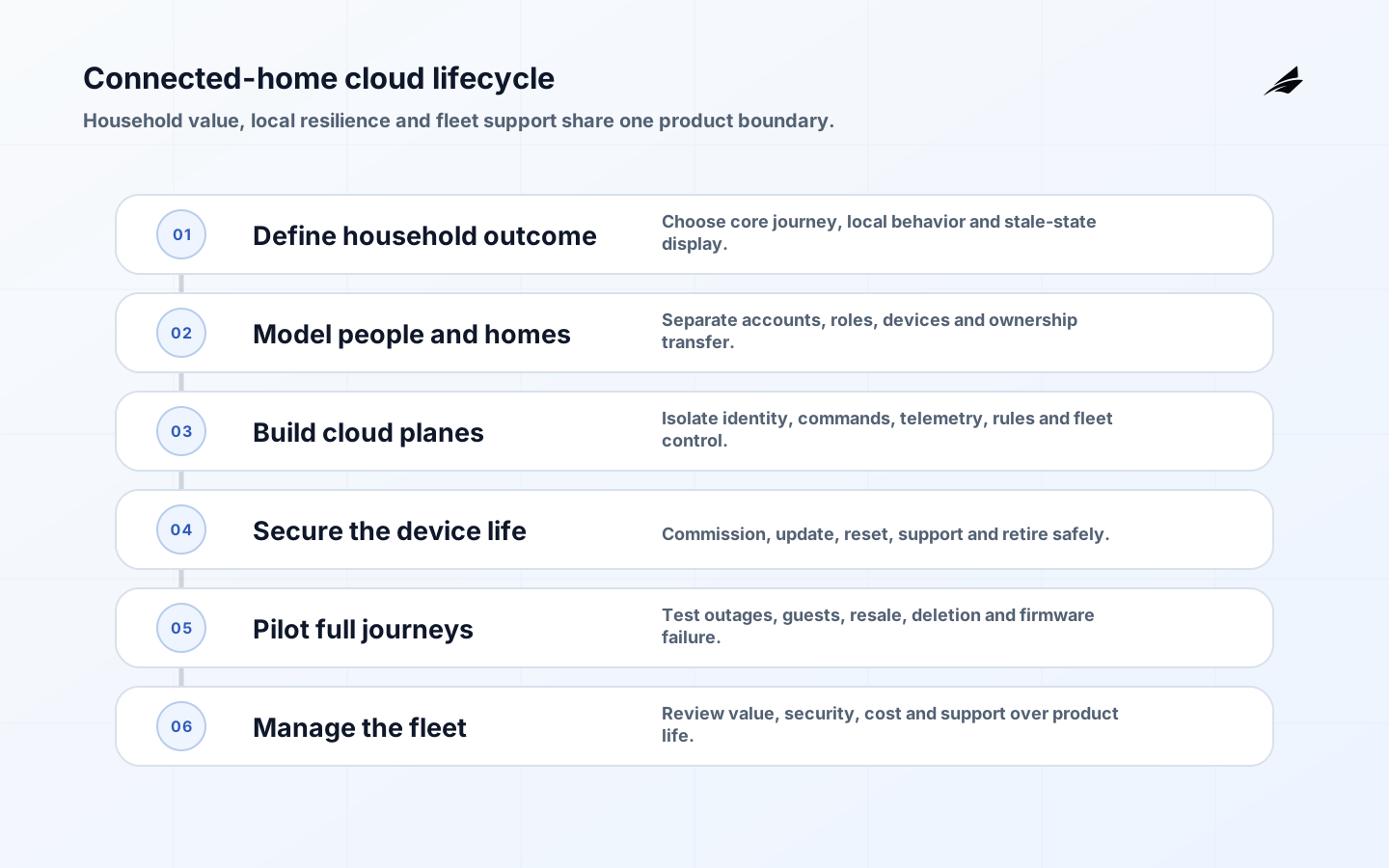
A connected home solutions cloud is not a product purchase with a predictable outcome. It is an operating change spanning household devices, mobile applications, event services, automation, customer support and long-lived product fleets. The useful question is whether the proposed service improves a named workflow while preserving security, recoverability and accountable ownership. This guide turns that question into a sequence of decisions, evidence and release gates that buyers, architects and delivery leaders can use together.
Begin with the companion Edilec resources on the connected home cloud FAQ, the edge gateway checklist, cloud cost visibility. They provide neighboring architecture and implementation detail. This article concentrates on the exact boundaries, delivery evidence and recurring management decisions that determine whether connected-home cloud remains useful after the first release.
Define the connected-home product before the cloud
The cloud scope begins with a household outcome such as energy visibility, access control or coordinated comfort. It may include account and home models, device registry, commissioning support, command routing, telemetry ingestion, rules, notifications, firmware distribution, diagnostics and support tools. It should not absorb functions that must remain local for safety, latency or basic usability. Define which actions work without internet access, which require cloud authorization and what the resident sees when state is stale.
Record device classes, expected fleet life, event frequency, command latency, household sharing, installer roles, regions and support promises. Separate product identity from device identity and both from a physical home. Plan ownership transfer, rental turnover, resale and account deletion. A prototype that works for one developer account says little about multi-user consent, offline behavior, duplicate events, delayed commands, millions of certificates or a device that remains installed for ten years.
| Decision | What must be explicit | Acceptance evidence |
|---|---|---|
| Product outcome | Resident task, local fallback and unacceptable failure | End-to-end journey and degraded-mode acceptance |
| Household model | Homes, rooms, members, guests, installers and transfer | Authorization matrix and ownership-transfer test |
| Device lifecycle | Commission, attest, update, reset, retire and replace | Fleet-state model and lifecycle exercise |
| Data policy | Events collected, purpose, retention, export and deletion | Field inventory and verified deletion trace |
| Service promise | Latency, availability, support period and regional scope | Service objectives and costed support commitment |
Design the cloud around device and household lifecycles
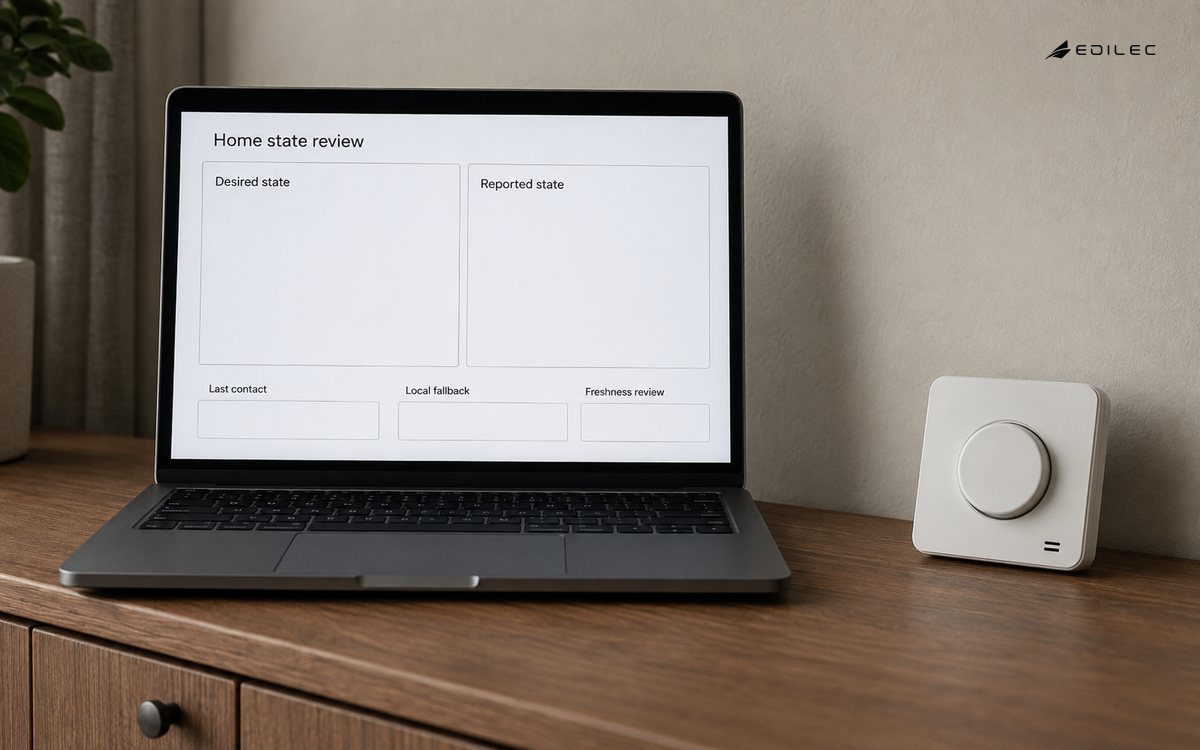
Use separate planes for identity, commands, telemetry, automation, fleet management and analytics. Devices authenticate with unique credentials and connect through rate-limited, replay-resistant channels. Commands carry correlation, expiry and idempotency information; device shadows or digital twins expose desired and reported state without pretending stale state is current. Event pipelines partition noisy devices, quarantine malformed payloads and preserve ordering only where the product requires it. Rules that protect basic function should execute locally.
Treat a home as a sensitive context. Occupancy, motion, access and energy patterns can reveal behavior even when names are absent. Collect only events tied to a declared feature or support need, document retention by field, isolate production support access and provide deletion and export workflows that account for backups and derived data. Consent should follow the relevant person and purpose. Household members need clear visibility into shared devices, recordings, automations and administrative changes.
Build identity, privacy and update controls into the platform
NIST’s IoT baseline calls for capabilities such as device identification, configuration, data protection, interface access control, secure software update and cybersecurity-state awareness. Those become platform contracts: every supported device profile must state how it identifies, updates, resets and reports security status. Secure-by-design principles favor safe defaults and manufacturer ownership of avoidable risk. Matter can improve local interoperability, but certification or protocol compatibility does not replace cloud authorization, privacy or fleet response.
Use NIST’s current NISTIR 8259 series and IoT requirement catalogs to shape device contracts. CISA’s Secure by Design guidance supports safer defaults and accountable product ownership. The Connectivity Standards Alliance explains the Matter standard, while the FCC’s U.S. Cyber Trust Mark provides current consumer-IoT labeling context.
| Control area | Implementation detail | Proof before scale |
|---|---|---|
| Device identity | Per-device credential, attestation where justified and reset-safe rotation | Clone, revocation and ownership-transfer tests |
| Authorization | Home-scoped roles, guest expiry and sensitive-action confirmation | Cross-home and former-member denial tests |
| Updates | Signed packages, staged rollout, health guard and rollback | Interrupted and faulty-update recovery |
| Privacy | Purpose-bound event schema, retention and support access | Export, deletion and privileged-access audit |
| Abuse resistance | Quotas, anomaly detection and command expiry | Compromised-device and replay simulation |
Deliver a narrow vertical slice before a broad device catalog
Build one vertical slice from commissioning through daily use, support and retirement. A good pilot has two device models, several household roles, intermittent connectivity, firmware updates and realistic event volume. Instrument command age, state convergence, onboarding failures and support diagnostics. Run apartment turnover, phone loss, router replacement, cloud-region failure and account deletion. Add device classes only after the platform contract makes their lifecycle behavior predictable; otherwise each integration becomes a permanent exception.
Treat every stage as a gate, not a calendar milestone. The owner records the decision, evidence, unresolved exceptions and rollback trigger. A stage closes only when representative users complete the workflow, telemetry explains failure, support can diagnose it, and recovery has been exercised. This keeps connected-home cloud from expanding on enthusiasm while operational debt remains invisible.
Model cost per active household and supported device
Model device connection, message and storage consumption, rules execution, notifications, egress, observability, identity, support tooling, security operations, firmware hosting, regional duplication and engineering on-call. Convert the total to cost per active household and per feature, then test heavy-event and mostly-idle cohorts. Long fleet life is the dominant obligation: certificates, dependencies and cloud APIs must outlive launch assumptions. Include vulnerability response, update delivery and end-of-support communication in the product margin.
For connected-home platforms, estimate lifecycle cost by workload and by responsibility. Include discovery, integration, migration, verification, security review, environments, observability, support, change management, vendor management, data movement, incident response and exit work. Keep contingency attached to known uncertainty rather than hiding it in a blended rate. Reforecast after the pilot with observed effort and consumption; that is more defensible than extrapolating a demonstration.
Common failure modes and practical responses
Typical failures include cloud-only basic control, account structures that cannot represent a household, shared device secrets, unlimited telemetry, no command expiry, silent state staleness, firmware rollout without health gates and deletion that leaves derived data untouched. Teams also underestimate support: residents describe rooms and symptoms, not device IDs and broker offsets. Diagnostics must connect the customer journey to device, network, command and service evidence without granting support broad access to household activity.
For connected-home platforms, the practical response is a small control loop: detect the condition, identify the accountable owner, limit exposure, preserve evidence, recover the workflow, and decide whether the underlying design must change. Record exceptions with an expiry date and compensating control. Repeated exceptions are architecture evidence, not administrative noise, and should change the roadmap or narrow the service boundary.
Example: reliable heating control during an internet outage
A heating controller must accept schedules and manual set-point changes even when the internet is unavailable. The local controller keeps the current schedule and safety limits; the cloud manages household accounts, remote changes, energy history, notifications and fleet updates. Every remote command expires, carries an operation ID and returns accepted, applied or failed state. The application shows last-contact time and distinguishes desired temperature from confirmed device state.
The pilot covers owner, adult member, temporary guest and installer roles. Tests include power loss, router replacement, duplicated telemetry, delayed command delivery, expired guest access, home transfer, revoked device identity, failed firmware and cloud-region loss. Support can retrieve a bounded diagnostic bundle with resident approval. Cost tests model winter event bursts, and privacy verification traces deletion through primary stores, analytics tables and scheduled backup expiry.
For connected-home platforms, the team releases only the proven slice, monitors user and system outcomes through a full operating cycle, and keeps the previous route available until reconciliation closes. At the review, leaders compare baseline and observed results, examine near misses and support effort, and either expand, redesign or stop. That decision discipline matters more than completing every item in an original feature list.
How to measure value and operating health
Track successful commissioning, time to first useful action, command completion within objective, desired-to-reported state convergence, offline success, active devices per household, firmware coverage, vulnerable-device exposure, notification delivery, support contacts and cloud cost per active household. Segment by hardware and firmware version. A high monthly-active-device count can hide failing commands or abandoned households; product, reliability, security and cost measures must be reviewed together.
| Measure type | Example measure | Decision it informs |
|---|---|---|
| Product | Households completing the core journey each week | Whether the feature creates sustained value |
| Reliability | Command success, event age and local fallback success | Whether cloud dependence is acceptable |
| Fleet | Supported-version coverage and update failure rate | Whether long-lived devices remain manageable |
| Economics | Cloud and support cost per active household | Whether pricing and architecture remain viable |
Key takeaways
- Define local behavior and stale-state communication before cloud architecture.
- Model homes, people, devices and ownership transfer as separate concepts.
- Make secure identity, updates, deletion and support evidence part of every device contract.
- Pilot complete lifecycles, including reset, resale, failure and retirement.
- Manage value, security and cost per active household over the fleet lifetime.
Frequently asked questions
Does Matter remove the need for a connected-home cloud?
No. Matter supports interoperable local device communication and commissioning, while many products still use cloud services for remote access, history, notifications, fleet operations or cross-home administration. Keep basic behavior local where the product requires resilience.
Should the platform use a hyperscaler IoT service?
A managed IoT service can accelerate secure connectivity and fleet functions, but the product team still owns household authorization, privacy, offline behavior, data contracts, support and exit. Evaluate limits and switching cost against the expected fleet lifetime.
How much telemetry should a home device send?
Only what a defined feature, reliability objective, security control or support process needs. Set event contracts, sampling, retention and quotas by device class. More telemetry raises cost and privacy exposure without automatically improving diagnosis.
Conclusion
A home solutions cloud is a long-lived product system, not a message broker with a mobile application. Its design must preserve useful local behavior, make household authority understandable, protect behavioral data and operate every device through update and retirement. A narrow lifecycle-complete pilot provides the evidence needed to forecast cost and scale the platform responsibly.