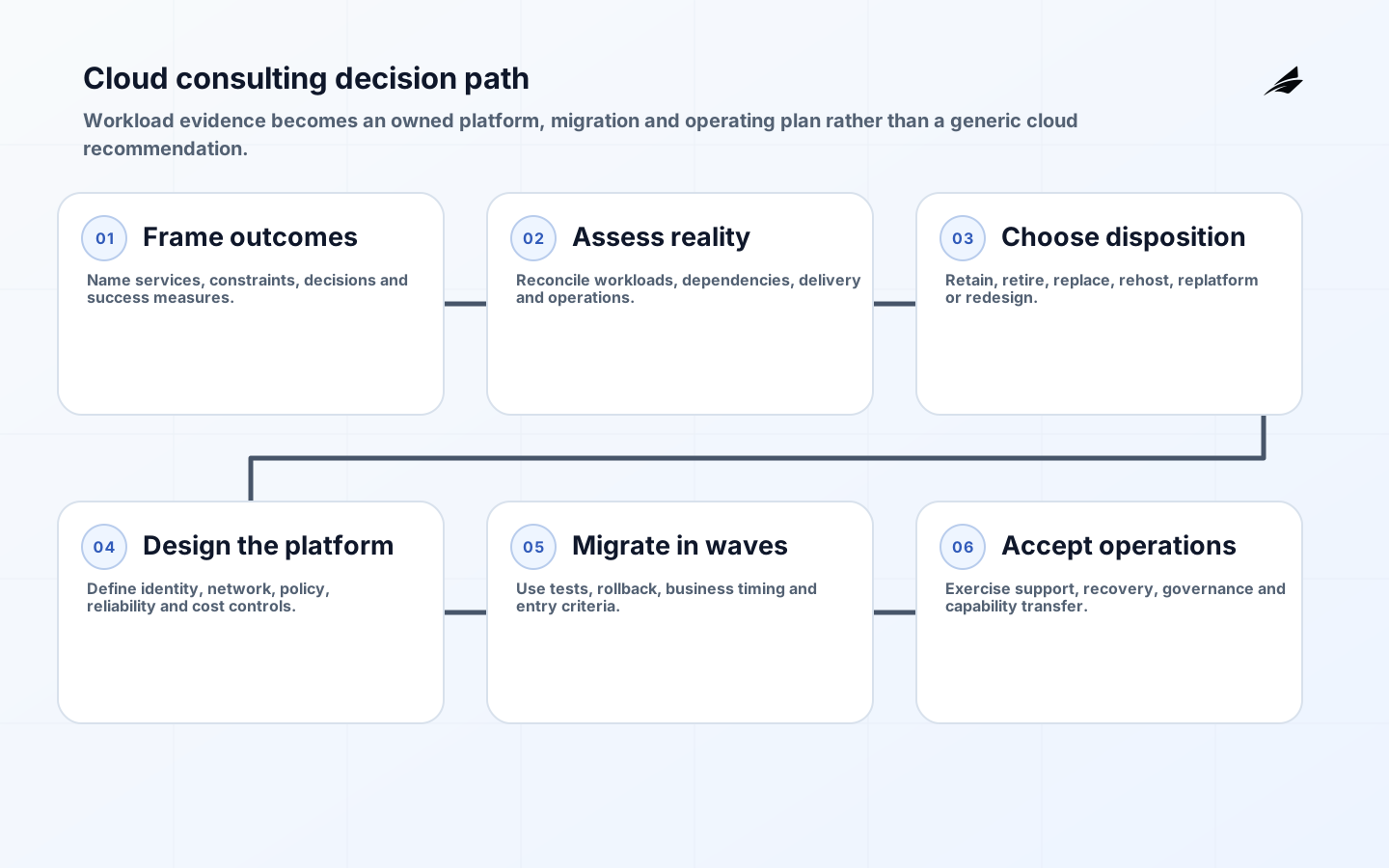
Cloud computing consulting should turn business constraints and workload evidence into decisions that an organization can implement and operate. It is not simply a recommendation to move applications to a public cloud. A useful engagement determines which service models fit, which responsibilities remain with the customer, how identities and data will be protected, how applications will be migrated or modernized, how consumption will be governed and what evidence will demonstrate readiness. The result should be an owned delivery plan rather than a presentation of generic cloud capabilities.
NIST defines cloud computing through characteristics such as on-demand self-service, broad network access, resource pooling, rapid elasticity and measured service. Those characteristics create opportunities, but they also change provisioning, financial and operational controls. Consulting therefore needs to address architecture, delivery, security, reliability, organization and economics together. A technically sound landing zone will still fail its purpose if teams cannot deploy through it, costs cannot be allocated, recovery is untested or no one owns the service after the consultants leave.
Define the decisions the engagement must produce
Begin with a decision charter. Name the business services in scope, the reason change is needed, the constraints that cannot be ignored and the leaders authorized to approve architecture, risk, funding and migration. Replace broad goals such as “become cloud-first” with testable outcomes: shorten environment provisioning, restore a critical service within its approved objective, establish a supported analytics platform or retire an expiring data center dependency. Record what is excluded so that adjacent transformation work does not silently enter the engagement.
The charter should identify required outputs and their acceptance criteria. Common outputs include a verified workload inventory, disposition decisions, a target operating model, platform architecture, security control mapping, migration waves, cost model, risk register and capability-transfer plan. Assign an internal owner to every output. Consultants can assemble evidence and facilitate choices, but the organization must retain authority for data classification, risk acceptance, financial commitments and business-service priorities.
| Decision area | Evidence needed | Accepted outcome |
|---|---|---|
| Workload disposition | Dependencies, lifecycle, demand and constraints | Retain, retire, replace, rehost, replatform or redesign decision |
| Platform | Identity, network, policy and delivery requirements | Approved target architecture with accountable owners |
| Migration | Business calendar, test results and rollback path | Sequenced waves with entry and exit criteria |
| Operations | Service objectives, telemetry and recovery needs | Runbooks, escalation paths and support acceptance |
Build a trustworthy current-state assessment
Inventory applications, infrastructure, data stores, interfaces, identities, certificates, operational tools, licenses and contractual dependencies. Reconcile automated discovery with interviews and system records because each source will contain omissions. For every workload, capture its owner, users, business criticality, data classification, availability and recovery expectations, demand pattern, technical lifecycle, upstream and downstream dependencies, deployment method and current operating cost. Mark uncertain facts explicitly instead of turning estimates into apparent certainty.
Assess the delivery system as well as the estate. Examine how teams request environments, approve changes, manage secrets, test releases, investigate incidents and restore data. This reveals constraints that an infrastructure inventory cannot show. For example, an application may be technically portable while its release depends on manual database changes and a shared administrator account. That evidence affects migration sequencing and the amount of engineering required before the workload can safely exploit cloud elasticity or managed services.
Choose service models and ownership boundaries
Infrastructure, platform and software services allocate control differently. Select them workload by workload rather than treating one model as an enterprise default. A managed database can reduce undifferentiated operational work, but the customer still owns data classification, access design, schema behavior, recovery objectives and application compatibility. A virtual machine offers more control but also retains operating-system hardening, patching and capacity responsibilities. Document these tradeoffs in plain language for the people who will operate and fund the service.
Create a responsibility model across the cloud provider, central platform team, security function, product team, service desk and any managed-service partner. Separate who designs, implements, verifies, monitors and responds; these duties frequently belong to different groups. Define authority for urgent containment, privileged access, production changes, budget exceptions and disaster declaration. Pair the responsibility model with interfaces describing which tool, record and time expectation apply when work crosses teams.
Design the minimum viable cloud platform
The platform should provide repeatable account or subscription creation, federated identity, least-privilege roles, network patterns, encryption and key management, centralized logging, policy enforcement, cost allocation and deployment paths. Express configuration through reviewed automation where practical. Provide approved patterns for common workload types instead of forcing every product team to assemble foundational controls independently. Exceptions need an owner, reason, compensating control and expiry date.
Use the major-cloud Well-Architected guidance as a structured review aid, not as a substitute for context. Test reliability, security, operational excellence, performance, cost and sustainability against each service’s actual consequences. Architecture decisions should record alternatives, constraints and reversal difficulty. Portability deserves a specific decision: some provider-native services deliver substantial operational value, while unnecessary coupling can increase exit effort. The correct balance depends on business lifespan, capability and recovery needs.
Plan migration as controlled service change
Group migrations by dependencies, business risk and learning value. Early waves should exercise the platform and operating model without exposing the organization to consequences it cannot yet manage. Each wave needs entry criteria for inventory quality, architecture approval, security controls, test data, support readiness and rollback feasibility. Exit criteria should cover functional behavior, performance, monitoring, backup, restore, access review, cost visibility and acceptance by the permanent service owner.
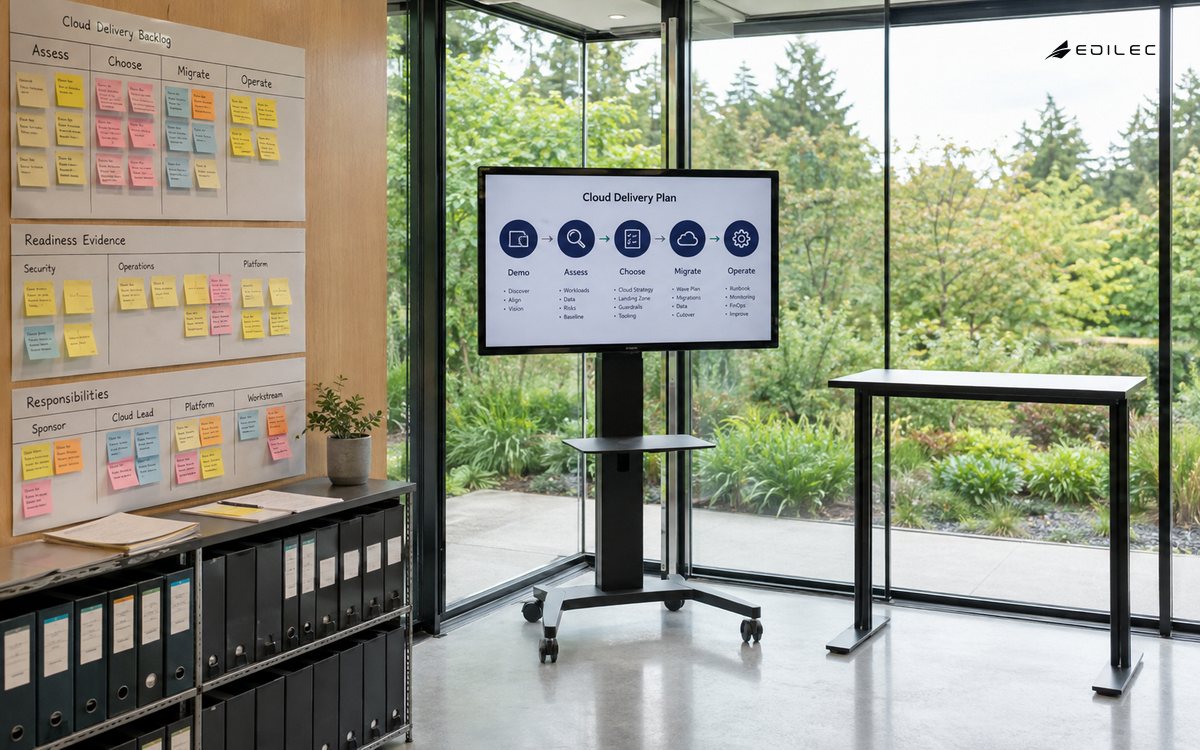
A practical example is a customer portal that depends on an identity service, document store and billing interface. Migrating only the web tier may create latency and failure modes across the remaining connections. The plan should map each transaction, decide which dependencies move together, rehearse data synchronization, validate degraded behavior and specify how cutover state will be reconciled. Rollback must account for data written after cutover, not merely redeploy the previous application version.
| Delivery gate | Proof | Pause condition |
|---|---|---|
| Platform ready | Identity, policy, logging and deployment exercised | Critical control depends on an untested manual step |
| Workload ready | Dependencies, data movement and rollback rehearsed | Owner or authoritative inventory is missing |
| Operations ready | Alerts, restore and escalation completed by support staff | Project team remains the only effective responder |
| Financially ready | Allocation, forecast and anomaly handling demonstrated | Consumption cannot be attributed or governed |
Create a cost and commercial plan that supports decisions
Separate consulting fees, migration engineering, cloud consumption, network transfer, marketplace software, support, training and ongoing operations. Model representative demand and uncertainty rather than presenting one precise total. Include parallel-running periods, data movement, observability, backups and retained systems. Where useful, connect spend to a business unit such as cost per environment, tenant or transaction. Absolute cost alone cannot show whether a platform is efficient or whether a growing service is creating proportionate value.
Apply FinOps practices from the start: establish allocation metadata, billing-data access, forecast cadence, anomaly response and named budget owners. Optimization authority should be bounded. Scheduling a nonproduction environment may be safely automated, while reducing production capacity or purchasing a long commitment requires evidence and approval. Report realized effects after performance, resilience and labor consequences rather than counting every recommendation as a saving.
Manage security, reliability and supplier risks
Maintain a risk register tied to workloads and decisions. Typical risks include excessive privilege, incomplete asset discovery, exposed management interfaces, untested recovery, quota exhaustion, regional dependency, license restrictions, skills gaps and supplier concentration. For each risk, record the consequence, affected service, preventive and detective controls, evidence owner, residual exposure and review date. A certification or provider assurance report does not demonstrate that the customer configured its own tenancy or application safely.
Use threat scenarios and failure exercises to test seams. Rehearse compromised credentials, unavailable identity, failed deployment, accidental deletion, billing anomaly and loss of a regional dependency. Confirm who detects the event, who can contain it, which logs remain available and how business users are informed. Security and resilience evidence should be produced through normal delivery and operations, not assembled only before an audit or launch review.
Turn recommendations into an executable backlog
- Approve the decision charter, business-service scope and accountable owners.
- Reconcile the estate inventory and label every important uncertainty.
- Choose workload dispositions and document service-model responsibilities.
- Build and exercise the smallest platform slice that can host a representative workload.
- Sequence migration waves with dependency, rollback and operational acceptance criteria.
- Establish security, reliability and cost evidence before increasing migration volume.
- Transfer repositories, runbooks, access and decision records to permanent teams.
- Review outcomes after each wave and revise patterns using observed evidence.
Consulting deliverables should enter the organization’s normal systems: architecture decisions in the governed repository, risks in the accountable register, platform code in customer-controlled version management and migration work in owned backlogs. Capability transfer is demonstrated when internal teams can provision, deploy, investigate, restore and govern a representative service. Attendance at workshops is not sufficient proof of operational independence.
Key takeaways
- Define cloud consulting through the decisions and evidence it must produce.
- Assess applications, dependencies and the delivery system before selecting migration approaches.
- Document responsibilities across provider, platform, security and workload teams.
- Use controlled waves with tested rollback, recovery and operational acceptance.
- Govern consumption and unit economics without trading away reliability.
- Make internal capability and ownership part of completion.
Frequently asked questions
How long should a cloud consulting engagement last?
Duration should follow the decisions and evidence required, not an arbitrary calendar promise. A bounded workload assessment may be short, while an enterprise operating-model and migration plan requires broader discovery and validation. Define milestones around accepted outputs, and avoid extending assessment indefinitely when a small implementation experiment can resolve uncertainty more directly.
Should a consultant recommend a single cloud provider?
Only when workload, regulatory, commercial, capability and resilience evidence supports that decision. A single provider can reduce operational complexity; multiple providers can address specific constraints but add identity, network, tooling and skills overhead. Evaluate service by service and document the consequences instead of treating provider count as an objective.
What proves that the consulting work is complete?
Completion requires accepted decisions, customer-controlled artifacts and demonstrated operation. Internal teams should be able to use the platform, deploy a representative workload, respond to alerts, restore protected data, explain cost and maintain the risk record. A final report without exercised ownership leaves the most important work unfinished.
Conclusion
Effective cloud computing consulting connects strategy to a service that people can safely run. It begins with business outcomes and verified workload evidence, then establishes service-model boundaries, platform controls, migration waves, cost governance and operational acceptance. Each recommendation should identify an owner, decision, implementation path and proof.
The strongest result is not a larger cloud footprint. It is an organization able to choose appropriate cloud services, migrate without losing control, recover from failure, understand consumption and improve its platform using evidence. That capability remains valuable after the engagement ends.